Another nail house is actually a nail church. Citicorp Center was built without corner columns to accommodate St. Peter’s Church, which occupied one corner of the block on which the skyscraper was built. The engineer who built Citicorp Center made a mistake related to the church’s accommodation and famously corrected it after the building was built.
Two movies from now, after Toy Story 3 and Newt, Pixar is *finally* releasing a movie with a female main character. The only problem? She’s a princess.
I have nothing against princesses. I have nothing against movies with princesses. But don’t the Disney princesses pretty much have us covered? If we had to wait for your thirteenth movie for you to make one with a girl at the center, couldn’t you have chosen something — something — for her to be that could compete with plucky robots and adventurous space toys?
Update: The score to beat is 1,050,200 points. (Oops, Wiebe just died as I was typing this. He’s got two guys left.) Wiebe owns the second highest score with 1,049,100 points.
Update: He just died again. He’s at ~370,000 with one guy left. Not looking good.
Update: Last guy. 457,000. Not looking good.
Update: He finally got it going but ended up short of the record with 923,400. Word is he’s got two more chances to break it today.
Update: No dice…didn’t break the score with any of his games.
1. A detailed examination of the Star Trek franchise which shows that the film by JJ Abrams is merely the latest in a long series of successful reboots.
2. A list of rules to follow to successfully reboot a franchise, whether it’s Star Trek or Bond or Batman.
Don’t abuse the audience goodwill. Remember, you sell the audience on your story based on certain expectations. Break that unspoken contract and you’re in trouble. No one bought a ticket for Spider-Man 3 thinking they were going to get a romance with musical comedy interludes, yet that’s what it felt like we got.
If you’re doing a new version of a beloved old property, that means you need to figure out what it was people liked and make damn sure it’s in there. That doesn’t mean you have to do it the same way every time, you just have to do it. James Bond movies have been retooled a number of times, but we never lose the license to kill, the exquisite stunt work, the Bond theme music, or the cool cars and hot girls. There’s about a million miles of difference between Moonraker and Casino Royale, but they’re both recognizably Bond movies and they were both successful, because they met the baseline audience expectation of what a James Bond movie would give them.
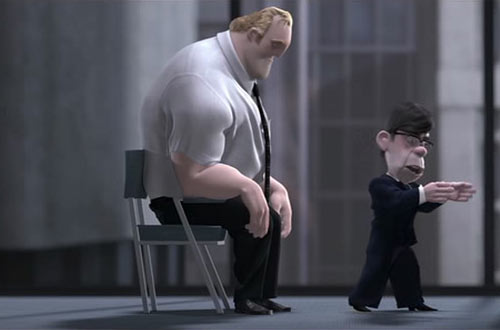
This is my dedication to the creative team behind Pixar’s movie The Incredibles. I loved the depth of the world, the buildings, the gadgets and most of all I loved the chairs.
RunPee is quite possibly the GREATEST MOVIE WEB SITE EVER. It tells you the best time to run to the bathroom during a movie and what happened while you were gone. Star Trek has four available times, the first of which starts when Captain Pike leaves the bridge for Nero’s ship.
1. Traveling into the future is easy. We travel into the future all the time, at a fixed rate: one second per second. Stick around, you’ll be in the future soon enough. You can even get there faster than usual, by decreasing the amount of time you experience elapsing with respect to the rest of the world — either by low-tech ways like freezing yourself, or by taking advantage of the laws of special relativity and zipping around near the speed of light. (Remember we’re talking about what is possible according to the laws of physics here, not what is plausible or technologically feasible.) It’s coming back that’s hard.
She was a librarian. Her husband was a postal worker. They lived on his salary and bought art with hers. Both are now retired. They have no children. “We bought art we could afford and that would fit into the apartment,” they say. Water from the fish tank once splashed a Warhol they owned. It later had to be restored.
Did you notice all the lens flares in Star Trek? JJ Abrams’ rationale for them — he refers to them as “another actor” in the movie — is pretty interesting.
I love the idea that the future was so bright it couldn’t be contained in the frame. The flares weren’t just happening from on-camera light sources, they were happening off camera, and that was really the key to it. I want [to create] the sense that, just off camera, something spectacular is happening. There was always a sense of something, and also there is a really cool organic layer thats a quality of it.
The result is supposed to be funny but I thought it also somewhat validated Abrams’ remarks above. (via snarkmarket & waxy)
Henry Jenkins and Snarkmarket also address my biggest problem with the movie, that the cadet-to-captain thing happened way too quickly to Kirk and his crew. Jenkins’ contention is that the new movie treats the Enterprise as a start-up company; Tim adds this gem of a line:
But it’s not academia; it’s the NBA. You give these kids the ball.
So, which NBA player is Kirk supposed to be? While not an exact comparison, I’m going to say that Kirk is Tony Parker to Spock’s Tim Duncan. And Scotty = Manu Ginobli?
Noodling is the practice of catching catfish by letting them latch onto your arm.
To begin, a noodler goes underwater to depths ranging from only a few feet to up to twenty feet, placing his hand inside a discovered catfish hole. If all goes as planned, the catfish will swim forward and latch onto the fisherman’s hand, usually as a defensive maneuver in order to try to escape the hole. If the fish is particularly large, the noodler can hook the head around its gills.
This video captures some noodling fishermen in action.
Reading two-week-old 13-page New Yorker articles about Rwanda probably isn’t your favorite thing to do, but if you’re a subscriber, I’d urge you to check out Philip Gourevitch’s fascinating article about what’s been happening in Rwanda in the fifteen years since the genocide. It’s a complicated situation (boldface mine):
On the fifteenth anniversary of the genocide, Rwanda is one of the safest and most orderly countries in Africa. Since 1994, per-capita gross domestic prduct has nearly tripled, even as the population has increased by nearly twenty-five per cent, to more than ten million. There is national health insurance, and a steadily improving education system. […] Most of the prisoners accused or convicted of genocide have been released. The death penalty has been abolished. And Rwanda is the only nation where hundred of thousands of people who took part in mass murder live intermingled at every level of society with the families of their victims.
Like I said, complicated. This is the best thing I’ve read in the New Yorker in a long while.
Update: As We Forgive is a documentary film about the Rwandan reconciliation.
Can survivors truly forgive the killers who destroyed their families? Can the government expect this from its people? And can the church, which failed at moral leadership during the genocide, fit into the process of reconciliation today? In As We Forgive, director Laura Waters Hinson and narrator Mia Farrow explore these topics through the lives of four neighbors once caught in opposite tides of a genocidal bloodbath, and their extraordinary journey from death to life through forgiveness.
McQuarrie says only after finishing the film and preparing to do press interviews about it did he and Singer realize they both had completely different conceptions about the plot.
“I pulled Bryan aside the night before press began and I said, ‘We need to get our stories straight because people are starting to ask what happened and what didn’t,’ ” recalls McQuarrie. “And we got into the biggest argument we’ve ever had in our lives.”
He continues: “One of us believed that the story was all lies, peppered with little bits of the truth. And the other one believed it was all true, peppered with tiny, little lies. … We each thought we were making a movie that was completely different from what the other one thought.”
I always assumed that Verbal was telling the truth the whole time, in the cavalier the-truth-can’t-hurt-me manner of the movie master criminal. (thx, dave)
[1] What’s the statute of limitations on spoiler warnings? The Usual Suspects is fourteen years old; surely everyone who wanted to see it has seen it by now. ↩
Woody Allen + Larry David + the process for making a feature-length film - all but about 2 minutes of the footage = the trailer for Whatever Works.
An eccentric New Yorker played by Larry David abandons his upper class life to lead a more bohemian existence. He meets a young girl from the south and her family and no two people seem to get along in the entanglements that follow. This is a comedy also starring Ed Begley Jr., Patricia Clarkson, Conleth Hill, Michael McKean, Evan Rachel Wood, and a number of other amusing types.
[Note: spoilers.] Bones did it for me. As soon as he sat down next to Kirk on the shuttle, I was hooked. Loved Star Trek, wanted to go again as soon we got out.
J.J. Abrams did something kinda crazy with the film though. He took the entire Star Trek canon and tossed it out the window. Because of the whole time travel thing, the events that occurred in The Original Series, The Next Generation, Voyager, DS9, and the previous 10 movies will not happen. Which means that in terms of sequels to this film, the slate is pretty much clean for Abrams or whomever he passes it off to.
Well. Almost. Events in this alternate timeline unfold differently but the same. Even though the USS Kelvin was destroyed with Kirk’s father aboard, Kirk and the rest of the gang somehow all still end up on the Enterprise. But the destruction of an entire planet and 6 billion people should have a somewhat larger effect going forward.
Also worth noting is how the time travel in Trek compares with that on Lost, a show Abrams co-created and currently executive produces. On Lost (so far), the universe is deterministic: no matter who travels when, not much changes. Time travel can affect little details here and there, but the big events unfold the same way each time and every character remembers events unfolding in the same way, no matter when they are on the timeline. Star Trek’s universe is not that way; characters before time travel events remember events unfolding differently. According to the older Spock, the Romulan ship going back in time changed things. Kirk knew his dad, Vulcan wasn’t sucked into a black hole, etc.
And yeah, we do hear ships whoosh as they go to warp and all that, but that’s what we expect to hear, having evolved in an atmosphere which whooshes when things fly past us. I’d prefer that we hear nothing, but I accept that as a filmmaker’s prerogative to make the audience comfortable.
But I’ll add that for years I have complained about sounds in space, saying that done correctly, making things silent can add drama. That sentiment was proven here; the sudden silence as we leave the ship and fly into space with the doomed crewmember is really eerie and unsettling.
“Star Trek” was an early manifestation of our contemporary absorption with the pop culture of the past. The show’s creator, Gene Roddenberry, was a gifted hack writer for TV Westerns like “Have Gun, Will Travel” and cop shows like “Highway Patrol,” and “Star Trek,” though set in a nominally stylized future, was essentially a Western cop show. In fact, Roddenberry pitched the series to NBC as “Wagon Train” to the stars; and, as Captain Kirk noted in his log, the ship would venture out on “patrol,” cruising the galaxy like a city beat.
3. The Usual Suspects. Considered the best twist ending by many people, it was hard to put this so far down at #3. I’ve seen a couple people put this crime thriller starring Kevin Spacey on “Worst Twist Endings” lists, but those people are just idiots wanting to sound smarter and more sophisticated than everyone else.
Science fiction often holds a mirror up to contemporary culture, critiquing its practices, politics, and mores. So, too, with Romulan ale. Because of the United Federation of Planets’ standoff with the Romulan Empire, the drink is illegal within the Federation — much like Cuban cigars are in the U.S. But like the captains of industry of today, captains of starships indulge in this vice.
Oddly, my only complaint is that (somehow) his piece isn’t long enough. Adam, you didn’t even get in to “Tea. Earl Grey. Hot.” (thx, alaina)
The trailer for District 9 looks interesting. I particularly like the way the alien’s face is pixelated out in the interview, both for privacy in the world of the film and to not spoil the reveal for movie goers.
There’s very little information about this online, but here’s what I’ve scraped together. Milton Glaser: To Inform and Delight is a documentary on the legendary designer and it will be released in theaters sometime near the end of May. You know, one of those huge summer blockbusters.
I posted about Glaser’s Ten Things I Have Learnedseveral years ago, mostly for point #5’s rejoinder to “less is more”: “Just enough is more”. Rereading it now, I’m much more interested in some of the other points, particularly 1-3.
And the important thing that I can tell you is that there is a test to determine whether someone is toxic or nourishing in your relationship with them. Here is the test: You have spent some time with this person, either you have a drink or go for dinner or you go to a ball game. It doesn’t matter very much but at the end of that time you observe whether you are more energised or less energised. Whether you are tired or whether you are exhilarated. If you are more tired then you have been poisoned. If you have more energy you have been nourished. The test is almost infallible and I suggest that you use it for the rest of your life.
Early in Frost/Nixon, we meet Irving Lazar, who negotiates on behalf of Richard Nixon with David Frost. He didn’t get that much screen time, but Lazar struck me as an interesting character1 so I looked him up on Wikipedia after the movie. Michael Korda, himself a publishing bigwig, wrote a profile of Lazar for the New Yorker in 1993. Korda was befriended by Lazar early on in his career and went on to do many deals with the legendary agent.
Early on, Lazar hit upon three rules that have stood him in good stead for over fifty years. The first was that he could always reach anyone, anywhere, any time. His secret weapon is the world’s largest address book, full of the private, unlisted numbers of people whom nobody else can reach. Who else can pick up the phone and call Mrs. Norton Simon, Jack Nicholson, Barry Diller, Larry McMurtry, Arthur Schlesinger, Richard Nixon, Cher, Gregory Peck, or Henry Kissinger, and get through immediately? The second rule was always to go directly to the top. Lazar doesn’t deal with underlings. The last rule was to insist on a quick answer. Even now, if I tell Irving that I want to think something over or discuss it with someone else he will snap, “Never mind, I can see you’re not interested, I’ll talk to Phyllis Grann.”
[1] My first impression was, this guy seems a bit like Truman Capote to me. Well, duh: the actor playing him, Toby Jones, also portrayed Capote in Infamous. ↩
My favorite thought-piece about Ferris Bueller is the “Fight Club” theory, in which Ferris Bueller, the person, is just a figment of Cameron’s imagination, like Tyler Durden, and Sloane is the girl Cameron secretly loves.
One day while he’s lying sick in bed, Cameron lets “Ferris” steal his father’s car and take the day off, and as Cameron wanders around the city, all of his interactions with Ferris and Sloane, and all the impossible hijinks, are all just played out in his head. This is part of the reason why the “three” characters can see so much of Chicago in less than one day — Cameron is alone, just imagining it all.
I can’t figure out if Meryl Streep is almost nailing her Julia Child impression or completely blowing it. Also, Streep is ~5’7”….I don’t know what they’re doing in the movie to make her look so tall, but it doesn’t work.
Note: If you are a member and tried to log in, it didn't work, and now you're stuck in a neverending login loop of death, try disabling any ad blockers or extensions. Or try logging out and then back in. Still having trouble? Email me!






Socials & More