kottke.org posts about food
A list of what restaurant professionals want to see more and less of in 2006. Anthony Bourdain wants less “Truffle oil. ‘Fusion.’ Water sommeliers. Overdesigned dining rooms. Mayonnaise on sushi. ‘Concept’ restaurants. Novelty martinis.” (via eater)
Glee Gum sells “make your own chewing gum” kits for $10. “It’s really easy: Soften the chicle gum base, either in the microwave or on the stove. Then you add the sugar, corn syrup, and the flavor packets, knead it a little, and WOW! You’ve made your own gum!”
Pepsi’s market cap surpassed Coca-Cola’s last week for the first time ever. The secret to their success? Diversifying into other snacks (Frito-Lay) and beverages (Tropicana and Gatorade).
The SF Chronicle has a list of the top 100 wines of 2005.
Update: This list covers only wines from CA, WA, OR, and ID, not from the whole US or world. (thx, rich)
Author Michael Pollan is coming out with a new book next year called The Omnivore’s Dilemma, based in part (or excerpted from?) on his 2004 article in the NY Times Magazine, Our National Eating Disorder.
eGullet recently interviewed author Michael Ruhlman and he had this to say about what he liked about working in a professional kitchen:
You can’t lie in a kitchen — that’s what I like most about it. You’re either ready or you’re not, you’re either clean or you’re a mess. You’re either good or you’re bad. You can’t lie. If you lie, it’s obvious. If your food’s not ready, then it’s not ready. If you’re in the weeds, its clear to everybody — you can’t say that you aren’t. So I love that aspect of it. I love the immediacy of it, the vitality of it.
I’ve worked in a number of different places over the years and the ones I ended up liking the least were the places that allowed people (myself included) to hide. Some companies just have way too many people for the amount of available work. Other times, particular employees have a certain status within the organization that allows them to determine their own schedules and projects. Deadlines are often malleable, meaning that work can pushed off. Inexperienced or nontechnical managers might not have a clue how long a task should take a programmer…budgeting 2 weeks for a six-hour task that seems hard buys one a lot of blog-surfing time. Companies with coasting employees are everything a kitchen isn’t; they just feel slow, wasteful, lifeless, and eventually they suck the life out of you too.
If I remember correctly, Tense Present (published in the April 2001 issue of Harper’s) was the first bit of writing I ever read by David Foster Wallace. I didn’t fall for him immediately. I liked the article fine, but as I thought more about it in the following weeks — particularly in light of other nonfiction I was reading in magazines and newspapers — the more I liked it. A quick search on the Web revealed that not only had this Wallace written more nonfiction for magazines, he’d written entire books and was considered by some to be the best young author writing in America. A few months later I read Infinite Jest and it was love.
Tense Present is one of the essays included in Consider the Lobster, a collection of nonfiction by Wallace due out on December 13th. It’s included under a new name (Authority and American Usage) and is, like many of the other pieces in the book, the “director’s cut” of the original, but re-reading it brought back good memories about, well, how good it was to discover Wallace’s writing.
Several of essays in CtL I’d read before, including the title essay from the Aug 2004 issue of Gourmet (which according to Gourmet EIC Ruth Reichl almost didn’t make it into the magazine at all). I read The View From Mrs. Thompson’s in Rolling Stone shortly after 9/11 and remember thinking that it was the best reaction to 9/11 that I’d seen, but reading it again 4 years later, the impact wasn’t quite the same…until the last 2-3 paragraphs when you remember that he spends the whole essay setting the table so he can hit you with the whole meal in one mouthful and you then spend several hours attempting to digest what you’ve just read.
The View… and Up, Simba, a piece on John McCain’s 2000 bid for President that also ran in Rolling Stone (at half the length under the title The Weasel, Twelve Monkeys, and the Shrub), were my favorites, but they’re all so good (if you enjoy reading nonfiction in Wallace’s signature style, which I very much do). A common complaint of Wallace’s writing is that it’s not very straightforward, even though clarity seems to be his purpose. I don’t mind the challenge the writing provides; I read Wallace for a similar reason Paul is reading surrealist poetry, to make my brain work a little bit for its reward. In The End of Print, David Carson outlined his design philosophy in relation to its ultimate goal, communication. Carson used design to make people work to decipher the message with the idea that by doing that work, they would be more likely to remember the message. I’d like to think that Wallace approaches his writing similarly.
A just-concluded eGullet conversation with Ruth Reichl, currently editor-in-chief of Gourmet magazine and former food critic for The New York Times.
Bakeoff! A Gladwell article from back in September on a project that used different team methodologies to attempt to create the perfect cookie: an open source approach, an approach based on extreme programming, and a traditional hierarchical team. You may be surprised which team won.
We had a couple of notable lunches in Saigon. The first was at Quan An Ngon. The owner of this establishment found the best street food vendors in Saigon, offered them a steady wage, and brought them all under one roof to form a restaurant[1]. When you arrive (and after waiting for 10 minutes or more at this busy place) and are shown to your table, you pass the various cooks preparing their street specialties. The waiter was super-quick in taking our order so we didn’t get too good of a look at the menu, but we managed to have an excellent lunch.
A couple of days later, we checked out La Fenetre Soleil (the link is in Japanese, but the photos are good). As you probably know, France ruled Vietnam for about 100 years and the influence can be seen in several aspects of life there. La Fenetre Soleil feels quite French (circa 1940), mostly due to the architecture of the building and the deliberate styling of the proprietors. There are a few tables, but we sat in two ridiculously comfortable stuffed chairs and lunched on banh mi with cold drinks. A very cool place to chill out and have a small meal or a drink…comfortable enough to lounge for hours.
[1] A great idea, BTW. I wonder if such a thing could work in NYC?[2]
[2] Or some other city somewhere else. I live in NYC so I spend a lot of time (publicly and privately) wondering if things I notice elsewhere could work where I live.
Older article in the Economist about eating in Vietnam. I wonder if the black market food (sea turtle, tiger, bear, porcupine, etc.) is still available.
Wanted to share a few last things from Bangkok while they’re still (relatively) fresh in my head.
1. Green tuk tuks. I read somewhere that a) the locals don’t much care for the tuk tuks (photo) because they’re noisy & polluting and that they’re only still around because tourists use them, and b) supposedly no new tuk tuks are allowed on the street, but that’s more of a guideline than a fast rule. How about this…start regulating tuk tuks like taxis, put a meter in them, stop the unannounced commission-subsidization detours, and require them to be electric (they’re glorified golf carts after all). The crammed streets of Bangkok need more smaller vehicles like tuk tuks, not less, but without the pollution, noise, and the unreliability.
2. Both the Grand Palace and the Reclining Buddha at Wat Pho are worth a look. We happened to go to the Grand Palace on the day they were changing the Emerald Buddha’s clothes (done to celebrate the changing of the seasons), so we didn’t get to see him. But the Reclining Buddha made up for it…I was not prepared for how large he was. Quite impressive.
3. We were lucky to be in Bangkok for the Loy Krathong festival, which is a celebration at the end of the rainy season where you float your worries out onto the water in the form of a floating flower arrangement with candles and incense. But it was largely a bust for us…it rained/torrential downpoured most of the evening, and we didn’t really know where to go in Bangkok to participate/experience the event. I think Loy Krathong might be better experienced on a smaller scale (i.e. not in the big city).
4. On Saturday (which seems like forever-ago from my Wednesday vantage point in another country), we went to check out Chatuchak Weekend Market, which IMO is overrated. It’s a completely overwhelming experience, it’s difficult to find anything (they labelled each section with what could be found there, but they rarely matched reality), and is recommended only for really hardcore shoppers. Check out some of the smaller markets instead; the Suan Lum Night Market near Lumpini Park was a good one that we ran across. For food, check out the Aw Kaw Taw market.
Perhaps a bit more if I remember. (Oh, and I’ve got lots of photos from Hong Kong and Bangkok, but posting them will probably happen when I get home…need a proper monitor for editing and whatnot.)
Where to go for the top eats in Saigon, including best French, pho, and banh mi.
For our first lunch in Saigon, we met up with Graham from Noodlepie, a Saigon-centric food blog. We cabbed it from our hotel to Quan Co Tam - Banh Canh Trang Bang to have one of his favorite Vietnamese dishes, banh trang phoi suong (literally “rice pancake exposed in the dew (at night)”). Here’s the outlay:
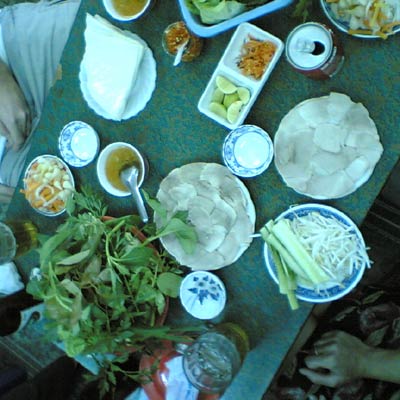
It’s a simple dish; just boiled pork wrapped in thin rice paper with an assortment of herbs, pickled onions & carrots, cucumber, and raw bean sprouts. As you can see from the photo (or the much better photos that Graham took on a previous trip), the plate of herbs that they give you is quite impressive and varied; one smelled like lemon, another like fish. All wrapped up and dipped in fish sauce, it’s delicious and simple.
Afterwards we headed to the market, Graham for dinner fixings and us for some browsing around. Before we parted, he treated us to a sugarcane & lemon drink (mia da) and a pennywort smoothie (not as bad as I’d thought for something that tasted like salad through a straw). Thanks for the nice lunch, Graham!
We’ve arrived safely in Vietnam. Saigon is by far the most European stop on our trip, which makes sense because Thailand was never colonized by a European power[1] and Hong Kong was British and therefore not European[2]. There are cafes, French restaurants, European architecture, public spaces like squares and parks, etc. It feels like Europe here.
And there are a lot of dongs here. The Vietnamese currency is the dong[3]. Our hotel is just off of Dong Khoi. I’ve seen several restaurants and shops with “Dong” in the name. Beavis and Butthead would love it here; I myself have been making culturally insensitive jokes pertaining to the currency and my pants pocket all afternoon.
[1] The only SE Asian country never to have been so colonized.
[2] Hello, angry Brits! Of course you’re European, but you know what I mean. For starters, you’ve got your own breakfast, as opposed to the continental.
[3] The 50,000 & 100,000 dong notes are plastic and see-through in a couple spots. US currency is so not cool.
Red Bull was originally a Thai energy drink. I’ve seen the original in the stores here, along with several competing brands.
When you only know a few words of a language, it’s easy to get confused when speaking. Somehow the phrase “tod mon pla” is one of the few Thai phrases that has stuck fast in my head, so much so that I’m afraid I’ll get flustered when somebody greets me with “sa-wat dee kha” that I will answer with “tod mon pla”:
Them: “Hello!”
Me: “Fish cakes.”
Thai also sounds a bit like Klingon to me; it’s all the short one-syllable letter combinations strung together. Any day now, instead of “khawp khun khrap” (which means “thank you”), I’m going to reply with qapla’ (roughly pronounced “kah-pla”, it’s the Klingon word for “success” or “good luck”[1]).
Meanwhile, my fast and loose eating on the streets of Bangkok has finally caught up with me as I’ve been spending a little more time in the bathroom than usual for the past day. I flew too close to the sun on bags of soda, my friends. It’s not bad, but I think I’ll lay off getting ice from places on the street.
[1] qapla’ is the only Klingon word that I know, gleaned from hours of watching ST:TNG on TV in high school and college. I’m a big dork, but not the kind that’s anything approaching fluent in Klingon.
Just got back from dinner at Anna’s Cafe (118 Soi Sala Daeng). I had the grilled chicken with garlic and pepper and Meg got tom kah gung (the coconut and galangal soup that we learned how to make in our cooking class, except with shrimp instead of chicken). The reviewers at Fodor’s didn’t like Anna’s, but we thought it was pretty good. Anna’s also seems to be the place in Bangkok to go for your birthday…we heard Happy Birthday sung five different times while we were there.
Matt writes about finding good food in an unfamiliar city. We’ve been struggling with this on our trip to Asia. Offline approaches (books, recommendations by locals, etc.) seem to work well, as does taking a peek on eGullet or Chowhound.
We stopped for lunch today at Tonpo, which is right on the river near a water taxi stop. The heat is brutal here, especially in the middle of the day, so the breeze from the river was quite refreshing. One of the dishes we ordered was fried chicken wrapped in pandanus leaves:
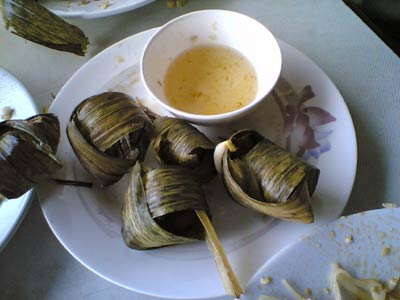
The fried chicken was excellent, some of the best I’ve had (I think we’re venturing out tonight to get more at this place Meg heard about). But do you see that sauce next to the chicken? It tasted exactly like Bazooka bubble gum, swear to god. Fried chicken and gum, a match made in heaven.
We’ve been eating a lot off the street[1] here in Bangkok. On our morning and afternoon walks to and from the Skytrain[2], there are one-person food carts each serving up a particular little snack for 5-10 baht[3] apiece. It’s a good grazing situation; lunch yesterday lasted about five hours[4] and consisted of some orange juice, a thai iced coffee, pork balls on a stick, grilled chicken on a stick, some sort of sweet coconut custard thing, chrysanthemum juice, some noodles that very much tasted like ramen (with pork), more sweet coconut custard things, some peanut crepes…
[1.5 hour interlude for a foot and thai massage[5] that I quite enjoyed and Meg quite didn’t]
…fried dough balls, pork and pineapple on a stick, a bag of orange soda, pork crepes with tiny egg[6], and dessert tacos. Altogether it was maybe US$6 for the two of us (and my dad ate some too).[7]
I love eating this way and it was something that was sorely missing in HK.
[1] From street vendors, not literally off the street.
[2] Auto traffic is awful here…traffic jams everywhere. So we’ve been using the Metro (subway), Skytrain (the elevated train), and the river taxis to get around. They get us to most places we need to go. There are motorcycle taxis available, but we’d rather not split up on the journey. Two/three-person motorcycle-powered rickshaws called tuk tuks are also available, but we’ve heard conflicting reports of the usefulness/sketchiness that we’ve opted out of them altogether.
[3] It’s about 40 baht to a US dollar. A meal at a small restaurant with tables on the street cost us around US$5 for the two of us, including gigantic beer.
[4] We started out at Aw Kaw Taw market, walked over to Chatuchak market, and then to the area around Sala Daeng.
[5] The massage was around US$7 per person. I want one every day.
[6] Onto each crepe, the cook cracked a tiny egg. He made up about 10 for the woman ahead of us and cracked 10 tiny eggs, one for each crepe.
[7] To those who say they can’t afford to travel, I say to you: stop making excuses. If you’ve got the income and leisure time to be spending time reading this blog, are sufficiently motivated, and make it a priority in your life[8], you can certainly afford it. The most costly item is the plane ticket, but if you watch for deals and are flexible in where you want to visit (maybe you go to Brazil instead of Thailand), you can get over here for less than you might think. And once you’re here, you can get by on $20 a day, including lodging. Travel is cheaper here as well, buses and trains are always an option, and there are several low-cost airlines that serve the region. It requires a little effort and intrepidity, but low-cost international travel can be done.
[8] This is the big sticking point for most people, I think. If you choose to have a family or focus on your career or pursue a costly photography hobby, you might not have the money or flexibility to travel this way. But that’s a choice you’ve made (on some level)…and I would argue that if you’re 30 years old, you can arrange to make an overseas trip once every 3-5 years, and that’s about 7-8 trips by the time you’re 60.
Meg and I took a Thai cooking class today at Baipai Cooking School on the recommendation of my friend Darby (thx, Darb!). Since cooking is her thing, Meg’s got the full write-up with photos. They pick you up at your hotel, you spend 4 hours cooking (part instruction, part hands-on) in a small outdoor kitchen (there were about 8-10 other people in the class) tasting as you go, you eat the meal you cook, and then they drop you back at your hotel. All for around US$35 per person. We made pad thai, tom kha gai (chicken & galangal in coconut milk soup), fish cakes, and tab tim grobb (water chestnut in coconut milk). Very fun and highly recommended.
Newer posts
Older posts




Socials & More