

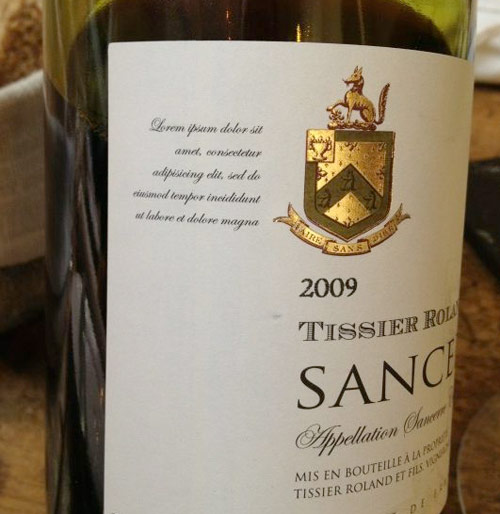
Lorem ipsum on French wine label
Oof…a wine by Roland Tissier has lorem ipsum on the label.
(via stellar)

This site is made possible by member support. 💞
Big thanks to Arcustech for hosting the site and offering amazing tech support.
When you buy through links on kottke.org, I may earn an affiliate commission. Thanks for supporting the site!
kottke.org. home of fine hypertext products since 1998.
Beloved by 86.47% of the web.
Oof…a wine by Roland Tissier has lorem ipsum on the label.
(via stellar)
Sour candy is sour because of the acidity level. The Minnesota Dental Association has compiled a chart listing several popular sour candies, all of which are acidic enough to cause tooth enamel loss and some of which are almost as acidic as battery acid! Here’s part of the chart:

(via mlkshk)
Update: I meant to add that the ph scale is logarithmic (like the Richter scale) so that a pH of 3.0 is 10 times more acidic than a pH of 4.0. That means that even the pH 1.6 & 1.8 candies on the list aren’t quite battery acid, but it also means that a pH 2.0 candy has 100x more acidity than is required to cause enamel loss, not just 2x.
Drinkify matches up the music you’re listening to with a suggested drink. According to the site, Daft Punk pairs best with 6 oz. Bombay Sapphire Gin served neat, Philip Glass should be accompanied by a bottle of red wine, The Clash goes with 1 oz. cocaine + 1 oz. grenadine served in a highball, and you can probably guess what you drink while listening to Snoop Dogg:

(via coudal)
Now that the folks at Next Restaurant are done with their initial menu (Paris, 1906), they’re giving it all away in a cookbook available exclusively for iBooks. And they’re going to do the same thing for each of their menus.
Next is a restaurant like no other. Every season the menu and service explore an entirely different cuisine. Buying a ticket is the only way to get in… and the entire season sold out in a few hours. The inaugural menu took diners back to Paris: 1906, Escoffier at the Ritz for a multi-course pre fixe dinner that was described by the New York Times as “Belle Epoque dishes largely unseen on American tables for generations.”
Ok, someone needs to do this: 1. Open a restaurant (in New York, say) that features old menus from Next every three months using the Next cookbooks to plan menus. 2. Call it Previous. 3. Profit!
This is likely the best piece you’ll read about the economics of the McRib and McDonald’s motivation in its periodic reintroduction.
At this volume, and with the impermanence of the sandwich, it only makes sense for McDonald’s to treat the sandwich as a sort of arbitrage strategy: at both ends of the product pipeline, you have a good being traded at such large volume that we might as well forget that one end of the pipeline is hogs and corn and the other end is a sandwich. McDonald’s likely doesn’t think in these terms, and neither should you.
Oh and speaking of pipelines:
And for its part, the McRib makes a mockery of this whole terribly labor-intensive system of barbecue, turning it into a capital-intensive one. The patty is assembled by machinery probably babysat by some lone sadsack, and it is shipped to distribution centers by black-beauty-addicted truckers, to be shipped again to franchises by different truckers, to be assembled at the point of sale by someone who McDonald’s corporate hopes can soon be replaced by a robot, and paid for using some form of electronic payment that will eventually render the cashier obsolete.
There is no skilled labor involved anywhere along the McRib’s Dickensian journey from hog to tray, and certainly no regional variety, except for the binary sort — Yes, the McRib is available/No, it is not — that McDonald’s uses to promote the product. And while it hasn’t replaced barbecue, it does make a mockery of it.
(via @joeljohnson)
Recent tests conducted by Food Safety News show that about 75% of the honey sold in US grocery stores isn’t officially honey.
The results show that the pollen frequently has been filtered out of products labeled “honey.” The removal of these microscopic particles from deep within a flower would make the nectar flunk the quality standards set by most of the world’s food safety agencies.
The food safety divisions of the World Health Organization, the European Commission and dozens of others also have ruled that without pollen there is no way to determine whether the honey came from legitimate and safe sources.
In the U.S., the Food and Drug Administration says that any product that’s been ultra-filtered and no longer contains pollen isn’t honey. However, the FDA isn’t checking honey sold here to see if it contains pollen.
It’s that last sentence that really pisses me off…the FDA and USDA are pathetic jokes.
Anyway, there is speculation that the pollen removal is masking the use of unregulated, uninspected, and illegally imported Chinese honey.
Eric Wenger, director of quality services for Golden Heritage Foods, the nation’s third largest packer, said his company takes every precaution not to buy laundered Chinese honey.
“We are well aware of the tricks being used by some brokers to sell honey that originated in China and laundering it in a second country by filtering out the pollen and other adulterants,” said Wenger, whose firm markets 55 million pounds of honey annually under its Busy Bee brand, store brands, club stores and food service.
“The brokers know that if there’s an absence of all pollen in the raw honey we won’t buy it, we won’t touch it, because without pollen we have no way to verify its origin.”
James Kendall’s wife’s 90-year-old grandmother recently cleaned out her pantry and Kendall documented some of the ancient foodstuffs lurking within.

(via @lomokev)
You’re given a name and you have to guess if it’s a cheese or a font. This might be the most difficult game I’ve ever played. (thx, @ziggy444)
A version of Food Rules by Michael Pollan illustrated by Maira Kalman? Hell yeah!
Michael Pollan and Maira Kalman come together to create an enhanced Food Rules for hardcover, now beautifully illustrated and with even more food wisdom.
Michael Pollan’s definitive compendium, Food Rules, is here brought to colorful life with the addition of Maira Kalman’s beloved illustrations.
This brilliant pairing is rooted in Pollan’s and Kalman’s shared appreciation for eating’s pleasures, and their understanding that eating doesn’t have to be so complicated. Written with the clarity, concision, and wit that is Michael Pollan’s trademark, this indispensable handbook lays out a set of straightforward, memorable rules for eating wisely. Kalman’s paintings remind us that there is delight in learning to eat well.
Ed Levine and the crew over at Serious Eats are coming out with a book that attempts to distill the last five years of the web site into book form. Serious Eats: A Comprehensive Guide to Making and Eating Delicious Food Wherever You Are comes out in early November.
Ed Levine, whom Ruth Reichl calls the “missionary of the delicious,” and his SeriousEats.com editors present their unique take on iconic foods made and served around the country. From house-cured, hand-cut corned beef sandwiches at Jake’s in Milwaukee to fried-to-order doughnuts at Shipley’s Do-Nuts in Houston; from fresh clam pizza at Zuppardi’s Pizzeria in West Haven, Connecticut, to Green Eggs and Ham at Huckleberry Bakery and Caf’e in Los Angeles, Serious Eats is a veritable map of some of the best food they have eaten nationwide.
Covering fast food, family-run restaurants, food trucks, and four-star dining establishments, all with zero snobbery, there is plenty here for every food lover, from coast to coast and everywhere in between. Featuring 400 of the Serious Eats team’s greatest food finds and 50 all-new recipes, this is your must-read manual for the pursuit of a tasty life.
You’ll learn not only where to go for the best grub, but also how to make the food you crave right in your own kitchen, with original recipes including Neapolitan Pizza (and dough), the Ultimate Sliders (which were invented in Kansas), Caramel Sticky Buns, Southern Fried Chicken, the classic Reuben, and Triple-Chocolate Adult Brownies. You’ll also hone your Serious Eater skills with tips that include signs of deliciousness, regional style guides (think pizza or barbecue), and Ed’s hypotheses-ranging from the Cuban sandwich theory to the Pizza Cognition Theory-on what makes a perfect bite.
Using Whole Foods as an example, Martin Lindstrom shows how retail stores use subtle tactics to get people to buy more than they might have otherwise.
Speaking of fruit, you may think a banana is just a banana, but it’s not. Dole and other banana growers have turned the creation of a banana into a science, in part to manipulate perceptions of freshness. In fact, they’ve issued a banana guide to greengrocers, illustrating the various color stages a banana can attain during its life cycle. Each color represents the sales potential for the banana in question. For example, sales records show that bananas with Pantone color 13-0858 (otherwise known as Vibrant Yellow) are less likely to sell than bananas with Pantone color 12-0752 (also called Buttercup), which is one grade warmer, visually, and seems to imply a riper, fresher fruit. Companies like Dole have analyzed the sales effects of all varieties of color and, as a result, plant their crops under conditions most ideal to creating the right ‘color.’
(via @daveg)
From the current issue of Lapham’s Quarterly, a collection of facts and anecdotes about food. I can’t pick a favorite, so here are three:
Paul Newman’s character amazingly eats fifty hard-boiled eggs in one hour in Cool Hand Luke. Sixty-five hard-boiled eggs eaten in sixty minutes and forty seconds is the actual world record, held by Sonya Thomas.
As to why he didn’t drink water, an inebriated W. C. Fields purportedly responded, “Fish fuck in it.”
“As if I swallowed a baby,” said William Makepeace Thackeray about eating his first oyster.
(via @claytoncubitt)
A forthcoming book from Tyler Cowen: An Economist Gets Lunch: New Rules for Everyday Foodies. No description yet, but if you’re a regular reader of Marginal Revolution (the Food and Drink stuff in particular), you can probably figure out what it’ll entail.
Huitlacoche (pronounced weet-la-KOH-chay) is a fungus, called corn smut in the US, that has recently become something of a delicacy. “Before, it was seen as a food of the poor. Now it’s the food of the rich,” following the same track as lobster. The cultivation of huitlacoche is growing dramatically, as an infected stock sells for more than a normal corn cob. The flavor is described as earthy and unique, perhaps most similar to a mushroom.
In recent decades — before huitlacoche really took off — the fungus largely was sauteed with garlic, onions and poblano chile strips and served by street vendors in quesadillas, folded-over corn tortillas. Then cooks realized its flavor would make nearly any dish sensational. Restaurants sometimes offer it with beef, fish, in crepes with chipotle sauce, with eggs, in cream soups or with shrimp.
I would like to eat corn smut.
(Via Balloon Juice)
Socials & More