kottke.org posts about climate crisis

Paul Hawken’s Project Drawdown “is the world’s leading source of climate solutions.” In the list of solutions, perhaps surprisingly to many, silvopasture comes in at number nine. Issue 2 of the excellent Australia based Matters Journal came out with this fun illustrated guide to silvopasture.
Silvopasture is the symbiotic integration of livestock grazing and forest management. This can either be achieved by strategically planting trees into a conventional, and usually treeless, grazing pasture or by thinning a wooded forest so that livestock can graze beneath its canopy.
Drawdown estimated that silvopasture is currently practiced on 351 million acres of land globally. If this was increased to 554 million acres by 2050 then CO2 emissions could be reduced by 31.19 gigatons. To put this figure into perspective, Drawdown estimates that if seven percent of the world’s population had rooftop solar to power their houses it would avoid 24.6 gigatons of CO2 emissions.
The piece ends with quite a few links worth checking out to learn more about this agroforestry practice.
From The New Humanitarian, a mid-year update on 10 humanitarian trends and crises to watch in 2019 (here’s their initial post). The #1 item on the list, deservedly so, is climate displacement:
Vulnerable communities around the world have long known what the aid sector is just beginning to articulate: climate change is a humanitarian issue, and its fingerprints are all over today’s emergencies.
Climate shocks and disasters continued to fuel displacement around the globe through the first half of the year, from tropical cyclones to slow-burning droughts. Pacific Island nations were on high alert early in the year as storm after storm swept through the region in quick succession. Conflict is as dangerous as ever in Afghanistan, yet the number of people displaced by drought and floods in recent months is on par with the numbers fleeing war. Drought has left 45 million in need in eastern, southern, and the Horn of Africa. This, along with conflict, has spurred new displacement in countries like Somalia, where at least 49,000 people have fled their homes so far this year, according to UNHCR. The UN’s refugee agency warns of “growing climate-related displacement” - a sign of the continuing shift in the aid sector as humanitarian-focused agencies increasingly underline the links between climate change and crises.
Our rapidly changing climate has either caused or exacerbated several of the other crises on the list — Syria, Ethiopia, infectious diseases, the global refugee population. This isn’t stuff that’s going to happen…it is happening, it has happened. And it’s going to get worse. (via tmn)
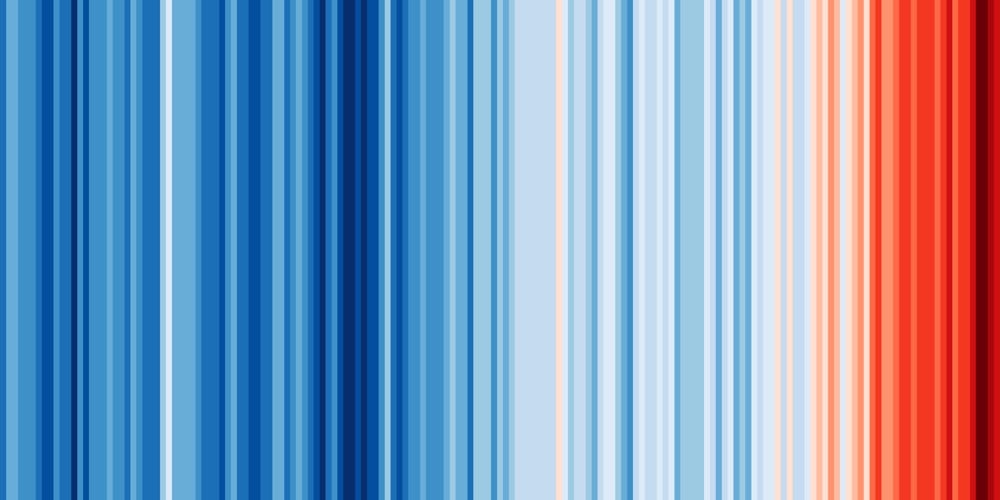
Using temperature data from around the world, climate scientist Ed Hawkins has built a tool for viewing the “climate stripes” for almost any location, a data visualization that represents the change in temperature over time over the past 100+ years. For most locations, the graphs shift from blues to oranges & reds as the climate warms, neatly illustrated by the global graph:
Here’s Vermont (where I live) and Arizona:
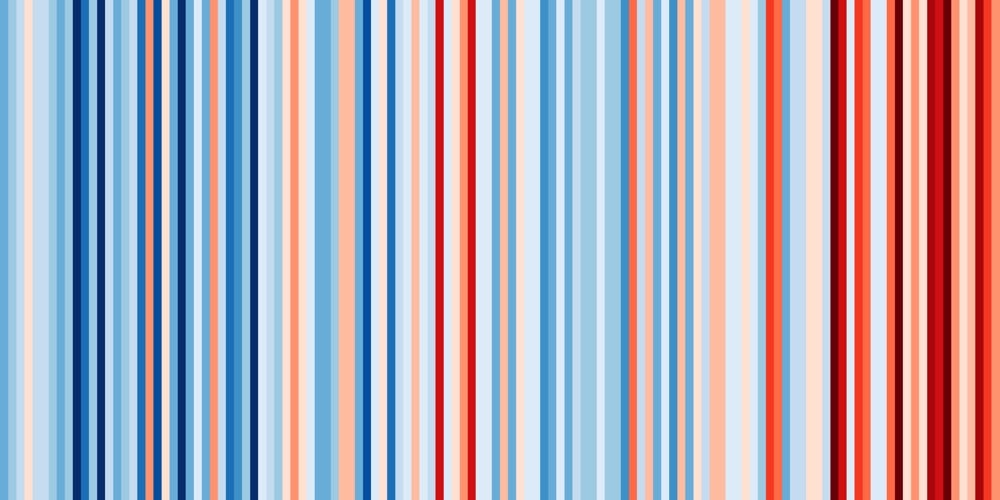
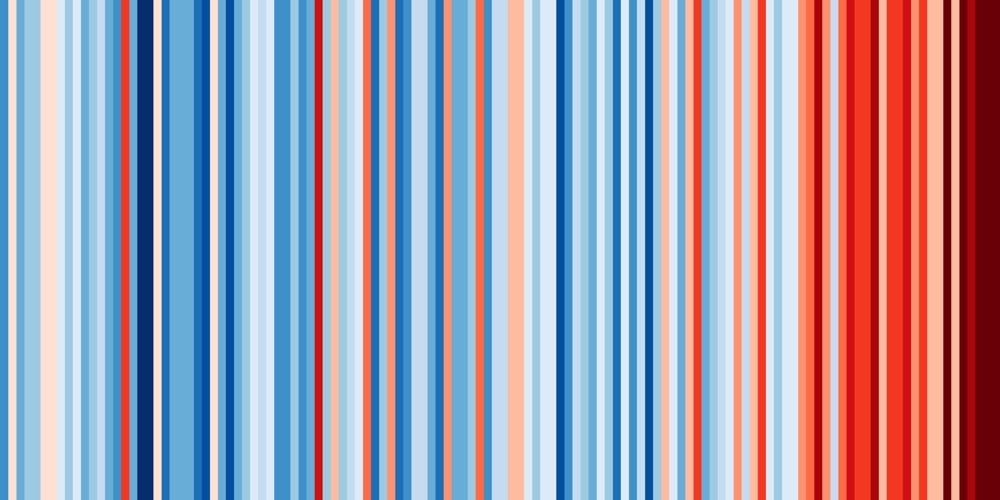
You can see there’s more variation on the regional level than globally. Check out the graph for Mississippi:
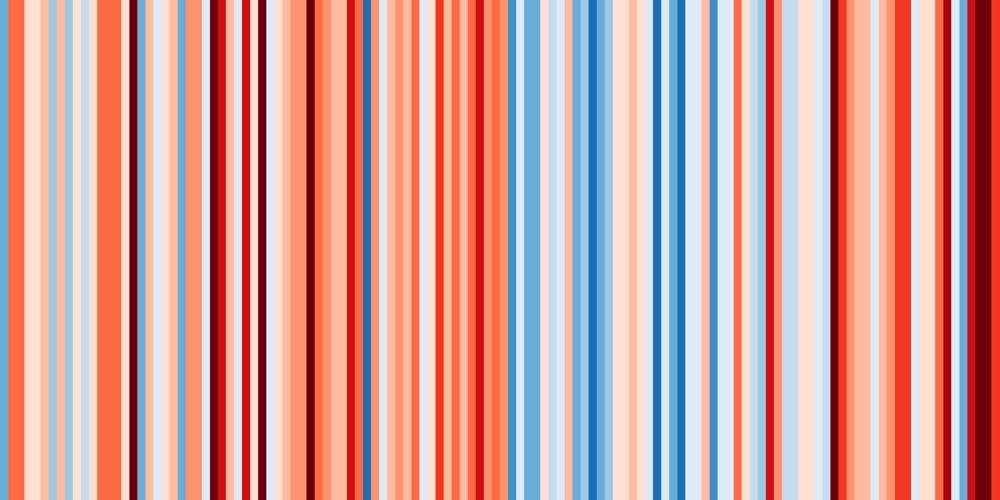
The warming patterns for particular regions are not going to be uniform…some places are actually forecast to get cooler and wetter rather than hotter and dryer. You can create and download your own climate stripes here…perhaps you can use it to make a global warming blanket. (via riondotnu)
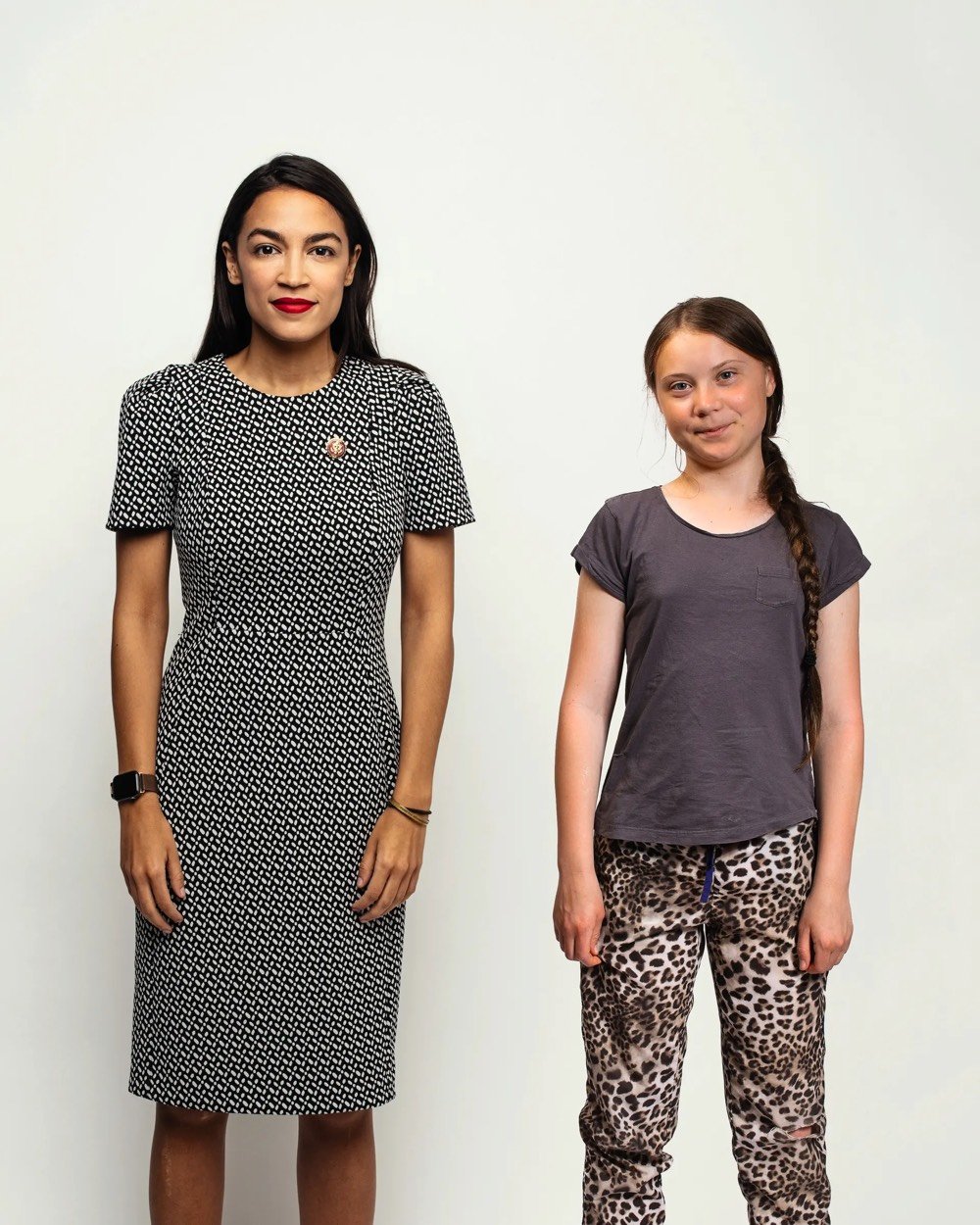
Late last month, US Congresswoman Alexandria Ocasio-Cortez and climate activist Greta Thunberg had a lengthy conversation over video chat about leadership, climate change, politics, and activism.
GT: Many people, especially in the US, see countries like Sweden or Norway or Finland as role models — we have such a clean energy sector, and so on. That may be true, but we are not role models. Sweden is one of the top 10 countries in the world when it comes to the highest ecological footprints, according to the WWF — if you count the consumer index, then we are among the worst per capita.
In Sweden, the most common argument that we shouldn’t act is that we are such a small country with only 10 million inhabitants — we should focus more on helping other countries. That is so incredibly frustrating, because why should we argue about who or what needs to change first? Why not take the leading role?
AOC: We hear the same exact argument here. And this is the United States of America! People say, “Well, we should wait for China to do something.” There’s this political culture of people trying to say America First — that the US is the best nation in the world, yet at the same time they’re saying, “Well, China’s not doing it, why should we?”
And I think it’s the same argument: are we going to choose to lead, or are we going to sit on our hands? It seems as if they take pride in leading on fracking, on being the number one in oil, in consumption, in single-use plastics. But they don’t seem to want to take pride in leading on the environment and leading for our children.
Early on in the conversation, they touched on something that’s always bothered me in news stories about or criticism of Thunberg: her age.
AOC: One of the things I’m interested in hearing from you is that often people say, “Don’t politicise young people.” It’s almost a taboo. That to have someone as young as you coming out in favour of political positions is manipulative or wrong. I find it very condescending, as though, especially in this day and age with the access to information we have, you can’t form your own opinions and advocate for yourself. I’m interested in how you approach that — if anyone brings that up with you?
GT: That happens all the time. That’s basically all I hear. The most common criticism I get is that I’m being manipulated and you shouldn’t use children in political ways, because that is abuse, and I can’t think for myself and so on. And I think that is so annoying! I’m also allowed to have a say — why shouldn’t I be able to form my own opinion and try to change people’s minds?
But I’m sure you hear that a lot, too; that you’re too young and too inexperienced. When I see all the hate you receive for that, I honestly can’t believe how you manage to stay so strong.
In disciplines as varied as academics, athletics, chess, and art, the achievements of young people are celebrated, but Thunberg expresses her ideas and opinions about how to address climate change and starts a massive movement of young people around the globe and suddenly 16 is too young to participate in our culture and political process? Bullshit.
The high temperature on Saturday in Guadalajara, Mexico was 86 °F. On Sunday morning, up to three feet of hail fell on the city and it looked like this:
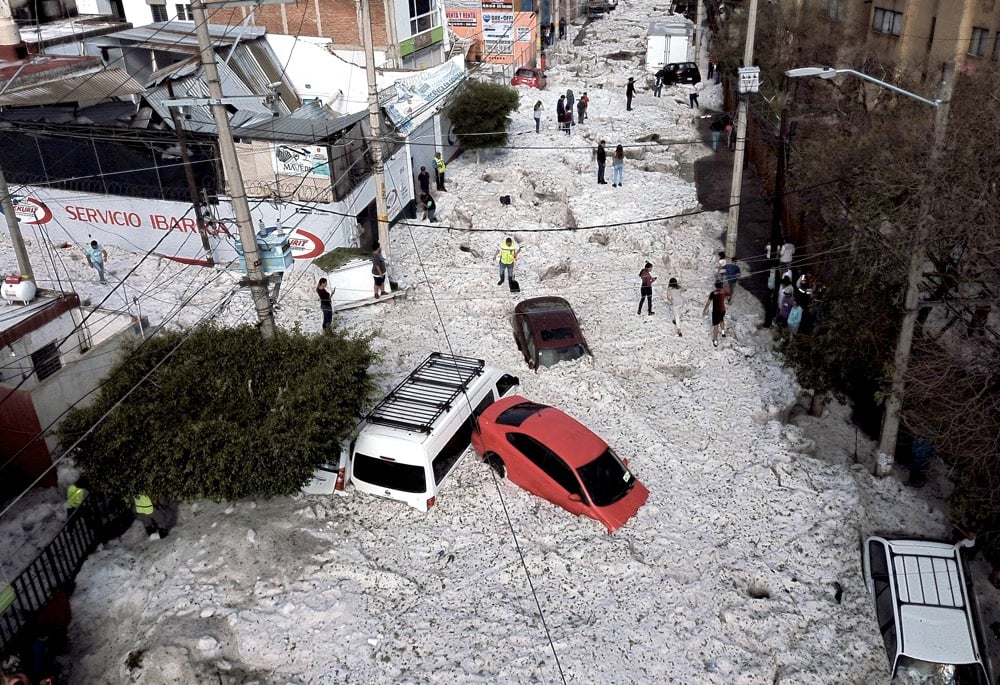
Enrique Alfaro, the governor of Jalisco, wrote on Twitter that he had never seen anything like it.
“I witnessed scenes that I had never seen before: hail more than a meter high,” he tweeted, “and then we ask ourselves if climate change exists.”
Weather is not climate, but our warmer atmosphere is going to make extreme weather events like this more likely and frequent. As the Times says with characteristic understatement:
Experts say it is not unusual to have a hailstorm at this time of year in western Mexico, but the amount of hail was extreme.
Yesterday I wrote about a Vancouver store offering plastic bags with embarrassing messages on them to encourage customers to use their own bags for their groceries. Under new laws that took effect on June 1, stores in the city must stop offering paper/plastic bags or charge for them.
NPR’s Planet Money team pulled some research together that suggests that banning plastic bags might do more harm than good (at least in the short term).
Taylor found these bag bans did what they were supposed to: People in the cities with the bans used fewer plastic bags, which led to about 40 million fewer pounds of plastic trash per year. But people who used to reuse their shopping bags for other purposes, like picking up dog poop or lining trash bins, still needed bags. “What I found was that sales of garbage bags actually skyrocketed after plastic grocery bags were banned,” she says. This was particularly the case for small, 4-gallon bags, which saw a 120 percent increase in sales after bans went into effect.
Trash bags are thick and use more plastic than typical shopping bags. “So about 30 percent of the plastic that was eliminated by the ban comes back in the form of thicker garbage bags,” Taylor says. On top of that, cities that banned plastic bags saw a surge in the use of paper bags, which she estimates resulted in about 80 million pounds of extra paper trash per year.
The waste issue is better, but paper bag production increases carbon emissions. And tote bags, particularly those made from cotton, aren’t great either.
The Danish government recently did a study that took into account environmental impacts beyond simply greenhouse gas emissions, including water use, damage to ecosystems and air pollution. These factors make cloth bags even worse. They estimate you would have to use an organic cotton bag 20,000 times more than a plastic grocery bag to make using it better for the environment.
Last week, Greta Thunberg and dozens of other young climate activists called on adults to join them in a climate strike on September 20.
Once again our voices are being heard on the streets, but it is not just up to us.
We feel a lot of adults haven’t quite understood that we young people won’t hold off the climate crisis ourselves. Sorry, if this is inconvenient for you. But this is not a single-generation job. It’s humanity’s job. We young people can contribute to a larger fight and that can make a huge difference.
So this is our invitation to you. Starting on Friday 20 September we will kick start a week of climate action with worldwide strikes for the climate. We’re asking you to step up alongside us. There are many different plans underway in different parts of the world for adults to join together and step up and out of your comfort zone for our climate. Let’s all join together; with our neighbours, co-workers, friends, family and go out on to the streets to make our voices heard and make this a turning point in our history.
A response — signed by folks like Bill McKibben, Rebecca Solnit, Mark Ruffalo, Naomi Klein, and Margaret Atwood — appeared the next day:
Starting Friday September 20, at the request of the young people who’ve been staging school strikes around the world, we’re walking out of our workplaces and homes to spend the day demanding action on climate change, the great existential threat that all of us face. It’s a one-day climate strike, if you will — and it will not be the last. This is going to be the beginning of a week of climate action all over the world. And we hope to make it a turning point in history.
We hope others will join us: that people will leave their offices, their farms, their factories; that candidates will step off the campaign trail and football stars off the pitch; that movie actors will scrub off their makeup and teachers lay down their chalk; that cooks will close their restaurants and bring meals to protests; that pensioners too will break their daily routines and join in sending the one message our leaders must hear: Day by day, business as usual is creating an ecological crisis that is destroying the chance for a healthy, safe future on our planet.
I’m in — kottke.org will not publish on September 20th. You can join in here. Stay tuned to the Global Climate Strike site for more information on how to find events near you. (via laura olin)
In Britain, the birthplace of the industrial revolution, no coal has been used to produce power for the last 11 days. This is an arresting chart of how quickly the country’s reliance on coal has been reduced:

Britain is setting new records for going without coal-powered energy. In the latest milestone, it has gone for more than eight days without using coal to generate electricity — the longest such period since 1882.
The coal-free run comes just two years after the National Grid first ran without coal power for 24 hours.
Phasing out the heavily polluting fuel is a key step in the transition towards a net-zero carbon economy and essential to averting catastrophic climate change.
Britain still derives ~50% of its power from natural gas, but this is a very hopeful chart. “Gradually then suddenly” works against us in dealing with climate change but it also could work in our favor.
In the latest episode of Last Week Tonight, John Oliver discusses the Green New Deal and carbon pricing. Oliver invited beloved children’s science educator Bill Nye to help him explain a few things and Nye delivered a short but passionate speech about what’s at stake in the political battle over climate change:
I’ve got an experiment for you. Safety glasses on. By the end of this century, if emissions keep rising, the average temperature on earth could go up another four to eight degrees. What I’m saying is: the planet’s on fucking fire!
There are a lot of things we could do to put it out. Are any of them free? No, of course not. Nothing’s free you idiots! Grow the fuck up, you’re not children anymore. I didn’t mind explaining photosynthesis to you when you were 12. But you’re adults now and this is an actual crisis, got it? Safety glasses off, motherfuckers.
The entire segment is worth watching (particularly if you haven’t been keeping up on what the Green New Deal actually is) but Nye’s closing remarks are at ~18:30 for the impatient.
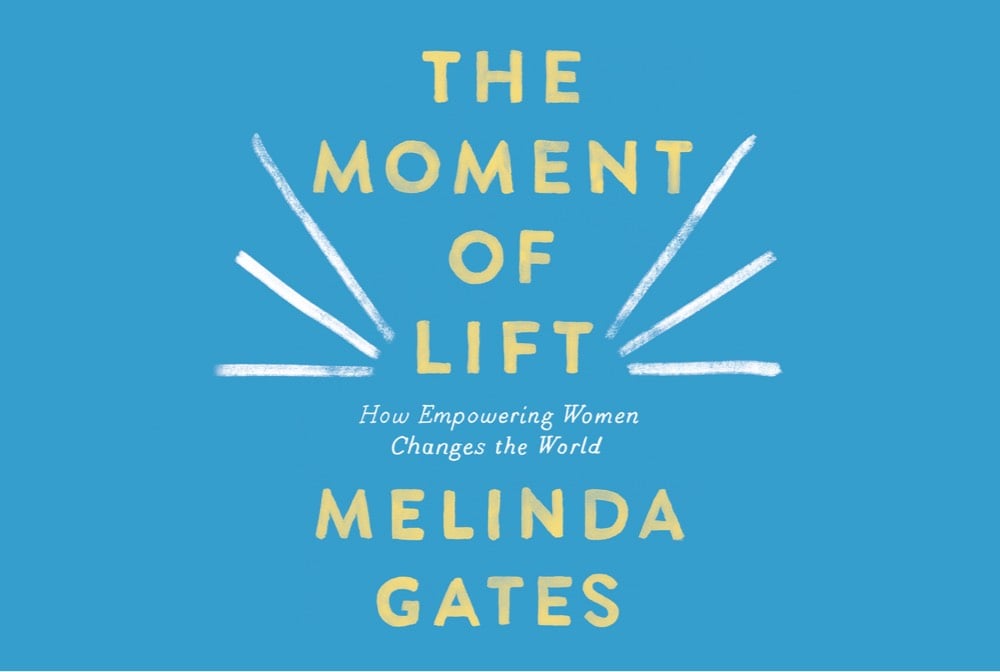
In a recent Facebook post, President Obama 1 shared a few books that he’s been reading recently. At the tippy top is Melinda Gates’ The Moment of Lift: How Empowering Women Changes the World.
When you lift up women, you lift up everybody — families, communities, entire countries. That’s not just the right approach; it’s backed up by research and countless real-world examples. In her book, Melinda tells the stories of the inspiring people she’s met through her work all over the world, digs into the data, and powerfully illustrates issues that need our attention — from child marriage to gender inequity in the workplace. I’ve called Melinda an impatient optimist and that’s what she delivers here — the urgency to tackle these problems and the unwavering belief that solving them is indeed possible.
From a short excerpt of the book:
In my travels, I’ve learned about hundreds of millions of women who want to decide for themselves whether and when to have children, but they can’t. They have no access to contraceptives. And there are many other rights and privileges that women and girls are denied: The right to decide whether and when and whom to marry. The right to go to school. Earn an income. Work outside the home. Walk outside the home. Spend their own money. Shape their budget. Start a business. Get a loan. Own property. Divorce a husband. See a doctor. Run for office. Ride a bike. Drive a car. Go to college. Study computers. Find investors. All these rights are denied to women in some parts of the world. Sometimes these rights are denied under law, but even when they’re allowed by law, they’re still often denied by cultural bias against women.
Two of the top ten solutions on Paul Hawken’s list for slowing the effects of climate change are “educating girls” and “family planning”, which taken together would have a greater impact on reversing climate change than any other thing on the list.
Obama also recommends Pachinko by Min Jin Lee, a book I’ve been curious about ever since it was published. Friends have recommended it and the cover always catches my eye in the bookstore even though I’m never specifically looking for it. I don’t even know why I’ve been resisting it…just ordered it!
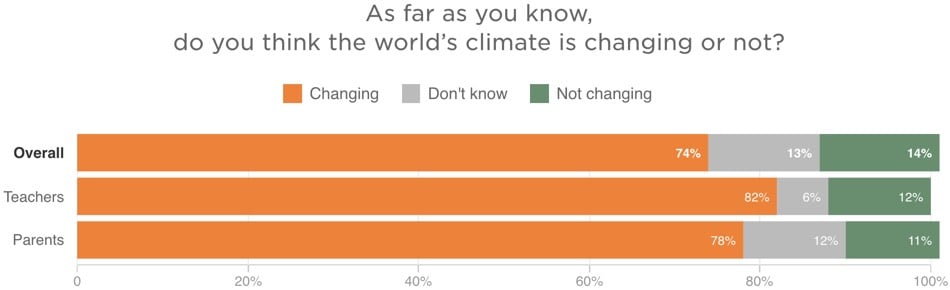
According to a poll conducted by NPR/Ipsos, over 80% of American parents want climate change to be taught in our schools, but only 42% of the teachers polled say that they teach it in their classrooms.
If they don’t hear about it at home, will kids learn about climate change in school? To answer this question, NPR/Ipsos also completed a nationally representative survey of around 500 teachers. These educators were even more likely than the general public to believe in climate change and to support teaching climate change.
In fact, 86% of teachers believe climate change should be taught in schools. In theory.
But in practice, it’s more complicated. More than half — 55% — of teachers we surveyed said they do not cover climate change in their own classrooms or even talk to their students about it.
The most common reason given? Nearly two-thirds (65%) said it’s outside their subject area.
NPR education correspondent Anya Kamenetz shared 8 Ways To Teach Climate Change In Almost Any Classroom, regardless of what subject you teach.
5. Assign a research project, multimedia presentation or speech.
Gay Collins teaches public speaking at Waterford High School in Waterford, Conn. She is interested in “civil discourse” as a tool for problem-solving, so she encourages her students “to shape their speeches around critical topics, like the use of plastics, minimalism, and other environmental issues.
I am, however, still hung up on the 12% of teachers polled who said that the world’s climate is not changing.
In this short video essay, David Attenborough succinctly describes the main problem of the anthropocene (that modern humans are not living sustainably as they once could as hunter gatherers), explains the effect we’ve had on the planet, and then suggests how we can fix things (italics mine):
The plan for our planet is remarkably simple. Reduce our impact by making sure that everything we do, we can do forever.
Sustainability is such a buzzword these days that I have long since stopped thinking about what it actually means; Attenborough nails it with “making sure that everything we do, we can do forever”. The Earth seems infinite in scope but not with 7, 8, or 9 billion humans hungry for food, thirsty for water, and lusty for status & entertainment.
The simple plan Attenborough describes has four parts:
1. Phase out fossil fuels and replace them with renewables.
2. Upgrading to efficient food production and reducing our consumption of meat.
3. Proper worldwide ocean management.
4. Rewilding the world.
As he allows, it’s a bit more complicated than that — check out Paul Hawken’s list for a more detailed list of things we can do to fight climate change.
At the Salk Institute for Biological Studies, Dr. Joanne Chory is working on a project to create plants capable of storing more carbon for a longer period of time than normal plants in order to help mitigate the effects of climate change.
Suberin — also known as cork — is a naturally occurring carbon-rich substance found in plant roots. It absorbs carbon yet resists decomposition (which releases carbon back into the atmosphere), enriches soil and helps plants resist stress.
By understanding and improving just a few genetic pathways in plants, Salk’s plant biologists believe they can help plants grow bigger, more robust root systems that absorb larger amounts of carbon, burying it in the ground in the form of suberin.
The Salk team will use cutting-edge genetic and genomic techniques to develop these Salk Ideal Plants.
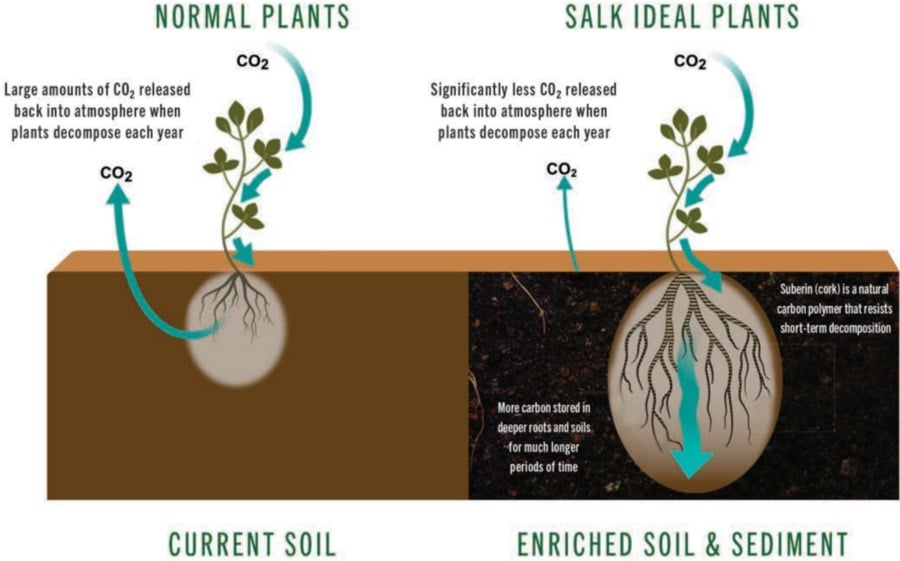
According to this piece in the Guardian on the project, one of the techniques they’re using is CRISPR, basically a genetic copy/paste system. Once the team demonstrates they can grow these larger root systems in model plants, they’ll genetically transfer that capability to the world’s largest food crops like rice, wheat, and corn.
As a bonus, the team believes that Ideal Plants will have other positive effects:
In addition to mitigating climate change, the enhanced root systems will help protect plants from stresses caused by climate changes and the additional carbon in the soil will make the soil richer, promoting better crop yields and more food for a growing global population.
This project is firmly on the wizard end of the wizards vs prophets spectrum.
The canals, the sewers, the buildings, the bridges and the rest of the Venice’s infrastructure has all been engineered to deal with a particularly challenging environment: not-particularly-solid ground constantly battered by salt water. In this short film, we learn how the city works and what steps have been taken over the centuries to ensure the smooth function of the city.
Whether Venice can survive the severe sea level rise coming in the next few decades is still an open question. (thx, david)
In a Q&A with the NY Times back in October, George R.R. Martin connected the goings-on in Westeros with the challenges raised by climate change here in the real world.
The people in Westeros are fighting their individual battles over power and status and wealth. And those are so distracting them that they’re ignoring the threat of “winter is coming,” which has the potential to destroy all of them and to destroy their world. And there is a great parallel there to, I think, what I see this planet doing here, where we’re fighting our own battles. We’re fighting over issues, important issues, mind you — foreign policy, domestic policy, civil rights, social responsibility, social justice. All of these things are important. But while we’re tearing ourselves apart over this and expending so much energy, there exists this threat of climate change, which, to my mind, is conclusively proved by most of the data and 99.9 percent of the scientific community. And it really has the potential to destroy our world. And we’re ignoring that while we worry about the next election and issues that people are concerned about, like jobs. Jobs are a very important issue, of course. All of these things are important issues. But none of them are important if, like, we’re dead and our cities are under the ocean. So really, climate change should be the number one priority for any politician who is capable of looking past the next election. But unfortunately, there are only a handful of those. We spend 10 times as much energy and thought and debate in the media discussing whether or not N.F.L. players should stand for the national anthem than this threat that’s going to destroy our world.
That message has always lurked in the background of the HBO show but seemed closer to the surface in the latest episode — mild spoilers! — which finds several factions that were formerly set against each other in various configurations all working together to defeat a much more threatening common enemy. It is quite difficult, nearly impossible even, to imagine a similar coalition of Democrats, Republicans, Democratic Socialists, Libertarians, and everyone in between allied with each other to combat climate change, but we’re going have to get there somehow. We either do it soon and get the world we want or we continue to do very little and pay a much heavier price later for a world that no one wants.
Update: See also Democratic Presidential candidate Elizabeth Warren’s recap of the first episode of the current season of Game of Thrones. Wait, what?!
And as much as Dany wants to take on her family’s enemies and take back the Iron Throne, she knows that she must first fight the army of the dead that threatens all mankind. This is a revolutionary idea, in Westeros or anywhere else. A queen who declares that she doesn’t serve the interests of the rich and powerful? A ruler who doesn’t want to control the political system but to break the system as it is known? It’s no wonder that the people she meets in Westeros are skeptical.
Newer posts
Older posts





Socials & More