kottke.org posts about climate crisis
Again. Venice is flooded again. The flooding happens so often that it’s pretty much business as usual:
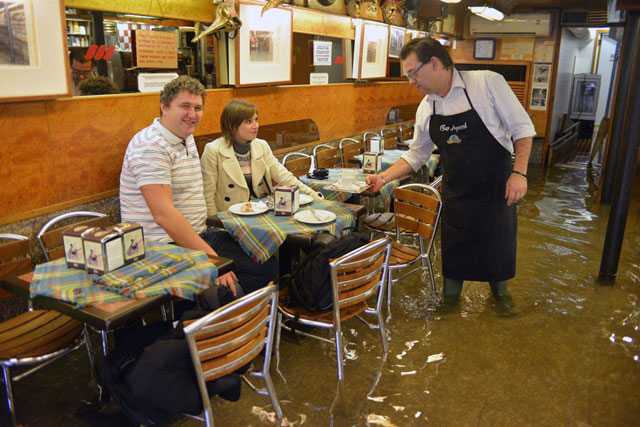
Except that this is a pretty serious long-term issue for Venice. The flooding is called acqua alta and according to a city guide, the current mark of 149 cm means that almost 70% of the city is flooded. And six of the top fifteen high water marks were recorded within the past 10 years.
But a project is underway to ease the flooding: a series of gates intended to protect the city called the MOSE Project.
The New Yorker’s David Remnick urges President Obama to address climate change during his second term in a Kennedy-esque “we choose to go to the Moon” fashion.
Barack Obama can take pride in having fought off a formidable array of deep-pocketed revanchists. As President, however, he is faced with an infinitely larger challenge, one that went unmentioned in the debates but that poses a graver threat than any “fiscal cliff.” Ever since 1988, when NASA’s James Hansen, a leading climate scientist, testified before the Senate, the public has been exposed to the issue of global warming. More recently, the consequences have come into painfully sharp focus. In 2010, the Pentagon declared, in its Quadrennial Defense Review, that changes in the global climate are increasing the frequency and the intensity of cyclones, droughts, floods, and other radical weather events, and that the effects may destabilize governments; spark mass migrations, famine, and pandemics; and prompt military conflict in particularly vulnerable areas of the world, including the Middle East, Southeast Asia, and sub-Saharan Africa. The Pentagon, that bastion of woolly radicals, did what the many denialists in the House of Representatives refuse to do: accept the basic science.
The economic impact of weather events that are almost certainly related to the warming of the earth — the European heat wave of 2003 (which left fifty thousand people dead), the Russian heat waves and forest fires of 2010, the droughts last year in Texas and Oklahoma, and the preelection natural catastrophe known as Sandy — has been immense. The German insurer Munich Re estimates that the cost of weather-related calamities in North America over the past three decades amounts to thirty-four billion dollars a year. Governor Andrew Cuomo, of New York, has said that Sandy will cost his state alone thirty-three billion. Harder to measure is the human toll around the world-the lives and communities disrupted and destroyed.
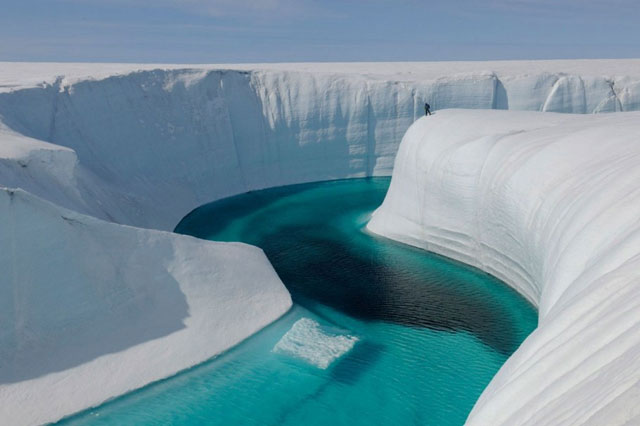
Photographer James Balog (the guy behind a new documentary called Chasing Ice) spent years taking pictures of the melting glaciers. In a variety of ways, these photos are quite incredible.
PBS ombudsman Michael Getler calls out NewsHour for “a faulty application of journalistic balance” in a recent segment on climate change.
Although global warming strikes me as one of those issues where there is no real balance and it is wrong to create an artificial or false equivalence, there is no harm and some possibility of benefit in inviting skeptics about the human contribution and other factors to speak, but in a setting in which the context of the vast majority of scientific evidence and speakers is also made clear.
What was stunning to me as I watched this program is that the NewsHour and Michels had picked Watts — who is a meteorologist and commentator — rather than a university-accredited scientist to provide “balance.” I had never heard of Watts before this program and I’m sure most viewers don’t, as part of their routines, read global warming blogs on either side of the issue.
I’m not being judgmental about Watts or anything he said. He undoubtedly is an effective spokesperson. But it seems to me that if you decide you are going to give airtime to the other side of this crucial and hot-button issue, you need to have a scientist.
Where have I seen this before, a massive long-lasting Arctic storm that looks a lot like a hurricane? Oh right, The Day After Tomorrow.
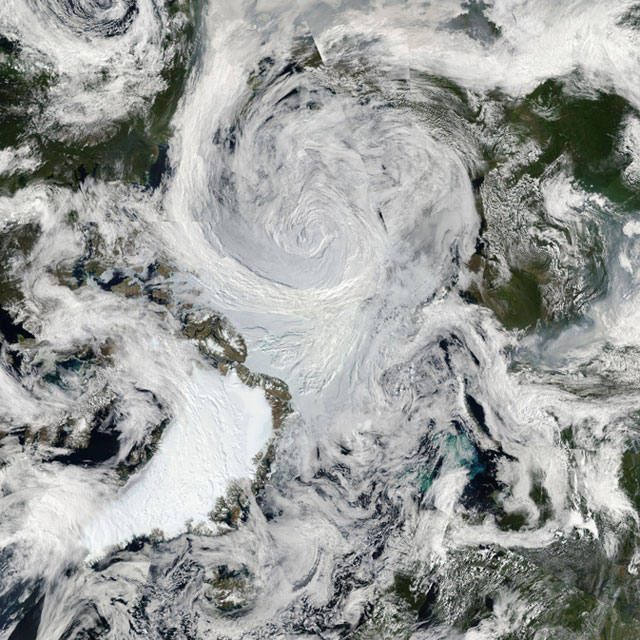
The storm had an unusually low central pressure area. Paul A. Newman, chief scientist for Atmospheric Sciences at NASA’s Goddard Space Flight Center in Greenbelt, Md., estimates that there have only been about eight storms of similar strength during the month of August in the last 34 years of satellite records. “It’s an uncommon event, especially because it’s occurring in the summer. Polar lows are more usual in the winter,” Newman said.
Arctic storms such as this one can have a large impact on the sea ice, causing it to melt rapidly through many mechanisms, such as tearing off large swaths of ice and pushing them to warmer sites, churning the ice and making it slushier, or lifting warmer waters from the depths of the Arctic Ocean.
I love The Day After Tomorrow. I know it’s a cheeseball disaster movie (which is pretty much why I love it) but it’s also looking more than a little prescient. Well, as prescient as a cheeseball disaster movie can be anyway. In the Washington Post the other day, prominent climatologist James Hansen wrote that human-driven climate change is responsible for an increase in extreme weather.
My projections about increasing global temperature have been proved true. But I failed to fully explore how quickly that average rise would drive an increase in extreme weather.
In a new analysis of the past six decades of global temperatures, which will be published Monday, my colleagues and I have revealed a stunning increase in the frequency of extremely hot summers, with deeply troubling ramifications for not only our future but also for our present.
This is not a climate model or a prediction but actual observations of weather events and temperatures that have happened. Our analysis shows that it is no longer enough to say that global warming will increase the likelihood of extreme weather and to repeat the caveat that no individual weather event can be directly linked to climate change. To the contrary, our analysis shows that, for the extreme hot weather of the recent past, there is virtually no explanation other than climate change.
In many ways, the phrase “global warming” is grossly misleading. “Oh,” we think, “it’s gonna be a couple degrees warmer in NYC in 20 years than it is now.” But the Earth’s climate is a chaotic non-linear system, which means that a sudden shift of a degree or two — and when you’re talking about something as big as the Earth, a degree over several decades is sudden — pushes things out of balance here and there in unpredictable ways. So it’s not just that it’s getting hotter, it’s that you’ve got droughts in places where you didn’t have them before, severe floods in other places, unusually hot summers, and even places that are cooler than normal, all of which disrupts the animal and plant life that won’t be able to acclimate to the new reality fast enough.
But pretty Arctic cyclone though, right?
If I could package a cool breeze into a newsletter, I’d do it. Because a lot of you are hot. How hot? In towns across the U.S., 942 temperature records have already been broken this month. In June, 3,282 temperature records were broken. And since the beginning of the year, 23,283 daily high records have been set. These two maps tell the pretty amazing story of the 2012, the year of the heat.
Russian scientists are seeing dramatically increased levels of methane coming from melting permafrost in the East Siberian Ice Shelf. If enough methane is released, that could really put a foot on the gas pedal with this whole global warming thing.
“Earlier we found torch-like structures like this but they were only tens of metres in diameter. This is the first time that we’ve found continuous, powerful and impressive seeping structures, more than 1,000 metres in diameter. It’s amazing,” Dr Semiletov said. “I was most impressed by the sheer scale and high density of the plumes. Over a relatively small area we found more than 100, but over a wider area there should be thousands of them.”
Scientists estimate that there are hundreds of millions of tonnes of methane gas locked away beneath the Arctic permafrost, which extends from the mainland into the seabed of the relatively shallow sea of the East Siberian Arctic Shelf. One of the greatest fears is that with the disappearance of the Arctic sea-ice in summer, and rapidly rising temperatures across the entire region, which are already melting the Siberian permafrost, the trapped methane could be suddenly released into the atmosphere leading to rapid and severe climate change.
I’m slowly working my way through Charles Mann’s 1493 and there are interesting tidbits on almost every page. One of my favorite bits of the book so far is a possible explanation of the Little Ice Age that I hadn’t heard before put forth by William Ruddiman.
As human communities grow, Ruddiman pointed out, they open more land for farms and cut down more trees for fuel and shelter. In Europe and Asia, forests were cut down with the ax. In the Americas before [Columbus], the primary tool was fire. For weeks on end, smoke from Indian bonfires shrouded Florida, California, and the Great Plains.
Burning like this happened all over the pre-Columbian Americas, from present-day New England to Mexico to the Amazon basin to Argentina. Then the Europeans came:
Enter now the Columbian Exchange. Eurasian bacteria, viruses, and parasites sweep through the Americas, killing huge numbers of people — and unraveling the millenia-old network of human intervention. Flames subside to embers across the Western Hemisphere as Indian torches are stilled. In the forests, fire-hating trees like oak and hickory muscle aside fire-loving species like loblolly, longleaf, and slash pine, which are so dependent on regular burning that their cones will only open and release seed when exposed to flame. Animals that Indians had hunted, keeping their numbers down, suddenly flourish in great numbers. And so on.
The regular fires and forest regrowth resulted in less carbon dioxide in the atmosphere and the atmosphere traps less heat. It’s like global warming in reverse.
U.S. National Snow and Ice Data Center is reporting that Arctic Sea ice was at its lowest January level since satellite records began.
NSIDC reported that ice extent was unusually low in Hudson Bay, Hudson Strait, and Davis Strait in the early winter. Normally frozen over by late November, these areas did not completely freeze until mid-January 2011. The Labrador Sea was also unusually ice-free.
(via @polarben)
The Asia Society has an exhibition of photos taken of Himalayan glaciers as early as 1899 paired with photos taken more recently from the same vantage points. The differences are stark. Be sure to check out the Comparative Photography section to get a sense of the scale involved. More photos at the NY Times Lens blog.
In a review in Prospect, Matt Ridley, who is no slouch as a science writer himself, calls Andrew Montford’s The Hockey Stick Illusion “one of the best science books in years”. Pretty high praise for what Ridley also calls “the biography of a graph”. Specifically, this graph:
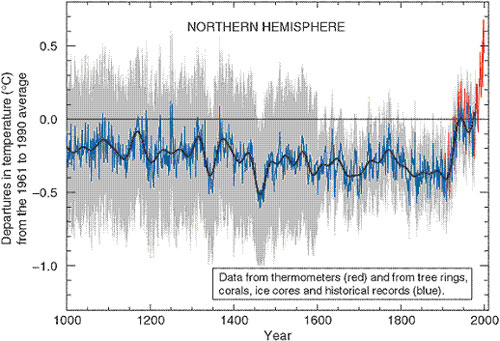
You may have seen it in An Inconvenient Truth in this form. The graph shows the dramatic rise in temperature in the northern hemisphere over the past 100 years caused, presumably, by humans. But as Montford details in his book, the graph is incorrect.
[The author] had standardised the data by “short-centering” them — essentially subtracting them from a 20th century average rather than an average of the whole period. This meant that the principal component analysis “mined” the data for anything with a 20th century uptick, and gave it vastly more weight than data indicating, say, a medieval warm spell.
Talk about an inconvenient truth.
Update: As expected, ye olde inbox is humming on this one. Here are a few places to look for the other other side of the story: Real Climate, Climate Progress (2, 3), New Scientist, and RealClimate. (thx, reed, barath, aaron)
Over at Worldchanging, Alex Steffen calls Bill Gates’ talk about climate change the most important speech ever given at TED. Gates said that the number one priority for him and the Gates Foundation (the world’s largest philanthropic organization) is to combat human-driven climate change.
He reckons that because population is going to continue to grow for at least four decades, because billions of poor people want more equitable prosperity, and because (as he sees it) improvements in energy efficiency are limited, we have to focus on the last element of the equation, the carbon intensity of energy. Simply, we need climate-neutral energy. We need to use nothing but climate-neutral energy.
Antarctic ice isn’t melting as much as predicted because the overall global warming trend and the Antarctic hole in the ozone are at cross purposes with each other. Temporarily.
As the ozone hole heals in the coming decades, the winds will weaken, the continent will become much warmer in summer — and melting will increase.
Jared Diamond has come to believe that some large multinational companies (like Chevron, Wal-Mart, and Coca-Cola) are “among the world’s strongest positive forces for environmental sustainability”.
The embrace of environmental concerns by chief executives has accelerated recently for several reasons. Lower consumption of environmental resources saves money in the short run. Maintaining sustainable resource levels and not polluting saves money in the long run. And a clean image — one attained by, say, avoiding oil spills and other environmental disasters — reduces criticism from employees, consumers and government.
This article in the NY Times fits nicely with my belief that carbon offsets are bullshit.
“The carbon offset has become this magic pill, a kind of get-out-of-jail-free card,” Justin Francis, the managing director of Responsible Travel, one of the world’s largest green travel companies to embrace environmental sustainability, said in an interview. “It’s seductive to the consumer who says, ‘It’s $4 and I’m carbon-neutral, so I can fly all I want.’” Offsets, he argues, are distracting people from making more significant behavioral changes, like flying less.
(via @daveg)
In a New Yorker book review this week, Elizabeth Kolbert tears Levitt and Dubner a new one over the geoengineering chapter of SuperFreakonomics, calling the pair’s thinking on the issue “horseshit”.
Given their emphasis on cold, hard numbers, it’s noteworthy that Levitt and Dubner ignore what are, by now, whole libraries’ worth of data on global warming. Indeed, just about everything they have to say on the topic is, factually speaking, wrong. Among the many matters they misrepresent are: the significance of carbon emissions as a climate-forcing agent, the mechanics of climate modelling, the temperature record of the past decade, and the climate history of the past several hundred thousand years.
To combat receding Himalayan glaciers caused by man-made climate change, Indian Chhewang Norphel has been building his own glaciers.
Here, Norphel is using what is abundant — stone — to conserve what is precious — water. The idea is simple: Divert the unneeded autumn and winter runoff into a series of large, rock-lined holding ponds. As the days grow colder, the ponds freeze and interconnect into a growing glacier. He has built 10 glaciers across the region. His largest stretched more than a mile before an unusual week of rain wiped it out in 2006.
Norphel says that a good artificial glacier costs about $50,000.
New Scientist reports that Czech beer tastes worse than it used to due to climate change.
Climatologist Martin Mozny of the Czech Hydrometeorological Institute and colleagues say that the quality of Saaz hops — the delicate variety used to make pilsner lager — has been decreasing in recent years. They say the culprit is climate change in the form of increased air temperature.
Winemaking regions are shifting due to climate change as well.
Nicola Twilley proposes a Climate Change Tasting Menu that highlights food and drink demonstrating the effects of human activities on climate.
The starter would feature new products that have only recently been cultivated locally, thanks to climate change — Devon olive oil perhaps, accompanied by a nice glass of Kent rosé. The main course might be controversial: test-tube grown imitation meats and vegetables that recreate the flavour and mouthfeel of species that are already lost or threatened with extinction by climate change.
Here are 20 bold/crazy ideas that could save the world…most of them related to energy and climate change.
A relatively small piece of the Sahara could theoretically provide electricity for the entire planet if it were covered in solar thermal mirrors. Plus think of all those jobs to build a solar plant the size of Britain. The new transmission grid would be quite a project as well…
Update: Hmm, the site appears to be down and redirected to same squatter spam thing. I’ll put the link back up when the site (hopefully) returns.
Update: The Infrastructurist site is still down but I found the original link on the Guardian.
Climatologist James Hansen, who is the director of NASA’s Goddard Institute for Space Studies and the creator of one of the first climate models that predicted global warming, is convinced that the problem of climate change caused by humans is much more dire than is generally thought (subscribers only link; abstract).
Hansen has now concluded, partly on the basis of his latest modeling efforts and partly on the basis of observations made by other scientists, that the threat of global warming is far greater than even he had suspected. Carbon dioxide isn’t just approaching dangerous levels; it is already there. Unless immediate action is taken-including the shutdown of all the world’s coal plants within the next two decades-the planet will be committed to climate change on a scale society won’t be able to cope with. “This particular problem has become an emergency,” Hansen said.
Hansen is so adamant about this belief that he has begun participating in protests around the globe, an unusual level of activism for such a respected and high-ranking government official. The last sentence of the piece reads:
He said he was thinking of attending another demonstration soon, in West Virginia coal country.
Elizabeth Kolbert, the author of the piece above, reports that Hansen not only attended that demonstration but got arrested.
Nathan Myhrvold, billionaire polymath, recently wrote a series of three posts for the Freakonomics blog about his trips to Iceland and Greenland.
I’d like to say that global warming was evident during my visit, but that is not really the case. Indeed, [my guide] Salik tells me that he and most Greenlanders are pretty skeptical about it. The local fishing industry used to be based on arctic prawns, but the sea temperature has changed just enough that the prawns are much further north, so now they fish for cod.
But, as Salik points out, this cycle has happened several times in living memory. The same with the glaciers: yes they are retreating, but at least in his area, they have yet to reach the limits that the locals remember them. Objective measurements do show that climate change is happening. Nevertheless I was amused that the locals don’t seem to think it is such a big deal.
The photos are worth a look by themselves.
Freeman Dyson on the average lifespan of a carbon dioxide molecule in Earth’s atmosphere.
Roughly, the total atmospheric carbon is eight hundred gigatons and photosynthesis absorbs seventy gigatons of carbon per year, giving a lifetime of about twelve years. This is the average time that a carbon dioxide molecule spends in the atmosphere before it is absorbed by a land plant. I used this lifetime to estimate how long it would take for a major change in the land vegetation to produce a major change in the atmosphere. This calculation completely ignores the ocean. In reality the flow of carbon dioxide into the ocean is about twice as large as the flow into land vegetation. So the lifetime of a carbon dioxide molecule in the atmosphere is really only about five years.
Due to “when will the ice break up” contests in Alaska and other records dating back more than 150 years, climate scientists are able to study the onset of spring thaws.
Seventeen lakes in Europe, Asia and the U.S. with records going back 150 years are thawing, on average, 13 days earlier now than when first recorded, said Wisconsin lake scientist Barbara Benson.
Frustrating that there’s no charts associated with the story; this is a case where a picture would be worth 1000 words.
How nine cities from around the world are cutting their energy usage.
For cities, the motivation is twofold. All the hand-wringing over climate change has prompted more cities to do their part to contain greenhouse-gas emissions that most scientists believe are causing global warming. In the U.S., more than 700 mayors have signed an agreement to try to follow the Kyoto Protocol’s goal of reducing greenhouse-gas emissions — even though the Senate has rejected the treaty.
The other major motivation for cities: energy costs, which have more than doubled since 2000. Strapped for cash, municipalities are scrambling to save as much money on energy use as they can.
Signs of progress and setbacks in addressing climate change at the conclusion of Nobel Laureate Al Gore’s annus mirabilis. From Al Gore’s Nobel lecture:
However, despite a growing number of honorable exceptions, too many of the world’s leaders are still best described in the words Winston Churchill applied to those who ignored Adolf Hitler’s threat: “They go on in strange paradox, decided only to be undecided, resolved to be irresolute, adamant for drift, solid for fluidity, all powerful to be impotent.”
So today, we dumped another 70 million tons of global-warming pollution into the thin shell of atmosphere surrounding our planet, as if it were an open sewer. And tomorrow, we will dump a slightly larger amount, with the cumulative concentrations now trapping more and more heat from the sun.
The full text of Gore’s lecture is here.
Stopping underground coal fires would significantly reduce the amount of carbon dioxide being pumped into the atmosphere.
Underground coal fires in China alone produce as much carbon dioxide annually as all the cars and light trucks in the United States.
A coal fire near Centralia, PA has been burning continuously since 1962 and prompted the permanent evacuation of the townspeople.
Al Gore won a share of the 2007 Nobel Peace Prize for what is essentially a PowerPoint presentation. More info here.
Update: Yes, yes, I know Al Gore uses Keynote and not Powerpoint. Hence the “essentially”. (thx, everyone in the world)
Update: Amazingly, Al Gore now has an Emmy, an Oscar, and now a Nobel Prize. All he needs is a Grammy for the full Gore. (thx, brent)
Update: Man, you folks are testy today. When I say that Gore won a Nobel Prize for a Powerpoint presentation (again, “essentially”), I’m not being derogatory towards Gore. I like Gore…I’ve written several posts about him. But whatever his other accomplishments regarding the environment, he won the Nobel for An Inconvenient Truth. No movie, no prize. Period. Suppose someone had told you two years ago that someone would win a Nobel Peace Prize for a Hollywood film of a Powerpoint presentation…you’d have laughed in their face and every other part of their body!
Detailed satellite photo of the northern polar ice cap showing that for the first time in recorded history, the Northwest passage (the orange line) is open to sea traffic. The passage was a subject of intense interest to the European powers from the late 1400s, who wanted to find a way to Asia by boat that didn’t involve sailing around Africa. (via ben)
Regarding Eve Mosher’s project to draw a flood line around Brooklyn and lower Manhattan, here are a couple of related projects. Ledia Carroll’s Restore Mission Lake Project outlined the shore of an historical lake which used to sit in the midst of San Francisco’s Mission neighborhood. Under The Level explores the possibility and consequences of Katrina-level flooding in NYC. (thx, kayte and dens)
Newer posts
Older posts





Socials & More