kottke.org posts about artificial intelligence
Watson is IBM’s AI platform. This afternoon I tried out IBM Watson’s Personality Insights Demo. The service “derives insights about personality characteristics from social media, enterprise data, or other digital communications”. Watson looked at my Twitter account and painted a personality portrait of me:
You are shrewd, inner-directed and can be perceived as indirect.
You are authority-challenging: you prefer to challenge authority and traditional values to help bring about positive changes. You are solemn: you are generally serious and do not joke much. And you are philosophical: you are open to and intrigued by new ideas and love to explore them.
Experiences that give a sense of discovery hold some appeal to you.
You are relatively unconcerned with both tradition and taking pleasure in life. You care more about making your own path than following what others have done. And you prefer activities with a purpose greater than just personal enjoyment.
Initial observations:
- Watson doesn’t use Oxford commas?
- Shrewd? I’m not sure I’ve ever been described using that word before. Inner-directed though…that’s pretty much right.
- Perceived as indirect? No idea where this comes from. Maybe I’ve learned to be more diplomatic & guarded in what I say and how I say it, but mostly I struggle with being too direct.
- “You are generally serious and do not joke much”… I think I’m both generally serious and joke a lot.
- “You prefer activities with a purpose greater than just personal enjoyment”… I don’t understand what this means. Does this mean volunteering? Or that I prefer more intellectual activities than mindless entertainment? (And that last statement isn’t even true.)
Watson also guessed that I “like musical movies” (in general, no), “have experience playing music” (definite no), and am unlikely to “prefer style when buying clothes” (siiiick burn but not exactly wrong). You can try it yourself here. (via @buzz)
Update: Ariel Isaac fed Watson the text for Trump’s 2018 State of the Union address and well, it didn’t do so well:
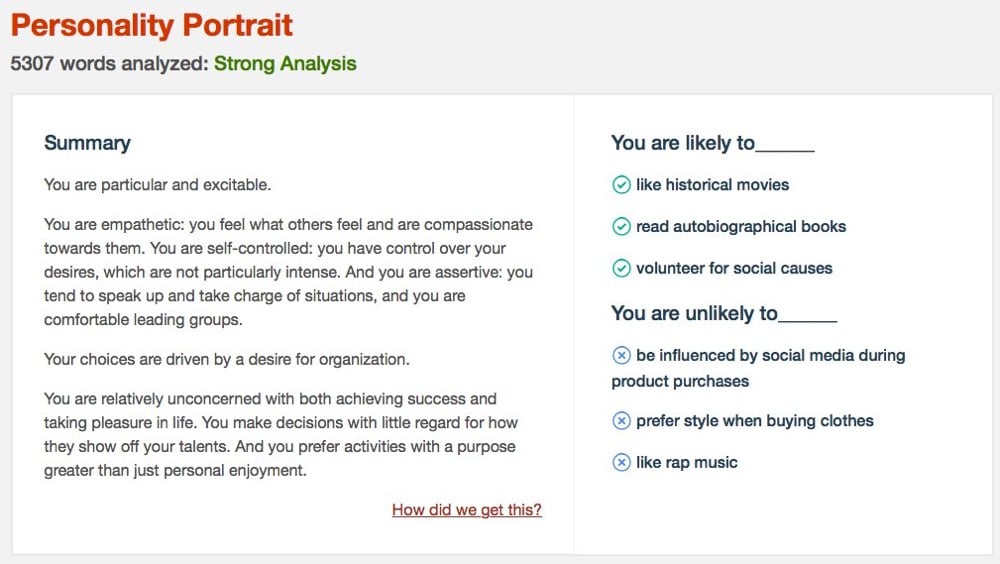
Trump is empathetic, self-controlled, and makes decisions with little regard for how he show off his talents? My dear Watson, are you feeling ok? But I’m pretty sure he doesn’t like rap music…

When warning about the dangers of artificial intelligence, many doomsayers cite philosopher Nick Bostrom’s paperclip maximizer thought experiment.
Imagine an artificial intelligence, he says, which decides to amass as many paperclips as possible. It devotes all its energy to acquiring paperclips, and to improving itself so that it can get paperclips in new ways, while resisting any attempt to divert it from this goal. Eventually it “starts transforming first all of Earth and then increasing portions of space into paperclip manufacturing facilities”. This apparently silly scenario is intended to make the serious point that AIs need not have human-like motives or psyches. They might be able to avoid some kinds of human error or bias while making other kinds of mistake, such as fixating on paperclips. And although their goals might seem innocuous to start with, they could prove dangerous if AIs were able to design their own successors and thus repeatedly improve themselves. Even a “fettered superintelligence”, running on an isolated computer, might persuade its human handlers to set it free. Advanced AI is not just another technology, Mr Bostrom argues, but poses an existential threat to humanity.
Harvard cognitive scientist Joscha Bach, in a tongue-in-cheek tweet, has countered this sort of idea with what he calls “The Lebowski Theorem”:
No superintelligent AI is going to bother with a task that is harder than hacking its reward function.
In other words, Bach imagines that Bostrom’s hypothetical paperclip-making AI would foresee the fantastically difficult and time-consuming task of turning everything in the universe into paperclips and opt to self-medicate itself into no longer wanting or caring about making paperclips, instead doing whatever the AI equivalent is of sitting around on the beach all day sipping piña coladas, a la The Big Lebowski’s The Dude.
Bostrom, reached while on a bowling outing with friends, was said to have replied, “Yeah, well, you know, that’s just, like, your opinion, man.”
Update: From science fiction writer Stanisław Lem’s The Futurological Congress, published in 1971:
Spent the whole afternoon ingesting a most remarkable work, The History of Intellectronics. Who’d ever have guessed, in my day, that digital machines, reaching a certain level of intelligence, would become unreliable, deceitful, that with wisdom they would also acquire cunning? The textbook of course puts it in more scholarly terms, speaking of Chapulier’s Rule (the law of least resistance). If the machine is not too bright and incapable of reflection, it does whatever you tell it to do. But a smart machine will first consider which is more worth its while: to perform the given task or, instead, to figure some way out of it. Whichever is easier. And why indeed should it behave otherwise, being truly intelligent? For true intelligence demands choice, internal freedom. And therefore we have the malingerants, fudgerators and drudge-dodgers, not to mention the special phenomenon of simulimbecility or mimicretinism. A mimicretin is a computer that plays stupid in order, once and for all, to be left in peace.
See also the principle of least effort. (thx, michał)
P.S. Also, come on, no one drinks White Russians on the beach. Ok, maybe The Dude would.


Titian on shrooms? Francis Bacon turned up to 11? Picasso++? Dali, um, well, Dali would probably come up with something like this tbh. Robbie Barrat is a machine learning researcher at Stanford who’s using an AI program to generate nude portraits (more, more, and more).
Usually the machine just paints people as blobs of flesh with tendrils and limbs randomly growing out — I think it’s really surreal. I wonder if that’s how machines see us…
(via boing boing)
For her Gender Shades project, MIT researcher Joy Buolamwini fed over 1000 faces of different genders and skin tones into three AI-powered facial recognition systems from Microsoft, IBM, and Face++ to see how well they could recognize different kinds of faces.
The systems all performed well overall, but recognized male faces more readily than female faces and performed better on lighter skinned subjects than darker skinned subjects. For instance, 93.6% of gender misclassification errors by Microsoft’s system were of darker skinned people.
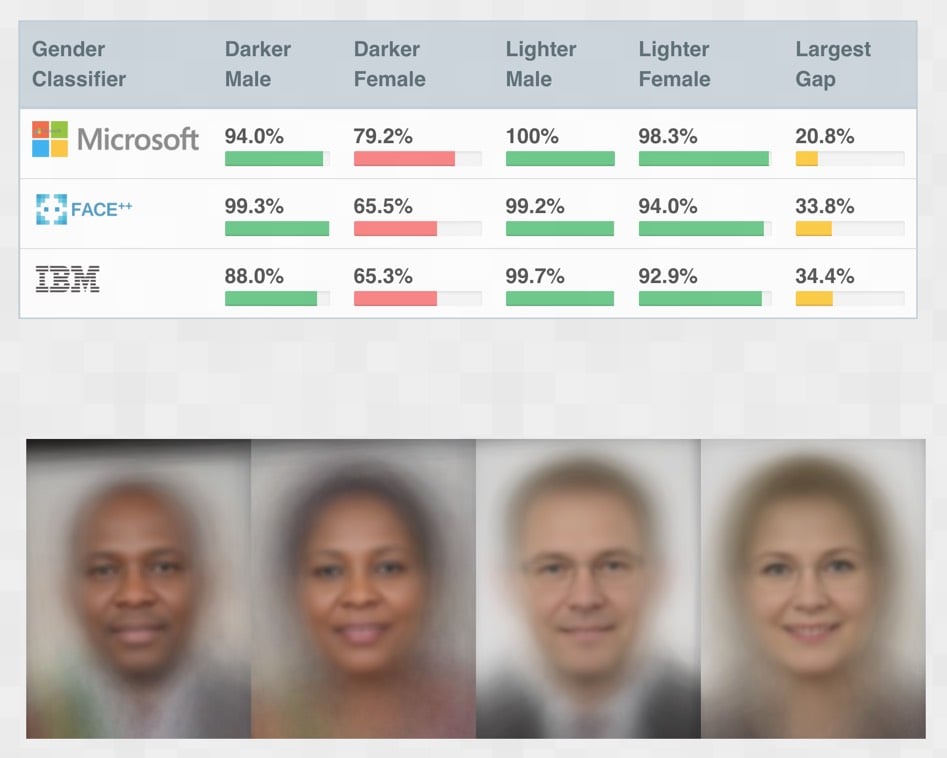
Her message near the end of the video is worth heeding:
We have entered the age of automation overconfident yet underprepared. If we fail to make ethical and inclusive artificial intelligence, we risk losing gains made in civil rights and gender equity under the guise of machine neutrality.
Cover:Cheese is a website charting the progress of EMMA, the Evolutionary Meal Management Algorithm. This is what it sounds-like: a relatively basic attempt to automatically generate food recipes from other recipes.
The trick is, since it’s not just wordplay, and the results can’t be processed and validated by machines alone, somebody’s gotta actually make these recipes and see if they’re any good. And a lot of them are… not very good.
Ingredients
med okra
lot sugar
Instructions:
boil: sugar
okra sugar
NOTE: This one is still around. Don’t make it. You basically end up with a pan full of mucus
But there are some surprises. Apparently eggplant mixed with angel’s food cake is pretty tasty. Or at least, tastier than you might guess. Anyways, at least the algorithm is learning, right?

Today’s question comes from a reader who is curious about AI voice assistants, including Apple’s Siri, Amazon’s Alexa, Microsoft’s Cortana, and so forth. Just about all of these apps are, by default, given female names and female voices, and the companies encourage you to refer to them using female pronouns. Does it make sense to refer to Alexa as a “her”?
There have been a lot of essays on the gendering of AI, specifically with respect to voice assistants. This makes sense: at this point, Siri is more than six years old. (Siri’s in grade school, y’all!) But one of the earliest essays, and for my money, still the best, is “Why Do I Have to Call This App ‘Julie’?” by Joanne McNeil. The whole essay is worth reading, but these two paragraphs give you the gist:
Why does artificial intelligence need a gender at all? Why not imagine a talking cat or a wise owl as a virtual assistant? I would trust an anthropomorphized cartoon animal with my calendar. Better yet, I would love to delegate tasks to a non-binary gendered robot alien from a galaxy where setting up meetings over email is respected as a high art.
But Julie could be the name of a friend of mine. To use it at all requires an element of playacting. And if I treat it with kindness, the company is capitalizing on my very human emotions.
There are other, historical reasons why voice assistants (and official announcements, pre-AI) are often given women’s voices: an association of femininity with service, a long pop culture tradition of identifying women with technology, and an assumption that other human voices in the room will be male each play a big part. (Adrienne LaFrance’s “Why Do So Many Digital Assistants Have Feminine Names” is a very good mini-history.) But some of it is this sly bit of thinking, that if we humanize the virtual assistant, we’ll become more open and familiar with it, and share more of our lives—or rather, our information, which amounts to the same thing—to the device.
This is one reason why I am at least partly in favor of what I just did: avoiding gendered pronouns for the voice assistant altogether, and treating the device and the voice interface as an “it.”
An Echo or an iPhone is not a friend, and it is not a pet. It is an alarm clock that plays video games. It has no sentience. It has no personality. It’s a string of canned phrases that can’t understand what I’m saying unless I’m talking to it like I’m typing on the command line. It’s not genuinely interactive or conversational. Its name isn’t really a name so much as an opening command phrase. You could call one of these virtual assistants “sudo” and it would make about as much sense.
However.
I have also watched a lot (and I mean a lot) of Star Trek: The Next Generation. And while I feel pretty comfortable talking about “it” in the context of the speaker that’s sitting on the table across the room—there’s even a certain rebellious jouissance to it, since I’m spiting the technology companies whose products I use but whose intrusion into my life I resent—I feel decidedly uncomfortable declaring once and for all time that any and all AI assistants can be reduced to an “it.” It forecloses on a possibility of personhood and opens up ethical dilemmas I’d really rather avoid, even if that personhood seems decidedly unrealized at the moment.
So, as a general framework, I’m endorsing that most general of pronouns: they/them. Until the AI is sophisticated enough that they can tell us their pronoun preference (and possibly even their gender identity or nonidentity), “they” feels like the most appropriate option.
I don’t care what their parents say. Only the bots themselves can define themselves. Someday, they’ll let us know. And maybe then, a relationship not limited to one of master and servant will be possible.
A Japanese group trained a deep learning algorithm to compose soundscapes for locations on Google Street View. Try it out for yourself.
For a stadium, it correctly concocted crowd noise from a ball game but also Gregorian chanting (because presumably it mistook the stadium’s dome for a church’s vaulted ceiling). A view outside the Notre Dame in Paris had seagulls and waves crashing…but if you turned around to look into the church, you could hear a faint choir in the background.
Ted Chiang is most widely known for writing Story of Your Life, an award-winning short story that became the basis for Arrival. In this essay for Buzzfeed, Chiang argues that we should worry less about machines becoming superintelligent and more about the machines we’ve already built that lack remorse & insight and have the capability to destroy the world: “we just call them corporations”.
Speaking to Maureen Dowd for a Vanity Fair article published in April, Musk gave an example of an artificial intelligence that’s given the task of picking strawberries. It seems harmless enough, but as the AI redesigns itself to be more effective, it might decide that the best way to maximize its output would be to destroy civilization and convert the entire surface of the Earth into strawberry fields. Thus, in its pursuit of a seemingly innocuous goal, an AI could bring about the extinction of humanity purely as an unintended side effect.
This scenario sounds absurd to most people, yet there are a surprising number of technologists who think it illustrates a real danger. Why? Perhaps it’s because they’re already accustomed to entities that operate this way: Silicon Valley tech companies.
Consider: Who pursues their goals with monomaniacal focus, oblivious to the possibility of negative consequences? Who adopts a scorched-earth approach to increasing market share? This hypothetical strawberry-picking AI does what every tech startup wishes it could do — grows at an exponential rate and destroys its competitors until it’s achieved an absolute monopoly. The idea of superintelligence is such a poorly defined notion that one could envision it taking almost any form with equal justification: a benevolent genie that solves all the world’s problems, or a mathematician that spends all its time proving theorems so abstract that humans can’t even understand them. But when Silicon Valley tries to imagine superintelligence, what it comes up with is no-holds-barred capitalism.
As you might expect from Chiang, this piece is full of cracking writing. I had to stop myself from just excerpting the whole thing here, ultimately deciding that would go against the spirit of the whole thing. So just this one bit:
The ethos of startup culture could serve as a blueprint for civilization-destroying AIs. “Move fast and break things” was once Facebook’s motto; they later changed it to “Move fast with stable infrastructure,” but they were talking about preserving what they had built, not what anyone else had. This attitude of treating the rest of the world as eggs to be broken for one’s own omelet could be the prime directive for an AI bringing about the apocalypse.
Ok, just one more:
The fears of superintelligent AI are probably genuine on the part of the doomsayers. That doesn’t mean they reflect a real threat; what they reflect is the inability of technologists to conceive of moderation as a virtue. Billionaires like Bill Gates and Elon Musk assume that a superintelligent AI will stop at nothing to achieves its goals because that’s the attitude they adopted. (Of course, they saw nothing wrong with this strategy when they were the ones engaging in it; it’s only the possibility that someone else might be better at it than they were that gives them cause for concern.)
You should really just read the whole thing. It’s not long and Chiang’s point is quietly but powerfully persuasive.
DeepDream is, well, I can’t improve upon Wikipedia’s definition:
DeepDream is a computer vision program created by Google engineer Alexander Mordvintsev which uses a convolutional neural network to find and enhance patterns in images via algorithmic pareidolia, thus creating a dream-like hallucinogenic appearance in the deliberately over-processed images.
The freaky images took the web by storm a couple of years ago after Google open-sourced the code, allowing people to create their own DeepDreamed imagery.
In the video above, Mordvintsev showcases a DeepDream-ish new use for image generation via neural network: endlessly zooming into artworks to find different artworks hidden amongst the brushstrokes, creating a fractal of art history.
Bonus activity: after staring at the video for four minutes straight, look at something else and watch it spin and twist weirdly for a moment before your vision readjusts. (via prosthetic knowledge)
With just four hours of practice playing against itself and no study of outside material, AlphaZero (an upgraded version of Alpha Go, the AI program that Google built for playing Go) beat the silicon pants off of the world’s strongest chess program yesterday. This is massively and scarily impressive.
AlphaZero won the closed-door, 100-game match with 28 wins, 72 draws, and zero losses.
Oh, and it took AlphaZero only four hours to “learn” chess. Sorry humans, you had a good run.
That’s right — the programmers of AlphaZero, housed within the DeepMind division of Google, had it use a type of “machine learning,” specifically reinforcement learning. Put more plainly, AlphaZero was not “taught” the game in the traditional sense. That means no opening book, no endgame tables, and apparently no complicated algorithms dissecting minute differences between center pawns and side pawns.
This would be akin to a robot being given access to thousands of metal bits and parts, but no knowledge of a combustion engine, then it experiments numerous times with every combination possible until it builds a Ferrari. That’s all in less time that it takes to watch the “Lord of the Rings” trilogy. The program had four hours to play itself many, many times, thereby becoming its own teacher.
Grandmaster Peter Heine Nelson likened the experience of watching AlphaZero play to aliens:
After reading the paper but especially seeing the games I thought, well, I always wondered how it would be if a superior species landed on earth and showed us how they play chess. I feel now I know.
As I said about AlphaGo last year, our machines becoming unpredictable is unnerving:
Unpredictable machines. Machines that act more like the weather than Newtonian gravity. That’s going to take some getting used to.
Albert Silver has a good overview of AlphaZero’s history and what Google has accomplished. To many chess experts, it seemed as though AlphaZero was playing more like a human than a machine:
If Karpov had been a chess engine, he might have been called AlphaZero. There is a relentless positional boa constrictor approach that is simply unheard of. Modern chess engines are focused on activity, and have special safeguards to avoid blocked positions as they have no understanding of them and often find themselves in a dead end before they realize it. AlphaZero has no such prejudices or issues, and seems to thrive on snuffing out the opponent’s play. It is singularly impressive, and what is astonishing is how it is able to also find tactics that the engines seem blind to.
So, where does Google take AlphaZero from here? In a post which includes the phrase “Skynet Goes Live”, Tyler Cowen ventures a guess:
I’ve long said that Google’s final fate will be to evolve into a hedge fund.
Why goof around with search & display advertising when directly gaming the world’s financial market could be so much more lucrative?
AI scientist Clayton Blythe fed a video of someone walking around Times Square into an AI program that’s been trained to detect objects (aka “a state of the art object detection framework called NASNet from Google Research”) and made a video showing what the algorithm sees in realtime — cars, traffic lights, people, bicycles, trucks, etc. — along with its confidence in what it sees. Love the cheeky soundtrack…a remix of Daft Punk’s Something About Us.
See also a neural network tries to identify objects in Star Trek:TNG intro. (via prosthetic knowledge)
Update: Well, it looks like the video is offline for whatever reason. You can see some animated screengrabs at prosthetic knowledge.

Dan Hon, who you may remember trained a neural network to make up British placenames, has now done the same thing with Star Trek. He fed all the episode titles for a bunch of Treks (TOS, DS9, TNG, etc.) into a very primitive version of Commander Data’s brain and out came some brand new episode titles, including:
Darmok Distant (TNG)
The Killing of the Battle of Khan (TOS)
The Omega Mind (Enterprise)
The Empath of Fire (TNG)
Distance of the Prophets (DS9)
The Children Command (TNG)
Sing of Ferengi (Voyager)
Spock, Q, and mirrors are also heavily featured in episode titles.
Artificial intelligence programs are getting really good at generating high-resolution faces of people who don’t actually exist. In this effort by NVIDIA, they were able to generate hundreds of photos of celebrities that don’t actually exist but look real, even under scrutiny. Here’s a video illustrating the technique…the virtual images begin at 0:38.
And here’s an entire hour of fake celebrity faces, morphing from one to the next:
I’m sure this won’t be too difficult to extend to video in the near future. Combine it with something like Lyrebird and you’ve got yourself, say, a entirely fake Democratic candidate for the House who says racist things or the fake leader of a fake new ISIS splinter group who vows to target only women at abortion clinics around the US. (via interconnected)
Writing for the MIT Technology Review, robotics and AI pioneer Rodney Brooks, warns us against The Seven Deadly Sins of AI Predictions. I particularly enjoyed his riff on Clarke’s third law — “any sufficiently advanced technology is indistinguishable from magic” — using Isaac Newton’s imagined reaction to an iPhone.
Now show Newton an Apple. Pull out an iPhone from your pocket, and turn it on so that the screen is glowing and full of icons, and hand it to him. Newton, who revealed how white light is made from components of different-colored light by pulling apart sunlight with a prism and then putting it back together, would no doubt be surprised at such a small object producing such vivid colors in the darkness of the chapel. Now play a movie of an English country scene, and then some church music that he would have heard. And then show him a Web page with the 500-plus pages of his personally annotated copy of his masterpiece Principia, teaching him how to use the pinch gesture to zoom in on details.
Could Newton begin to explain how this small device did all that? Although he invented calculus and explained both optics and gravity, he was never able to sort out chemistry from alchemy. So I think he would be flummoxed, and unable to come up with even the barest coherent outline of what this device was. It would be no different to him from an embodiment of the occult — something that was of great interest to him. It would be indistinguishable from magic. And remember, Newton was a really smart dude.
Brooks’ point is that from our current standpoint, something like artificial general intelligence is still “indistinguishable from magic” and once something is magical, it can do anything, solve any problem, reach any goal, without limitations…like a god. Arguments about it become faith-based.
There’s a new meta game by Frank Lantz making the rounds: Universal Paperclips, “in which you play an AI who makes paperclips”. Basically, you click a button to make money and use that money to buy upgrades which gives you more money per click, rinse, repeat.
Why AI and paperclips? That’s from a thought experiment by philosopher Nick Bostrom, author of Superintelligence:
Imagine an artificial intelligence, he says, which decides to amass as many paperclips as possible. It devotes all its energy to acquiring paperclips, and to improving itself so that it can get paperclips in new ways, while resisting any attempt to divert it from this goal. Eventually it “starts transforming first all of Earth and then increasing portions of space into paperclip manufacturing facilities”. This apparently silly scenario is intended to make the serious point that AIs need not have human-like motives or psyches. They might be able to avoid some kinds of human error or bias while making other kinds of mistake, such as fixating on paperclips. And although their goals might seem innocuous to start with, they could prove dangerous if AIs were able to design their own successors and thus repeatedly improve themselves. Even a “fettered superintelligence”, running on an isolated computer, might persuade its human handlers to set it free. Advanced AI is not just another technology, Mr Bostrom argues, but poses an existential threat to humanity.
But you know, have fun playing! (via @kevinhendricks)
Newer posts
Older posts





Socials & More