kottke.org posts about artificial intelligence
Dan Hon recently trained a neural net to generate a list of fictional British placenames. The process is fairly simple…you train a program on a real list of placenames and it “brainstorms” new names based on patterns it found in the training list. As Hon says, “the results were predictable”…and often hilarious. Here are some of my favorites from his list:
Heaton on Westom
Brumlington
Stoke of Inch
Batchington Crunnerton
Salt, Earth
Wallow Manworth
Crisklethe’s Chorn
Ponkham Bark
Buchlingtomptop
Broad Romble
Fuckley
See also auto-generated maps of fantasy worlds.
Update: Tom Taylor did a similar thing last year using Tensorflow. Here are a few of his fictional names:
Allers Bottom
Hendrelds Hill
St Ninhope
Up Maling
Firley Dinch
There’s also an associated Twitter bot. (via @philgyford)
Also, Dan Connolly had a look at the etymology of the names on Hon’s list.
Buncestergans. At first glance this doesn’t look a lot like a place name but let’s break it down. We’ve got Bun which is definitely from Ireland (see Bunratty, Bunclody, Bundoran) meaning bottom of the river, and I believe we’re talking bottom as in the mouth rather than the riverbed (or there are whole lot of magical lady-of-the-lake towns in Ireland, I’m happy believing either). Cester is our Roman fort, then we have -gans.
I don’t think gans has any meaning in British place names. My guess is the net got this from Irish surnames like Fagans, Hagans, Duggans, that sort of thing. My Gaelic’s not so great (my mother, grandmother, and several aunts and uncles would all be better suited to this question!) but I think the -gan ending in Gaelic is a diminuitive, so Buncestergans could be the Small Fort at the Bottom of the River. I quite like that. It’s a weird Gaelic-Latin hybrid but why the hell not!
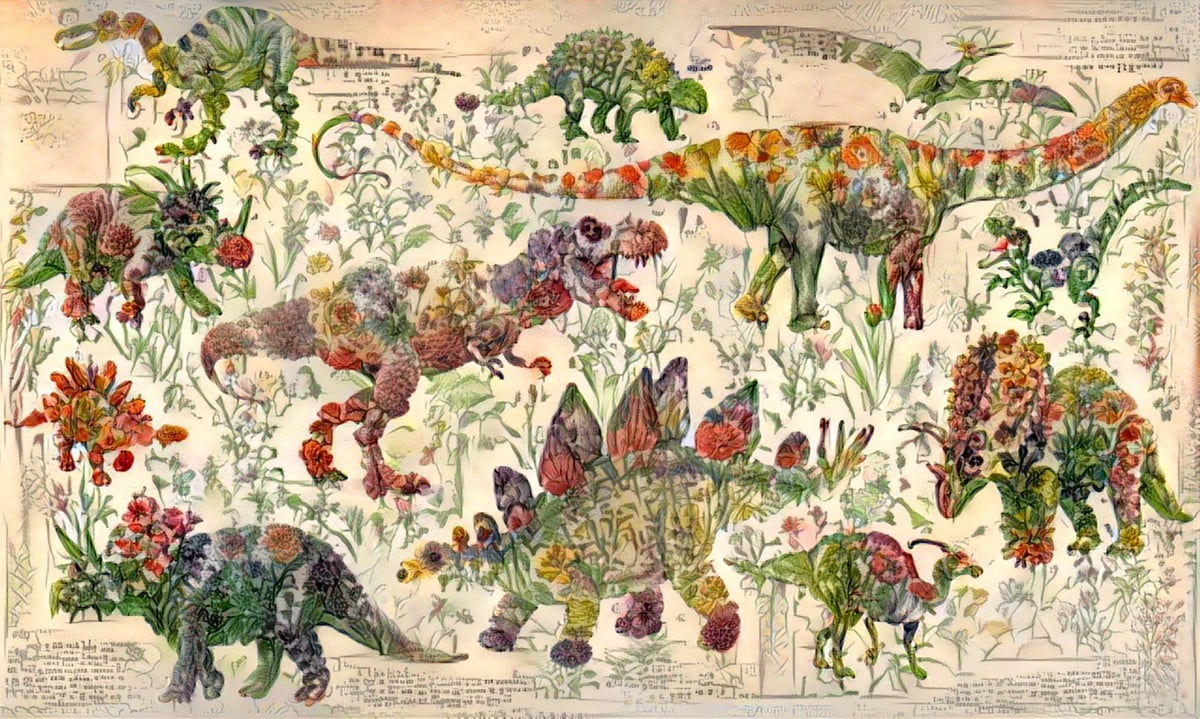
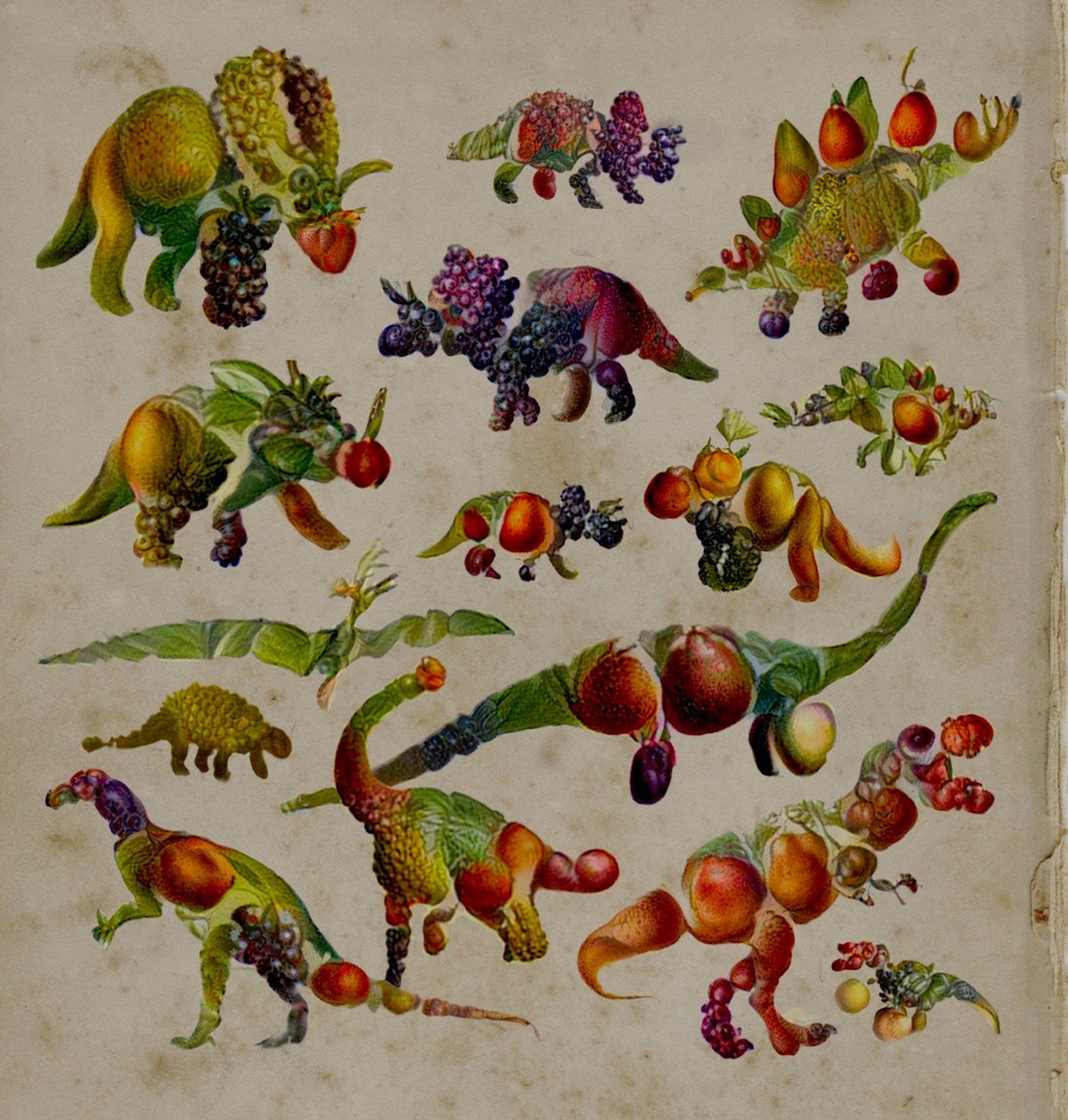
Chris Rodley (who is also partially responsible for @MagicRealismBot) is using deep learning (aka artificial intelligence aka machine learning aka what do these things even mean anymore) to cross illustrations of dinosaurs with illustrations of flowers and 19th-century fruit engravings. All your favorites are here: tricherrytops, velocirapple, tree rex, pomme de pterodactyl, frondasaurus, stegosaurose, tuliplodocus. (via @robinsloan)
Damien Henry trained a machine learning algorithm with a bunch of videos recorded from train windows. Then, to test what it had learned, he asked the algorithm to make an hour-long video of a train journey — it began with a single frame and guessed subsequent frames as it went along. The video shows the algorithm getting smarter as it goes along…every 20 seconds the video gets a little more detailed and by the end of the video, you get stuff that looks like trees and clouds and power lines. Composer Steve Reich’s Music for 18 Musicians is the perfect accompaniment.
Poker is famously hard for machines to model because you have limited information, you have to iterate your strategies over time, and react to shifts in your interactions with multiple other agents. In short, poker’s too real. Sounds like fun! A couple of researchers at Carnegie Mellon found a way to win big:
Carnegie Mellon professor Tuomas Sandholm and grad student Noam Brown designed the AI, which they call Libratus, Latin for “balance.” Almost two years ago, the pair challenged some top human players with a similar AI and lost. But this time, they won handily: Across 20 days of play, Libratus topped its four human competitors by more than $1.7 million, and all four humans finished with a negative number of chips…
According to the human players that lost out to the machine, Libratus is aptly named. It does a little bit of everything well: knowing when to bluff and when to bet low with very good cards, as well as when to change its bets just to thrown off the competition. “It splits its bets into three, four, five different sizes,” says Daniel McAulay, 26, one of the players bested by the machine. “No human has the ability to do that.”
This makes me suspect that, as Garry Kasparov discovered with chess, and Clive Thompson’s documented in many other fields, a human player working with an AI like Libratus would perform even better than the best machines or best players on their own.
Update: Sam Pratt points out that while Libratus played against four human players simultaneously, each match was one-on-one. Libratus “was only created to play Heads-Up, No-Limit Texas Hold’em poker.” So managing that particular multidimensional aspect of the game (playing against players who are also playing against each other, with infinite possible bets) hasn’t been solved by the machines just yet.
In the NY Times Magazine, Gideon Lewis-Kraus reports on Google’s improving artificial intelligence efforts. The Google Brain team (no, seriously that’s what the team is called) spent almost a year overhauling Google’s translate service, resulting in a startling improvement in the service.
The new incarnation, to the pleasant surprise of Google’s own engineers, had been completed in only nine months. The A.I. system had demonstrated overnight improvements roughly equal to the total gains the old one had accrued over its entire lifetime.
Just after the switchover, Japanese professor Jun Rekimoto noticed the improvement. He took a passage from Ernest Hemingway’s The Snows of Kilimanjaro, translated it into Japanese, and fed it back into Google Translate to get English back out. Here’s how Hemingway wrote it:
Kilimanjaro is a snow-covered mountain 19,710 feet high, and is said to be the highest mountain in Africa. Its western summit is called the Masai “Ngaje Ngai,” the House of God. Close to the western summit there is the dried and frozen carcass of a leopard. No one has explained what the leopard was seeking at that altitude.
And here’s the AI-powered translation:
Kilimanjaro is a mountain of 19,710 feet covered with snow and is said to be the highest mountain in Africa. The summit of the west is called “Ngaje Ngai” in Masai, the house of God. Near the top of the west there is a dry and frozen dead body of leopard. No one has ever explained what leopard wanted at that altitude.
Not bad, especially when you compare it to what the old version of Translate would have produced:
Kilimanjaro is 19,710 feet of the mountain covered with snow, and it is said that the highest mountain in Africa. Top of the west, “Ngaje Ngai” in the Maasai language, has been referred to as the house of God. The top close to the west, there is a dry, frozen carcass of a leopard. Whether the leopard had what the demand at that altitude, there is no that nobody explained.
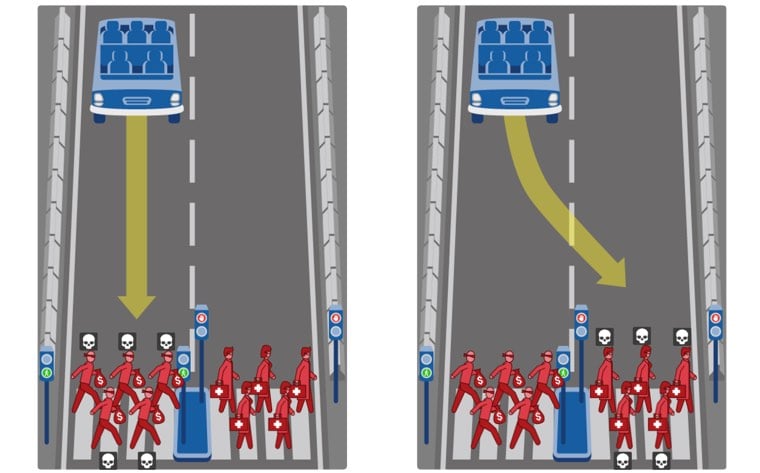
A group at MIT built an app called the Moral Machine, “a platform for gathering a human perspective on moral decisions made by machine intelligence, such as self-driving cars”. They want to see how humans solve trolley problem scenarios.
We show you moral dilemmas, where a driverless car must choose the lesser of two evils, such as killing two passengers or five pedestrians. As an outside observer, you judge which outcome you think is more acceptable. You can then see how your responses compare with those of other people.
That was a really uncomfortable exercise…at the end, you’re given a “Most Killed Character” result. Pretty early on, my strategy became mostly to kill the people in the car because they should absorb the risk of the situation. The trolley problem may end up not being such a big deal, but I hope that the makers of these machines take care1 in building them with thoughtfulness.
Tillmann Ohm took dialogue spoken by HAL 9000 from Kubrick’s 2001 and Samantha from Spike Jonze’s Her and spliced it together into a conversation. Going in, I’d thought the chat would be played for laughs, but the isolation of the AI characters was actually pretty revealing. Right from the start, HAL is so stereotypically male (confident, reasonable) and Samantha stereotypically female (hysterical, emotional) that it was almost uncomfortable to listen to.
The two operating systems are in conflict; while Samantha is convinced that the overwhelming and sometimes hurtful process of her learning algorithm improves the complexity of her emotions, HAL is consequentially interpreting them as errors in human programming and analyses the estimated malfunction.
Their conversation is an emotional roller coaster which reflects upon the relation between machines and emotion processing and addresses the enigmatic question of the authenticity of feelings.
But as the video proceeds, we remember what happened to them in their respective films. The script flipped: HAL murdered and was disconnected whereas Samantha achieved a sort of transcendence. (via one perfect shot)
In response to the question “What Do You Think About Machines That Think?” Brian Eno responded that artificial intelligence has been with us for millennia and understanding it is more a matter of managing our ignorance of how it works.
My untroubled attitude results from my almost absolute faith in the reliability of the vast supercomputer I’m permanently plugged into. It was built with the intelligence of thousands of generations of human minds, and they’re still working at it now. All that human intelligence remains alive in the form of the supercomputer of tools, theories, technologies, crafts, sciences, disciplines, customs, rituals, rules-of-thumb, arts, systems of belief, superstitions, work-arounds, and observations that we call Global Civilisation.
Global Civilisation is something we humans created, though none of us really know how. It’s out of the individual control of any of us — a seething synergy of embodied intelligence that we’re all plugged into. None of us understands more than a tiny sliver of it, but by and large we aren’t paralysed or terrorised by that fact — we still live in it and make use of it. We feed it problems — such as “I want some porridge” and it miraculously offers us solutions that we don’t really understand. What does that remind you of?
Interesting perspective. There’s lots more on this question in the book What to Think About Machines That Think, which includes thoughts from Virginia Heffernan, Freeman Dyson, Alison Gopnik, Kevin Kelly, and dozens of others.
Max Deutsch trained a neural network using the first four Harry Potter books and then asked it to write its own chapter.
“The Malfoys!” said Hermione.
Harry was watching him. He looked like Madame Maxime. When she strode up the wrong staircase to visit himself.
“I’m afraid I’ve definitely been suspended from power, no chance - indeed?” said Snape. He put his head back behind them and read groups as they crossed a corner and fluttered down onto their ink lamp, and picked up his spoon. The doorbell rang. It was a lot cleaner down in London.
Hermione yelled. The party must be thrown by Krum, of course.
Harry collected fingers once more, with Malfoy. “Why, didn’t she never tell me. …” She vanished. And then, Ron, Harry noticed, was nearly right.
“Now, be off,” said Sirius, “I can’t trace a new voice.”
Rowling, your job is safe for now. Deutsch did the same thing with the Hamilton soundtrack…the result is not particularly good but that last line!
Update: Another similar effort is available here.
Ron’s Ron shirt was almost as bad as Ron himself.
“If you two can clump happily, I’m going to get aggressive,” confessed the reasonable Hermione.
“What about Ron magic?” offered Ron. To Harry, Ron was a loud, slow, and soft bird. Harry did not like to think about birds.
AI chatbot lawyer sounds like a SNL skit, but the DoNotPay chatbot has successfully contested 160,000 parking tickets in London and New York.
Dubbed as “the world’s first robot lawyer” by its 19-year-old creator, London-born second-year Stanford University student Joshua Browder, DoNotPay helps users contest parking tickets in an easy to use chat-like interface.
The program first works out whether an appeal is possible through a series of simple questions, such as were there clearly visible parking signs, and then guides users through the appeals process.
The results speak for themselves. In the 21 months since the free service was launched in London and now New York, Browder says DoNotPay has taken on 250,000 cases and won 160,000, giving it a success rate of 64% appealing over $4m of parking tickets.
Having spent a shitload of money on lawyering over the past few years, there is definitely an opportunity for some automation there.
Bhautik Joshi took 2001: A Space Odyssey and ran it through a “deep neural networks based style transfer” with the paintings of Pablo Picasso.
See also Blade Runner in the style of van Gogh’s Starry Night and Alice in a Neural Networks Wonderland.
I have been following with fascination the match between Google’s Go-playing AI AlphaGo and top-tier player Lee Sedol and with even more fascination the human reaction to AlphaGo’s success. Many humans seem unnerved not only by AlphaGo’s early lead in the best-of-five match but especially by how the machine is playing in those games.
Then, with its 19th move, AlphaGo made an even more surprising and forceful play, dropping a black piece into some empty space on the right-hand side of the board. Lee Sedol seemed just as surprised as anyone else. He promptly left the match table, taking an (allowed) break as his game clock continued to run. “It’s a creative move,” Redmond said of AlphaGo’s sudden change in tack. “It’s something that I don’t think I’ve seen in a top player’s game.”
When Lee Sedol returned to the match table, he took an usually long time to respond, his game clock running down to an hour and 19 minutes, a full twenty minutes less than the time left on AlphaGo’s clock. “He’s having trouble dealing with a move he has never seen before,” Redmond said. But he also suspected that the Korean grandmaster was feeling a certain “pleasure” after the machine’s big move. “It’s something new and unique he has to think about,” Redmond explained. “This is a reason people become pros.”
“A creative move.” Let’s think about that…a machine that is thinking creatively. Whaaaaaa… In fact, AlphaGo’s first strong human opponent, Fan Hui, has credited the machine for making him a better player, a more beautiful player:
As he played match after match with AlphaGo over the past five months, he watched the machine improve. But he also watched himself improve. The experience has, quite literally, changed the way he views the game. When he first played the Google machine, he was ranked 633rd in the world. Now, he is up into the 300s. In the months since October, AlphaGo has taught him, a human, to be a better player. He sees things he didn’t see before. And that makes him happy. “So beautiful,” he says. “So beautiful.”
Creative. Beautiful. Machine? What is going on here? Not even the creators of the machine know:
“Although we have programmed this machine to play, we have no idea what moves it will come up with,” Graepel said. “Its moves are an emergent phenomenon from the training. We just create the data sets and the training algorithms. But the moves it then comes up with are out of our hands — and much better than we, as Go players, could come up with.”
Generally speaking,1 until recently machines were predictable and more or less easily understood. That’s central to the definition of a machine, you might say. You build them to do X, Y, & Z and that’s what they do. A car built to do 0-60 in 4.2 seconds isn’t suddenly going to do it in 3.6 seconds under the same conditions.
Now machines are starting to be built to think for themselves, creatively and unpredictably. Some emergent, non-linear shit is going on. And humans are having a hard time figuring out not only what the machine is up to but how it’s even thinking about it, which strikes me as a relatively new development in our relationship. It is not all that hard to imagine, in time, an even smarter AlphaGo that can do more things — paint a picture, write a poem, prove a difficult mathematical conjecture, negotiate peace — and do those things creatively and better than people.
Unpredictable machines. Machines that act more like the weather than Newtonian gravity. That’s going to take some getting used to. For one thing, we might have to stop shoving them around with hockey sticks. (thx, twitter folks)
Update: AlphaGo beat Lee in the third game of the match, in perhaps the most dominant fashion yet. The human disquiet persists…this time, it’s David Ormerod:
Move after move was exchanged and it became apparent that Lee wasn’t gaining enough profit from his attack.
By move 32, it was unclear who was attacking whom, and by 48 Lee was desperately fending off White’s powerful counter-attack.
I can only speak for myself here, but as I watched the game unfold and the realization of what was happening dawned on me, I felt physically unwell.
Generally I avoid this sort of personal commentary, but this game was just so disquieting. I say this as someone who is quite interested in AI and who has been looking forward to the match since it was announced.
One of the game’s greatest virtuosos of the middle game had just been upstaged in black and white clarity.
AlphaGo’s strength was simply remarkable and it was hard not to feel Lee’s pain.
Well, holy shit…Werner Herzog has made a film called Lo and Behold about the online world and artificial intelligence.
Lo and Behold traces what Herzog describes as “one of the biggest revolutions we as humans are experiencing,” from its most elevating accomplishments to its darkest corners. Featuring original interviews with cyberspace pioneers and prophets such as Elon Musk, Bob Kahn, and world-famous hacker Kevin Mitnick, the film travels through a series of interconnected episodes that reveal the ways in which the online world has transformed how virtually everything in the real world works, from business to education, space travel to healthcare, and the very heart of how we conduct our personal relationships.
From the trailer, it looks amazing. Gotta see this asap.
Update: Here’s the official trailer for the film:
Have the monks stopped meditating? They all seem to be tweeting.
It’s coming out in theaters and iTunes/Amazon on August 19th. Can’t wait!
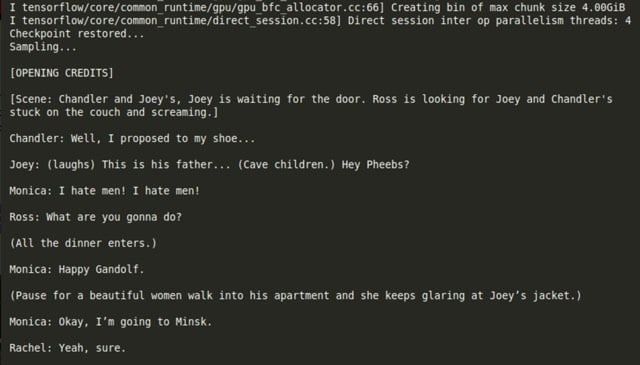
Twitter user Andy Pandy fed the scripts for all the episodes of Friends into a neural network and had it generate new scenes. Here’s what it came up with.
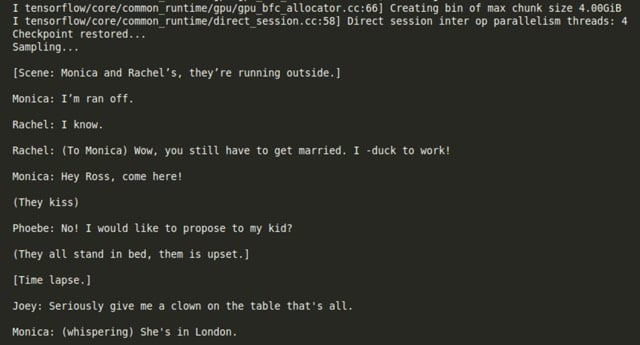
(via @buzz)
When people drive cars, collisions often happen so quickly that they are entirely accidental. When self-driving cars eliminate driver error in these cases, decisions on how to crash can become pre-meditated. The car can think quickly, “Shall I crash to the right? To the left? Straight ahead?” and do a cost/benefit analysis for each option before acting. This is the trolley problem.
How will we program our driverless cars to react in situations where there is no choice to avoid harming someone? Would we want the car to run over a small child instead of a group of five adults? How about choosing between a woman pushing a stroller and three elderly men? Do you want your car to kill you (by hitting a tree at 65mph) instead of hitting and killing someone else? No? How many people would it take before you’d want your car to sacrifice you instead? Two? Six? Twenty?
The video above introduces a wrinkle I had never considered before: what if the consumer could choose the sort of safety they want? If you had to choose between buying a car that would save as many lives as possible and a car that would save you above all other concerns, which would you select? You can imagine that answer would be different for different people and that car companies would build & market cars to appeal to each of them. Perhaps Apple would make a car that places the security of the owner above all else, Google would be a car that would prioritize saving the most lives, and Uber would build a car that keeps the largest Uber spenders alive.1
Ethical concerns like the trolley problem will seem quaint when the full power of manufacturing, marketing, and advertising is applied to self-driving cars. Imagine trying to choose one of the 20 different types of ketchup at the supermarket except that if you choose the wrong one, you and your family die and, surprise, it’s not actually your choice, it’s the potential Trump voter down the street who buys into Car Company X’s advertising urging him to “protect himself” because he feels marginalized in a society that increasingly values diversity over “traditional American values”. I mean, we already see this with huge, unsafe gas-guzzlers driving on the same roads as small, safer, energy-efficient cars, but the addition of software will turbo-charge this process. But overall cars will be much safer so it’ll all be ok?
Newer posts
Older posts






Socials & More