kottke.org posts about TV
This long four-part interview of 30 Rock show runner Robert Carlock at the AV Club is, as mentioned, long but worth reading if you’re into TV or 30 Rock. Part one covers season one & and part of two, and part two walks us through part of season two & season three.
[Jerry Seinfeld’s] people and NBC were talking at a very high level about promoting Bee Movie, and they were encouraging us to use him. We were really eager to do anything we could to continue our life writing the show, in part, at that point, because we’d really fallen in love with writing it. I will never have another opportunity to write for those people again. Writing a half-hour for Alec Baldwin is insane. And to work with Tina. A lot of the things this show has done, like product integration and guest stars, is partly to give NBC the fewest number of excuses possible to get rid of us. If they’re saying, “We’ll promote you. Have Seinfeld on,” and we all love Seinfeld, we’ll sit down and try to find a way to do it on our terms-much like product integration, where every time we’ve done it, we’ve had the luxury of being able to call it out or mock it or integrate it. This past live show had a couple of P.I. things in it, because that was so much about television that you’re able to do it. We were happy to have Jerry come on the show, and he shot 10 pages in a very long day. We usually shoot six or seven pages, so it was a real burden.
Parts three & four to come. (via @khoi)
Prochronism analyzes word usage in shows like Mad Men and Downton Abbey to hunt down anachronisms…like “a callback for” and “pay phone” from a recent episode of Mad Men.
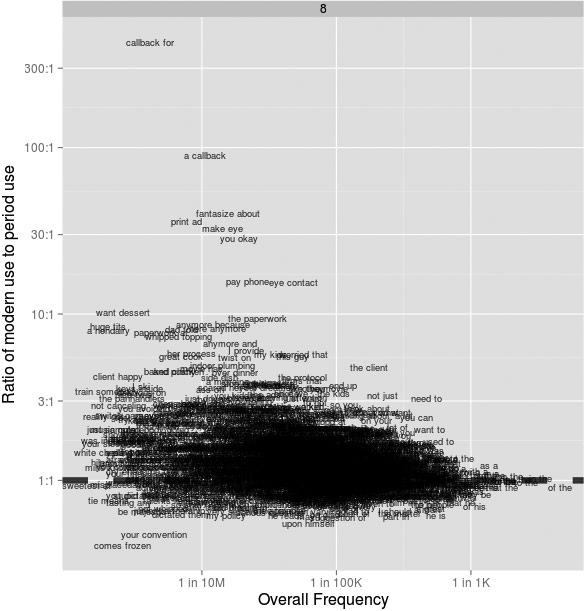
The big one from the charts: Megan gets “a callback for” an audition. This is, the data says, a candidate for the worst anachronism of the season. The word “callback” is about 100x more common by the 1990s, and “callback for” is even worse. The OED doesn’t have any examples of a theater-oriented use of “callback” until the 1970s; although I bet one could find some examples somewhere earlier in the New York theater scene, that may not save it. It wouldn’t really suite Megan’s generally dilettantish attitude towards the theater, or the office staff’s lack of knowledge of it, for them to be so au courant. “call-back” and “call back” don’t seem much more likely.
(via waxy)
George Dvorsky details five possible scientific explanations for Westeros’ seasons of unpredictable length. A “wobbly planetary tilt” is one possible reason:
In the episode “The Kingsroad,” we learn that Westeros has at least one moon. It’s very possible, therefore, that they have a very small or distant moon, that is causing a variable tilt in their planet’s rotational axis.
It’s interesting to note that, according to legend, Westeros used to have two moons, but “one wandered too close to the sun and it cracked from the heat” pouring out a thousand thousand dragons. Well, dragons aside, it’s conceivable that some kind of cataclysmic celestial event could have wiped out their second moon, which would have thrown their planet’s rotational axis out of whack.
This might be the coolest thing a sitting President has ever done. Aside from, maybe, freeing the slaves or The New Deal or winning WWII.
Update: And an amazingly depressing excerpt from a speech Obama gave earlier in the day:
But we only finished paying off our student loans — check this out, all right, I’m the President of the United States — we only finished paying off our student loans about eight years ago.
The first episode of Girls, an eagerly awaited HBO series by executive producer Judd Apatow and writer/director Lena Dunham, is available for free on YouTube (HBO disabled embedding for some dumb reason). HBO plans to do this with Veep next week as well.
Is Tom Junod’s long piece in Esquire a takedown of Jon Stewart? Or just a thorough examination of the messiness of being an ambitious public figure these days? I couldn’t tell. But if you’re a Stewart fan or Daily Show viewer, Junod’s piece is well worth a read.
Now look at him. It’s seven years later, and he’s aged like a president. He’s been graying for years, but now he’s gone gray, and a transformation seems to have taken place. He’s forty-eight years old. He has a wife and two young kids whose lives he worries about missing because he stays so late and works so hard. Last year, when he did that thing, that Jon Stewart thing, that rally in Washington, D. C., he looked like he was starting to, like, fill out — his suit looked a little small on him as he made his big valedictory speech — but now he’s gaunt, and his face is sort of bladelike, collecting itself around the charcoal axis of his eyes, nose, and mouth. Still, he’s jacked. The whole studio is. You don’t have any choice at The Daily Show. For one thing, the music gets louder and louder as you wait before finally reminding you where Stewart’s from with a climactic rendition of Born to Run. For another, there’s a tummler, a warm-up guy who bounds around telling you that you might laugh to yourself while watching Jon Stewart at home, you might smile and chuckle at the apercus, you might silently congratulate yourself for getting the jokes, but you’re not at home anymore, and here you have a responsibility — you’re the laugh track. “Do you want to be on TV! Do you want to meet Jon Stewart! Then you better get loud…”
And now here he is. The man did stand-up for years, and in the studio you can actually see it on him, because whereas on television he clings to his desk like it’s an iron lung (former writers say that you know a bit is doomed if it requires him to get up from behind it), here he actually stands up and goes out to the audience to answer questions. And he’s a kibitzer — it’s not Plato’s Symposium, folks. The first question is “What’s your daily routine?” and Stewart answers as he’s been answering since Destiny’s Child was together: “Jazzercise.” The second question is “Which one of the animals on my T-shirt would you like to be?” and Stewart responds with a question of his own: “Is there a correct answer to that?” And even when a young woman with short hair and glasses and a faded cause on her T-shirt asks if “our greatest media critic” has actually had an impact on the way the media does business, he instantaneously cocks his chin, sucks in his cheeks, and narrows his eyes until he looks like a wizened version of the man whose image is emblazoned on the wall outside; then he deepens his voice confidentially and says, “Well, look who’s carrying the NPR tote bag.” Of course, he denies having an impact — “the satirist depends on shame, and everyone knows that our culture has become shameless” — but when somebody calls out, “But you killed Crossfire!” he says, “No, I didn’t. Crossfire was already dead…”
And there it is again, that denial of power upon which his power depends. It’s strange, isn’t it: One of the fastest and most instinctive wits in America feeling it necessary to go on explaining himself again and again; a man who lives to clarify resorting to loophole; the irrepressible truth-teller insisting on something that not one person of the two hundred watching his show in the studio — never mind the millions who will watch on television — can possibly believe.
In this video, Erlend Lavik compares the relatively spare visual style of The Wire with that of other TV programs.
(via @uxprinciples)
Since Google released the video for their augmented reality glasses the other day, people have been busy making videos that show a more realistic (or cynical) portrayal of how the glasses might work. Here are a couple of the better ones. First a version of the glasses with Google ads:
And this one gives new meaning to the phrase “banner blindness”:
While not specifically about Google Glasses, this concept video by Keiichi Matsuda is also worth a look:
I will also direct your attention to the second episode of Black Mirror, a UK drama series by Charlie Brooker.
A satire on entertainment shows and our insatiable thirst for distraction set in a sarcastic version of a future reality. In this world, everyone must cycle on exercise bikes, arranged in cells, in order to power their surroundings and generate currency for themselves called Merits. Everyone is dressed in a grey tracksuit and has a “doppel”, a virtual avatar inspired by Miis and Xbox 360 Avatars that people can customise with clothes, for a fee of merits. Everyday activities are constantly interrupted by advertisements that cannot be skipped or ignored without financial penalty.
(via jake & stellar)
Jim Henson made this pitch video to sell The Muppet Show to CBS. It starts a bit slow but stick with it.
There’s also a scene with Kermit right at the end which unfortunately didn’t make it into the clip.
After Leo’s powerful speech, Kermit appears from off-screen against a CBS logo and shrugs, “What the hell was that all about?”
And just because, here’s the opening theme song of The Muppet Show. (via @gavinpurcell)
Frontline is doing a four-hour show about the world financial crisis, which, according to many people featured on the program, is ongoing.
Since 2008, Wall Street and Washington have fought against the tide of the fiercest financial crisis since the Great Depression. What have they wrought? In a special four-hour investigation, FRONTLINE tells the inside story of the struggles to rescue and repair a shattered economy, exploring key decisions, missed opportunities, and the unprecedented and uneasy partnership between government leaders and titans of finance that affects the fortunes of millions of people around the world.
The program airs on April 24th.
If you’ve never seen the early seasons of The Simpsons, a good way to catch up might be to watch this:
Just a quick hack to experiment what happens if you watch a lot of The Simpsons episodes at the same time. It just took 10 lines of code and a few hours of processing.
About the video:
-Top to bottom: each row shows a season (from season 1 to season 10)
-Left to right: each column shows an episode (from episode 1 to episode 13)
A total of 130 episodes is displayed, framerate is 25fps, thumbnails have been captured at 80x60px
I also enjoyed this minimalist representation of the Simpson family in Lego:

(via @TrevorBaum)
A book written by Jerry Beck in 1994 called The 50 Greatest Cartoons: As Selected by 1,000 Animation Professionals does indeed contain a list of the 50 greatest cartoons as chosen by industry professionals. The list is filthy with Warner Bros cartoons, particularly by the recently aforementioned Chuck Jones (four of the top five are by Jones). I don’t know how many are available on YouTube, but I tracked down a couple to show my 4-year-old son, Ollie: Duck Amuck and Rabbit of Seville.
By the time we were finished with Rabbit of Seville, Ollie had literally peed his pants from laughing so hard. I think I’m gonna get the Looney Tunes collection on Blu-ray so we can watch more but I’m a bit afraid of what the hijinks of Wile E. Coyote and The Road Runner might do to my boy’s pants.
Many thanks to Aaron Cohen for holding down the fort here at kottke.org for the past week. You should check out the Mad Men recap he did for last night’s episode, complete with an illustration from Chris Piascik (prints and t-shirts available).

You can also find Aaron at the helm of 2012 Boston Bacon and Beer Festival…tickets go on sale soon.
Season 5 of Mad Men starts on Sunday. It’s been on hiatus for 12 years, and it might be hard to remember season 4 without some of the Mad Men related info linked below. With such a long break, there’s been quite a bit of Mad Men news floating around. In order to cut it down a little, most of this stuff is from the last week or so. Don’t try to eat it all in one sitting you’ll get a stomach ache and have to sleep off your hangover on your office couch.
-Here’s where we left off in Season 4.
-Everything Don Draper Said in Season 4.
-Although, Matthew Weiner has asked reviewers with advanced copies of Sunday’s premier not to discuss key details in their previews, such as the year this season takes place, Weiner is changing a song featured in the episode because it wasn’t released until 6 months after the episode takes place. ‘Look of Love’ was released at the beginning of 1967 placing the episode in, or around, the summer of 1966. This is about a year after Season 4 ended. Maybe this is subterfuge?
-George Lois is still mad.
-Newsweek recently had an issue celebrating the return of Mad Men where the ads were all retro. Here are all those ads.
-The psychotherapist who consulted on Mad Men’s development talks about why the characters feel so real.
-Some (spoiler free) previews of what to expect on Sunday.
Imagine if Mad Men was a Nintendo game…
That is the question that Grantland is attempting to answer with a NCAA-style tournament bracket.

Did we mention that our esteemed editor-in-chief hung out with President Obama last week? Because that totally happened. Just two regular guys, discussing Linsanity, Blake Griffin’s jump shot, what it’s like to pitch a baseball while wearing a bulletproof vest, and — as the conversation wound down — The Wire. Asked to name the greatest Wire character of all time (let it never be said that Grantland does not ask the tough questions!), the Commander in Chief didn’t hesitate: “It’s gotta be Omar, right? I mean, that guy is unbelievable, right?”
With respect to the President, Omar is the most overrated character on The Wire. I mean, I love Omar. I do. He is everyone’s favorite character and easy to love because he’s one of the show’s most manufactured characters. Gay, doesn’t swear, strong sense of morals, robs drug dealers, respected/feared by all…come on, all that doesn’t just get rolled up into one person like that. The Wire aspires to be more than just mere television, but when Omar is on the screen, it’s difficult for me to take the show as seriously as it wants me to.
Newer posts
Older posts





Socials & More