kottke.org posts about TV
Quick reviews of some things I’ve read, seen, heard, and experienced in the past month or so. I was out of town for a few days so there are more books on here than usual. I’m trying to keep it up…reading right now but too early to call: Broad Band, Am I There Yet?, Black Panther: A Nation Under Our Feet. Oh and I’m really glad The Americans is back on, even though it’s the final season. (As I’ve said before, don’t pay too much attention to the letter grades. They are subjective and frequently wrong.)
Star Trek Voyager. Not in the same league as Next Generation, but it hums along nicely after they get going. (B)
Mr. Robot. I watched the first episode of season three and then got distracted by other things. Anybody watch the whole season? Is it worth circling back? (TBD)
Annihilation. I enjoyed this more than many people I know, but not as much as Matt Zoller Seitz. Eager to watch it again since reading the book (see below). (B+)
Lincoln. I love this movie. One of Spielberg’s best. (A)
Ugly Delicious. I wanted to hate this, but it’s really interesting and David Chang wears you down with his, well, I wouldn’t call it charm exactly. The episode that really hooked me was the Thanksgiving one, when he’s wandering around a massive supermarket with his mom, who’s mockingly calling him “David Chang” (you can almost hear the appended ™ in her voice) and then refers to him as the “Baby King”. Also, for a chef, Chang is weirdly incurious about food but harangues people for not appreciating kimchi. I really should write a longer post about this… (A-)
Murder on the Orient Express. Better than I had heard, if you choose to embrace its slight campiness. I really enjoyed Branagh’s Poirot. (B+)
Geostorm. I love disaster movies like this, but I kept checking my phone during this one and a day or two later I couldn’t have told you a single plot point. That will not stop me from watching it again because (see first sentence). (C)
Sunsets. I recommend them, particularly on the beach. (A)
The Wizard and the Prophet by Charles Mann. “I recommend that you read The Wizard and the Prophet”. (A)
Sing, Unburied, Sing by Jesmyn Ward. Great book, deserving of all its accolades. (A-)
Annihilation by Jeff VanderMeer. This is likely an unpopular opinion, but I liked the movie more. Upon finishing, I was not inclined to read the sequels. (B)
The Odyssey, translated by Emily Wilson. As I mentioned here, I’m reading this aloud to my kids, which feels a little like a time machine trip back to antiquity. (A)
An Incomplete History of Protest. Inspiring collection of objects related to the protests of everything from the AIDS crisis to Vietnam. Fascinating to see how the disenfranchised leveraged art and design to counter their neglect by the powerful. (A-)
Grant Wood: American Gothic and Other Fables. Fun to see American Gothic up close, but I was more impressed by some of Wood’s other work, particularly his illustration-like landscapes. I showed the kids a photo I had taken of one of the paintings and Ollie said, “that looks like a 3D rendering!” (B+)
Stephen Shore at MoMA. I’d label this a “must see” if you’re into photography at all. Shore’s shape-shifting career is inspiring. (A-)
Red Sparrow. I was texting with a friend about how cool it would be if J. Law’s character in Red Sparrow was Paige Jennings from The Americans all grown up, but the timelines don’t match up. (B-)
Harry Potter Hogwarts Battle. I don’t play a lot of board games so maybe this is a common thing now, but I really like how all the players have to work together against the game to win. But once you get past the first couple of decks, the games take *forever*. (B+)
The Royal Tenenbaums. Rushmore will always be my sentimental Wes Anderson fave, but Tenenbaums is right up there. (A)
Consider the Lobster by David Foster Wallace. I have been listening to the audiobook version while in the car, and Wallace’s reading of the first story, Big Red Son (about an adult video awards show), made me laugh so hard that I had to pull of the road at one point. (A)
Logan Lucky. Much better on the second watch. I don’t know why I didn’t appreciate it the first time around…I love Soderbergh and this is basically Ocean’s 7/11. (A-)
Moon. I saw this when it originally came out but didn’t like it as much the second time around. Great soundtrack though. (B+)
Sleep. An 8-hour-long album designed to be played while you sleep. I listened to the entire album while working, and it’s pretty good for that purpose as well. (A-)
Simon and the Whale. Wonderful room and service. Really good cocktails. I know the kitchen crew and they still blew me away with the food. (A)
Girls Trip. I haven’t laughed so hard at a movie since I don’t know when. Bridesmaids maybe? Can’t wait to watch this again in a few months. (A-)
Ready Player One. I very much enjoyed watching this movie. Spielberg must have had fun going back through the 80s pop culture he had a large part in shaping. (A-)
Electricity. I’m writing this not from my usual home office but from the lobby of the local diner/movie theater. We had a wind storm last night, which knocked the power out at my house. That means no heat, no water, no wifi, and very poor cell reception. And a tree came down across the road I live on, so I was “stranded” for a few hours this morning until someone showed up with a chainsaw. I unreservedly recommend electricity (and civilization more generally). (A+)
In this video, Lessons from the Screenplay examines what makes one of the best episodes of Black Mirror, USS Callister, so effective and entertaining.
The USS Callister episode of Black Mirror is a bit of an anomaly amongst the nineteen episodes of the series. It cleverly introduces the antagonist in an unconventional way, brings the premise of an old Twilight Zone episode into the near future, and manages to constantly be doing multiple things at once.
His second example of how the show does multiple things at once, which occurs right at the end of the episode, is excellent.
Poetry in America is an upcoming 12-part series exploring poetry on a variety of topics. Each episode features the discussion of a single poem — “I cannot dance upon my toes” by Emily Dickinson, “Skyscraper” by Carl Sandburg, “N.Y. State of Mind” by Nas — with a collection of notable people — Samantha Power, Shaquille O’Neal, E.O. Wilson, Yo Yo Ma, Bill Clinton. The first episode airs this week but is already available on Amazon.

On Tuesday, my friend Rex Sorgatz came out with the very timely book, The Encyclopedia of Misinformation, the full subtitle of which is “A Compendium of Imitations, Spoofs, Delusions, Simulations, Counterfeits, Impostors, Illusions, Confabulations, Skullduggery, Frauds, Pseudoscience, Propaganda, Hoaxes, Flimflam, Pranks, Hornswoggle, Conspiracies & Miscellaneous Fakery”. Today I’m happy to present an excerpt about the genesis and use of the laugh track on television. [The video insert on how the laff box worked is mine.] -jason
No technique in television production has been more maligned than the laugh track, yet it somehow perseveres through decades of ridicule.
It all started innocently, as a quick hack to solve a technical problem. Charley Douglass, a sound engineer at CBS in the early ’50s, was annoyed at studio audiences who inconveniently laughed at the wrong moments. Sometimes they chuckled too long at unfunny bits; other times, they refused to bellow with sufficient gusto. To evenly redistribute the laughter, Douglass invented a contraption that looked like a steampunk organ collided with a cyberpunk adding machine, connected on the back end to magnetic tapes with recorded laughter. By pressing buttons on the laff box (that’s actually what he called it), an orchestrator could punch up guffaws, chortles, and giggles on demand. The magical machine also acted as a sort of demographic keyboard, with inputs for specific genders, ages, and ethnicities, plus a foot pedal that controlled the duration of each laugh. One keystroke might simulate frothy housewife giggle; another, guy who missed joke but laughs anyway. Keys could be combined into melodic chords of laughter, bringing down the house in a crescendo of hilarity.
The gizmo was a success, smoothing out the aural wrinkles in programs like The Abbott and Costello Show and I Love Lucy. It was a necessary evil of this nascent era, when television was rapidly changing from live broadcast to taped recordings. Audiences were still growing accustomed to the big square tube in their living rooms, and the laugh track helped ease the transition by simulating an intimate theater experience at home. You knew when to laugh because they told you when to laugh.
Naturally, this quaint bag of laughs was quickly abused. Sitcoms in the ’60s and ’70s took the laff box and cranked it to eleven. Realizing canned chuckles freed them from the burden of a live audience, shows like Gilligan’s Island and The Brady Bunch ratcheted the laugh track to egregious levels. No show could escape the canned laughter craze — beloved programs like The Muppet Show and M*A*S*H used laugh tracking, even during outdoor scenes, when a studio audience was improbable. When animated shows like The Flintstones and The Jetsons added tracks of artificial mirth, the entire illusion of a captive studio audience was finally shattered.
Show creators hated the laugh track, spurring a constant feud with network executives who believed audiences enjoyed the audio cues. To adjudicate the conflict, CBS held a controlled experiment in 1965 with its brand-new show Hogan’s Heroes. The network tested two versions of the World War II comedy — one with canned laughter, one without. The test audiences overwhelmingly preferred the laugh-tracked show. Since then, nearly all CBS comedies have contained audience laughter.
Fake laughter was far from universal though. Many beloved shows, including The Mary Tyler Moore Show, Friends, Cheers, and Seinfeld, used studio audiences for most of their laughter, only adding dashes of the canned stuff through sweetening (that’s the term of art).1
But laughter of all kinds — live or tracked — was becoming the joke of the sitcom industry, as a morose aura started to envelop the merriment. An oft-told anecdote asserted that due to track age, the laff box contained the chortles of dead people. The canard seems to have originated with Jim Carrey as Andy Kaufman in Man on the Moon (1999), who ad libbed this bit of dialogue about sitcoms like Taxi:
It’s just stupid jokes and canned laughter! And you don’t know why it’s there, but it’s there! And it’s dead people laughing, did you know that? Those people are dead!1
It might have been true in the ’70s, but the claim is likely not accurate today, as audio engineers are known to assiduously update their libraries with new snorts and snickers.
Regardless, the stench of dead laughter was in the air. Starting in the early aughts, shows began to jettison the laugh track, as most celebrated comedies of the era — The Office, Arrested Development, Curb Your Enthusiasm, Orange Is the New Black, 30 Rock, Community, Louie, Modern Family — abandoned the cheesy blandishment. Some programs maintain laugh tracks today (especially those on CBS), and they do tend to get good ratings. In fact, one can almost divide sitcoms into two categories — “critically acclaimed” versus “high ratings” — on whether they use a laugh track. As a generalization, shows that cozen a laugh from the viewer perform better in the ratings but seldom win Emmys.
Although widely derided, the laugh track served its purpose. Television began as a medium for viewing live events with an audience (essentially theater-at-a-distance), and it took decades for television to evolve into its own medium. The laff box allowed producers to literally play the audience, like an organ. Perhaps it was synthetic, but the technical innovation put the audience into the tube, creating a more communal experience in our homes. Today, that role — incorporating a disembodied audience — is played by social media. LOL.
If you’re interested in reading about more simulations, skullduggery, and flimflam, The Encyclopedia Of Misinformation is now available on Amazon.
Being Serena is a five-art HBO documentary series on Serena Williams that focuses on her pregnancy, the birth of her daughter, and her determination to get back on the court and compete at a championship level.
I don’t know if there’s anything left for me in tennis, but I’m not done yet.
The first episode will air on May 2. Deadline has further details.
For the final show of The Arsenio Hall Show, Queen Latifah organized a huge amount of hip hop talent for a tribute. It’s amazing. Some more details here. The segment features Yo-Yo, MC Lyte, Naughty by Nature, A Tribe Called Quest, Fu-Schnickens, CL Smooth, Guru from Gang Starr, Das EFX, GZA and few others from Wu-Tang Clan, KRS-One, and Mad Lion, and, as mentioned previously, is amazing. (via @mattwhitlockPM)
Morgan Neville’s documentary about Fred Rogers will be out in theaters on June 8; the trailer above just dropped today.
Fred Rogers led a singular life. He was a puppeteer. A minister. A musician. An educator. A father, a husband, and a neighbor. Fred Rogers spent 50 years on children’s television beseeching us to love and to allow ourselves to be loved. With television as his pulpit, he helped transform the very concept of childhood. He used puppets and play to explore the most complicated issues of the day — race, disability, equality and tragedy. He spoke directly to children and they responded by forging a lifelong bond with him-by the millions. And yet today his impact is unclear. WON’T YOU BE MY NEIGHBOR? explores the question of whether or not we have lived up to Fred’s ideal. Are we all good neighbors?
You can watch a clip of the film here.
Annie Onishi is a general surgery resident at Columbia University and Wired asked her to break down scenes from movies and TV shows featuring emergency rooms, operating rooms, and other medical incidents. Spoiler alert: if you seek medical treatment from a TV doctor, you will probably die. Secondary spoiler alert: that adrenaline-shot-to-the-heart scene in Pulp Fiction is not as implausible as you might think, even if some of the details are wrong.

We should all be talking more about High Maintenance, a show sort of about weed but really about the human condition.
Last season’s episode “Grandpa” is unlike anything else I’ve seen on TV, but do yourself a favor and start with their original webisodes and work your way up to the current season on HBO. ”Rachel” is also not to be missed (Dan Stevens plus Rachel Comey, swoon).
Emily Gould’s recent profile on co-creator Katja Blichfeld gives a look at half of the real-life (former) couple behind the show. I particularly like the story of her career trajectory.
Before she was known for High Maintenance, Blichfeld was a casting director, a job at which she was very successful (she won an Emmy for her work on 30 Rock) and at which she arrived via an indirect path. Born in Long Beach, California, to Danish parents, she grew up attending Evangelical Christian schools, where she was taught that much of pop culture was the devil’s doing. “Like I couldn’t watch The Smurfs,” she explains, “because of witchcraft and sorcery.” She spent a couple of semesters at Long Beach City College, dropped out, moved to Chicago, worked in admin at a university, and then, in 2004, followed a relationship that had begun on Friendster to New York. “We were watching a lot of movies together, and the way that I would talk about movies was always very actor-centric. And I remember this person saying, ‘You should be a casting director.’” Blichfeld decided she’d try to get an internship. She made a list of people she wanted to work for, topped with Jennifer McNamara, who had just won a bunch of awards for her work on Sex and the City: “She, being a casting director — you know, very good at seeing potential — saw it in me, lucky me, and took me on.
The life-imitates-art-imitates-life aspect of Blichfeld’s breakup and the show really gets me, too.
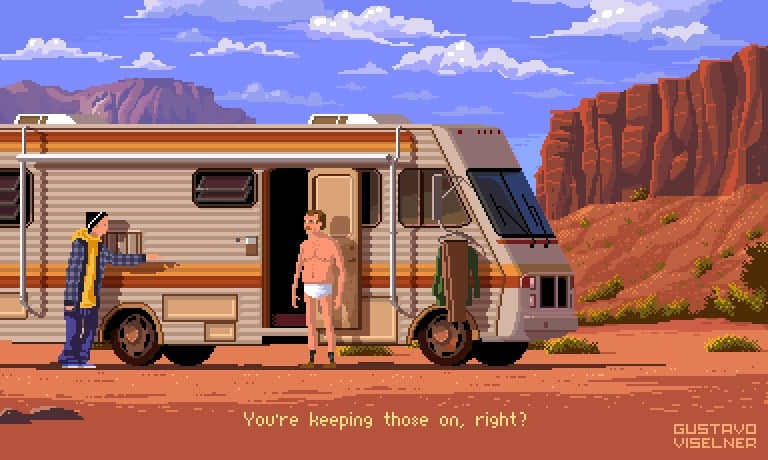
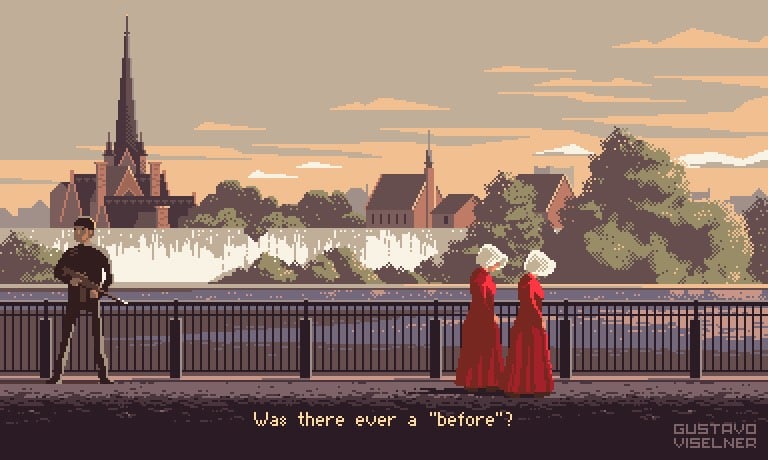
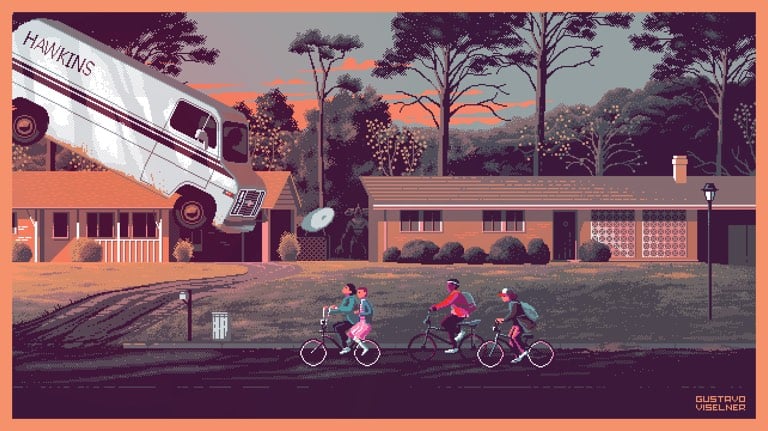
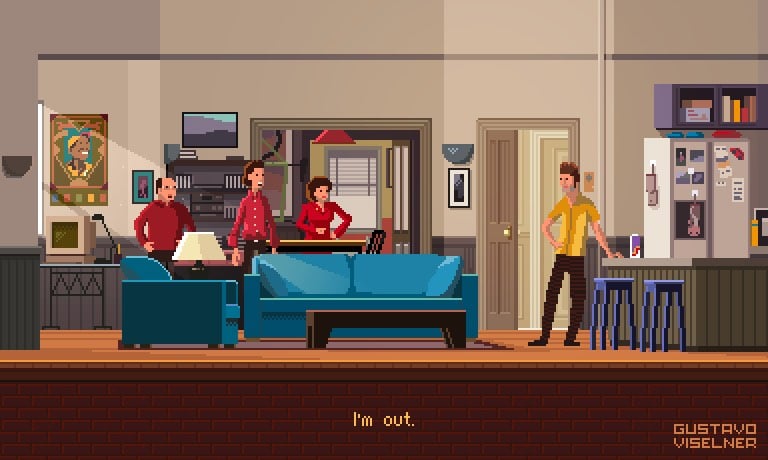
For his Pixel Art TV project, Gustavo Viselner illustrates scenes from TV shows in a pixelized video game style. Looks like he’s done scenes from Game of Thrones, The Handmaid’s Tale, Breaking Bad, The Fresh Prince of Bel-Air, Seinfeld, Star Trek, and several others. (via @john_overholt)
Update: See also The Screenshots, a project by Jon Haddock from 2000 in which scenes from historical & fictional events are rendered in a The Sims-like style. (via @dens)
In this clip from an episode of Mister Rogers’ Neighborhood, breakdancer Jermaine Vaughn shows Mister Rogers and his television neighbors a few moves, including some popping and locking and the moonwalk.
That guy is game for anything, even if it makes him look dorky…probably especially if it makes him look dorky. Rogers knew the value of not letting what others might think about you get in the way of your curiosity or a new experience.
Also, DJs and producers take note: his lines “like there’s a wave going the whole way through your body” and “then make it come back, huh” are ripe for sampling.
Quick reviews of some things I’ve read, seen, heard, and experienced in the past month or so. I have fallen off the book reading wagon…I really really need to find some time to start reading more. Maybe after the Olympics are done and I’ve made it through all of the levels in Alto’s Odyssey…
2018 Winter Olympic Games. Yes, the Olympics are corrupt & corporate and NBC’s coverage is often lacking, but on the other hand, all of America gets a two-week look at all of these amazing women, immigrants, children of immigrants, and openly gay athletes (some of them just children) displaying many different kinds of femininity and masculinity while performing amazing feats and suffering humbling defeats. The Olympics, as the joke goes, is the future that liberals want and America is watching and loving it. (A-)
Black Panther. Really entertaining and affecting after an expositional slow start. (B+)
Leonardo da Vinci by Walter Isaacson. Leonardo da Vinci is not overrated. (B+)
Alto’s Odyssey. A worthy successor to one of my favorite games. (A-)
Reply All: The Bitcoin Hunter. Is admitting that you bought illegal drugs on Silk Road a thing you can do without the risk of being prosecuted? (B+)
Black Panther The Album. I can’t wait to drive around playing this as loud as I can. Also, based on my experience, movies should put more effort into their soundtracks. The really good ones (like this one) inspire repeat viewings and cause me to remember the movie more fondly. (A-)
Paddington. If more people in the UK over 65 had watched Paddington, Brexit wouldn’t have happened. (A-)
Paddington 2. Seriously, these Paddington movies are better than they have any right to be. Smart and lots of heart. (B+)
See You in the Cosmos. Read this to the kids as a bedtime story over the past few months. We all loved it. Rocketry, Carl Sagan, the Voyager Golden Record…what’s not to like? (A-)
Allied. Bland and forgettable. (C-)
On Being: interview with Isabel Wilkerson. An excellent interview of the author of The Warmth of Other Suns, one of the best books I’ve read in recent years. (A-)
Phantom Thread soundtrack. More strong work by Jonny Greenwood. But don’t listen if you want something upbeat. (B+)
Song Exploder. A podcast where musicians break down their well-known songs. Always solid. I recently caught the episodes about the Stranger Things theme song and DJ Shadow. Oh, and I’m going to give the Arrival score a listen soon. (A-)
Apollo 13. One of my I’ll-watch-this-whenever-it’s-on movies. Love the scientific and engineering detective scenes. (B+)
Alias Grace. Several people asserted this was a better Margaret Atwood adaptation than The Handmaid’s Tale, but I didn’t think so. (B)
I, Tonya. I enjoyed this more than I thought I would. (A-)
Goodthreads T-shirt. Goodthreads is one of Amazon’s house brands. Ordered a couple of these after a recommendation from Clayton Cubbitt and damn if they’re not some of the most comfortable and best-fitting t-shirts I’ve ever worn. And only $12! My new go-to. (A-)
Sleep. One of the best things I’ve done for my work and my sanity is going to bed at about the same time every night and getting at least 6.5 hours (and often 7-8 hours) of sleep every night. (A+)
This American Life: Chip in My Brain. Holy parenting nightmare. (B+)
Professor Marston & The Wonder Women. The surprising role of BDSM in the development of Wonder Woman. (B+)
Atomic Blonde. John Wick-like. I wanted to like this more but the plot was a little muddled. (B)
SpaceX launch of Falcon Heavy. That choreographed double booster landing… (A)
Past installments of my media diets can be found here.
In the fourth episode of the first season of The Wire, the one that really hooks you fully into the show, detectives Bunk and McNulty enter a crime scene and scour it for potential clues, communicating with each other almost entirely using variations of the word “fuck”.
It’s a great scene, almost pure visual filmmaking and an homage to a singularly versatile word. In his new book, All the Pieces Matter: The Inside Story of The Wire, Jonathan Abrams details how this scene came to be made. New York Magazine has an excerpt.
David comes up to us and describes a scene. He says, “You’re going to go to the scene. You’re going to realize that [the previous] detective, he did a bad job. Wendell, you’re going to see the photos of the girl. Dominic, you’re going to start getting the stats, looking at what the report was. Going back over, you’re going to realize it’s impossible to have gone down the way it was reported, because the guy would have to be like eight feet tall to get that trajectory. If he did, then something must be left in here, and you’re looking for any evidence that may be around, and Wendell, you discover that there’s a shot through the window. The glass is on the inside. It means it came from the outside. That means whoever the perpetrator was wasn’t inside, like the person they say in the report. The bullet came from outside. From there, let’s see the trajectory. It would be right here, in the refrigerator. Let’s see, not the wall. In the refrigerator, we find the bullet here. Let’s go outside, make a new discovery.” He explained the whole scene to us. He said, “Now you guys are going to do that whole thing, but they’re going to be on me about the profanity and language that we use.” So, I said, “Let’s just come out the box with it.” He said, “You’re going to do that whole scene, but the only word you can say is ‘fuck.’” I said, “What?”

Adi Robertson at The Verge has a fun, informative history of old cathode ray tube television sets, plus the people who study them, keep them working, and continue to use them. One maybe-surprising constituency: retro gamers.
Old games may look torn or feel laggy on a new TV. That’s in part because LCD screens process an entire frame of an image and then display it, rather than receiving a signal and drawing it right away.
Some games are completely dependent on the display technology. One of the best-known examples is Duck Hunt, which uses Nintendo’s Zapper light gun. When players pull the trigger, the entire screen briefly flashes black, then a white square appears at the “duck’s” location. If the optical sensor detects a quick black-then-white pattern, it’s a hit. The entire Zapper system is coded for a CRT’s super fast refresh rate, and it doesn’t work on new LCD TVs without significant DIY modification.
Old-school arcades, too, need to constantly maintain and replace their old tube monitors. Weirdly, this makes old television sets extremely valuable, even as it’s more and more difficult to have them recycled or thrown away.
“CRTs are essentially the bane of the electronic recycling industry,” says Andrew Orben, director of business development at Tekovery, one of the companies Barcade uses to dispose of irrevocably broken hardware. The tubes contain toxic metals that could leach into a dump site, and 18 states specifically ban sending them to landfills. They’re made of raw materials that are often impossible to sell at a profit, primarily glass that’s mixed with several pounds of lead.
They’re also insanely heavy. Even in 2002, a 40” tube TV would weigh more than 300 pounds. (Bigger TVs used to be rear-projections, remember?)
The worst commercial aired during last night’s handegg match was this Dodge Ram ad featuring a snippet of a speech by Martin Luther King Jr. King, of course, was an outspoken critic of capitalism. In fact, later in the very same speech, he railed against this type of advertising. Here’s the audio of that part of his speech overlaid on the Dodge Ram commercial:
Now the presence of this instinct explains why we are so often taken by advertisers. You know, those gentlemen of massive verbal persuasion. And they have a way of saying things to you that kind of gets you into buying. In order to be a man of distinction, you must drink this whiskey. In order to make your neighbors envious, you must drive this type of car. In order to be lovely to love you must wear this kind of lipstick or this kind of perfume. And you know, before you know it, you’re just buying that stuff. That’s the way the advertisers do it…
It often causes us to live above our means. It’s nothing but the drum major instinct. Do you ever see people buy cars that they can’t even begin to buy in terms of their income? You’ve seen people riding around in Cadillacs and Chryslers who don’t earn enough to have a good T-Model Ford. But it feeds a repressed ego.
You can listen to King’s speech in its entirety here:
(thx, hyder)
Newer posts
Older posts





Socials & More