kottke.org posts about NYC
Casey Neistat tries to steal his own bike in several locations around NYC and finds it’s pretty easy…even if you’re doing so right in front of a police station.
I recently spent a couple of days conducting a bike theft experiment, which I first tried with my brother Van in 2005. I locked my own bike up and then proceeded to steal it, using brazen means — like a giant crowbar — in audacious locations, including directly in front of a police station. I wanted to find out whether onlookers or the cops would intervene. What you see here in my film are the results.
This is a video of the earlier attempt he mentions. (via ★ironicsans)
The Shake Shack gets a lukewarm one-star review from Pete Wells at the NY Times…the main problem was consistency.
How the burger could change lives I never divined, but on occasion it was magnificent, as beefy and flavorful as the outer quarter-inch of a Peter Luger porterhouse.
More often, though, the meat was cooked to the color of wet newsprint, inside and out, and salted so meekly that eating it was as satisfying as hearing a friend talk about a burger his cousin ate.
Even when the burgers were great, they could be great in one of two distinct ways. In the classic Shake Shack patty, a tower of ground beef is flattened against a searing griddle with a metal press and made to stay there, spitting and hissing, until one surface turns all brown and crunchy. A patty handled this way takes command of a Shackburger, standing up to its tangy sauce, its crisp lettuce, its wheels of plum tomato.
Sometimes, though, the grill cook hadn’t had the energy needed for smashing and searing. Instead the patty was tall, soft and melting, so pink inside that its juices began to soak the bun at the first bite. Good as this version was, it was anomalous.
The Shack Burger is still my favorite hamburger and sitting in Madison Square Park eating one on a warm night with friends — hell, even waiting in line for 45 minutes catching up — is one of my favorite NYC activities.
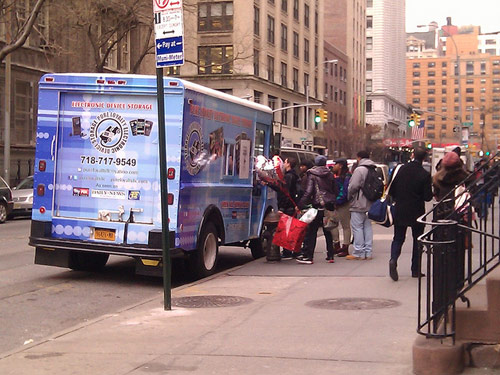
Mobile phones are banned in NYC public schools so a company called Pure Loyalty parks trucks outside of several schools so that students can check their phones, iPods, and other devices for the duration of the school day.
Pure Loyalty LLC is the originator in electronic device storage. We put student safety first and work together with school safety to make sure that phones are checked in and out in a timely fashion for students to go straight to class and then home after school.
Each student is given a security card to ensure that their device is only returned to them!!!! If a student with a security card loses their ticket, not to worry. We have a system in place that secures their phone. Each student is given a FREE security card. Replacement cards are $1.
(photo by Jesse Chan-Norris)
From the This Must Be the Place series, a lovely short film about the Prime Burger Restaurant in midtown Manhattan. The restaurant opened in 1938 and one of the servers, Artie, has been there since 1952.
For many of the guys that work here, the restaurant is like a second home — some of them have been slinging burgers, making shakes, and waiting on customers at this location for decades. Opened in 1938, the place hasn’t been altered since the early ’60s, and it looks all the better for it. Here the waiters and workers of Prime Burger discuss their views on their chosen profession, and the unique nature of the place itself.
(via @daveg)
Update: Over at Serious Eats, Ed Levine gives some advice on how to order properly at Prime Burger.
So why the need to order right? Because to keep up with the fast food chains, the DiMicelis started par-broiling their burgers. Par-broiling produces a less juicy burger. So when you order at Prime Burger specify you want your burger ($5.25 for a hamburger, $5.95 for a cheeseburger) made from scratch, and that you’re willing to wait the extra few minutes.
Economist Jason Barr and his colleagues measured the bedrock depth in Manhattan and correlated it with building height. In doing so, they busted the long-held belief that there were no skyscrapers between Midtown and the Financial District because of insufficient bedrock.
What the economists found was that some of the tallest buildings of their day were built around City Hall, where the bedrock reaches its deepest point in the city, about 45 meters down, between there and Canal Street, at which point the bedrock begins to rise again toward the middle of the island. Indeed, Joseph Pullitzer built his record-setting New York World Building, a 349-foot colossus, at 99 Park Row, near the nadir, as did Frank Woolworth a decade later.
(via @bobulate)
A collection of things that New Yorkers say. Like “where’s the train?”, “you have to go to Brooklyn, it’s the law”, and “tourists!”
Susan Cain argues that the lack of privacy and freedom from interruption in modern offices might not be the best way for those office employees to be creative…particularly for introverts.
The New Groupthink has overtaken our workplaces, our schools and our religious institutions. Anyone who has ever needed noise-canceling headphones in her own office or marked an online calendar with a fake meeting in order to escape yet another real one knows what I’m talking about. Virtually all American workers now spend time on teams and some 70 percent inhabit open plan offices, in which no one has “a room of one’s own.” During the last decades, the average amount of space allotted to each employee shrank 300 square feet, from 500 square feet in the 1970s to 200 square feet in 2010.
The new offices of Foursquare and Buzzfeed (where I work from) are a perfect example of the New Groupthink Cain refers to….rows and rows of people sitting next to each other in open spaces. Much of this is because of NYC’s insane rental market, but Fog Creek’s offices are a nice counterexample:
Every developer, tester, and program manager is in a private office; all except two have direct windows to the outside (the two that don’t get plenty of daylight through two glass walls).
In an excerpt from the introduction to Subway, his collection of photographs of the NYC subway, Bruce Davidson recalls how he came to start taking photos on the subway in the 1980s.
As I went down the subway stairs, through the turnstile, and onto the darkened station platform, a sinking sense of fear gripped me. I grew alert, and looked around to see who might be standing by, waiting to attack. The subway was dangerous at any time of the day or night, and everyone who rode it knew this and was on guard at all times; a day didn’t go by without the newspapers reporting yet another hideous subway crime. Passengers on the platform looked at me, with my expensive camera around my neck, in a way that made me feel like a tourist-or a deranged person.
Geoff Manaugh of BLDGBLOG took some photos yesterday of a curious townhouse in Brooklyn Heights.
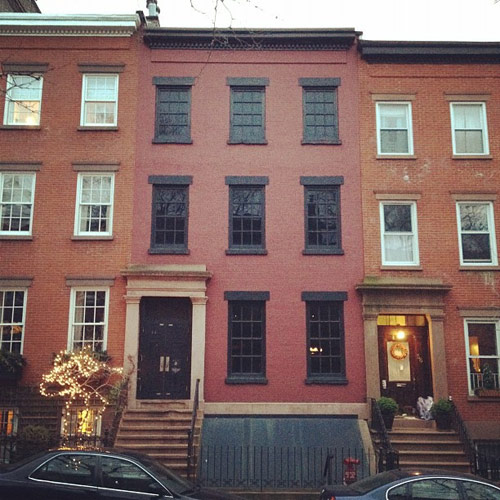
Curious in that the facade is 100% NYC rowhouse but it’s actually a secret subway exit. Here it is one Google Maps.
Starting today and continuing for the next four weeks, IFC Center in NYC is showing a “comprehensive retrospective” of films (Princess Mononoke, Spirited Away, My Neighbor Totoro) made by Studio Ghibli. Most of the films are new 35mm prints and some will be screened in dubbed and subtitled Japanese versions.
Oh, and IFC is also doing midnight showings of Raiders of the Lost Ark this month.
Before he made movies, Stanley Kubrick was a photographer for Look magazine. Here are a selection of Kubrick’s photos of New York City life in the 1940s, even then displaying his keen cinematic eye.
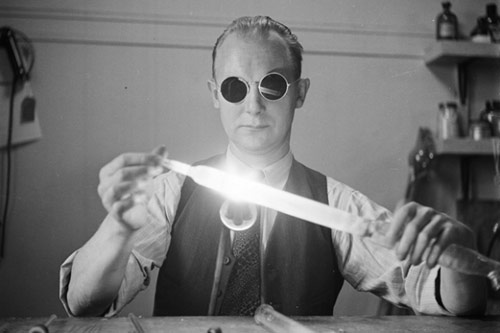
Prints are available. (thx, mark)
Over at Edible Geography, Nicola Twilley documents the banana ripening process at a facility in the Bronx.
During our visit, Paul Rosenblatt told us that he aims to ripen fruit in five days at 62 degrees, but, to schedule fruit readiness in accordance with supply and demand, he can push a room in four days at 64 degrees, or extend the process to seven days at 58 degrees.
“The energy coming off a box of ripening bananas could heat a small apartment,” Rosenblatt explains, which means that heavy-duty refrigeration is required to keep each room temperature-controlled to within a half a degree. In the past, Banana Distributors of New York has even experimented with heating parts of the building on captured heat from the ripening process.
To add to the complexity, customers can choose from different degrees of ripeness, ranging from 1 (all green) to 7 (all yellow with brown sugar spots). Banana Distributors of New York proudly promise that they have “Every Color, Every Day,” although Rosenblatt gets nervous if he has more than 2000 boxes of any particular shade.
Occupy Wall Street went up to protest at Lincoln Center last night during a performance of Philip Glass’ opera Satyagraha. New Yorker music critic Alex Ross was there and captured the protest on video, which included Glass himself reading the closing lines from the opera, amplified to the crowd by the people’s mic. It is an amazing scene.
When the Satyagraha listeners emerged from the Met, police directed them to leave via side exits, but protesters began encouraging them to disregard the police, walk down the steps, and listen to Glass speak. Hesitantly at first, then in a wave, they did so. The composer proceeded to recite the closing lines of Satyagraha, which come from the Bhagavad-Gita (after 3:00 in the video above): “When righteousness withers away and evil rules the land, we come into being, age after age, and take visible shape, and move, a man among men, for the protection of good, thrusting back evil and setting virtue on her seat again.” True to form, he said it several times, with the “human microphone” repeating after him. Lou Reed and Laurie Anderson were in attendance, and at one point Reed helped someone crawl over the barricade that had been set up along the sidewalk.
(via stellar)
Girl Walk // All Day is a feature-length dance music video set in NYC…the soundtrack is Girl Talk’s All Day. Kickstarter is hosting a premiere for the film (+ dance party) on December 8 at the Brooklyn Masonic Temple…and it’s free (you just need to RSVP). Here’s the trailer:
Famed pizzeria Grimaldi’s is being forced out of their space under the Brooklyn Bridge and is moving up the block…without their coveted coal oven. But now comes word that Patsy Grimaldi, former owner of Grimaldi’s, is moving into the old space with a new restaurant called Juliana’s. If I recall correctly, about half of the Grimaldi’s menu is devoted to a telling of the Patsy’s/Grimaldi’s feud…looks like they’re gonna need another page or two.
ExtendNY extends Manhattan’s street grid worldwide. Here’s 64908th Street and 12,778th Avenue in Paris, France.
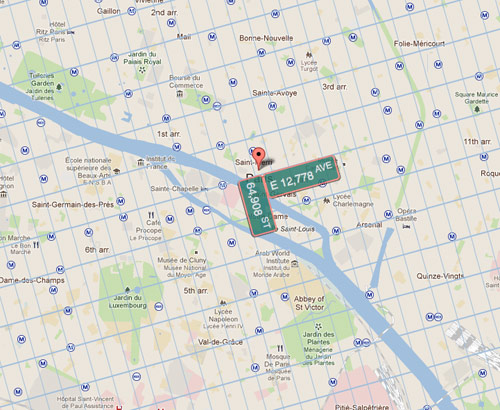
(via @bdeskin)
Gothamist has a collection of photos of the abandoned train platform underneath the Waldorf=Astoria.
Over the weekend we had a chance to visit the long-abandoned Waldorf-Astoria train platform, which allowed VIPs to enter the hotel in a more private manner — most famously it was used by Franklin D. Roosevelt, possibly to hide the fact that he was in a wheelchair suffering from polio. The mysterious track, known as Track 61, still houses the train car and private elevator, which were both large enough for FDR’s armor-plated Pierce Arrow car. Legend has it that the car would drive off the train, onto the platform and straight into the elevator, which would lead to the hotel’s garage.
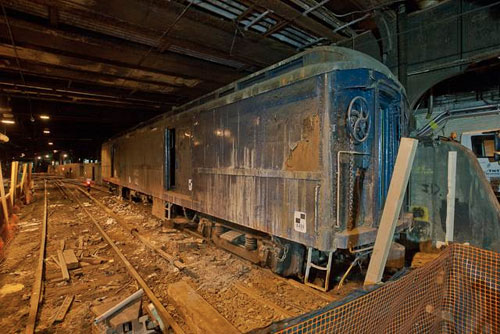
Photos by Sam Horine.
Matthew Porter’s photo composite Empire on the Platte is arresting.
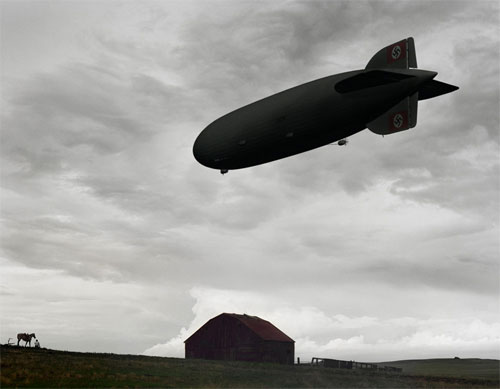
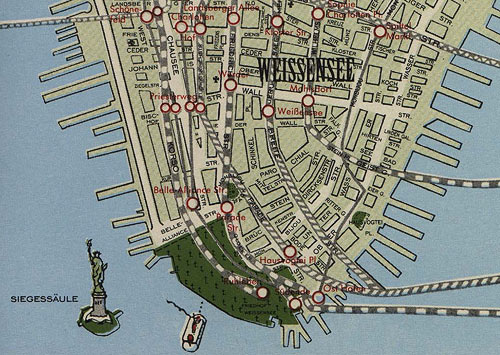
Pairs nicely with Melissa Gould’s Neu-York, “an obsessively detailed alternate-history map, imagining how Manhattan might have looked had the Nazis conquered it in World War II”.
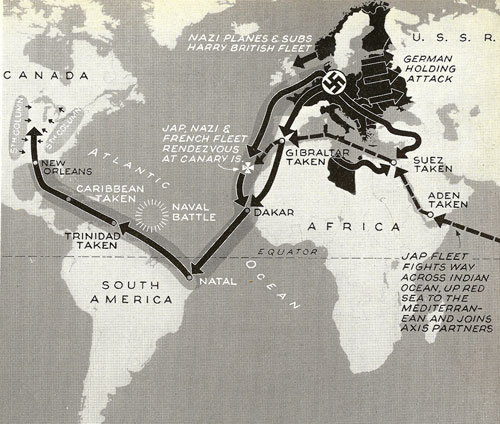
In 1942, Life magazine speculated about what an Axis invasion of North America might look like.
Got this from several people yesterday: are these people dressed up for Halloween or just live in Williamsburg? It’s surprisingly difficult to tell.
One of the many reasons to love the wooden water towers found on the tops of NYC buildings is that the structures themselves reveal the math behind how they work.
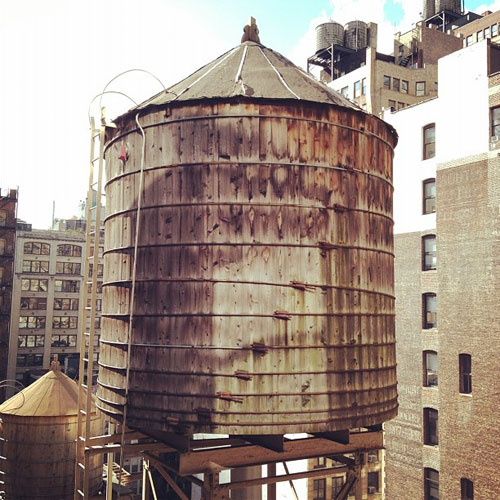
The distance between the metal bands holding the cylindrical structure together decreases from top to bottom because the pressure the water exerts increases with depth. The top band only needs to fight against the water at the very top of the tower but the bottom bands have to hold the entire volume from bursting out.
A couple years ago, I pointed to a 10-minute clip of a longer documentary called The Social Life of Small Urban Spaces. Some kind soul has put the whole thing up on Vimeo.
This witty and original film is about the open spaces of cities and why some of them work for people while others don’t. Beginning at New York’s Seagram Plaza, one of the most used open areas in the city, the film proceeds to analyze why this space is so popular and how other urban oases, both in New York and elsewhere, measure up. Based on direct observation of what people actually do, the film presents a remarkably engaging and informative tour of the urban landscape and looks at how it can be made more hospitable to those who live in it.
Update: The Vimeo video has been taken down, but you can find it on The Internet Archive.
From Quora, some good answers to the question What are some cultural faux pas in New York?
This one is absolutely vital — don’t interfere with others’ privacy. New York is a very crowded place. The way people deal with it is to create their own space. Thus, what outsiders often see as aloofness and isolation is, in fact, a sign of community; there is a shared ethos that everyone respects others’ privacy and expects others to respect his own. This is chiefly communicated through eye contact. If you stare at someone on the subway: if you linger in looking out your window into someone else’s bedroom; if you react to or interrupt a celebrity; or if you seem to be intentionally listening in to another’s conversation, you are violating one of New York’s most sacred unwritten rules. Keep yourself to yourself, buddy, and let others do the same.
Bill Cunningham New York, a documentary film about the unassuming king of street fashion photography, is out on DVD today.
“We all get dressed for Bill,” says Vogue editor Anna Wintour. The Bill in question is 80+ New York Times photographer Bill Cunningham. For decades, this Schwinn-riding cultural anthropologist has been obsessively and inventively chronicling fashion trends he spots emerging from Manhattan sidewalks and high society charity soirees for his beloved Style section columns On The Street and Evening Hours.
Cunningham’s enormous body of work is more reliable than any catwalk as an expression of time, place and individual flair. The range of people he snaps uptown fixtures like Wintour, Brooke Astor, Tom Wolfe and Annette de la Renta (who appear in the film out of their love for Bill), downtown eccentrics and everyone in between reveals a delirious and delicious romp through New York. But rarely has anyone embodied contradictions as happily and harmoniously as Bill, who lived a monk-like existence in the same Carnegie Hall studio at for fifty years, never eats in restaurants and gets around solely on bike number 29 (28 having been stolen).
It got great reviews…currently 98% on Rotten Tomatoes.
Gothamist is trying something new: long-form articles available for a small fee ($2-3) on the Kindle or as a PDF. The first one in the series is a real corker…Confessions of a “Rape Cop” Juror, a piece written by a member of the jury that acquitted two NYPD officers charged with raping a young woman in her East Village apartment.
The former cop sprang from his chair and rushed toward me, and before I could step back, the stocky arms of the ex-boxer were curled around my shoulders. To my left, I saw a crowd of faces; to my right, a place setting. One knife, one fork, and one dull spoon wrapped in a white cloth napkin — not much help if he started strangling me. The arms tightened, and then the high-pitched, soft-spoken voice I recognized from the witness stand whispered, “Thank you.”
My chest sank with a long exhale, and a whirlwind of high-powered suits and smiles rose from their glasses of Cabernet. They floated toward me with outstretched hands and watery eyes, the aroma of freshly baked focaccia robiolas mixing with their cologne. One floor below, diners in this Murray Hill Italian restaurant chattered away ignorant of the strange encounter at the top of the back staircase. The man hugging me was supposed to be the monster I had spent seven weeks analyzing and seven days judging. This was Kenneth Moreno, Rape Cop.
I haven’t read the piece but The Awl’s Choire Sicha has:
It’s a fascinating read, and I mean that in a very honest sense. In large part it’s about how unbelievably important jury service is in America, and about how we treat those accused of crimes. Whether you like the verdict or not, or whether you like the case presented by prosecutors or not (SIGH), this view into the thinking and process of the jurors is really valuable.
Great annotated list by Dennis Crowley of places that contributed to the creation of Foursquare.
Foursquare (and it’s predecessor, dodgeball.com) were designed and built in downtown NYC. Here’s a walking tour of where a lot of the ideas came from.
As Steven Johnson said, this is a “case study in how urban space fosters innovation”.
The New York Philharmonic, joined by Philip Glass himself, will perform the score for Koyaanisqatsi while the film is projected on a screen above the stage.
Lose yourself in Philip Glass’s powerful music for the 1982 Godfrey Reggio film Koyaanisqatsi: A Life Out Of Balance, performed live by the Philharmonic and the Philip Glass Ensemble, as the landmark film is projected on a huge screen above the Avery Fisher Hall stage.
There will be two performances, Nov 2 and Nov 3 at 7:30pm at Avery Fisher Hall. There are still tons of great seats available, but get ‘em while you can. Excited!
Newer posts
Older posts





Socials & More