kottke.org posts about Google
DeepDream is, well, I can’t improve upon Wikipedia’s definition:
DeepDream is a computer vision program created by Google engineer Alexander Mordvintsev which uses a convolutional neural network to find and enhance patterns in images via algorithmic pareidolia, thus creating a dream-like hallucinogenic appearance in the deliberately over-processed images.
The freaky images took the web by storm a couple of years ago after Google open-sourced the code, allowing people to create their own DeepDreamed imagery.
In the video above, Mordvintsev showcases a DeepDream-ish new use for image generation via neural network: endlessly zooming into artworks to find different artworks hidden amongst the brushstrokes, creating a fractal of art history.
Bonus activity: after staring at the video for four minutes straight, look at something else and watch it spin and twist weirdly for a moment before your vision readjusts. (via prosthetic knowledge)
With just four hours of practice playing against itself and no study of outside material, AlphaZero (an upgraded version of Alpha Go, the AI program that Google built for playing Go) beat the silicon pants off of the world’s strongest chess program yesterday. This is massively and scarily impressive.
AlphaZero won the closed-door, 100-game match with 28 wins, 72 draws, and zero losses.
Oh, and it took AlphaZero only four hours to “learn” chess. Sorry humans, you had a good run.
That’s right — the programmers of AlphaZero, housed within the DeepMind division of Google, had it use a type of “machine learning,” specifically reinforcement learning. Put more plainly, AlphaZero was not “taught” the game in the traditional sense. That means no opening book, no endgame tables, and apparently no complicated algorithms dissecting minute differences between center pawns and side pawns.
This would be akin to a robot being given access to thousands of metal bits and parts, but no knowledge of a combustion engine, then it experiments numerous times with every combination possible until it builds a Ferrari. That’s all in less time that it takes to watch the “Lord of the Rings” trilogy. The program had four hours to play itself many, many times, thereby becoming its own teacher.
Grandmaster Peter Heine Nelson likened the experience of watching AlphaZero play to aliens:
After reading the paper but especially seeing the games I thought, well, I always wondered how it would be if a superior species landed on earth and showed us how they play chess. I feel now I know.
As I said about AlphaGo last year, our machines becoming unpredictable is unnerving:
Unpredictable machines. Machines that act more like the weather than Newtonian gravity. That’s going to take some getting used to.
Albert Silver has a good overview of AlphaZero’s history and what Google has accomplished. To many chess experts, it seemed as though AlphaZero was playing more like a human than a machine:
If Karpov had been a chess engine, he might have been called AlphaZero. There is a relentless positional boa constrictor approach that is simply unheard of. Modern chess engines are focused on activity, and have special safeguards to avoid blocked positions as they have no understanding of them and often find themselves in a dead end before they realize it. AlphaZero has no such prejudices or issues, and seems to thrive on snuffing out the opponent’s play. It is singularly impressive, and what is astonishing is how it is able to also find tactics that the engines seem blind to.
So, where does Google take AlphaZero from here? In a post which includes the phrase “Skynet Goes Live”, Tyler Cowen ventures a guess:
I’ve long said that Google’s final fate will be to evolve into a hedge fund.
Why goof around with search & display advertising when directly gaming the world’s financial market could be so much more lucrative?
Google has launched a series of voice experiments that work with Google Home and also in the browser. For example, Mystery Animal is a 20 questions style game in which you attempt to guess the identity of a particular animal. Here’s how it works:
Another of the experiments, MixLab, helps you make music with simple voice commands (“add a club beat”, etc.). The experiments use AI to understand what people are asking them.
Nicole He, who worked on Mystery Animal and another experiment called Story Speaker, explains why it’s an interesting time to be goofing around with voice technology.
Talking out loud to computers has always felt more science fiction than real life. But speech recognition technology has come a long way, and developers are now making lots of useful things with voice devices. These days, you can speak out loud and have your lights turn on, or your favorite music played, or the news read to you.
That’s all nice and good, but there’s something clearly missing: the weird stuff. We should make things for voice technology that aren’t just practical. We should make things that are way more creative and bizarre. Things that are more provocative and expressive, or whimsical and delightful.
We’re in what I’m going to call The 1996 Web Design Era of voice technology. The web was created for something practical (sharing information between scientists), but it didn’t take very long for people to come up with strange and creative things to do with it.
I am terrible at 20 questions, so of course Mystery Animal stumped me. My last guess was “are you a zebra?” when the animal was actually a panda bear.
Writer and artist James Bridle has noticed that something is wrong on the internet. Specifically, algorithmically chosen and produced content is taking over more and more of the internet, including what your young children are watching on YouTube.
Someone or something or some combination of people and things is using YouTube to systematically frighten, traumatise, and abuse children, automatically and at scale, and it forces me to question my own beliefs about the internet, at every level.
By his own admission, there doesn’t seem to be anything egregiously wrong or upsetting about many of the examples Bridle uses. I mean, have you read Grimm’s fairy tales? Some of them are really dark and/or weird, like Black Mirror for children. But the effect in the aggregate is huge, resulting in what he asserts is a system of abuse in which Google is complicit, a technology fueled by advertising and weaponized against its users:
The architecture they have built to extract the maximum revenue from online video is being hacked by persons unknown to abuse children, perhaps not even deliberately, but at a massive scale. I believe they have an absolute responsibility to deal with this, just as they have a responsibility to deal with the radicalisation of (mostly) young (mostly) men via extremist videos — of any political persuasion. They have so far showed absolutely no inclination to do this, which is in itself despicable. However, a huge part of my troubled response to this issue is that I have no idea how they can respond without shutting down the service itself, and most systems which resemble it. We have built a world which operates at scale, where human oversight is simply impossible, and no manner of inhuman oversight will counter most of the examples I’ve used in this essay. The asides I’ve kept in parentheses throughout, if expanded upon, would allow one with minimal effort to rewrite everything I’ve said, with very little effort, to be not about child abuse, but about white nationalism, about violent religious ideologies, about fake news, about climate denialism, about 9/11 conspiracies.
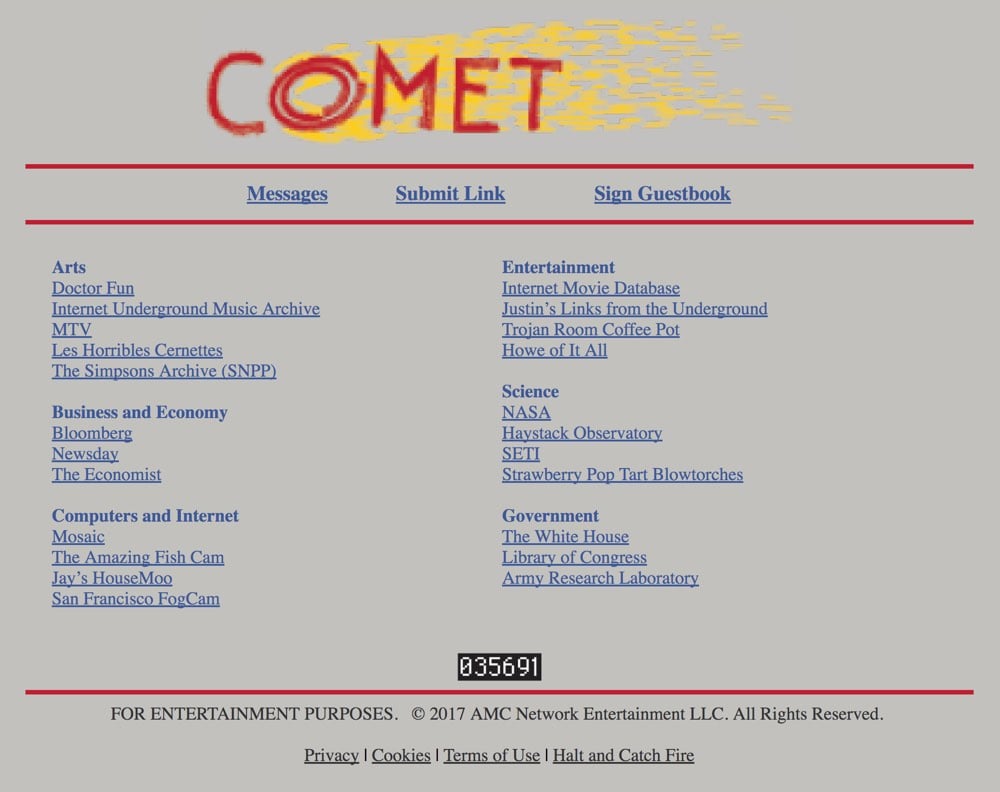
This season on Halt and Catch Fire, competing teams made up of the main characters are building web apps. One team is making a hand-curated directory called Comet and the other is building a search engine with a unique algorithm called Rover. It’s Yahoo vs. Google, more or less. AMC has put up the sites as they appear on the show up on the web: Comet and Rover. They also put up the Cameron Howe fan page seen in the most recent episode, The Howe of It All (that’s a perfectly anachronistic name). See also Yahoo’s website circa 1994 when it was still hosted on a server at Stanford.
A character in the most recent episode also mentioned Justin Hall, creator of the early web’s most well-known personal site, Justin’s Links from the Underground.
Anyone know where I can get a Comet t-shirt? (I already have a Cardiff Electric shirt. (No, really.)) Oh, maybe this?
Inside Music is a Web VR tool from Google and Song Exploder that lets you explore how songs from Perfume Genius, Phoenix, Ibeyi, and others are put together. Here’s a short video explanation:
You can turn different parts of each song off and on…guitars, bass, vocals, etc.; it’s cool to isolate different parts of each song. This works pretty well in the browser but I would imagine it’s a whole different deal if you have a VR rig.
Google has put the code for Inside Music on Github so if you’re a musician, you can explore your own songs in VR or put them up on the web for others to explore.
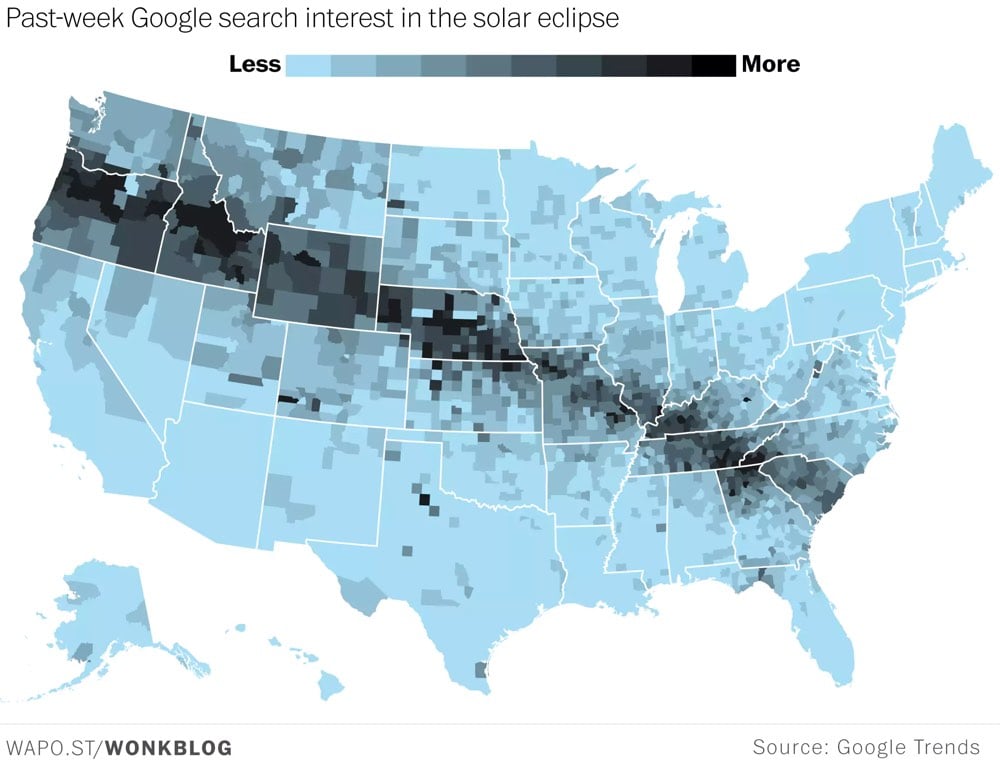
According to Google Trends, search traffic about the upcoming solar eclipse mirrors the path of totality. And according to XKCD, pre-eclipse search traffic for “eclipse” is outpacing pre-election search traffic for “election”.
In celebration of the 44th anniversary of the birth of hip hop, Google has replaced its logo with a pair of working turntables and a crate of records to scratch and mix.
On August 11, 1973, an 18-year-old, Jamaican-American DJ who went by the name of Kool Herc threw a back-to-school jam at 1520 Sedgwick Avenue in the Bronx, New York. During his set, he decided to do something different. Instead of playing the songs in full, he played only their instrumental sections, or “breaks” — sections where he noticed the crowd went wild. During these “breaks” his friend Coke La Rock hyped up the crowd with a microphone. And with that, Hip Hop was born.
The introduction and tutorial is hosted by Fab 5 Freddy, host of the groundbreaking Yo! MTV Raps show. You can play with the DJ setup here:
That was super fun…I spent more time than I would like to admit playing with that. See also Tim Carmody’s Spotify playlist, Introduction to Hip-Hop.
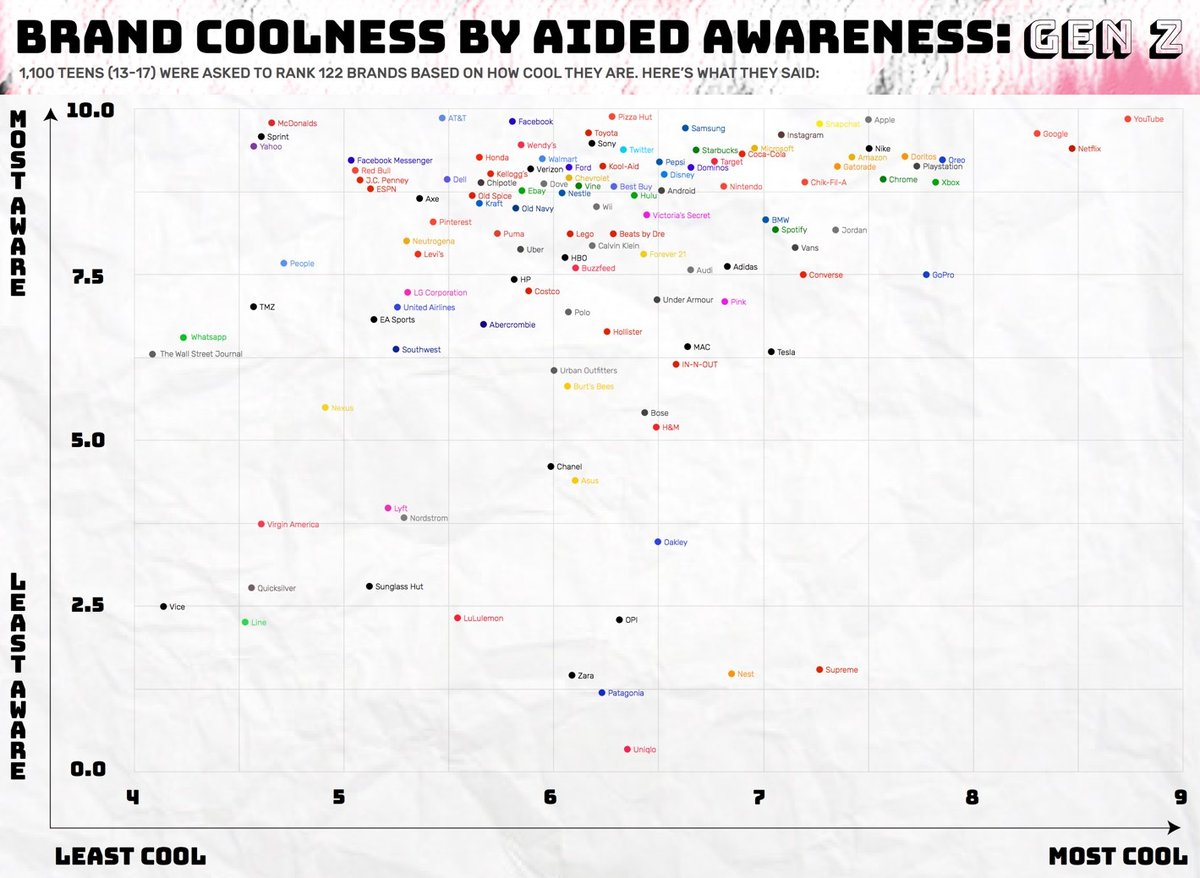
Google recently released a report about what US teenagers think is cool. The chart above is getting a bunch of attention on social media; teens aged 13-17 were asked to rank a bunch of brands according to how cool they think they are. Since the poll was commissioned by Google (and the results published by an internal marketing team), it’s unsurprising that three Google brands (YouTube, Google, Chrome) are in the top 10. Other interesting data points:
- Teens don’t know what Zara and Uniqlo are. Or Supreme.
- Buzzfeed is only slightly cooler than Ford and Chevrolet, which are both cooler than HBO. Perhaps because HBO can’t get you to a party and you can’t make out in a Buzzfeed?
- Kraft is cooler than Red Bull.
- Whatsapp, TMZ, Vice, and Yahoo are all super uncool.
- Twitter is cooler than Facebook, but Snapchat is much cooler than both.
- The Wall Street Journal is the least cool thing in the teen universe.
- This tweet is a good reminder not to take any of this too seriously.
There’s also this curious sentence in the introduction about Generation Z:
Unlike millennials, this group is ambitious, engaged, and feel like they can change the world.
Ouch. In what universe is that even a remotely true or fair statement?
In the NY Times Magazine, Gideon Lewis-Kraus reports on Google’s improving artificial intelligence efforts. The Google Brain team (no, seriously that’s what the team is called) spent almost a year overhauling Google’s translate service, resulting in a startling improvement in the service.
The new incarnation, to the pleasant surprise of Google’s own engineers, had been completed in only nine months. The A.I. system had demonstrated overnight improvements roughly equal to the total gains the old one had accrued over its entire lifetime.
Just after the switchover, Japanese professor Jun Rekimoto noticed the improvement. He took a passage from Ernest Hemingway’s The Snows of Kilimanjaro, translated it into Japanese, and fed it back into Google Translate to get English back out. Here’s how Hemingway wrote it:
Kilimanjaro is a snow-covered mountain 19,710 feet high, and is said to be the highest mountain in Africa. Its western summit is called the Masai “Ngaje Ngai,” the House of God. Close to the western summit there is the dried and frozen carcass of a leopard. No one has explained what the leopard was seeking at that altitude.
And here’s the AI-powered translation:
Kilimanjaro is a mountain of 19,710 feet covered with snow and is said to be the highest mountain in Africa. The summit of the west is called “Ngaje Ngai” in Masai, the house of God. Near the top of the west there is a dry and frozen dead body of leopard. No one has ever explained what leopard wanted at that altitude.
Not bad, especially when you compare it to what the old version of Translate would have produced:
Kilimanjaro is 19,710 feet of the mountain covered with snow, and it is said that the highest mountain in Africa. Top of the west, “Ngaje Ngai” in the Maasai language, has been referred to as the house of God. The top close to the west, there is a dry, frozen carcass of a leopard. Whether the leopard had what the demand at that altitude, there is no that nobody explained.
Google has updated their Timelapse feature on Google Earth, allowing you to scrub satellite imagery from all over the globe back in forth in time.
This interactive experience enabled people to explore these changes like never before — to watch the sprouting of Dubai’s artificial Palm Islands, the retreat of Alaska’s Columbia Glacier, and the impressive urban expansion of Las Vegas, Nevada. Today, we’re making our largest update to Timelapse yet, with four additional years of imagery, petabytes of new data, and a sharper view of the Earth from 1984 to 2016.
A good way to experience some of the most compelling locations is through the YouTube playlist embedded above…just let it run for a few minutes. Some favorite videos are the circular farmland in Al Jowf, Saudi Arabia, the disappearing Aral Sea, the erosion of the Breton National Wildlife Refuge in Louisiana, the urban growth of Chongqing, China, the alarmingly quick retreat of Alaska’s Columbia Glacier, and this meandering river in Tibet.
Soli is a newish project by Google described as “a new sensing technology that uses miniature radar to detect touchless gesture interactions”. It’s pretty cool. A group at The University of St. Andrews has found another potentially more amazing use for the sensor: recognizing specific objects and materials.
RadarCat (Radar Categorization for Input & Interaction) is a small, versatile radar-based system for material and object classification which enables new forms of everyday proximate interaction with digital devices. In this work we demonstrate that we can train and classify different types of objects which we can then recognize in real time. Our studies include everyday objects and materials, transparent materials and different body parts. Our videos demonstrate four working examples including a physical object dictionary, painting and photo editing application, body shortcuts and automatic refill based on RadarCat.
More simply put, if you put an orange on the sensor, it knows it’s an orange…and the system can learn new objects as well. It’s a barcode scanner without barcodes. Watch the video…you’ll get the idea pretty quickly.
Today’s Google Doodle honors the 100th anniversary of the birth of legendary newsman Walter Cronkite.
Today would be the 100th birthday of the man known widely throughout the ’60s and ’70s as “the most trusted man in America.” Walter Cronkite, the legendary broadcast journalist reported, served, and comforted a nation during its most trying times, including World War II, Watergate, the Vietnam War, and the assassination of JFK, to name a few.
Walter perpetuated an objective reporting style rooted in justice and integrity: “Press freedom is essential to our democracy, but the press must not abuse this license. We must be careful with our power. The free press, after all, is the central nervous system of a democratic society.”
Since I missed most of Cronkite’s career as a TV news anchor (I was 7 when he retired), I mostly associate him with the coverage of the Apollo 11 Moon landing and the early web meme Walter Cronkite Spit In My Food.
It was an unbelievable account of a drunken Walter Cronkite raging at a honeymooning couple in a restaurant. It included an obviously faked video clip of Walter Cronkite spitting and a fuzzy photograph of a man who looked vaguely like Cronkite.
Google’s honor is a bit ironic given that Cronkite favored tougher libel and slander laws for “would-be writers and reporters on the Internet”:
I am dumbfounded that there hasn’t been a crackdown with the libel and slander laws on some of these would-be writers and reporters on the Internet. I expect that to develop in the fairly near future.
as well as legislation against anonymous expression online:
I favor legislation that requires people to stand by their words by identifying themselves on the Internet. They should not be permitted to operate anonymously.
He was clear that he was not after censorship:
I hope to make it clear that I did say that I am opposed to any form of censorship. This is identification… forced identification by those who use the Internet. Not censorship. It is simply requiring them to take the same responsibility that people in print and in broadcasting have to take.
I have been following with fascination the match between Google’s Go-playing AI AlphaGo and top-tier player Lee Sedol and with even more fascination the human reaction to AlphaGo’s success. Many humans seem unnerved not only by AlphaGo’s early lead in the best-of-five match but especially by how the machine is playing in those games.
Then, with its 19th move, AlphaGo made an even more surprising and forceful play, dropping a black piece into some empty space on the right-hand side of the board. Lee Sedol seemed just as surprised as anyone else. He promptly left the match table, taking an (allowed) break as his game clock continued to run. “It’s a creative move,” Redmond said of AlphaGo’s sudden change in tack. “It’s something that I don’t think I’ve seen in a top player’s game.”
When Lee Sedol returned to the match table, he took an usually long time to respond, his game clock running down to an hour and 19 minutes, a full twenty minutes less than the time left on AlphaGo’s clock. “He’s having trouble dealing with a move he has never seen before,” Redmond said. But he also suspected that the Korean grandmaster was feeling a certain “pleasure” after the machine’s big move. “It’s something new and unique he has to think about,” Redmond explained. “This is a reason people become pros.”
“A creative move.” Let’s think about that…a machine that is thinking creatively. Whaaaaaa… In fact, AlphaGo’s first strong human opponent, Fan Hui, has credited the machine for making him a better player, a more beautiful player:
As he played match after match with AlphaGo over the past five months, he watched the machine improve. But he also watched himself improve. The experience has, quite literally, changed the way he views the game. When he first played the Google machine, he was ranked 633rd in the world. Now, he is up into the 300s. In the months since October, AlphaGo has taught him, a human, to be a better player. He sees things he didn’t see before. And that makes him happy. “So beautiful,” he says. “So beautiful.”
Creative. Beautiful. Machine? What is going on here? Not even the creators of the machine know:
“Although we have programmed this machine to play, we have no idea what moves it will come up with,” Graepel said. “Its moves are an emergent phenomenon from the training. We just create the data sets and the training algorithms. But the moves it then comes up with are out of our hands — and much better than we, as Go players, could come up with.”
Generally speaking,1 until recently machines were predictable and more or less easily understood. That’s central to the definition of a machine, you might say. You build them to do X, Y, & Z and that’s what they do. A car built to do 0-60 in 4.2 seconds isn’t suddenly going to do it in 3.6 seconds under the same conditions.
Now machines are starting to be built to think for themselves, creatively and unpredictably. Some emergent, non-linear shit is going on. And humans are having a hard time figuring out not only what the machine is up to but how it’s even thinking about it, which strikes me as a relatively new development in our relationship. It is not all that hard to imagine, in time, an even smarter AlphaGo that can do more things — paint a picture, write a poem, prove a difficult mathematical conjecture, negotiate peace — and do those things creatively and better than people.
Unpredictable machines. Machines that act more like the weather than Newtonian gravity. That’s going to take some getting used to. For one thing, we might have to stop shoving them around with hockey sticks. (thx, twitter folks)
Update: AlphaGo beat Lee in the third game of the match, in perhaps the most dominant fashion yet. The human disquiet persists…this time, it’s David Ormerod:
Move after move was exchanged and it became apparent that Lee wasn’t gaining enough profit from his attack.
By move 32, it was unclear who was attacking whom, and by 48 Lee was desperately fending off White’s powerful counter-attack.
I can only speak for myself here, but as I watched the game unfold and the realization of what was happening dawned on me, I felt physically unwell.
Generally I avoid this sort of personal commentary, but this game was just so disquieting. I say this as someone who is quite interested in AI and who has been looking forward to the match since it was announced.
One of the game’s greatest virtuosos of the middle game had just been upstaged in black and white clarity.
AlphaGo’s strength was simply remarkable and it was hard not to feel Lee’s pain.
Newer posts
Older posts





Socials & More