kottke.org posts about Earth
NASA recently released a time lapse video of the Earth constructed from over 3000 still photographs taken over the course of a year. The photos were taken by a camera mounted on the NOAA’s DSCOVR satellite, which is perched above the Earth at Lagrange point 1.
Wait, have we talked about Lagrange points yet? Lagrange points are positions in space where the gravity of the Sun and the Earth (or between any two large things) cancel each other out. The Sun and the Earth pull equally on objects at these five points.
L1 is about a million miles from Earth directly between the Sun and Earth and anything that is placed there will hover there relative to the Earth forever (course adjustments for complicated reasons aside). It is the perfect spot for a weather satellite with a cool camera to hang out, taking photos of a never-dark Earth. In addition to DSCOVR, at least five other spacecraft have been positioned at L1.
L2 is about a million miles from the Earth directly opposite L1. The Earth always looks dark from there and it’s mostly shielded from solar radiation. Five spacecraft have lived at L2 and several more are planned, including the sequel to the Hubble Space Telescope. Turns out that the shadow of the Earth is a good place to put a telescope.
L3 is opposite the Earth from the Sun, the 6 o’clock to the Earth’s high noon. This point is less stable than the other points because the Earth’s gravitational influence is very small and other bodies (like Venus) periodically pass near enough to yank whatever’s there out, like George Clooney strolling through a country club dining room during date night.
And quoting Wikipedia, “the L4 and L5 points lie at the third corners of the two equilateral triangles in the plane of orbit whose common base is the line between the centers of the [Earth and Sun]”. No spacecraft have ever visited these points, but they are home to some interplanetary dust and asteroid 2010 TK7, which orbits around L4. Cool! (via slate)
About a hundred years ago, a tiny asteroid making its way around the sun got caught in Earth’s gravity well. Now it’s locked in an irregular orbit far around our planet, between 38 and 100 times the distance between the Earth and its proper moon.
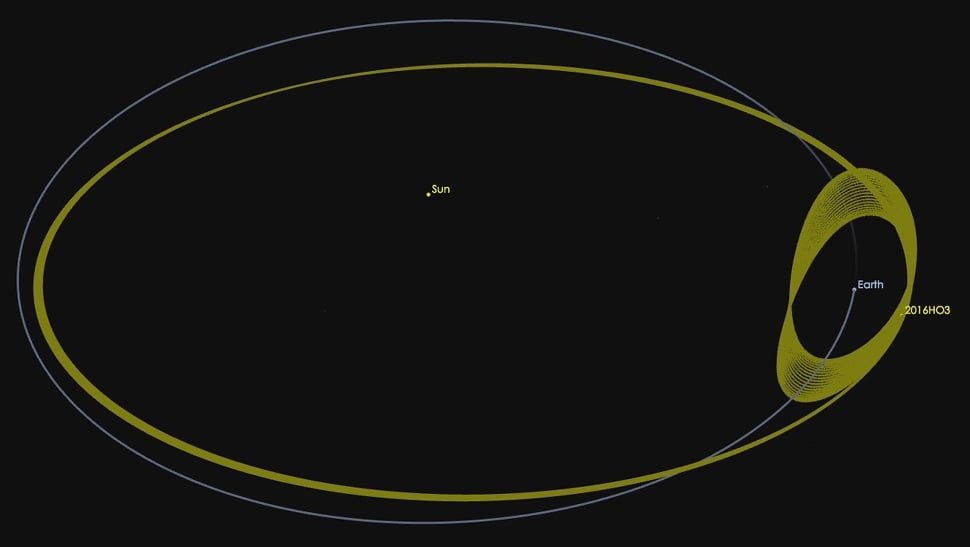
As it orbits the sun, asteroid 2016 HO3 spends about half of the time closer to the sun than Earth, and passes ahead of our planet. The other half of the time it falls behind.
It’s also in a tilted orbit, which causes it to weave up and down on the orbital plane like a bob on choppy waters. As NASA’s Paul Chodas put it in a press statement, “In effect, this small asteroid is caught in a little dance with Earth.”
In another couple of centuries, the asteroid will probably get far enough away that it’ll leave Earth behind forever. I wonder how many times this has happened — how many times the asteroids have been bigger, closer, but still not big or close enough to stay.
If all humans just up and disappeared one day, life on Earth would suffer in the short term but fare much better in the long run.
Full-screen this baby on the biggest high-definition screen you can find. A 5K iMac works spectacularly well.
A new paper by climate scientists, including ex-NASA scientist James Hansen, warns that our climate could dramatically change within decades, not centuries.
Virtually all climate scientists agree with Dr. Hansen and his co-authors that society is not moving fast enough to reduce emissions of greenhouse gases, posing grave risks. The basic claim of the paper is that by burning fossil fuels at a prodigious pace and pouring heat-trapping gases into the atmosphere, humanity is about to provoke an abrupt climate shift.
Non-linear systems, man. Gradually, then all at once.
Update: Slate’s Eric Holthaus has more on the paper and its potential implications.
In addition to the risk of “several meters” of sea level rise this century, which Hansen calls the most important finding, the final version of Hansen’s paper gives new emphasis to the possibility that the ocean’s heat circulation system may be in the process of shutting down. The circulation shutdown would precede the rapid increase in global sea levels. If the shutdown happens, simultaneous cooling of the waters near Greenland and Antarctica and warming in the tropics and midlatitudes could spawn frequent strong storms on the order of Hurricane Sandy or worse.
If that sounds a lot like the plot of The Day After Tomorrow to you, you’re not alone.
Hansen also released a 15-minute video about the paper:
The Japanese satellite Himawari caught yesterday’s total solar eclipse as it moved across the Pacific Ocean.
Update: @paulmison sent along some better views of the eclipse: here and here. I tried to find a better YouTube embed, but no dice. This one, taken of the eclipse in Micronesia, is pretty amazing though…you can see the solar flares coming off the surface of the Sun as it reaches totality. Holy shit, I’m getting excited for Eclipsathon 2017!
From NASA, an animation of the yearly cycle of the Earth’s plant life. The data is taken from satellite measurements (plant density for land and chlorophyll concentration for the ocean) and averaged over several years.
From December to February, during the northern hemisphere winter, plant life in the higher latitudes is minimal and receives little sunlight. However, even in the mid latitudes plants are dormant, shown here with browns and yellows on the land and dark blues in the ocean. By contrast the southern ocean and land masses are at the height of the summer season and plant life is revealed with dark green colors on the land and in the ocean. As the year progresses, the situations reverses, with plant life following the increased sunlight northward, while the southern hemisphere experiences decreased plant activity during its winter.
If you’re anything like me, about 2-3 times into the video’s cycle, you’ll be breathing in tune to the Earth. Oxygen in, carbon dioxide out. Carbon dioxide in, oxygen out. Oxygen in, carbon dioxide out… (via @EricHolthaus)
Here’s everything you need to know about the Earth, in a snappy 7-minute video. I am trying very hard not to watch the rest of Kurzgesagt’s videos this afternoon, but I did make time for this one on the Big Bang — key quote: “time itself becomes wibbly wobbly” — and how evolution works.
Bellerby & Co. Globemakers are one of the world’s last remaining makers of globes by hand. Their Instagram account is chock full of their handiwork.

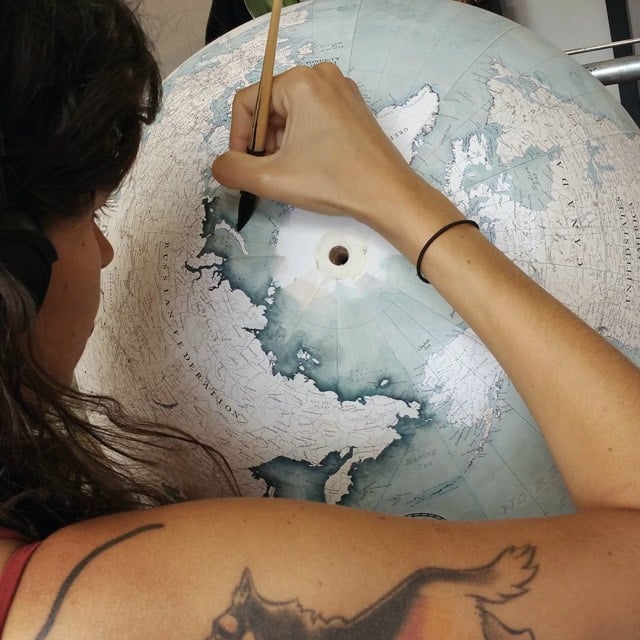
If I could afford it (£2000!), I’d get The Livingstone globe in Prussian blue. Beautiful and wonderful craftsmanship.
How massive are they? The Sun is 1 solar mass and as wide as 109 Earths. Sagittarius A, the black hole at the center of the Milky Way, weighs 4.3 million solar masses and is as wide as Mercury is far from the Sun. The black hole at the center of the Phoenix Cluster is one of the largest known black holes in the Universe; it’s 73 billion miles across, which is 19 times larger than our entire solar system (from the Sun to Pluto). As for how much it weighs, check this out:
I also like that if you made the Earth into a black hole, it would be the size of a peanut. (thx, reidar)
This is just flat-out incredible… NASA’s Deep Space Climate Observatory satellite captured a series of photos of the Moon as it moved between it and the Earth.

The image shows the “dark side” of the Moon, which we can’t see from Earth because it’s always pointed away from us.
The lunar far side lacks the large, dark, basaltic plains, or maria, that are so prominent on the Earth-facing side. The largest far side features are Mare Moscoviense in the upper left and Tsiolkovskiy crater in the lower left. A thin sliver of shadowed area of moon is visible on its right side.
“It is surprising how much brighter Earth is than the moon,” said Adam Szabo, DSCOVR project scientist at NASA’s Goddard Space Flight Center in Greenbelt, Maryland. “Our planet is a truly brilliant object in dark space compared to the lunar surface.”
I don’t know why, but this image gives me chills up my spine! Is anyone else freaking out about this?
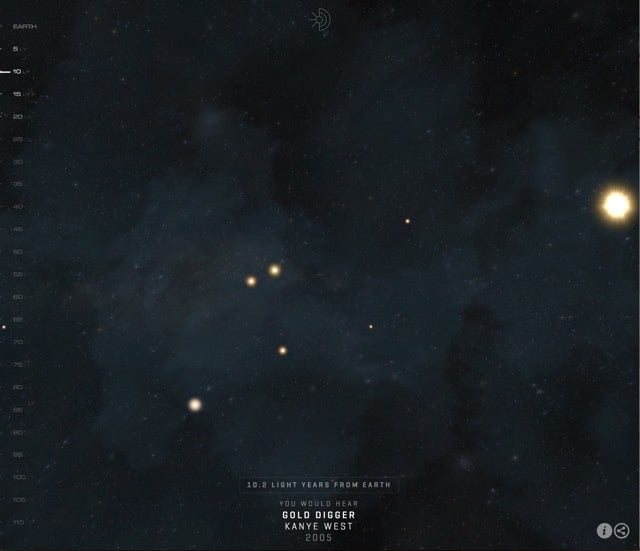
Taking inspiration from the opening sequence of Contact, lightyear.fm is a musical journey away from the Earth. As you get farther out (say, 10 light years away, just past star Ross 154 in the constellation of Sagittarius), you hear music that was broadcast on the radio at that time (Gold Digger by Kanye West).
Radio broadcasts leave Earth at the speed of light. Scroll away from Earth and hear how far the biggest hits of the past have travelled. The farther away you get, the longer the waves take to travel there — and the older the music you’ll hear.
This is the coolest.
Earth Primer is an upcoming iOS app that bills itself as “A Science Book for Playful People”. It looks amazing:
Earth Primer is a science book for playful people. Discover how Earth works through play-on your iPad. Join a guided tour of how Earth works, with the forces of nature at your fingertips. Visit volcanoes, glaciers, sand dunes. Play with them, look inside, and see how they work.
Earth Primer defies existing genres, combining aspects of science books, toys, simulations, and games. It is a new kind of interactive experience which joins the guided quality of a book with open ended simulation play.
Here’s a quick preview of the app. Can’t wait to explore this, with and without the kids.
Update: The Earth Primer app is now available on the App Store.
This is an ultra-HD time lapse of planet Earth in infrared. Infrared light is absorbed by clouds and water vapor, so the result is a sphere of roiling storms and trade winds.
Here’s a video with both hemispheres at once and another offering a closer view. If you’ve got a 4K display, this will look pretty incredible on it. James Tyrwhitt-Drake has done a bunch of other HD videos of the Earth and Sun, including Planet Earth in 4K and the Sun in 4K.

Canadian astronaut Chris Hadfield became a celebrity while aboard the International Space Station. Now he’s publishing a book of photographs he took during his time in orbit: You Are Here: Around the World in 92 Minutes.
During 2,597 orbits of our planet, I took about 45,000 photographs. At first, my approach was scattershot: just take as many pictures as possible. As time went on, though, I began to think of myself as a hunter, silently stalking certain shots. Some eluded me: Brasilia, the capital of Brazil, and Uluru, or Ayers Rock, in Australia. I captured others only after methodical planning: “Today, the skies are supposed to be clear in Jeddah and we’ll be passing nearby in the late afternoon, so the angle of the sun will be good. I need to get a long lens and be waiting at the window, looking in the right direction, at 4:02 because I’ll have less than a minute to get the shot.” Traveling at 17,500 miles per hour, the margin for error is very slim. Miss your opportunity and it may not arise again for another six weeks, depending on the ISS’s orbital path and conditions on the ground.
In an interview with Quartz, Hadfield says the proceeds from the book are being donated to the Red Cross.
Newer posts
Older posts




Socials & More