kottke.org posts about Earth
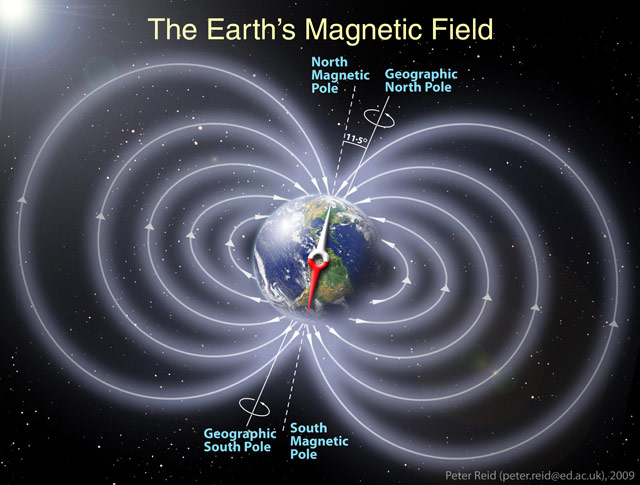
According to data collected by a European satellite array, the Earth’s magnetic field is shifting and weakening at a greater pace than previously thought. One of the reasons for the shift might be that the magnetic North and South poles are swapping positions.
Scientists already know that magnetic north shifts. Once every few hundred thousand years the magnetic poles flip so that a compass would point south instead of north. While changes in magnetic field strength are part of this normal flipping cycle, data from Swarm have shown the field is starting to weaken faster than in the past. Previously, researchers estimated the field was weakening about 5 percent per century, but the new data revealed the field is actually weakening at 5 percent per decade, or 10 times faster than thought. As such, rather than the full flip occurring in about 2,000 years, as was predicted, the new data suggest it could happen sooner.
You can read up on geomagnetic reversals on Wikipedia. A short sampling:
These periods [of polarity] are called chrons. The time spans of chrons are randomly distributed with most being between 0.1 and 1 million years with an average of 450,000 years. Most reversals are estimated to take between 1,000 and 10,000 years. The latest one, the Brunhes-Matuyama reversal, occurred 780,000 years ago. A brief complete reversal, known as the Laschamp event, occurred only 41,000 years ago during the last glacial period. That reversal lasted only about 440 years with the actual change of polarity lasting around 250 years. During this change the strength of the magnetic field dropped to 5% of its present strength.
A group led by Dr. Robert Costanza has calculated the value of the world’s ecosystems…the group’s most recent estimate puts the yearly value at $142.7 trillion.
“I think this is a very important piece of science,” said Douglas J. McCauley of the University of California, Santa Barbara. That’s particularly high praise coming from Dr. McCauley, who has been a scathing critic of Dr. Costanza’s attempt to put price tags on ecosystem services.
“This paper reads to me like an annual financial report for Planet Earth,” Dr. McCauley said. “We learn whether the dollar value of Earth’s major assets have gone up or down.”
The group last calculated this value back in 1997 and it rose sharply over the past 17 years, even as those natural habitats are disappearing. This line from the article stunned me:
Dr. Costanza and his colleagues estimate that the world’s reefs shrank from 240,000 square miles in 1997 to 108,000 in 2011.
Coral reefs shrank by more than half over the past 17 years…I had no idea the reef situation was that bad. Jesus.
If the Moon orbited the Earth at the same distance as the International Space Station, it might look a little something like this:
At that distance, the Moon would cover half the sky and take about five minutes to cross the sky. Of course, as Phil Plait notes, if the Moon were that close, tidal forces would result in complete chaos for everyone involved.
There would be global floods as a tidal wave kilometers high sweeps around the world every 90 minutes (due to the Moon’s closer, faster orbit), scouring clean everything in its path. The Earth itself would also be stretched up and down, so there would be apocalyptic earthquakes, not to mention huge internal heating of the Earth and subsequent volcanism. I’d think that the oceans might even boil away due to the enormous heat released from the Earth’s interior, so at least that spares you the flood… but replaces water with lava. Yay?
About 250 million years ago, Earth suffered its fifth (and worst) mass extinction event. Nearly seventy percent of land species disappeared. And they got off easy compared to marine species. Are we headed for another mass extinction on Earth? I’m not ready to break that news. But something unusual is definitely going on and extinction rates seem to be speeding up. Here’s an interesting chat with Elizabeth Kolbert, author of The Sixth Extinction.
The worst mass extinction of all time came about 250 million years ago [the Permian-Triassic extinction event]. There’s a pretty good consensus there that this was caused by a huge volcanic event that went on for a long time and released a lot of carbon-dioxide into the atmosphere. That is pretty ominous considering that we are releasing a lot of CO2 into the atmosphere and people increasingly are drawing parallels between the two events.
In a fly-by of Earth on its way to Jupiter, NASA’s Juno probe took a short movie of the Moon orbiting the Earth. It’s the first time the Moon’s orbit has been captured on film.
(via @DavidGrann)
Scientists from an advanced alien society have discovered a potentially remarkable planet that turns out to be “completely hostile to life”.
“Theoretically, this place ought to be perfect,” leading Terxus astrobiologist Dr. Srin Xanarth said of the reportedly blighted planet located at the edge of a spiral arm in the Milky Way galaxy. “When our long-range satellites first picked it up, we honestly thought we’d hit the jackpot. We just assumed it would be a lush, green world filled with abundant natural resources. But unfortunately, its damaged biosphere makes it wholly unsuitable for living creatures of any kind.”
“It’s basically a dead planet,” she added. “We give it another 200 years, tops.”
The alien researchers stated that the dramatically warming atmosphere of RP-26 contains alarming amounts of carbon dioxide and methane, as well as an ozone layer that-for reasons they cannot begin to fathom-has been allowed to develop a gaping hole. They also noted the presence of melting polar icecaps, floods, and enough pollutants to poison “every last drop of the planet’s fresh water, if you can even call it that.”
You finally really did it. You maniacs! You blew it up! God damn you! God damn you all to hell!
A pair of scientists looked at the rate at which the complexity of life increases and then extrapolated back to a point of zero complexity, aka the origin of life. The answer they came up with is 9.7 ± 2.5 billion years ago. Which is much older than the Earth. This idea has some provocative implications:
Sharov and Gordon say their interpretation also explains the Fermi paradox, which raises the question that if the universe is filled with intelligent life, why can’t we see evidence of it.
However, if life takes 10 billion years to evolve to the level of complexity associated with humans, then we may be among the first, if not the first, intelligent civilisation in our galaxy. And this is the reason why when we gaze into space, we do not yet see signs of other intelligent species.

There’s nothing like a composite photo of the Perseids meteor shower to hammer home the realization that the Earth is hurtling through space like the Millennium Falcon making the Kessel Run. Photo by David Kingham.
Where have I seen this before, a massive long-lasting Arctic storm that looks a lot like a hurricane? Oh right, The Day After Tomorrow.
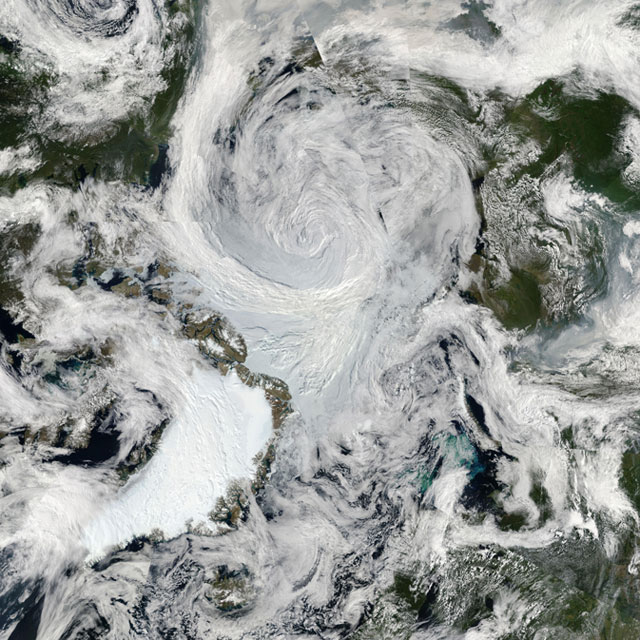
The storm had an unusually low central pressure area. Paul A. Newman, chief scientist for Atmospheric Sciences at NASA’s Goddard Space Flight Center in Greenbelt, Md., estimates that there have only been about eight storms of similar strength during the month of August in the last 34 years of satellite records. “It’s an uncommon event, especially because it’s occurring in the summer. Polar lows are more usual in the winter,” Newman said.
Arctic storms such as this one can have a large impact on the sea ice, causing it to melt rapidly through many mechanisms, such as tearing off large swaths of ice and pushing them to warmer sites, churning the ice and making it slushier, or lifting warmer waters from the depths of the Arctic Ocean.
I love The Day After Tomorrow. I know it’s a cheeseball disaster movie (which is pretty much why I love it) but it’s also looking more than a little prescient. Well, as prescient as a cheeseball disaster movie can be anyway. In the Washington Post the other day, prominent climatologist James Hansen wrote that human-driven climate change is responsible for an increase in extreme weather.
My projections about increasing global temperature have been proved true. But I failed to fully explore how quickly that average rise would drive an increase in extreme weather.
In a new analysis of the past six decades of global temperatures, which will be published Monday, my colleagues and I have revealed a stunning increase in the frequency of extremely hot summers, with deeply troubling ramifications for not only our future but also for our present.
This is not a climate model or a prediction but actual observations of weather events and temperatures that have happened. Our analysis shows that it is no longer enough to say that global warming will increase the likelihood of extreme weather and to repeat the caveat that no individual weather event can be directly linked to climate change. To the contrary, our analysis shows that, for the extreme hot weather of the recent past, there is virtually no explanation other than climate change.
In many ways, the phrase “global warming” is grossly misleading. “Oh,” we think, “it’s gonna be a couple degrees warmer in NYC in 20 years than it is now.” But the Earth’s climate is a chaotic non-linear system, which means that a sudden shift of a degree or two — and when you’re talking about something as big as the Earth, a degree over several decades is sudden — pushes things out of balance here and there in unpredictable ways. So it’s not just that it’s getting hotter, it’s that you’ve got droughts in places where you didn’t have them before, severe floods in other places, unusually hot summers, and even places that are cooler than normal, all of which disrupts the animal and plant life that won’t be able to acclimate to the new reality fast enough.
But pretty Arctic cyclone though, right?
What if Mars orbited the Earth at the same distance as the Moon…what would that look like? How about Neptune? Or Jupiter? Like this:
See also what the Earth would look like with Saturn’s rings. (via @stevenstrogatz)
Well, now, this is gorgeous. Stamen Design overlaid watercolor textures on OpenStreetMap map tiles to show you what it would look like if your favorite watercolorist designed Google Maps.
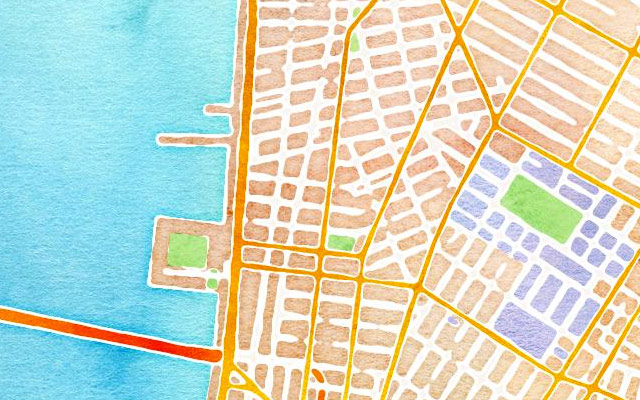
It’s fun to scroll and scroll. (via @tomcoates)
And since we all could stand to look at more pretty things, watch this video of what different landscapes would look like if Earth had Saturn’s rings. (via @ianmurren)
Space always seems so far away and much of it actually is. But space is actually quite close to where we are all sitting right now. The Kármán line, the commonly accepted boundary between the Earth’s atmosphere and space, is only 62 miles above sea level.
The line was named after Theodore von Kármán, (1881-1963) a Hungarian-American engineer and physicist who was active primarily in the fields of aeronautics and astronautics. He first calculated that around this altitude the Earth’s atmosphere becomes too thin for aeronautical purposes (because any vehicle at this altitude would have to travel faster than orbital velocity in order to derive sufficient aerodynamic lift from the atmosphere to support itself). Also, there is an abrupt increase in atmospheric temperature and interaction with solar radiation.
A distance of 62 miles can covered by a car on the interstate in less than an hour. Stable Earth orbits are achievable at only 100 miles above the Earth, with the ISS and Space Shuttles usually orbiting at a height of ~200 miles. To show how small a distance that really is, I made the following image…the orange line in the upper left represents 200 miles away from the surface.

Pretty crazy.
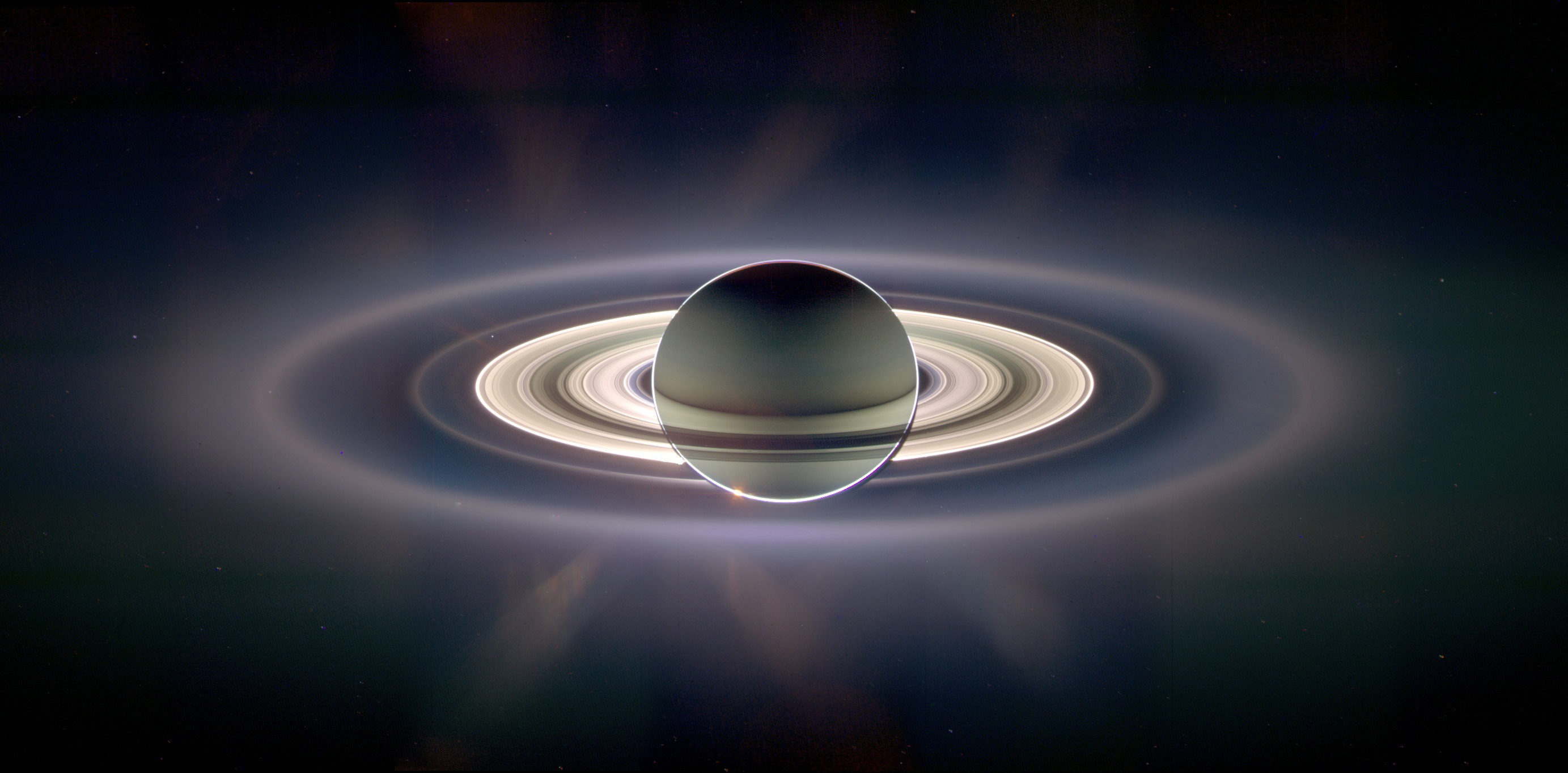
The Cassini spacecraft caught this remarkable photo of Saturn eclipsing the Sun in 2006.
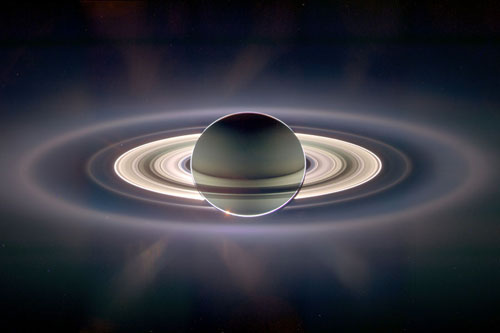
Click through for the big image and the massive image. If you look close can see the Earth in the image, for reals!
Newer posts
Older posts




Socials & More