kottke.org posts about Disney
Disney dropped the trailer for The Mandalorian and Grogu today, a feature-length film that will debut in theaters in May 2026. As this Star Wars Explained breakdown, er, explains, that the trailer was going to come out earlier but:
Word on the street is that it was supposed to come out this past Friday, but Disney was and is in the middle of some hot water. Acting like cowards in the face of authoritarianism will do that, especially when one of the franchises you own {shows footage of Andor} is about the exact opposite.
Last week, Disney made the decision to pull Jimmy Kimmel Live from the schedule because of threats from the Trump regime, prompting protests. Kimmel returns to the air tomorrow night:
“Last Wednesday, we made the decision to suspend production on the show to avoid further inflaming a tense situation at an emotional moment for our country. It is a decision we made because we felt some of the comments were ill-timed and thus insensitive,” the company said in a statement. “We have spent the last days having thoughtful conversations with Jimmy, and after those conversations, we reached the decision to return the show on Tuesday.”
This is pretty clever actually: Disney+ and ESPN+ will air a real-time, Toy Story-ified version of the Oct 1st Jacksonville Jaguars and Atlanta Falcons NFL game. From Deadline:
Using the NFL’s Next Gen Stats and on-field tracking data, every player and play will be presented in “Andy’s Room,” the familiar, brightly colored setting for the Toy Story franchise. The action will be virtually simultaneous with the main game telecast, with most plays recreated after an expected delay in the neighborhood of about 30 seconds. Woody, Buzz Lightyear and many other characters will be visible throughout, and a press release notes they will be “participating from the sidelines and in other non-gameplay elements.” Along with game action, the announcers, graphics, scoreboard, referees’ penalty announcements, celebrations and other parts of the experience will all be rendered in a Toy Story-centric fashion.
I stopped watching the NFL years ago, but I might tune in to see how this works.
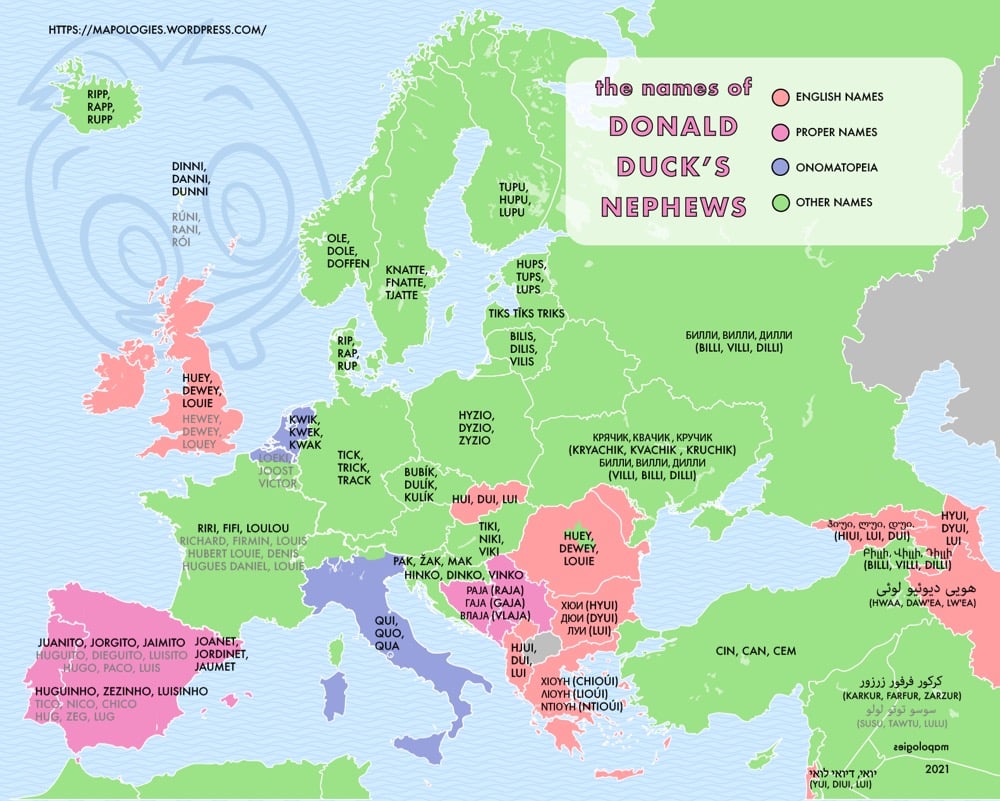
In the US and other English-speaking countries, the names of Donald Duck’s three nephews are Huey, Dewey, and Louie. As this map shows, they have different names in other countries — like Tick/Trick/Track in Germany, Billi/Villi/Dilli in Russia, and Ripp/Rapp/Rupp in Iceland.
You should check out the rest of the maps on the Mapologies blog as well, including maps of what the Milky Way is called in different countries and what people say when toasting.
I have been on this internet for a long damn time and somehow this has escaped my attention until just this morning: Disney reuses bits of animation in their movies and TV shows *all the time*. And blatantly so — just check out this comparison of sequences from The Jungle Book (made in 1967) and The Many Adventures of Winnie the Pooh (made in 1977):
There are many other instances of this reuse throughout Disney’s catalog of animation — The Fox and the Hound, 101 Dalmatians, Alice in Wonderland, Beauty and the Beast, Robin Hood etc.:
For animators under time constraints and on a budget, recycling footage was a sensible thing to do and probably wasn’t widely known among the viewing public until extensive at-home viewing, digital editing, and collecting sleuthing via the internet became available.
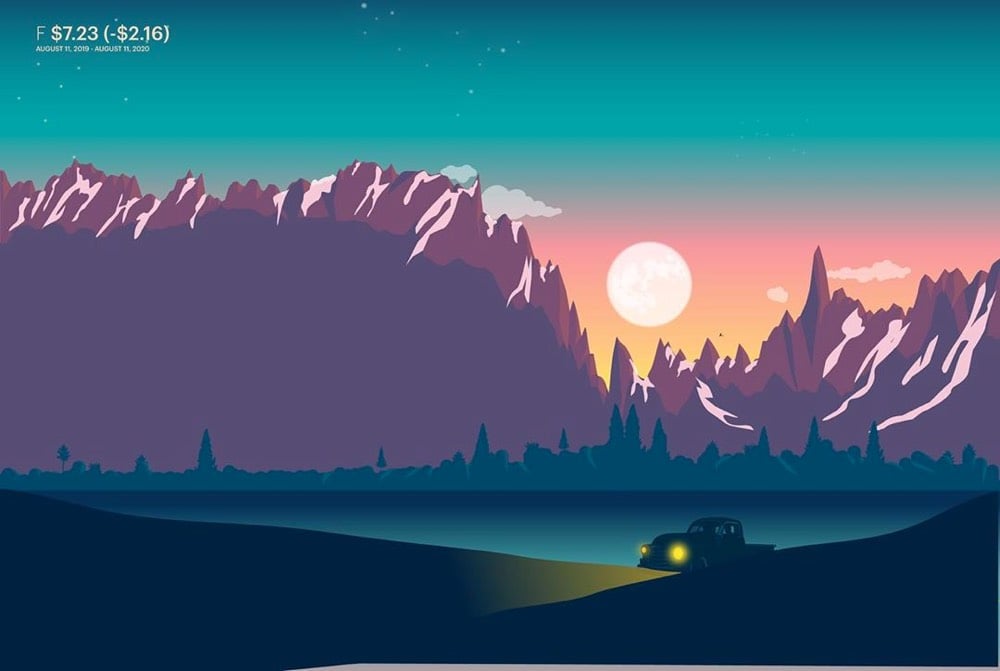
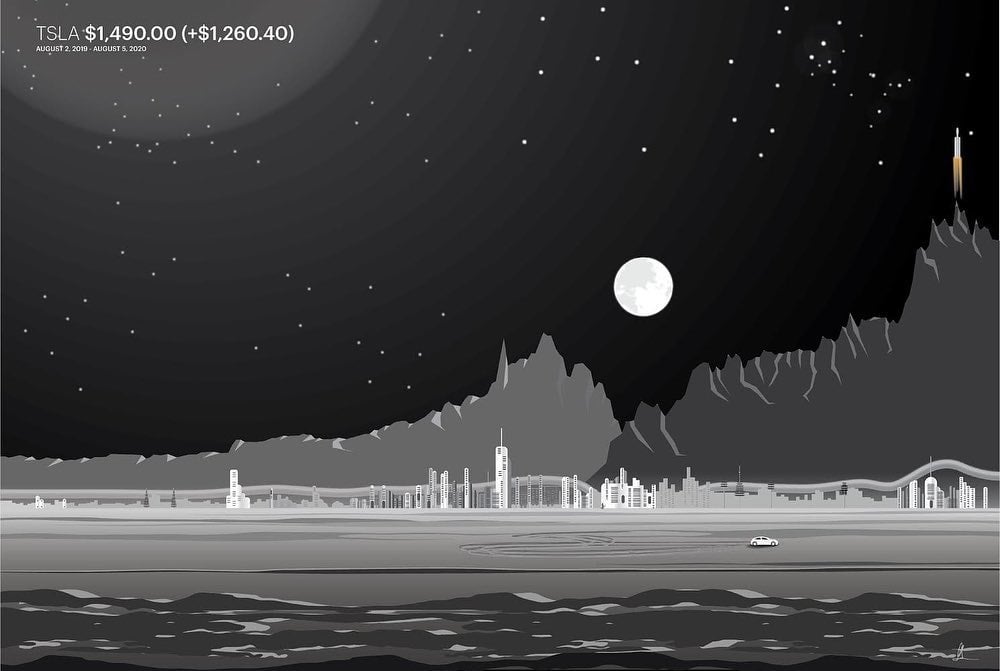
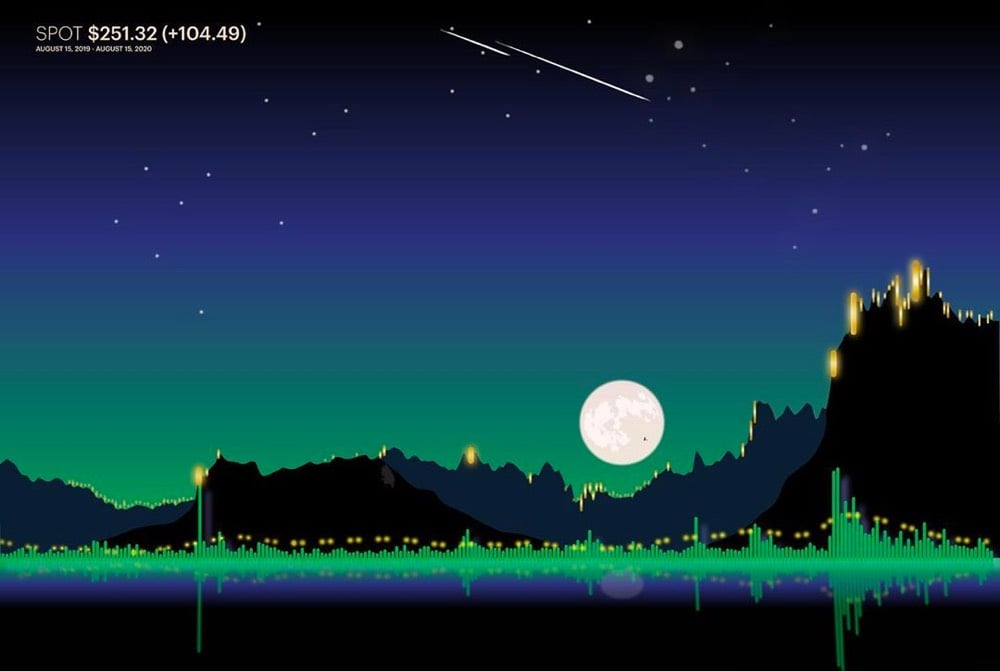
Inspired by the charts on Robinhood and Yahoo Finance, Gladys Orteza is turning the charts of notable stocks into landscape artworks, inserting references to the company into the art. The Ford chart at the top has a truck, the Tesla chart features a rocket (a reference to SpaceX), and the Disney one includes the twin suns of Tatooine & a Jawa Sandcrawler.
Reminds me of Michael Najjar’s High Altitude series (stock market charts represented by jagged Andean mountain peaks) and Jill Pelto turning climate change graphs into art. (via waxy)
This is a 45-second clip from Pinocchio, an animated film made by Disney in 1940.
The scene itself isn’t that exciting…until you actually start to wonder, wait, how was this made? The way the camera effortlessly swoops past buildings and through archways like one of Pixar’s infinitely pliable virtual cameras, the depth of field changing as we pan and zoom toward Pinocchio’s door — how did they do that 80 years ago, animating by hand? The film’s animators achieved this effect using a relatively recent invention, the multiplane camera.
The basic idea is that instead of animating characters against a single static background, you can animate several layers of independently moving scenes painted on glass. In a 1957 film, Walt Disney himself explained how the camera worked:
And here’s how Disney used the technique in dozens of scenes from Snow White to Bambi to 101 Dalmatians:
Because we’re seeing the output of an actual camera zooming and panning, many of these scenes feel more grounded in reality than even some of today’s best digital output. Even 80 years later, the effect is impressive, a real testament to the collaborative talent of Disney’s animators & technicians.
In the latest in a series of videos on film innovations that came from outside Hollywood, Phil Edwards highlights rotoscoping, a process of filming live action and transferring the motion to produce realistic animated movement invented by Max Fleischer.
As the above video shows, it started with Max’s brother Dave dancing on a roof in a clown costume. Footage of that was then used to model the classic Koko the Clown cartoons, which formed the basis for many Fleischer Studios films. Today, animators still use techniques like rotoscoping to turn real movement into animation.
A number of the studio’s most memorable cartoons used footage of legendary jazz singer Cab Calloway to create fluid animated sequences, like this dancing walrus from Betty Boop.
As Edwards notes, Fleischer’s studio also invented an early multiplane animation device, which allowed for the independent movement of different parts of the background to create the illusion of depth, resulting in yet more realism. Here’s Steven Johnson describing Disney’s more sophisticated multiplane camera in his book Wonderland: How Play Made the Modern World:
All of these technical and procedural breakthroughs summed up to an artistic one: Snow White was the first animated film to feature both visual and emotional depth. It pulled at the heartstrings in a way that even live-action films had failed to do. This, more than anything, is why Snow White marks a milestone in the history of illusion. “No animated cartoon had ever looked like Snow White,” Disney’s biographer Neil Gabler writes, “and certainly none had packed its emotional wallop.” Before the film was shown to an audience, Disney and his team debated whether it might just be powerful enough to provoke tears — an implausible proposition given the shallow physical comedy that had governed every animated film to date. But when Snow White debuted at the Carthay Circle Theatre, near L.A.’s Hancock Park, on December 21, 1937, the celebrity audience was heard audibly sobbing during the final sequences where the dwarfs discover their poisoned princess and lay garlands of flowers on her.
Alan Taylor of In Focus has curated a selection of photos taken during the first few days after Disneyland was opened to the public in July 1955.


Whaaaat the hell is up with Mickey and Minnie’s faces in that last photo? Maybe that’s what the kids in the top photo are running away from in terror?
Queueing theory is the scientific study of waiting in line. It can apply to familiar lines like those at the grocery store or bank but also to things like web servers, highway traffic, and telecommunications…basically any situation where you have things entering a system, being processed by a system for a certain period of time, and leaving the system.
The study of queueing is necessary because the effects of waiting in line often run counter to our intuition (which causes people to get cranky about it). Take this example from John Cook of tellers serving customers at a bank:
Suppose a small bank has only one teller. Customers take an average of 10 minutes to serve and they arrive at the rate of 5.8 per hour. What will the expected waiting time be? What happens if you add another teller?
We assume customer arrivals and customer service times are random (details later). With only one teller, customers will have to wait nearly five hours on average before they are served.
Five hours?! I would not have guessed anywhere close to that, would you? Now, add a second teller into the mix. How long is the average wait now? 2.5 hours? 1 hour? According to Cook, much lower than that:
But if you add a second teller, the average waiting time is not just cut in half; it goes down to about 3 minutes. The waiting time is reduced by a factor of 93x
Our lack of intuition about queues has to do with how much the word “average” is hiding…the true story is much more complex.
Aside from the math, designers of queueing systems also have to take human psychology into account.
There are three givens of human nature that queuing psychologists must address: 1) We get bored when we wait in line. 2) We really hate it when we expect a short wait and then get a long one. 3) We really, really hate it when someone shows up after us but gets served before us.
The boredom issue has been tackled in myriad ways — from the mirrors next to elevator banks to the TVs in dentist’s waiting rooms. Larson mentions a clever solution from the Manhattan Savings Bank, which once hired a concert pianist to play in its lobby as customers waited for tellers. “But Disney has been the absolute master of this aspect of queue psychology,” says Larson. “You might wait 45 minutes for an 8-minute ride at Disney World. But they’ll make you feel like the ride has started while you’re still on line. They build excitement and provide all kinds of diversions in the queue channel.” Video screens tease the thrills ahead, and a series of varied chambers that the queue moves through creates a sense of progress. Another solution: those buzzing pagers that restaurants in malls sometimes give you while you’re waiting for a table. Instead of focusing on the misery of the wait, you can go off and entertain yourself-secure in the knowledge that you’ll be alerted when it’s your turn.
Whole Foods had to work around our expectations when it switched to “serpentine” lines that seemed longer but actually served customers more quickly.
By 7 p.m. on a weeknight, the lines at each of the four Whole Foods stores in Manhattan can be 50 deep, but they zip along faster than most lines with 10 shoppers.
Because people stand in the same line, waiting for a register to become available, there are no “slow” lines, delayed by a coupon-counting customer or languid cashier. And since Whole Foods charges premium prices for its organic fare, it can afford to staff dozens of registers, making the line move even faster.
“No way,” is how Maggie Fitzgerald recalled her first reaction to the line at the Whole Foods in Columbus Circle. For weeks, Ms. Fitzgerald, 26, would not shop there alone, assigning a friend to fill a grocery cart while she stood in line.
When she discovered the wait was about 4 minutes, rather than 20, she began shopping by herself, and found it faster than her old supermarket.
See also How to Pick the Fastest Line at the Supermarket, Queue Theory and Design from 99% Invisible, and this paper from Bob Wescott, Seven Insights Into Queueing Theory. One of his insights:
It’s very hard to use the last 15% of anything. As the service center gets close to 100% utilization the response time will get so bad for the average transaction that nobody will be having any fun. The graph below is exactly the same situation as the previous graph except this graph is plotted to 99% utilization. At 85% utilization the response time is about 7x and it just gets worse from there.
For grocery stores or call centers, that means you’re going to have operators or cashiers sitting there “doing nothing” sometimes because if you don’t, you’re gonna be in trouble when a rush hits.
Update: John Frost shares an anecdote about his grandfather’s team designed the queueing system for the Matterhorn Bobsleds at Disneyland:
Another fun family story is the invention of the Matterhorn’s first of its kind switchback queue. Vic Greene and his team of Imagineers developed a system that would have the entrance to the switchback part of the queue be lower than the exit. When you stood at the entrance, the exit would appear closer to you in an optical illusion. The idea was to make your wait seem less cumbersome by visually shortening the queue.
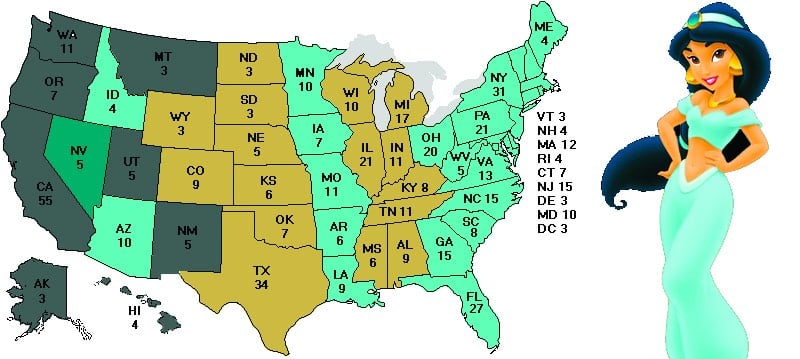
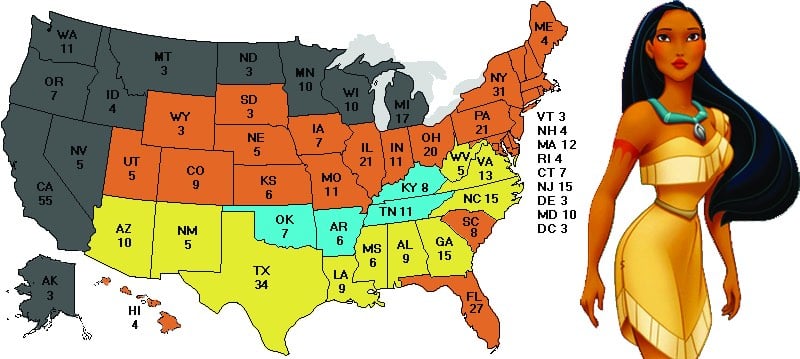
Pretty much what it says on the tin. Not much else to add.
Jorge Luengo Ruiz has collected what he calls the most beautiful shots in the history of Disney. The scenes are pulled from nearly every Disney feature-length animation ever made, including Snow White, Peter Pan, The Lion King, and Moana. There’s a simple shot early on of Dumbo’s shadow passing over the ground that I really liked.
Buzzfeed did some stills of the best shots from Studio Ghibli movies, but it would be great to see a video collection. Both studios have produced amazing work, but Ghibli might best Disney in terms of sheer artistry and beauty.
In a short film shot in 1957, Walt Disney described the multiplane camera, one of the many inventions and innovations his company had developed in order to produce more realistic and affecting animations. Instead of shooting single cels of animation on a single movable background, the multiplane camera could shoot several independently moving backgrounds, creating a sense of depth and perspective. A 1938 article in Popular Mechanics explained how the camera works.
Disney wanted to increase the eye value of the many paintings making up a picture by achieving a soft-focus effect on the backgrounds, illuminating the various levels of each scene individually, and separating” background from foreground, thus keeping background objects to their proper relative size.
His production crew labored for three years to perfect the novel picture-taking device to achieve these results. It consists of four vertical steel posts, each carrying a rack along which as many as eight carriages may be shifted both horizontally and vertically. On each carriage rides a frame containing a sheet of celluloid, on which is painted part of the action or background.
Resembling a printing press, the camera stands eleven feet tall and is six feet square. Made with almost micrometer precision, it permits the photographing of foreground and background cels accurately, even when the first is held firmly in place two feet from the lens and the lowest rests in its frame nine feet away. Where the script calls for the camera to “truck up” for a close-up, the lens actually remains stationary, while the various cels are moved upward. By this means, houses, trees, the moon, and any other background features, retain their relative sizes.
After being deployed on a short film as a test, the multiplane camera was used to film Snow White and the Seven Dwarfs, the first feature-length animated film. In the chapter on “Illusion” in his newest book Wonderland: How Play Made the Modern World, Steven Johnson writes that the use of the multiplane camera (along with other innovations in animation developed since the days of Steamboat Willie) had a profound effect on audiences.
All of these technical and procedural breakthroughs summed up to an artistic one: Snow White was the first animated film to feature both visual and emotional depth. It pulled at the heartstrings in a way that even live-action films had failed to do. This, more than anything, is why Snow White marks a milestone in the history of illusion. “No animated cartoon had ever looked like Snow White,” Disney’s biographer Neil Gabler writes, “and certainly none had packed its emotional wallop.” Before the film was shown to an audience, Disney and his team debated whether it might just be powerful enough to provoke tears — an implausible proposition given the shallow physical comedy that had governed every animated film to date. But when Snow White debuted at the Carthay Circle Theatre, near L.A.’s Hancock Park, on December 21, 1937, the celebrity audience was heard audibly sobbing during the final sequences where the dwarfs discover their poisoned princess and lay garlands of flowers on her. It was an experience that would be repeated a billion times over the decades to follow, but it happened there at the Carthay Circle first: a group of human beings gathered in a room and were moved to tears by hand-drawn static images flickering in the light.
In just nine years, Disney and his team had transformed a quaint illusion — the dancing mouse is whistling! — into an expressive form so vivid and realistic that it could bring people to tears. Disney and his team had created the ultimate illusion: fictional characters created by hand, etched onto celluloid, and projected at twenty-four frames per second, that were somehow so believably human that it was almost impossible not to feel empathy for them.
Interestingly, the multiplane camera also seems to be an instance of simultaneous invention (a concept also covered by Johnson in an earlier book, Where Good Ideas Come From). In addition to Disney’s multiplane camera, there were a few earlier earlier efforts and it’s unclear whether they were invented independently or how one inventor influenced another. But one thing is for certain: only Disney’s camera was deployed so skillfully and artfully that it changed cinema and our culture forever.1
This video quickly sums up almost 80 years of Disney animated movies, from Snow White and Pinocchio to Big Hero 6 and Zootopia. It’s astonishing how good the animation was in the early days and then got less so until fairly recently.
In this Simpsons couch gag, the show pays homage to some classic Disney animation styles. Featured are Steamboat Willie, Cinderella, Snow White and the Seven Dwarfs, The Jungle Book and Fantasia. The animation was done by Eric Goldberg, who worked at Disney on films like Aladdin and Pocahontas.
This is maddening if true: according to an industry insider, vendors making tie-in products for the new Star Wars movie were directed by Disney1 to exclude Rey from Star Wars related merchandise.
In January 2015, a number of toy and merchandise vendors descended on Lucasfilm’s Letterman Center in San Francisco. In a series of confidential meetings, the vendors presented their product ideas to tie in with the highly-anticipated new Star Wars film. Representatives presented, pitched, discussed, and agreed upon prototype products. The seeds of the controversies Lucasfilm is facing regarding the marketing and merchandising of The Force Awakens were sown in those meetings, according to the industry insider.
The insider, who was at those meetings, described how initial versions of many of the products presented to Lucasfilm featured Rey prominently. At first, discussions were positive, but as the meetings wore on, one or more individuals raised concerns about the presence of female characters in the Star Wars products. Eventually, the product vendors were specifically directed to exclude the Rey character from all Star Wars-related merchandise, said the insider.
“We know what sells,” the industry insider was told. “No boy wants to be given a product with a female character on it.”
What good does it do our culture if JJ Abrams and Kathleen Kennedy work to make popular movies with progressive characters if the cowards in marketing are not going to follow suit?
Update: Lots of people are sharing this story, and I wanted to highlight and explain the “if true” in the first paragraph. There are good reasons to be skeptical of the article I linked to. It relies completely on a single anonymous source. I have no idea what Sweatpants and Coffee’s fact-checking procedures are. There are also many Star Wars related products featuring Rey (like Lego), so clearly the directive to “exclude the Rey character from all Star Wars-related merchandise” was either not issued in such a restrictive manner or was disregarded in some cases.
Older posts




Socials & More