kottke.org posts about Disney
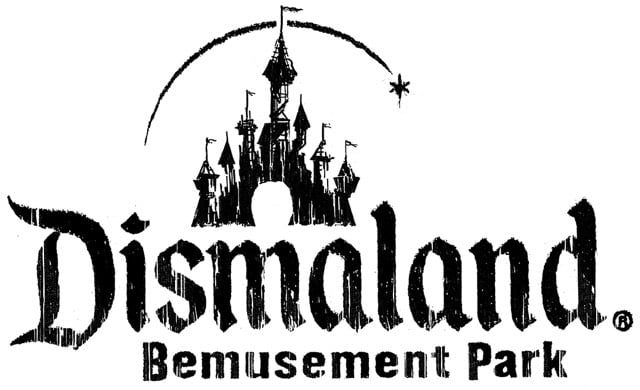
Banksy has opened an apocalyptic theme park called Dismaland in an abandoned resort in an English coastal town, Weston-super-Mare.
Are you looking for an alternative to the sugar-coated tedium of the average family day out? Or just somewhere a lot cheaper? Then this is the place for you. Bring the whole family to come and enjoy the latest addition to our chronic leisure surplus…
The entrance fee is £3 and the park will be open for five weeks. Colossal has the scoop, including a list of artists who contributed art to the park, er, show.
A demented assortment of bizarre and macabre artworks from no less than 50 artists from around the world including Damien Hirst, Bill Barminski, Caitlin Cherry, Polly Morgan, Josh Keyes, Mike Ross, David Shrigley, Bäst, and Espo. In addition, Banksy is showing 10 artworks of his own.
Colossal’s own Christopher Jobson curated the park’s short film program. Congrats! (Also, super jealous!)
Update: For a closer look at the park, check out the trailer:
From 1957, this is a drawing of the synergistic strategy of Walt Disney Productions, or what Todd Zenger of Harvard Business Review calls “a corporate theory of sustained growth”.
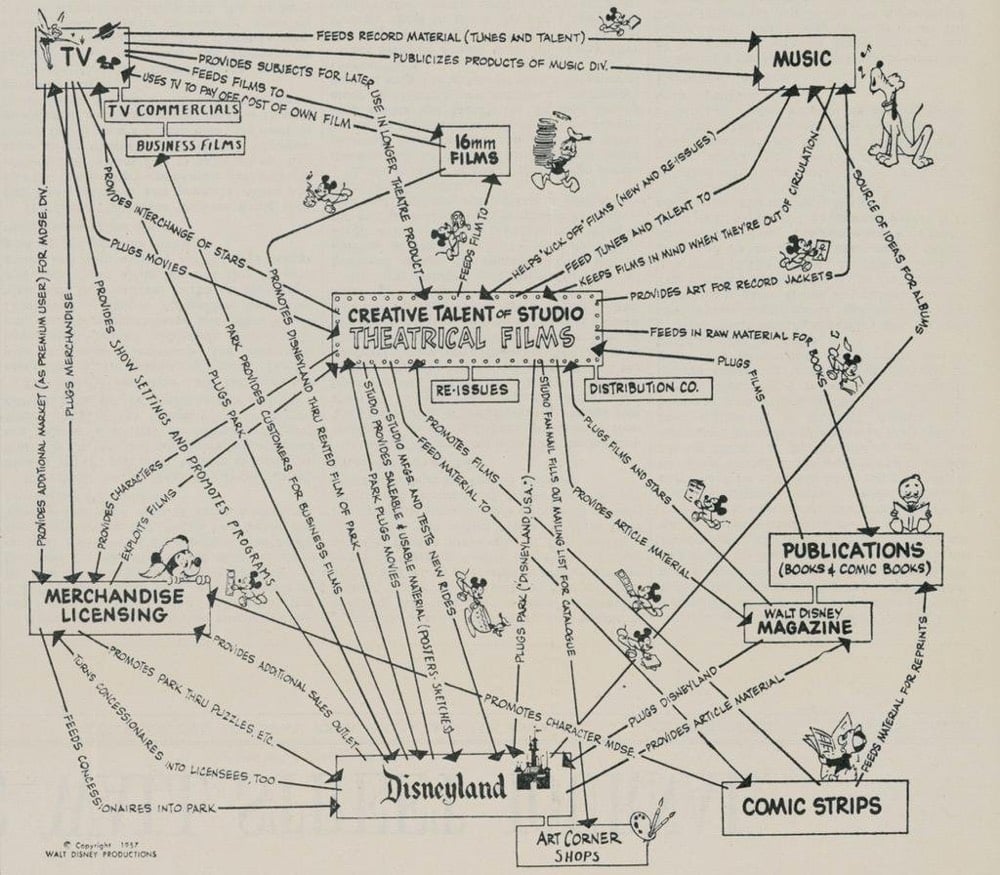
The boxes on the chart have changed, but since the appointment of Bob Iger as CEO, Disney has seemingly doubled down on Walt’s old strategy with their increased focus on franchises.
Disney’s dominance can be boiled down very simply to one word: franchises. Or rather, an “incessant focus on franchises” in the words of former Disney CFO Jay Rasulo.
“Everything we do is about brands and franchises,” Rasulo told a group of financial analysts last September. “Ten years ago we were more like other media companies, more broad-based, big movie slate, 20 something pictures, some franchise, some not franchise. If you look at our slate strategy now, our television strategy, almost every aspect of the company, we are oriented around brands and franchises.”
Franchises are well suited to extend across multiple parts of a big business like Disney, particularly because it’s a repeating virtuous cycle: movies drive merchandise sales and theme park visits, which in turn drives interest for sequels and spin-offs, rinse, repeat, reboot.
I wonder if more tech companies could be using this strategy more effectively. Apple does pretty well; their various hardware (iPhone, iPad, Mac), software (iOS, OS X), and services (iCloud, App Store, iTunes Store) work together effectively. Microsoft rode Office & Windows for quite awhile. Google seems a bit more all over the place — for instance, it’s unclear how their self-driving car helps their search business and Google+ largely failed to connect various offerings. Facebook seems to be headed in the right direction. Twitter? Not so much, but we’ll see how they do with new leadership. Or old leadership…I discovered Walt’s chart via interim Twitter CEO Jack Dorsey.
For years, one of the knocks on Pixar was the lack of main characters who are women in their movies. 2012’s Brave and this summer’s Inside Out have addressed this criticism to an extent1. But Alex of every flavored bean noticed that, in contrast to the diversity of male faces, female characters in Disney/Pixar’s recent movies all have the same face.
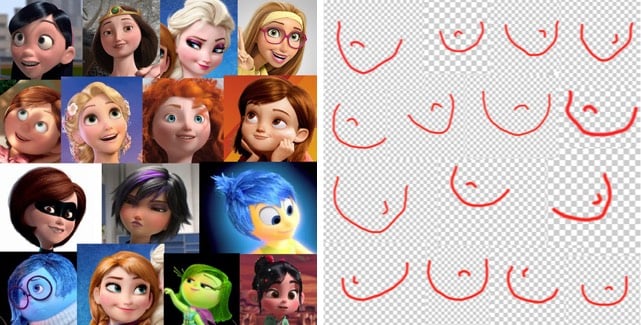
Boys in animated movies have faces that are square, round, skinny, fat, alien-looking, handsome, and ugly. The only face that girls get to have is some round snub-nosed baby face. That’s not right.
Great observation.
Update: This piece has generated some interesting comments on Good, including this one from Dan Povenmire, co-creator of Phineas and Ferb.
This is idiotic and obviously written by someone who (A) can’t draw and (B) has an axe to grind. The female characters they show have very varied faces. Yes the face shapes are all softer feminine shapes, but they purposely didn’t include female characters from those same movies with less feminine faces, like Edna Mode in The Incredibles, or the Witch or the Cook in Brave, or any of the older female characters, like the fairy godmother, or… whatever. All the princes and male romantic leads in these movies have the same face shape as well but NO, she takes old men and villains and comedy relief characters to “prove” how sexist animation is. This is just stupid.
If you want literally dozens of examples of other characters omitted from the list see the other comments below.
(via @ckoerner)
During the 1930s, animators at Walt Disney Studios developed a list of 12 basic principles of animation through which to achieve character and personality through movement. These principles were laid out in The Illusion of Life by Frank Thomas and Ollie Johnston. #6 is “slow-out and slow-in”:
As action starts, we have more drawings near the starting pose, one or two in the middle, and more drawings near the next pose. Fewer drawings make the action faster and more drawings make the action slower. Slow-ins and slow-outs soften the action, making it more life-like. For a gag action, we may omit some slow-out or slow-ins for shock appeal or the surprise element. This will give more snap to the scene.
Animator Vincenzo Lodigiani recently visualized the principles using a simple cube shape. You can see them individually here or all together in this video:
In a nod to the increasing prevalence of animation in app design, Khoi Vinh notes:
It’s a good reminder that as the overlap between interface design and animation grows wider, designers would do well to take note of the many decades of insight and knowledge that animators have accrued.
(via hn)
When Owen Suskind was three, a switch flipped within him and he went from a typical chatty rambunctious three-year-old to autistic.
I had just started a job as The Wall Street Journal’s national affairs reporter. My wife, Cornelia, a former journalist, was home with him — a new story every day, a new horror. He could barely use a sippy cup, though he’d long ago graduated to a big-boy cup. He wove about like someone walking with his eyes shut. “It doesn’t make sense,” I’d say at night. “You don’t grow backward.” Had he been injured somehow when he was out of our sight, banged his head, swallowed something poisonous? It was like searching for clues to a kidnapping.
After visits to several doctors, we first heard the word “autism.” Later, it would be fine-tuned to “regressive autism,” now affecting roughly a third of children with the disorder. Unlike the kids born with it, this group seems typical until somewhere between 18 and 36 months — then they vanish. Some never get their speech back. Families stop watching those early videos, their child waving to the camera. Too painful. That child’s gone.
But a tenuous connection remained between Owen and his pre-autistic self: Disney movies. And through them, Owen slowly learns how to communicate with the outside world again.
So we join him upstairs, all of us, on a cold and rainy Saturday afternoon in November 1994. Owen is already on the bed, oblivious to our arrival, murmuring gibberish…. “Juicervose, juicervose.” It is something we’ve been hearing for the past few weeks. Cornelia thinks maybe he wants more juice; but no, he refuses the sippy cup. “The Little Mermaid” is playing as we settle in, propping up pillows. We’ve all seen it at least a dozen times, but it’s at one of the best parts: where Ursula the sea witch, an acerbic diva, sings her song of villainy, “Poor Unfortunate Souls,” to the selfish mermaid, Ariel, setting up the part in which Ursula will turn Ariel into a human, allowing her to seek out the handsome prince, in exchange for her voice.
When the song is over, Owen lifts the remote. Hits rewind.
“Come on, Owen, just let it play!” Walt moans. But Owen goes back just 20 seconds or so, to the song’s next-to-last stanza, with Ursula shouting:
Go ahead — make your choice!
I’m a very busy woman, and I haven’t got all day.
It won’t cost much, just your voice!
He does it again. Stop. Rewind. Play. And one more time. On the fourth pass, Cornelia whispers, “It’s not ‘juice.’ ” I barely hear her. “What?” “It’s not ‘juice.’ It’s ‘just’ … ‘just your voice’!”
I grab Owen by the shoulders. “Just your voice! Is that what you’re saying?!”
He looks right at me, our first real eye contact in a year. “Juicervose! Juicervose! Juicervose!”
Walt starts to shout, “Owen’s talking again!” A mermaid lost her voice in a moment of transformation. So did this silent boy. “Juicervose! Juicervose! Juicervose!” Owen keeps saying it, watching us shout and cheer. And then we’re up, all of us, bouncing on the bed. Owen, too, singing it over and over — “Juicervose!” — as Cornelia, tears beginning to fall, whispers softly, “Thank God, he’s in there.”
This is the best thing I’ve read in a month, so so heartbreaking and amazing. Just pre-ordered the book…can’t wait to read the full version.
Paperman accompanied Wreck-It Ralph in the theaters last year but was released online yesterday. The short film is nominated for an Oscar in part because of its aesthetic: it’s a CGI-animated film from Disney that looks like it’s hand drawn.
Director John Kahrs told Cartoon Brew that the origin of Paperman “really came out of working so much with Glen [Keane] on Tangled.” After looking at the work of Keane — a classic Disney animator who worked on The Little Mermaid, Beauty and The Beast and Aladdin, among many other projects — Kahrs found himself with a new appreciation for traditional animation and drawing techniques. “I thought, Why do we have to leave these drawings behind? Why can’t we bring them back up to the front of the image again? Is there a way that CG can kinda carry along the hand drawn line in a way that we haven’t done before?”
The answer was yes. It just required a technology that no one had actually created yet.
Reminds me a bit of what Wes Anderson did with th stop motion animation in Fantastic Mr. Fox…he went back to a more traditional look that made the whole thing look less polished than it might have with newer techniques.
‘Escape from Tomorrow’ is a film by Randy Moore shot secretly at Disneyland and Disney World. Part of the buzz around the movie is that no one can imagine Disney allowing the movie to be released.
To attempt to describe the plot of “Escape” is to go down a rabbit hole as disorienting as any amusement park ride. Basically, the film is about a down-on-his luck fortysomething father (Roy Abramsohn) on the last day of a Disney World vacation with his henpecking wife and their two angelic children. As he takes his children to various attractions, the father is haunted by disturbing imagery; he is also, in the meantime (and with his children in tow), tailing two young flirtatious French girls around the park. Airy musical compositions you might find in classic Hollywood films play over many of these scenes, giving a light shading to the darker moments.
Moore shot the movie over 25 days and said production was never stopped by anyone inside the park.
To make the movie, Moore wouldn’t print out script pages or shot sequences for the 25 days he was filming on Disney turf, instead keeping all the info on iPhones. This way, when actors and crew were looking down between takes, passersby just thought they were glancing at their messages.
Here’s a scene from the movie:
(via ★interesting)
I’ve been offline for two days and Aaron already posted this (and had the information relayed to me via land line into my power-less house) but this is just too, like, wow to pass up. Disney is buying Lucasfilm for $4 billion.
Under the deal, Disney will acquire ownership of Lucasfilm, a leader in entertainment, innovation and technology, including its massively popular and “evergreen” Star Wars franchise and its operating businesses in live action film production, consumer products, animation, visual effects, and audio post production. Disney will also acquire the substantial portfolio of cutting-edge entertainment technologies that have kept audiences enthralled for many years. Lucasfilm, headquartered in San Francisco, operates under the names Lucasfilm Ltd., LucasArts, Industrial Light & Magic, and Skywalker Sound, and the present intent is for Lucasfilm employees to remain in their current locations.
And they’re gonna release a 7th Star Wars film:
Ms. Kennedy will serve as executive producer on new Star Wars feature films, with George Lucas serving as creative consultant. Star Wars Episode 7 is targeted for release in 2015, with more feature films expected to continue the Star Wars saga and grow the franchise well into the future.
Crazy. A non-Lucas non-prequel Star Wars film will hopefully be pretty great, but the purchase price is puzzling. Only $4 billion?
Remember when a Reddit thread about an imaginary military situation was turned into a movie? I think this could be Quora’s chance. The top answer by USMC Sergeant Jon Davis is filled with detailed charts and seems like it might work. The extreme dissonance that results from mixing Disney World landmarks with descriptions of military maneuvers is delicious.
The next phase would be the first two infantry companies sneaking in through the wooded area in the Southeast between Tomorrowland and Mainstreet, USA. Their primary targets are the train station and entrance to the park (to prevent enemy escape or reinforcements.) The Tomorrowland company’s objective is to secure the square and and buildings, as well as any advanced technologies it may hold. Marines and soldiers are advised to not use the teleporters. They’re a trap. They will only kill your unit and replace him with an evil alien. Their main attack route will be through the stage. Also important is that troops remember to take all underground entry points and gas them to prevent surprise attacks from the tunnels.
(via ★dens)
Pixar’s not involved — DisneyToon Studios is making it — but a direct-to-video Cars spin-off that features airplanes will go direct-to-video in spring 2013.
This movie is mostly a commercial for the inevitable billion-dollar toy/theme park tie-ins, but in general I am in favor of any kids movie that features White Zombie in the trailer. (via devour)
ps #1: This is probably going to get yanked from YT pretty quick. Sorry.
ps #2: My 3-yo son calls the main character in Cars “Lightening the Queen”. That would be an interesting movie.
The Fallen Princesses project imagines Disney characters if their stories didn’t end happily ever after.
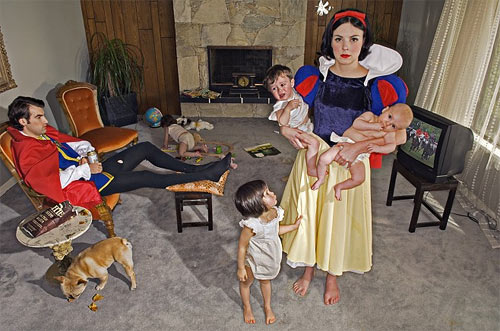
As a young girl, growing up abroad, I was not exposed to Fairy tales. These new discoveries lead to my fascination with the origins of Fairy tales. I explored the original brothers Grimm’s stories and found that they have very dark and sometimes gruesome aspects, many of which were changed by Disney. I began to imagine Disney’s perfect Princesses juxtaposed with real issues that were affecting women around me, such as illness, addiction and self-image issues.
Not so Charming. (via avenues)
Disney investors are getting a little antsy with Pixar and their irritating need to make movies that are good without worrying about their commercial success or how many action figures of the main characters can be sold. Says Disney’s CEO:
We seek to make great films first. If a great film gives birth to a franchise, we are the first company to leverage such success. A check-the-boxes approach to creativity is more likely to result in blandness and failure.
Invest in Dreamworks for that check-the-boxes creativity, why don’t you. (thx, kabir)
The NY Times has a look at the progress made by Disney since their 2006 acquisition of Pixar, a purchase some say Disney paid too much for.
“There is an assumption in the corporate world that you need to integrate swiftly,” Mr. Iger said. “My philosophy is exactly the opposite. You need to be respectful and patient.” Key to the successful integration, analysts say, has been Mr. Iger’s decision to give incoming talent added duties. Instead of just buying Pixar and moving on, Mr. Iger understood what made the acquisition valuable, said Mr. Price, the author. “If you are acquiring expertise,” he said, “then dispatch your newly purchased experts into other parts of the company and let them stretch their muscles.”
It also sounds as though Pixar has loosened their high standards since the acquisition…they’re outsourcing some animation, doing more sequels (Cars 2, presumably for the merchandising), and making several direct-to-DVD movies.
Some say the Disney magic is back. Hit TV shows (Hannah Montana), increased revenue from movies (Enchanted), and the acquisition of Pixar are all contributing factors, but new CEO Bob Iger is getting the most credit.
Mr Iger’s management style is said by many to have unlocked Disney’s creativity. “There was already creativity inside Disney, but Bob removed the barriers to it,” says Peter Chernin, chief operating officer of News Corporation, a rival media group. “Michael Eisner was all about his own creativity,” says Stanley Gold, a former Disney board director who led a campaign to oust Mr Eisner in 2004, referring to the way in which the former boss meddled in the detail of Disney’s parks and movies. In contrast, he says, “Bob pushes creative decisions to the people below him.”
Said it before and I’ll say it again: hire good creative people, let them do their thing, and ye shall reap the benefits. And Christ, no wonder Disney was sucking so bad:
Before Mr Iger took over, Disney had a factory-like process for animation in which a business-development team came up with ideas and allocated directors to them.
Photos by Taryn Simon of hidden and unfamiliar places in the US, like the marijuana crop grow room at the National Center for Natural Products Research in Mississippi. Here’s a somewhat overlapping selection of photos at Wired and another at The Morning News, which includes a great letter from Disney denying Simon access to their theme park’s underbelly.
After giving your request serious consideration, even though it is against company policy to consider such a request, it is with regret that I inform you that we are not willing to grant the permission you seek…As you are aware, our Disney characters, parks and other valuable properties have become beloved by young and old alike, and with this comes a tremendous responsibility to protect their use and the protection we currently enjoy. Should we lapse in our vigilance, we run the risk of losing this protection and the Disney characters as we know and love them…Especially during these violent times, I personally believe that the magical spell cast on guests who visit our theme parks is particularly important to protect and helps to provide them with an important fantasy they can escape to.
Newer posts
Older posts




Socials & More