


Matt writes about finding good food in an unfamiliar city. We’ve been struggling with this on our trip to Asia. Offline approaches (books, recommendations by locals, etc.) seem to work well, as does taking a peek on eGullet or Chowhound.

Advertise here with Carbon Ads
This site is made possible by member support. 💞
Big thanks to Arcustech for hosting the site and offering amazing tech support.
When you buy through links on kottke.org, I may earn an affiliate commission. Thanks for supporting the site!
kottke.org. home of fine hypertext products since 1998.
Beloved by 86.47% of the web.
kottke.org posts about Asia 2005
Meg basically posted what I was going to say about Jim Thompson House, so head on over to read up on this interesting house.
At dinner a couple of nights ago, my dad mentioned that the crews on Cathay Pacific are upset at flying the route over the North Pole because it increases their cancer risk due to less shielding from cosmic radiation. In response, Cathay has limited each crew’s NY/HK flights per month to two. (thx, david)
Fried chicken and gum
We stopped for lunch today at Tonpo, which is right on the river near a water taxi stop. The heat is brutal here, especially in the middle of the day, so the breeze from the river was quite refreshing. One of the dishes we ordered was fried chicken wrapped in pandanus leaves:
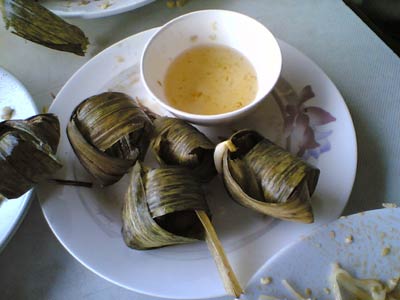
The fried chicken was excellent, some of the best I’ve had (I think we’re venturing out tonight to get more at this place Meg heard about). But do you see that sauce next to the chicken? It tasted exactly like Bazooka bubble gum, swear to god. Fried chicken and gum, a match made in heaven.
Ran across Karin-Marijke and Coen on their SE Asian trip…they were parked in Bangkok near Khao San. They’ve been on the road from the Netherlands since May 2003.
Street food in Bangkok
We’ve been eating a lot off the street[1] here in Bangkok. On our morning and afternoon walks to and from the Skytrain[2], there are one-person food carts each serving up a particular little snack for 5-10 baht[3] apiece. It’s a good grazing situation; lunch yesterday lasted about five hours[4] and consisted of some orange juice, a thai iced coffee, pork balls on a stick, grilled chicken on a stick, some sort of sweet coconut custard thing, chrysanthemum juice, some noodles that very much tasted like ramen (with pork), more sweet coconut custard things, some peanut crepes…
[1.5 hour interlude for a foot and thai massage[5] that I quite enjoyed and Meg quite didn’t]
…fried dough balls, pork and pineapple on a stick, a bag of orange soda, pork crepes with tiny egg[6], and dessert tacos. Altogether it was maybe US$6 for the two of us (and my dad ate some too).[7]
I love eating this way and it was something that was sorely missing in HK.
[1] From street vendors, not literally off the street.
[2] Auto traffic is awful here…traffic jams everywhere. So we’ve been using the Metro (subway), Skytrain (the elevated train), and the river taxis to get around. They get us to most places we need to go. There are motorcycle taxis available, but we’d rather not split up on the journey. Two/three-person motorcycle-powered rickshaws called tuk tuks are also available, but we’ve heard conflicting reports of the usefulness/sketchiness that we’ve opted out of them altogether.
[3] It’s about 40 baht to a US dollar. A meal at a small restaurant with tables on the street cost us around US$5 for the two of us, including gigantic beer.
[4] We started out at Aw Kaw Taw market, walked over to Chatuchak market, and then to the area around Sala Daeng.
[5] The massage was around US$7 per person. I want one every day.
[6] Onto each crepe, the cook cracked a tiny egg. He made up about 10 for the woman ahead of us and cracked 10 tiny eggs, one for each crepe.
[7] To those who say they can’t afford to travel, I say to you: stop making excuses. If you’ve got the income and leisure time to be spending time reading this blog, are sufficiently motivated, and make it a priority in your life[8], you can certainly afford it. The most costly item is the plane ticket, but if you watch for deals and are flexible in where you want to visit (maybe you go to Brazil instead of Thailand), you can get over here for less than you might think. And once you’re here, you can get by on $20 a day, including lodging. Travel is cheaper here as well, buses and trains are always an option, and there are several low-cost airlines that serve the region. It requires a little effort and intrepidity, but low-cost international travel can be done.
[8] This is the big sticking point for most people, I think. If you choose to have a family or focus on your career or pursue a costly photography hobby, you might not have the money or flexibility to travel this way. But that’s a choice you’ve made (on some level)…and I would argue that if you’re 30 years old, you can arrange to make an overseas trip once every 3-5 years, and that’s about 7-8 trips by the time you’re 60.
Travel tip
Much to my irritation (and that of others), many hotels charge for broadband internet access and the standard practice (at least on this trip) seems to be to charge per computer. So if both you and your traveling companion want to connect to the internet (via ethernet cable one at a time or both via wireless), you’re screwed. Luckily, we brought along an Airport Express; it’s small and fits easily in a suitcase. You hook that up to the ethernet cable and then you can both connect to that wireless network.
(With the Powerbook, you can also hook it up to the ethernet cable and then share your connection via the Airport. But the cables are typically short, so one of you loses that lounging-in-bed web surfing experience.)
Hong Kong wrap-up
Ok, one last wrap-up post about Hong Kong and then we’re focusing on the matter at hand in Bangkok (short summary: having a great time so far here). So, three things I really liked about/in Hong Kong and then some miscellaneous stuff.
1. Octopus cards. I really can’t say enough about how cool these cards are. Wikipedia provides a quickie definition: “The Octopus card is a rechargeable contactless stored value smart card used for electronic payment in online or offline systems in Hong Kong.” It’s a pay-as-you go stored value card…you put $100 bucks on it and “recharge” the card when it’s empty (or when it’s even more than empty…as long as your balance is positive when you use it, you can go into a HK$35 deficit, which you pay when you recharge the card). You can use it on pratically any public transportation in the city: buses, trains, MTR, trams, ferries, etc. It works with vending machines, at 7-Eleven, McDonald’s, Starbucks, and the supermarket. You don’t need to take it out of your wallet or purse to use it, just hold it near the sensor. Your card is not tied to your identity…there’s no PIN, you can pay cash, they don’t need to know your credit card number, SS#, or anything like that. They even make watches and mobile phones that have Octopus built it, so your phone (or watch) becomes your wallet. Mayor Bloomberg, if you’re listening, NYC needs this.
2. The on-train maps for the MTR. Here’s a (sort of blurry) photo (taken with my cameraphone):
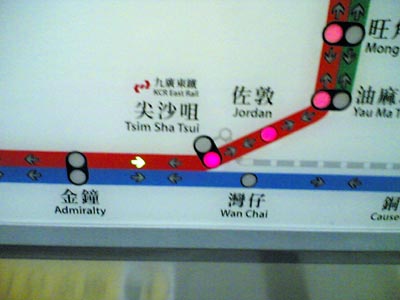
The current stop blinks red — in this case, Tsim Sha Tsui (blinking not shown, obviously) — with the subsequent stops lit in red. If the next stop connects to another line, that line blinks as well. A small green arrow indicates which direction you’re traveling and there’s an indictor (not shown) which lights up either “exit this side” or “exit other side” depending which way the doors are going to open. Great design.
3. Muji! We located one in Langham Place (an uber-story mall) in Mong Kok (for reference, the store in Silvercord in TST listed on their site has closed). Muji is kind of hard to describe if you’ve never been to one of their stores before (and if you live in the US, you probably haven’t because they’re aren’t any, aside from a small outpost in the MoMA Store). Adam (see previous link) roughly translates the name as “No Brand, Good Product”, so you can see why I like it so much. They sell a wide variety of products (take a look at their Japanese-only online store for an idea of what they carry); at the Monk Kok store, they had snacks & drinks, some furniture (made out of sturdy cardboard), their signature pens and notebooks (a display of the former was completely surrounded by a moat of teenaged girls, so much so that I didn’t get a chance to test any of the super-thin pens), some clothes (including some great pants that they didn’t have in anything approaching my size), dishes, cosmetics, bath products, and containers of all shapes, sizes, and uses. I wanted one of everything, but settled for a couple of shirts (with absolutely no logos or markings, inside or out, to indictate that they are Muji products).
m1. Big Buddha, worth the trip. It’ll better when the tram from Tung Chung and back is built, although then you’ll miss the boat ride (fun) and the bus ride (harrowing at times).
m2. The Peak Tram. Touristy, but also worth the trip. The weird/ugly anvil-shaped building at the top is currently under construction, so the views will be much better when its finished. Go at night for the best view.
m3. The view from the waterfront in Kowloon of the Hong Kong skyline at night is one of the best in the world.
m4. Speaking of, Hong Kong is a night-time city. All the buildings are lit up, there’s a nightly light show at 8pm (think Laser Floyd without the music), and buildings that appear monolithic in the daytime transform at night, either by disappearing into the darkness while leaving a graceful trace of their outline or acting as huge screens for projected light shows. Reminded me of Vegas in this respect.
m5. We had tea in the lobby of the InterContinental Hotel (go for the view, it’s incredible) and the live band played the theme song from The Lord of the Rings. I tried to get a recording of it with my phone (iPod was back in our hotel room), but it didn’t turn out so well. Very weird; we were cracking up and expecting the theme from Superman or even 3’s Company to follow.
m6. Oh, I’m sure there’s more, so I’ll add it here as I think of stuff.
Cooking school at Baipai
Meg and I took a Thai cooking class today at Baipai Cooking School on the recommendation of my friend Darby (thx, Darb!). Since cooking is her thing, Meg’s got the full write-up with photos. They pick you up at your hotel, you spend 4 hours cooking (part instruction, part hands-on) in a small outdoor kitchen (there were about 8-10 other people in the class) tasting as you go, you eat the meal you cook, and then they drop you back at your hotel. All for around US$35 per person. We made pad thai, tom kha gai (chicken & galangal in coconut milk soup), fish cakes, and tab tim grobb (water chestnut in coconut milk). Very fun and highly recommended.
Arrived in Bangkok
Quick note to say that we’ve arrived in Bangkok, which I think is going to be more our speed somehow. Not that Hong Kong wasn’t nice, but something about here feels better. We had a really chatty taxi driver on the way in (wish I’d gotten a photo or recorded some of the conversation, but I was too busy trying to keep up with his wall of words)…we learned a bit of the Thai language, that Pepsi is more popular than Coke here, and not to trust doormen. “Never go eat seafood where the doorman tell you to go eat seafood. Is too expensive. He get a commission. Go Chinatown, find your own.” And then when we drove up to the hotel, he spotted the doorman and his eyes narrowed…”there he is, the doorman,” and gave us a look of warning.
After checking in and showering, we met up with my dad, who took us for a typical Thai meal in a small, unassuming restaurant. Green mango salad, pork with spring vegetables, and a coconut milk soup with shrimp and mushrooms (it came in what looked like a bundt cake pan, with a small flame in the middle to keep the soup warm). Then we walked around a bit, orienting ourselves to the city. All the street food looked super good, and lots of bargains to be had at the night market (including about 15 different kinds of “pussy” listed on a card I had shoved in front of me on Patpong street). More to follow.
Levels
When you read up on Hong Kong prior to visiting, most guides make mention of the different levels of the city. Physical levels, that is.[1] The city proper is built on a hill and there are so many tall buildings that you quickly lose interest in counting all of them; imagine Nob Hill in San Francisco, except with skyscrapers. The famous escalator cuts through the city up the hill; the change in elevation over its short span is impressive, especially when you get to the top and realize you’re actually only a few horizontal blocks from where you started.
Much of the HK’s retail and dining is vertically oriented; there’s just not enough storefront real estate to contain it all. You’ll typically find restaurants on the 3rd or 4th floor of buildings and 3- to 6-level malls jammed with retail stores are everywhere; the Muji we went to was on level 7 of Langham Place. Skyways connect buildings together — as do subways — so much of the foot traffic in some areas isn’t even on the street level. Cars and buses (with two levels) zoom on highways passing over city streets and other highways, past the midlevels of buildings just a block or two away and down the hill. As a pedestrian, you can find yourself staring up at a 50-story building in front of you and then turning slightly to peer into the 15th floor of a building 2-3 blocks away. It’s a disorienting sensation, being on the ground level and the 15th floor at the same time, as if the fabric of space had folded back onto itself. Many people aren’t used to negotiating cities so intensively 3-D, particularly when all the maps reinforce the Flatlandness of the city grid.
[1] Well, not entirely physical. There are economic levels for one; the woman selling eggs on the street for a couple of HK$ each while tourists shop for Prada and Burberry only blocks away. You’ve got British culture over Chinese culture…and then Chinese culture layering back over that since the handover in 1997. You’ve got different levels of authenticity, from the fake electronics & handbags to the real Chanel cosmetics & Swarovski crystal, from the more touristy, mediated experiences to the hidden corners of real Hong Kong.
Dim sum bargain
The day before yesterday, we went for dim sum for lunch again…can’t get enough of those meat-stuffed buns and pastries. This time, we cleverly arranged to bring some locals along so we’d have a little better idea what was going on food-wise. Or rather, they cleverly arranged to meet up with us. A couple of days into the trip, we received an email from a couple of HK high school students, Denise and Christine. They just happened to be working on an article about blogging for a school magazine that gets published once a year, and wrote to see if they could interview us. We agreed — on the condition that we treat them to dim sum — and off we went on Saturday to the Chao Inn on Peking Road in TST.
We ordered a variety of dim sum, including a Chaozhou specialty dish (made of beef…it looked a little like headcheese), which after an initial taste by everyone at the table, was left for the wait staff to collect. We also had some shrimp dumplings, BBQ pork buns, sticky rice (and beef?) wrapped in lotus leaf, spring rolls, and some rice noodle dish I’m forgetting the exact ingredients of. We chatted about food, blogging, teen life in Hong Kong, movies, etc. They attend an English-speaking school, so their English was quite good and the conversation flowed easily. A favorite conversational tidbit was that when you buy fake electronics in Hong Kong, they ask you which logo you want on it (Sony, Panasonic, NEC, etc.) and then affix the proper sticker. Awesome.

Thanks for the nice lunch, girls. I hope you got what you needed for your interview.
Tall buildings
Being in Hong Kong is sufficient reason to revisit the Skyscraper Page, especially its excellent diagrams. Here are the 25 tallest buildings in Hong Kong; the tallest is 2 IFC, which is currently the fifth tallest building in the world (top 10).

My favorite Hong Kong skyscraper is the HSBC Building. Designed by Norman Foster, it’s the building that every architecture geek friend of yours tells you to check out while you’re in Hong Kong. Initially, I thought yeah, yeah, how great can it be, it looks kinda like every other modern steel and glass building, and then we went inside and rode the escalator up through the glass ceiling and into a huge atrium. Pretty cool. And then I saw the building from the side and also at night when the side stairwells are lit up with alternating red and white lighted patterns, and I really started to appreciate why it’s such a revered building; the Chinese even believe it’s got some of the best Feng Shui in HK.
Hong Kong walk signal
The streets of Hong Kong can be a hectic place, but one of the first things you notice is that the pedestrian street crossing signals have a very clear audio signal (one would assume, for the blind and/or very nearsighted). Some American signals has audio as well, but very few, they’re not very loud, and they generally kind of lacking. Anyway, I made an audio recording of the signals (30 sec, 240 KB mp3). The sound is kind of blown out (it’s my first experiment with the iTalk) and the signal doesn’t sound that loud IRL, but you get the gist.
Soup dumplings, part 2
Finally procured some dim sum here in HK (with more to come tomorrow). On a recommendation from Arthur, we hit Spring Moon in the Peninsula Hotel. After getting some oolong tea that smelled like apricots (which we later learned was also organic), we ordered the following:

From right to left are the xiao long bao with scallop (soup dumplings with scallop), the steamed green chive dumpling with minced shrimp, and rice noodle roll with chicken and spinach. Not pictured is the baked BBQ pork puff (the pastry had impossibly little flaky layers) that we started with.
And for dessert, Meg had the mango pudding and I went for the deep fried egg yolk buns. Arthur hyped up the mango pudding:
People that know me have heard me hype this up forever: there is a good chance that this place has the best mango pudding in the world. No exaggeration. You can also get the mango pudding in the lobby lounge, or get it room service if you’re staying at the hotel. I remember the first time I tried it, I was staying there, and we got mango pudding like every day. It’s just so damn good, I can’t even describe it. The texture is moist, not too rubbery, perfect mango flavor… it’s just awesome. If you’re EVER in Hong Kong, you must at least go to the Peninsula lobby and try this out. You won’t be dissappointed.
And according to Meg (who admittedly might not have extensive mango pudding experience), he’s not wrong. Now, being a Minnesota State Fair veteran, deep fried is something I do know a lot about, and those egg yolk buns (when you cut into them with your fork, they look like eggs; white bread surrounds a deep yellow bread center) were fantastic…somehow light and rich at the same time.
BTW, if you’re heading to Hong Kong (and elsewhere in Asia) in the future, you should check out last week’s Asia thread. Lots of great suggestions in there; thanks everyone.
Socials & More