



Timothy Snyder on strongmen. “Once you accept that Trump is strong, you are accepting that you are weaker than Trump. And once you accept the strongman form of politics, you no longer have recourse to laws, or norms, or even basic ideas of decency.”

Advertise here with Carbon Ads
This site is made possible by member support. 💞
Big thanks to Arcustech for hosting the site and offering amazing tech support.
When you buy through links on kottke.org, I may earn an affiliate commission. Thanks for supporting the site!
kottke.org. home of fine hypertext products since 1998.
Beloved by 86.47% of the web.
Entries for March 2026

De La Soul’s Tiny Desk Concert
Ok, you know this is going to be a good one: De La Soul plays a Tiny Desk Concert.
The humor of De La Soul has always been one of its calling cards. When DJ Maseo tells the Tiny Desk crowd, “Ladies and gentlemen, we’re a new group called De La Soul,” he means it as a joke. But, in so many ways, one of the most influential groups in hip-hop is new: the duties have been reassessed, the focus has shifted and the newness of The Plugs is laid plain here at the Tiny Desk.
Here’s the setlist:
YUHDONTSTOP
Will Be
Much More
Stakes is High
Sunny Storms
Different World
Breakadawn
Pony Ride
A Quick 16 for Mama
Me Myself and I
Feel free to dance at your desk or in your kitchen or wherever you’re listening.
The Beginning Comes After the End by Rebecca Solnit
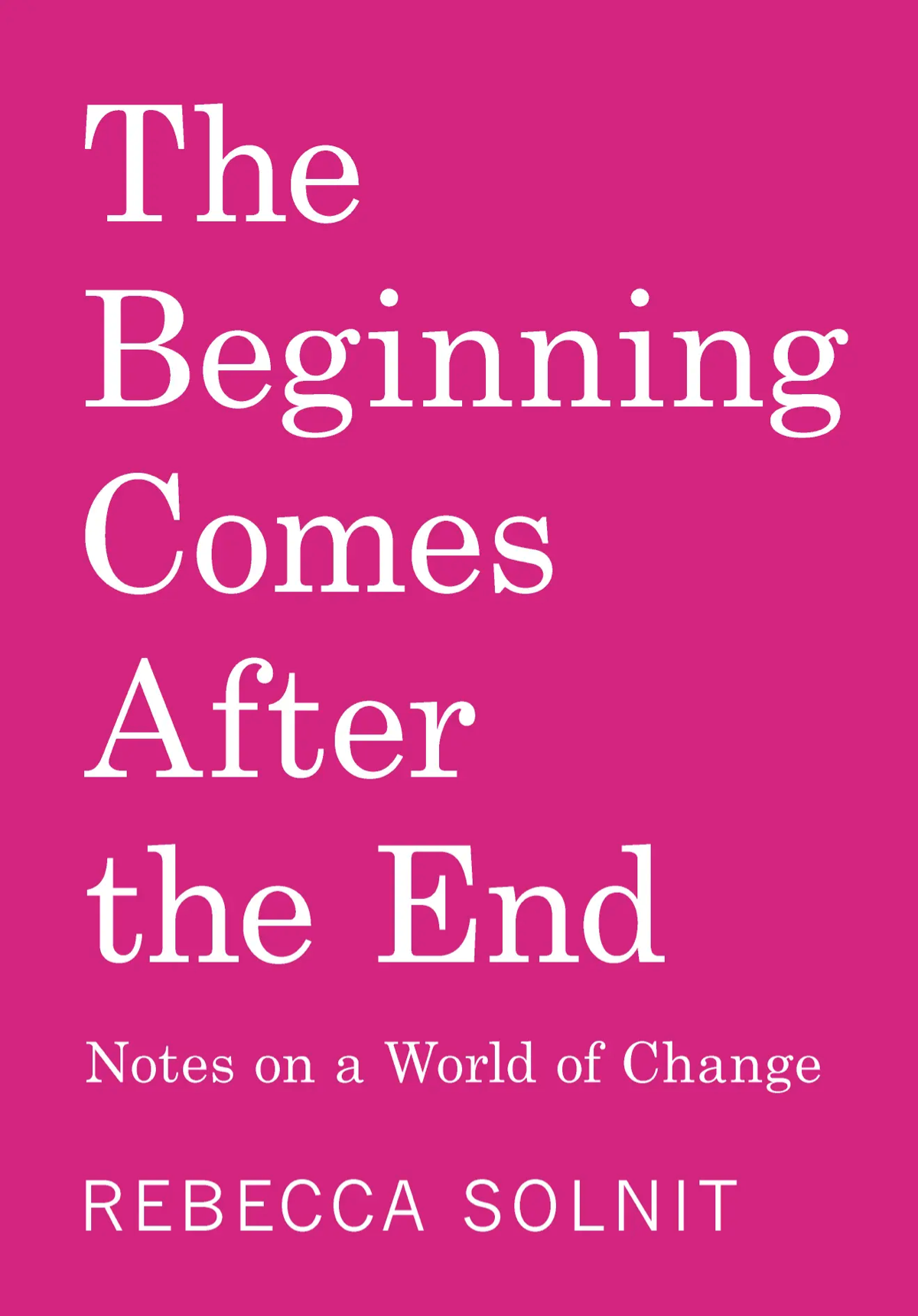
A new book by Rebecca Solnit came out yesterday; it’s called The Beginning Comes After the End: Notes on a World of Change (Amazon). The synopsis:
Rebecca Solnit offers a thrilling account of the sheer breadth and scale of social, political, scientific, and cultural change over the past three quarters of a century.
In this sequel to her enduring bestseller Hope in the Dark, Solnit surveys a world that has changed dramatically since the year 1960. Despite the forces seeking to turn back the clock on history, change is not a possibility; it is an inevitability.
The changes amount to nothing less than dismantling an old civilization and building a new one, whose newness is often the return of the old ways and wisdoms. In this rising worldview, interconnection is a core idea and value. But because the transformation is obscured within a longer arc of history, its scale is seldom recognized.
While the white nationalist and authoritarian backlash drives individualism and isolation, this new world embraces antiracism, feminism, a more expansive understanding of gender, environmental thinking, scientific breakthroughs, and Indigenous and non-Western ideas, pointing toward a more interconnected, relational world.
I feel like maybe I should read this. I need some hope about the world.
See also Solnit’s recent Longreads Questionnaire.
TIL about babysitting co-ops. “The premise is simple: Families in the co-op provide each other with free childcare. A point system…ensures that everyone contributes their fair share. Every half an hour is worth one point…”

The KDO Rolodex Is Now a Wee Feed Reader?
Hello, good afternoon! As I mentioned a few weeks ago, I have a bunch of new stuff for KDO in the pipeline. I’ve been focused on backend infrastructure recently to make my life (hopefully) easier and have gotten that to a place of “useful enough to test out to find all the bugs & irritations”. So onto some things that you folks can actually use.
When I launched the KDO Rolodex last July, it was a simple list of five recommended sites on the front page of the site. You could refresh to see more sites, but you couldn’t see the whole list all at once. Fun, but lots of room for improvement.
Over the weekend, I launched the full list of sites (186 at the moment) for your perusal. Any visitor to the site can see the sites & people I read to help make KDO. I’ve written before about why this is important to me:
I love linking out to other sites. The strength of the open web is in its many connections between nodes…the more, the better. Links are the whole goddamned point of the web! I want to send people away from kottke.org to learn something new or have a chuckle and then come back the next day for more. The goal is connection, knowledge, and sharing — I proudly have no competitors in this endeavor, only collaborators.
I loved seeing the whole list. So I kept pushing made something I’ve had on my todo list for awhile: I turned the Rolodex into a tiny RSS feed reader. Which I love even more. The feed reader feature is a bit rough around the edges, so I’m making available only to members while we beta test it. Here’s what it looks like:
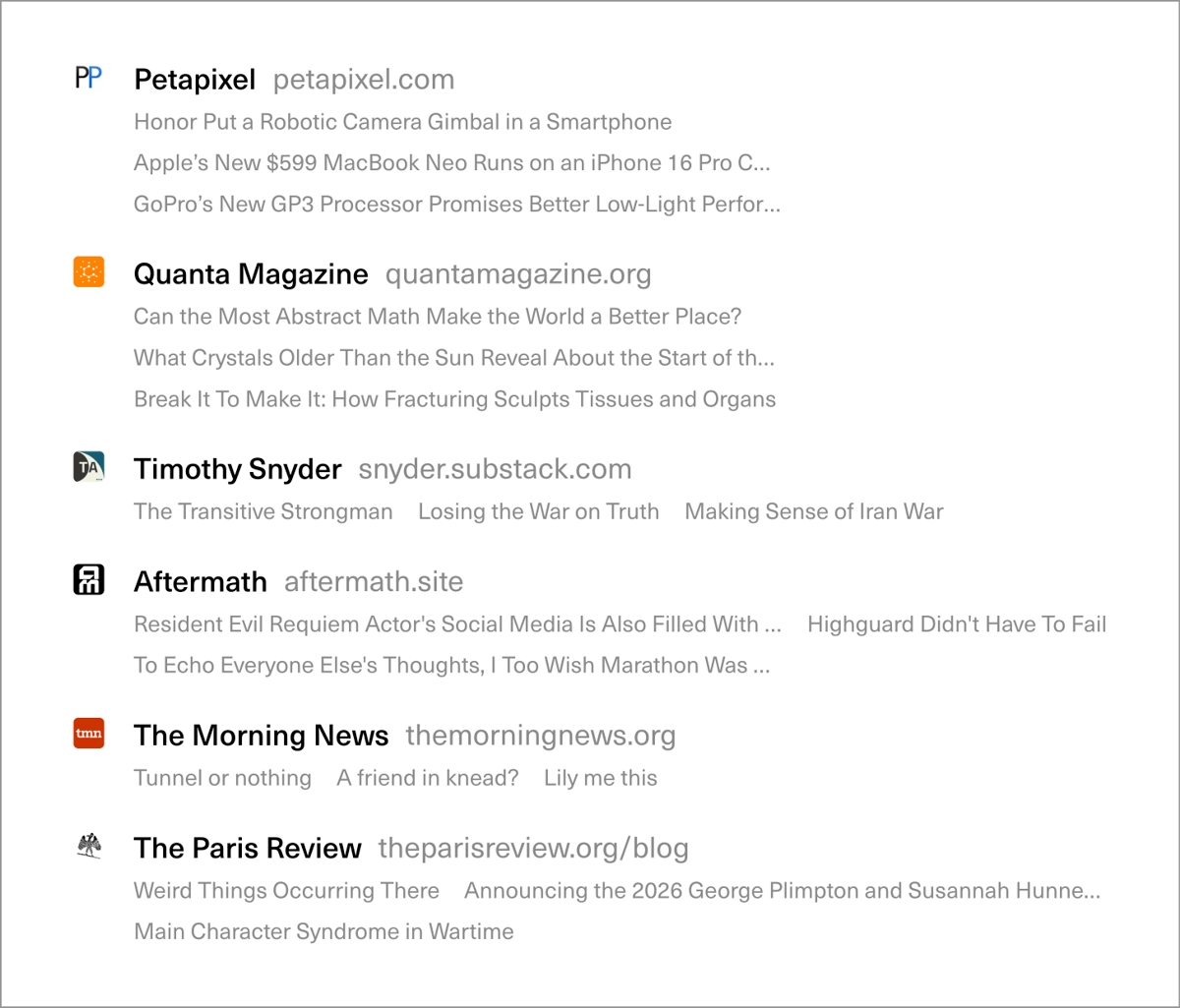
The three latest posts from each site or person are listed below their name; clicking on a post title will open the post in a new tab. You can obviously click on the name of the site/person to open that in a new tab too. Sites are sorted by most recently updated (this is true of the public listing as well). If you’re a member, please check it out and kick the tires.
For the curious, some details about the implementation. I use Feedbin as my feed reader and they have a pretty good API. So I built a sync system that adds the URLs of the sites in the Rolodex (if they have associated feeds) to Feedbin and tags them with “Rolodex”. Once the feeds are associated with sites, I can just retrieve new entries from those Rolodex-tagged feeds (every 30 min currently). There are a few sites causing problems — for instance, Beehiiv newsletters don’t appear to have RSS feeds by default?1 — and there are some other bugs, but I’m working on it. I’m not including posts from social sites (Bluesky, Mastodon) for now because that’s another level of velocity.
But like I said, I am loving this casual wee feed reader so far. No read/unread statuses, no counts, no folders, no pressure to catch up, no 3-pane view. I’d say 90-95% of the sites on the list work fine — and it doesn’t need to be 100%. Try it out, lemme know what you think.
Thanks to KDO members for helping to fund new features like this. If you’d like to help support the site, check out your membership options here. ✌️
If you try adding Ryan Broderick’s Garbage Day newsletter (hosted by Beehiiv) to Feedbin, it can’t find an RSS feed because there’s no link tag for it. The front page of the site doesn’t link to the feed anywhere. But if you dig around in the source code… ah, there it is. Same deal with Bobby Solomon’s new Horstman newsletter, except the RSS feed address isn’t anywhere in the source. 🤷♂️ So posts for those sites won’t show for now. ↩
Academy Museum of Motion Pictures Acquires Original Disney Adult. “There wouldn’t be a Disney as we know it without this guy, a grown man who has watched Tinker Bell And The Great Fairy Rescue more than 90 times.”

TIL about burping your house, aka lüften (in Germany), aka opening up the windows in your house daily to air it out, even in winter.

Color Photos of Rome (c. 1890s)

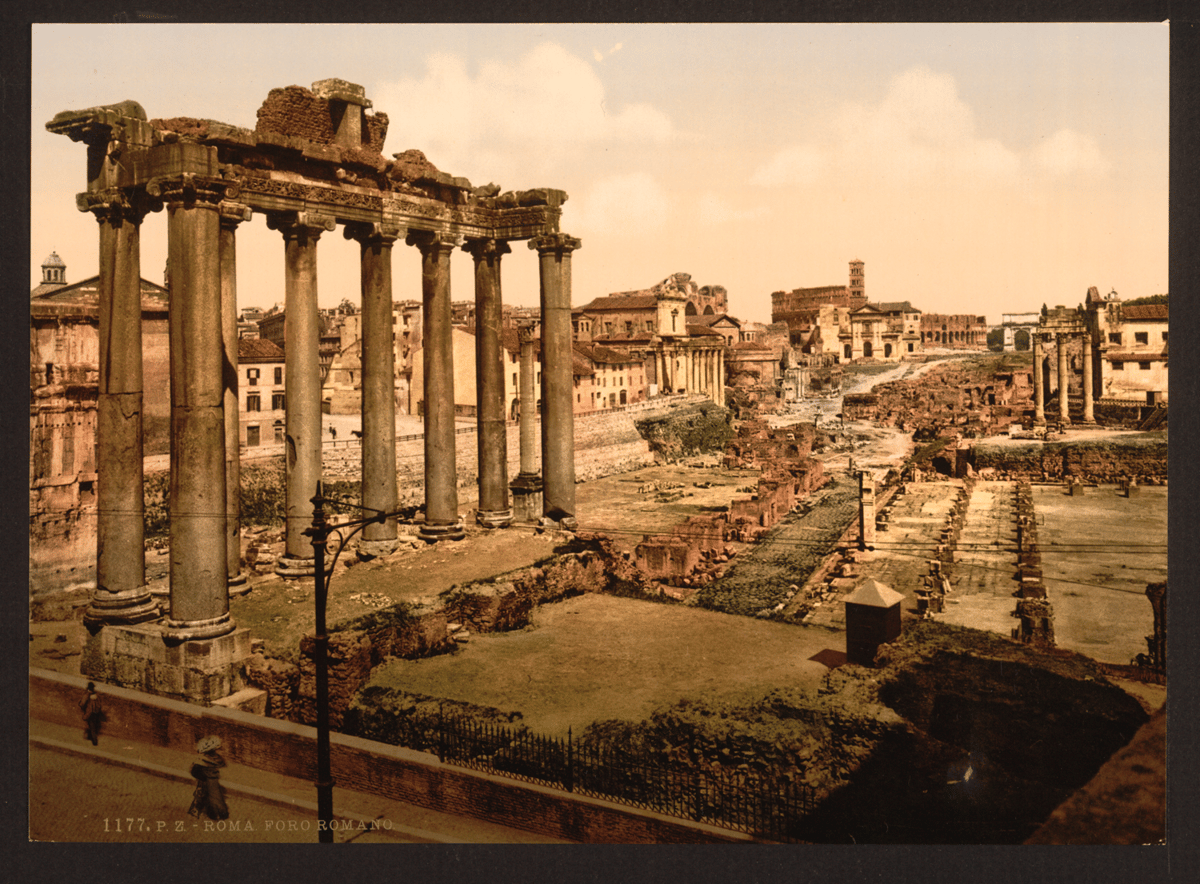
The Library of Congress houses an online collection of 48 color photographs of Rome taken in the 1890s. The prints were created using the photochrom process:
The prints look deceptively like color photographs. But when viewed with a magnifying glass the small dots that comprise the ink-based photomechanical image are visible. The photomechanical process permitted mass production of the vivid color prints. Each color in the final print required a separate asphalt-coated lithographic stone, usually a minimum of six stones and often more than ten stones.
If you look at the individual items from the collection (like the shot of the Colosseum), you’ll notice that the photographers were uncredited:
The names of individual photographers are rarely identified on the photochrom prints. Initials on the original negatives and entries in the Detroit Publishing Company ledgers at the Colorado Historical Society sometimes reveal the image creator.
(via open culture)
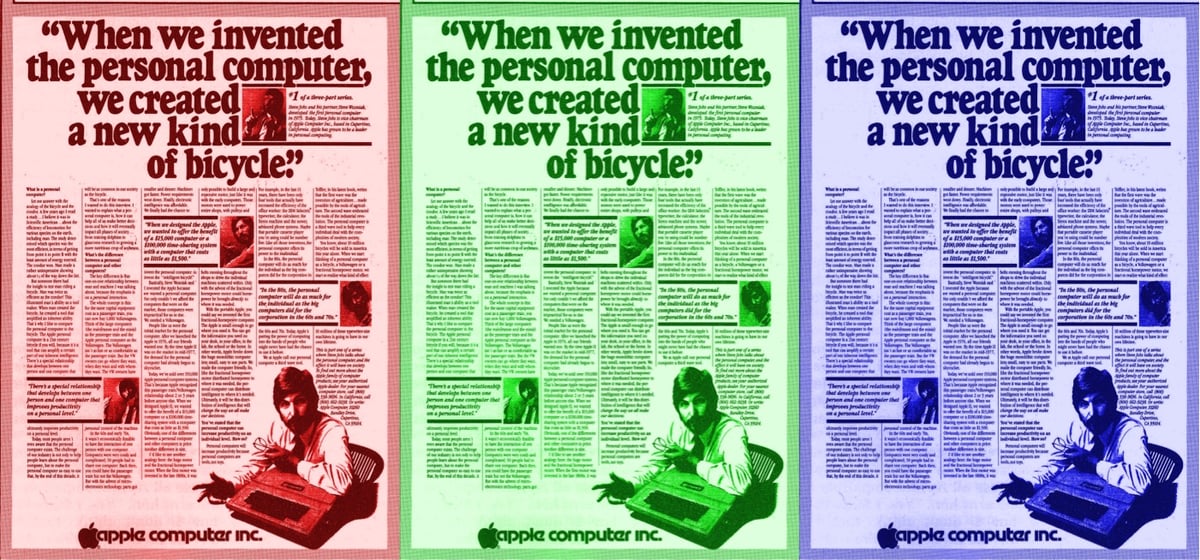
Steve Jobs famously said that computers are a bicycle for the mind. What does that make LLMs? An e-bike for the mind? A car for the mind? A jet plane for the mind?
LLMs are getting pretty good at unmasking pseudonymous users — their success rate is “far greater” than humans alone can manage.

“Imagine what it was like for women in colonial North America. Life was different depending on where you lived, your background, and how much money you had.”

HyperCard Changed Everything
This video traces the history of Apple’s HyperCard from Vannevar Bush’s idea of the Memex to the Mother of All Demos to the Xerox PARC Alto to Bill Atkinson, the inventor of HyperCard, who said:
HyperCard is a software erector set. It lets people put things together without having to know how to solder.
There’s a ton of information about HyperCard at hypercard.org, including this HyperCard simulator that runs in your browser.
Does Your Country Need Regime Change? A Quiz. “Is your country a notorious bad actor in the Middle East? Has your leader deployed the country’s military domestically against civilians who were protesting peacefully?”
Takashi Murakami Remixes Monet

As part of his show called Hark Back to Ukiyo-e: Tracing Superflat to Japonisme’s Genesis, currently on display in LA, Takashi Murakami painted his own version of Claude Monet’s Woman with a Parasol - Madame Monet and Her Son. The painting is paired with Murakami’s copies of woodblock prints (ukiyo-e) that influenced the work of Monet and other abstract & impressionist artists.
Here Murakami pairs a copy of Monet’s portrait with twelve enlarged versions of ukiyo-e prints by Kikukawa Eizan and his teacher, Utamaro. Through these examples Murakami shapes a narrative of Monet’s encounter with bijinga. They suggest the elements that Monet absorbed in his study of prints: statuesque three-quarter figures; sensual outlines; parasols viewed from below; cloud-like masses of cherry blossoms; windswept skirts. Another selection, Utamaro’s Yamauba and Kintarō, is an example of a bijinga sub-genre in which women are shown with young children.
As noted by Greg Allen, Murakami used an unusual process for his reproductions:
Copying the originals, Murakami had his own intimate encounter with these features, recognizing in the process the meticulous care taken in pursuit of delicate effects. He interprets them in his signature style, composed of layer upon layer of silkscreened acrylic paint, applied with a special squeegee work application method and coated in a glossy finish.
Remember the “scroll lock” key on your keyboard? What the heck was it for? And why is the same scrolling mechanic showing up in streaming service interfaces?

New Rembrandt Painting Discovered
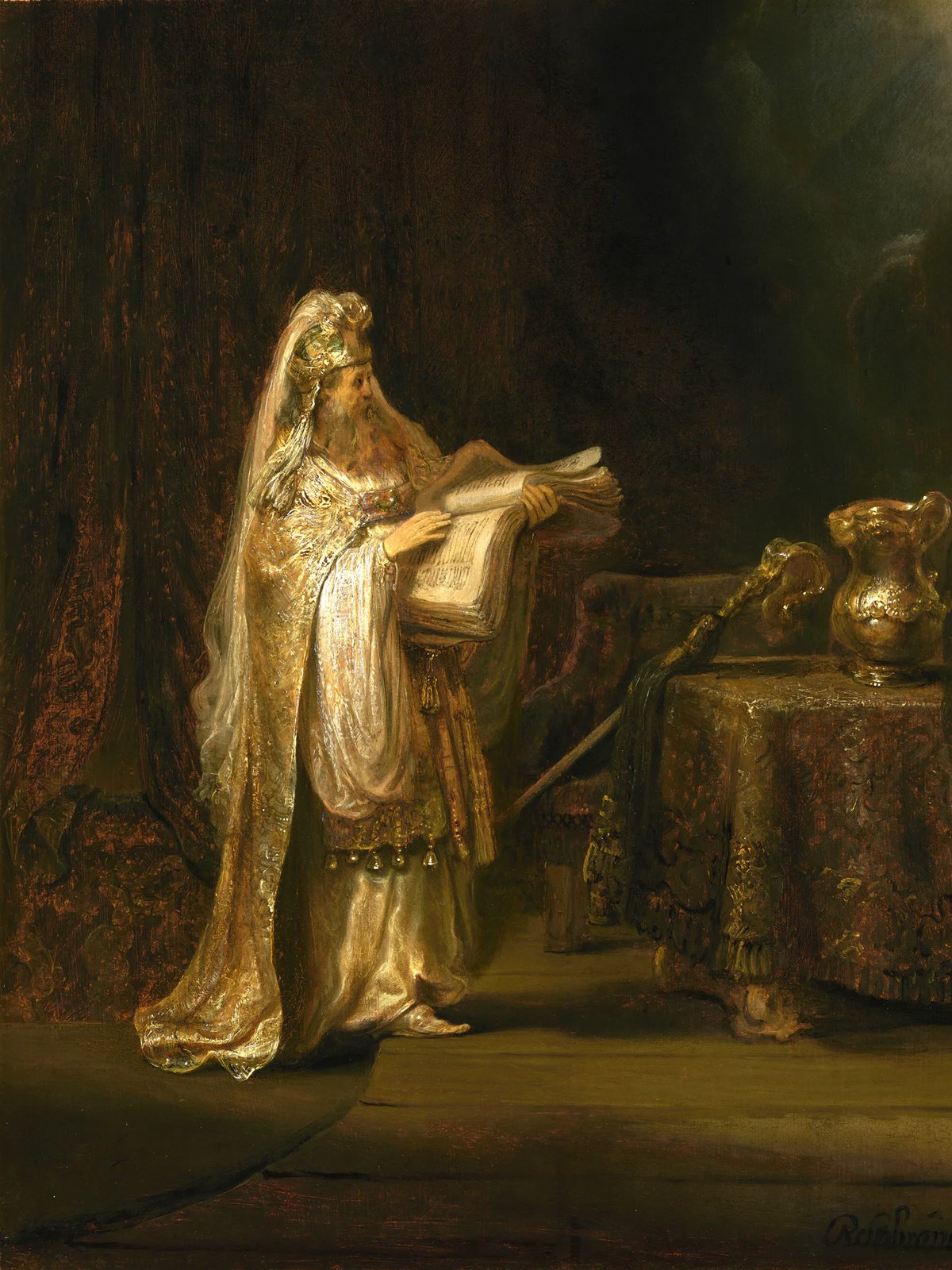
A painting from 1633 called Vision of Zacharias in the Temple has been newly identified by Rijksmuseum researchers as an authentic Rembrandt van Rijn. It had been decades since the painting was examined — art historians have access to all kinds of new techniques and information about Rembrandt’s methods and materials.
Vision of Zacharias in the Temple was shown at the major Rembrandt exhibition at the Stedelijk Museum Amsterdam in 1898. In 1960, however, it was excluded from Rembrandt’s oeuvre. A year later, a private collector purchased the work, after which it disappeared from public view. Only recently did the current owner contact the Rijksmuseum, allowing the painting to be examined again after 65 years.
The two-year investigation shows that all the pigments used also appear in other paintings by Rembrandt from the same period. The build-up of the paint layers and the handling are likewise consistent with his early work.
The painting is executed on two oak panels from trees grown in the south-east of Lithuania, a common wood source in the seventeenth century. The dimensions and construction correspond to panels Rembrandt frequently used. Dendrochronology (tree-ring dating) confirms that the inscribed date “1633” is plausible.
Here’s the back of the painting (the whole analysis is interesting):
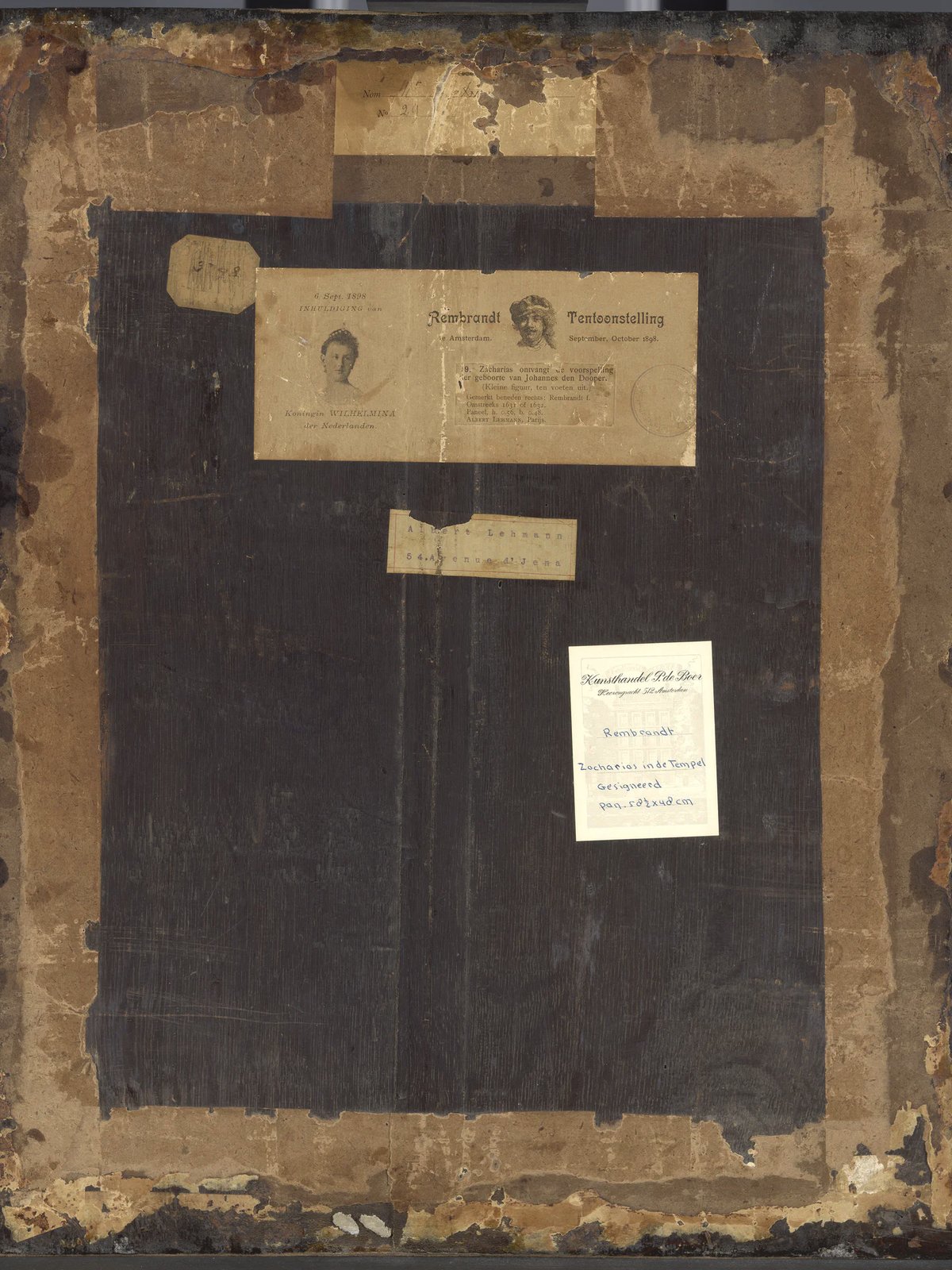
Vision of Zacharias in the Temple goes on display at the Rijksmuseum tomorrow. (via the history blog)
Recent advances in science have revolutionized our understanding of the Maya, e.g. there’s evidence that “more people lived in the classic-era Maya lowlands than on the Italian peninsula during the peak of the Roman empire…”

“Boredom is the price we pay for a life rich with meaning. Recognizing this makes the feeling more endurable.”

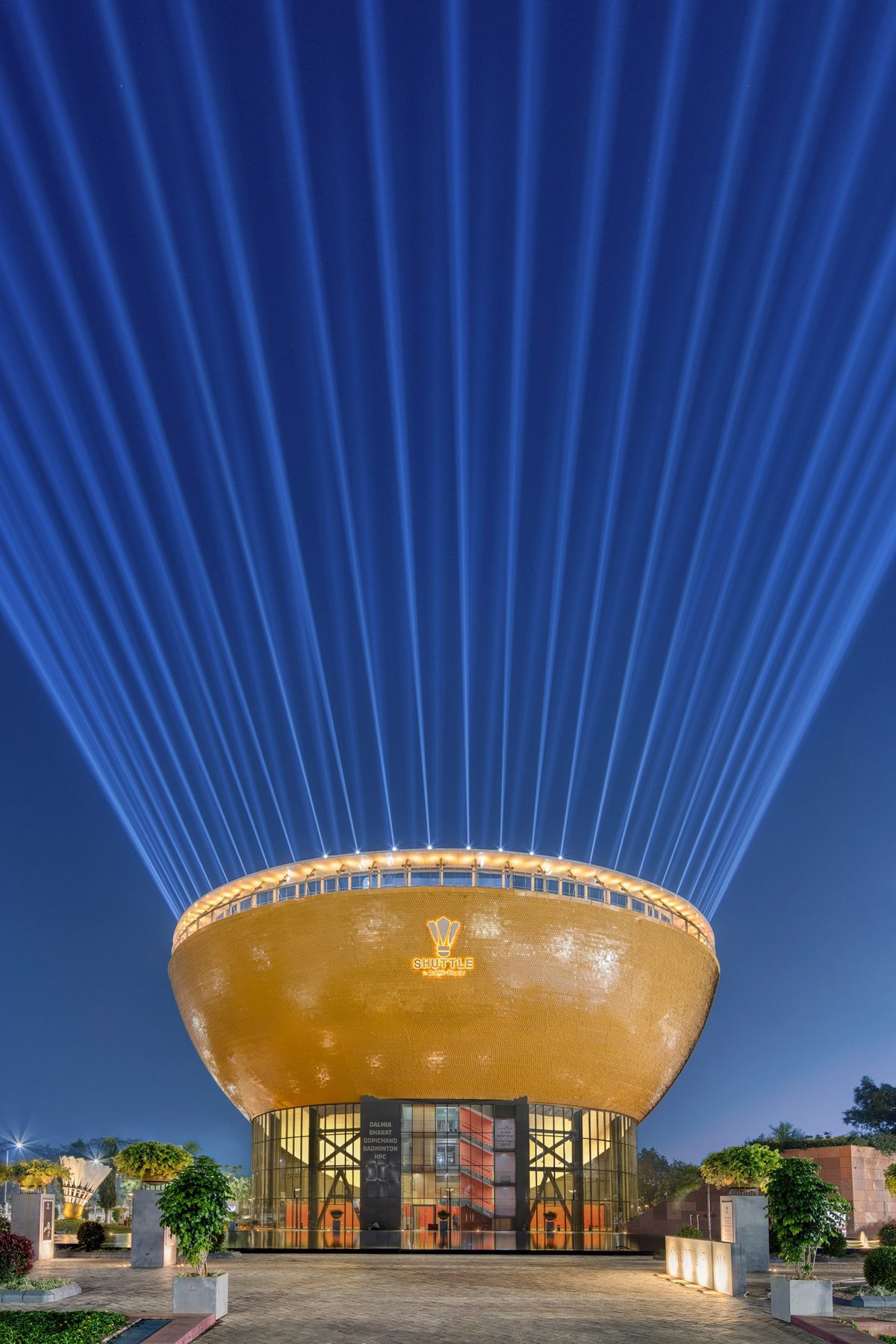
When lit up at night, this badminton academy in Bhubaneswar, India looks like a shuttlecock.
“Supercharged” solar activity and the equinox effect, which “doubles the chance of auroral activity around the spring and fall equinoxes”, could make March 2026 the best month for the northern lights until the mid-2030s.

Nine Inch Nails Releases Tron: Ares Remix Album
Last week, Nine Inch Nails released an album of remixes and unreleased session music from their Tron: Ares score called Tron Ares: Divergence. I’m listening to it now; pretty good so far.
“A long dive into the features that make my ideal music app, and why nothing currently fulfills the brief.”

This is the most 2026 thing I’ve ever heard: Sigmund Freud’s great-granddaughter Bella Freud has a video podcast on YouTube where she interviews people (Cate Blanchette, Lorde, Graydon Carter) while they lie on a psychiatrist’s couch.

A Boston man discovered a document passed down through his family: his ancestor’s freedom papers. “When he touched that paper he was touching the same place his relative touched in 1834.”
Lumière, Le Cinema!
Lumière, Le Cinema! is a new documentary film by Thierry Frémaux about Auguste & Louis Lumière and the early days of motion pictures — and includes 100+ newly restored films. It’s playing at MoMA at the end of this month; here’s their description:
Witness the birth of cinema with Thierry Frémaux’s Lumière, Le Cinéma! (2025), about the pioneering achievements of the French entrepreneurs Auguste and Louis Lumière in the late 19th century. Journey back to the 1890s, when the Lumière Company, with their astonishing new invention, the cinematograph, made it possible for audiences to voyage around the world in moving pictures for the first time. Featuring gorgeous new restorations of more than 100 comedies, dramas, and travelogues — some famous, some forgotten, and some never before seen — and set to an evocative score of period music by Gabriel Fauré, this wondrous documentary enables contemporary viewers to imagine an entirely new language of storytelling unfolding film by glorious film.
Just watching the trailer is wild — the restored footage from short films that are 120, 130 years old is astonishing. From a review in Collider:
From riding atop trains to showing off goofy vaudevillian acts or brief moments of comical violence, each clip speaks not only to what came before, but how these short pieces behave as the DNA for every genre, every facet of what we consider filmmaking to this very day. The biggest joy of all, of course, is the ability to see these films projected large and in all their restored glory, not simply segregated to being streamed on a small screen, or to suffer through damage that makes these segments feel all that more removed from the present. It’s as if many of these clips have been rescued from an island where they have been deserted for more than a century, carefully dusted off, and allowed finally to be seen in a context that their creators could only have dreamed possible.
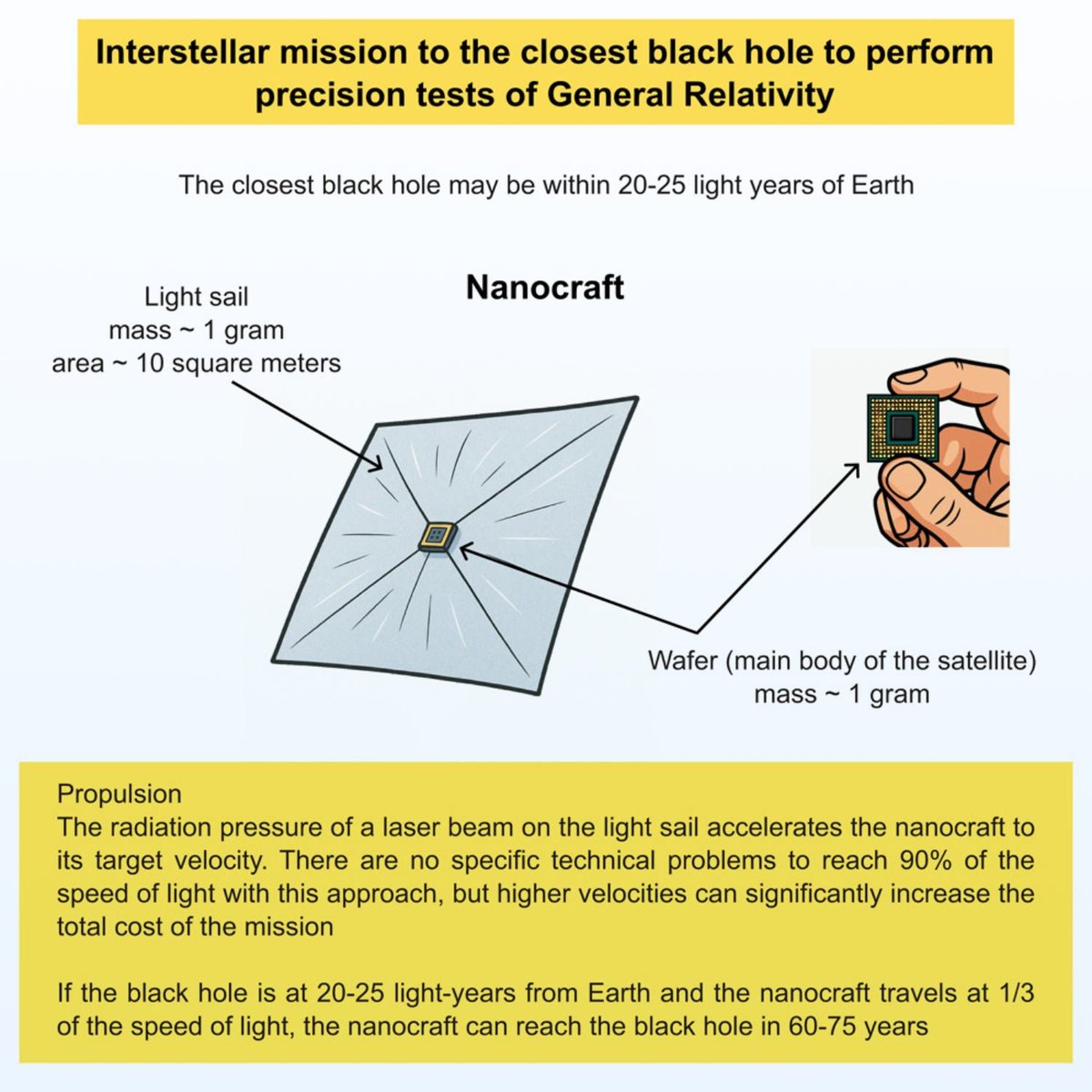
Astrophysicist Cosimo Bambi proposes sending a tiny spacecraft to study nearby black holes. “Earth-based lasers would blast the [light] sail with photons, accelerating the craft to a third of the speed of light.”
“Novartis has settled a lawsuit by the estate of Henrietta Lacks that alleged the [company] unjustly profited off her cells, which were taken…without her knowledge in 1951 and reproduced in labs to enable major medical advancements…”

Why Attack Iran?
There are many possible and plausible answers to this simple question. Timothy Snyder offers a useful perspective in helping answer it:
How do [we] understand the war with Iran? We must get away from the propaganda and ask why this might be happening, in light of the facts that we do know.
These facts suggest two interpretive frameworks: a foreign war as a mechanism to destroy democracy at home; and a foreign war as an element of personal corruption by the president of the United States.
From the United States, the most plausible angle of view is domestic politics, not foreign policy.
Trump is not a conventionally intelligent person and is losing his wits to age, but he remains an instinctual genius. There’s no grand plan here and there doesn’t need to be; he’s just moving towards his flame: enrichment for himself, entrenching power, and instability for everyone else.
Socials & More