


This site is made possible by member support. 💞
Big thanks to Arcustech for hosting the site and offering amazing tech support.
When you buy through links on kottke.org, I may earn an affiliate commission. Thanks for supporting the site!
kottke.org. home of fine hypertext products since 1998.
Beloved by 86.47% of the web.
Entries for July 2020
The Pandemic Experts Are Not Okay. American public health officials – ignored, attacked, overworked, underappreciated, frustrated, and fatigued – are at risk of burning out just a few months into a years-long pandemic.
Doublespeak: Language Designed to Mislead While Pretending Otherwise
Linguist William Lutz, former editor of the Quarterly Review of Doublespeak, went on CSPAN in 1989 to promote his book, Doublespeak. The video above is a 7-minute distillation of his thoughts on what he calls “language designed to mislead while pretending not to”. (Watch Lutz’s full interview here.)
You can read the first chapter of Doublespeak; an excerpt:
Doublespeak is not the product of carelessness or sloppy thinking. Indeed, most doublespeak is the product of clear thinking and carefully designed and constructed to appear to communicate when in fact it doesn’t. It is language designed not to lead but mislead. It is language designed to distort reality and corrupt thought… In the world created by doublespeak, if it’s not a tax increase, but rather “revenue enhancement” or “tax base broadening”, how can you complain about higher taxes? If it’s not acid rain, but rather “poorly buffered precipitation”, how can you worry about all those dead trees?
See also On Bullshit and Donald Trump. (via dunstan)
A Portrait of a Direct Descendent of Thomas Jefferson & Sally Hemings
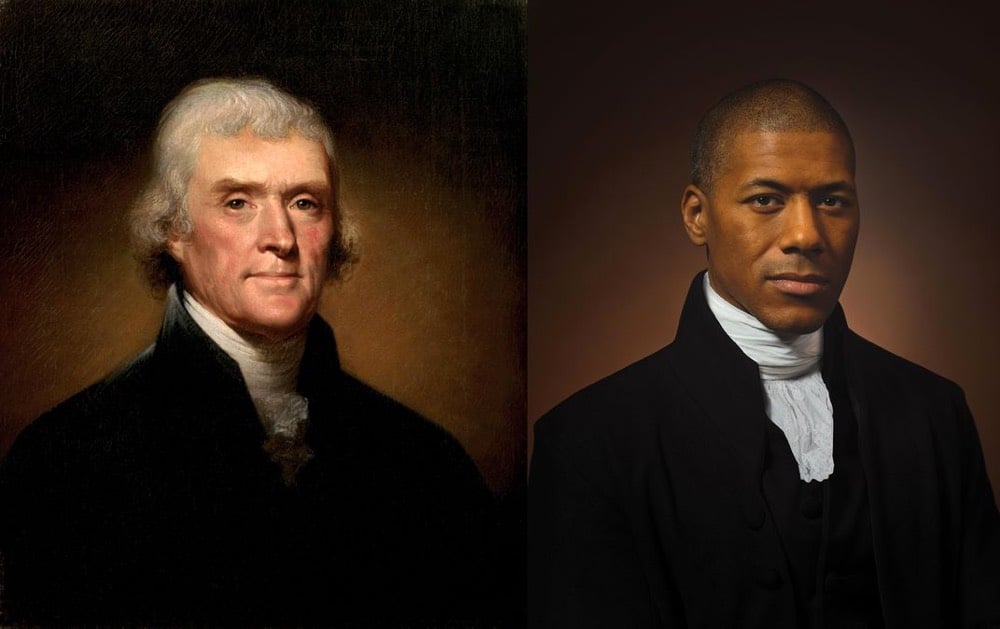
For his Descendents series, Drew Gardner takes photographs of people done up to look like their famous ancestors. The Smithsonian Magazine recently featured Gardner’s photo of Shannon LaNier recreating a portrait of his great-great-great-great-great-great-grandfather, Thomas Jefferson. Here’s the description of Jefferson’s portrait on the White House website:
The portrait of Jefferson was completed in Philadelphia before mid-May 1800 when he left that capital for Monticello. The face has the glow of health, a warm complexion. The sitter here looks directly at us and does so with candor, as our equal. The splendid eyes and mouth convey reason and tolerance.
At odds with that glowing description is LaNier’s very existence; he’s here today because Thomas Jefferson raped his great-great-great-great-great-great-grandmother Sally Hemings. Says LaNier of Jefferson:
He was a brilliant man who preached equality, but he didn’t practice it. He owned people. And now I’m here because of it.
Check out this video for a look at how the portrait was made and more of LaNier’s thoughts about it. (via open culture)
Tennessee Williams with Air-Conditioning. “There is no need to sweat or shout in such a small, well-chilled apartment. I can be heard across the room without raising my voice. Look, I have created a chore wheel for the three of us…”
Pre-order Black Futures, a collection of work by Black creators edited by Kimberly Drew and Jenna Wortham. Really excited to see how they put “images, photos, essays, memes, dialogues, recipes, tweets, poetry” into a cohesive whole.
I’m a Direct Descendant of Thomas Jefferson. Take Down His Memorial. “The time to honor the slave-owning founders of our imperfect union is past.”
A discussion of appropriation & and equity of access in the food/restaurant world. “All food is fusion, so why does it matter who is cooking what?”
A great review of the filmed version of Hamilton by Siddhant Adlakha. “The show’s more idealistic elements feel illusory in hindsight. It was made for a different America, and today, it’s easy to wonder whether that America ever existed at all.”
Why are US cases of Covid-19 increasing while deaths are decreasing? “The answer is simple. It’s called Simpson’s paradox and it’s the result of incorrectly pooling data and arriving at a false conclusion.”
A Mind Sang
A Mind Sang is an inventive short film about “perception, rebirth, and transformation”. What I most liked about watching was how effortless it was to see the transitions between all the optical illusions — but it wasn’t too easy. A great sense of pacing by filmmaker Vier Nev. Read an interview with Nev about his film on Vimeo’s blog. (via @mikeindustries)
When the Fourth of July Was a Black Holiday. “The Fourth became an almost exclusively African American holiday in the states of the former Confederacy - until white Southerners…snuffed these black commemorations out.”
Is the Fourth of July worth celebrating? “After Juneteenth, it’s hard to overlook the hollowness of American freedom.”
“What, to My People, is the Fourth of July?”
In a powerful video for the Movement For Black Lives, Daveed Diggs asks: “What, to My People, is the Fourth of July?”
What, to my people, is the Fourth of July? My people, who are failed every day by every country, sleepless in the long night, terrorized by fireworks, we who have cried salt baths for our kin.
Look at all we have borne for you: arms, armistice, the sweetest fruits, flesh of children hidden away from the ugly summer of their own blood — we are on the front lines. Help me, tell me, what do we tell the children of your Fourth of July? What is death to a daughter? What is river to a sea? Where is the country where my people are safe?
Ancestors set the table send dream mares in high supply. Too heavy, too spent, too hot to cook, no promise beyond the sparkly simple bombs. Keep your holiday, your hunger, the blood in your teeth. Police parade down streets, proud descendants of the slave patrol. Theater of denial, a propaganda pageant, and we are on the front lines all summer. My uncle can’t sleep and he was born free. And he ain’t never been.
The text performed by Diggs — written by Safia Elhillo, Danez Smith, Lauren Whitehead, W. Kamau Bell, Angel Nafis, Idris Goodwin, Pharoahe Monch, Camonghne Felix, and Nate Marshall — was inspired by Frederick Douglass’ July 5, 1852 speech, in which he asked, “What, to the American slave, is your Fourth of July?”
Fellow-citizens, pardon me, allow me to ask, why am I called upon to speak here to-day? What have I, or those I represent, to do with your national independence? Are the great principles of political freedom and of natural justice, embodied in that Declaration of Independence, extended to us? and am I, therefore, called upon to bring our humble offering to the national altar, and to confess the benefits and express devout gratitude for the blessings resulting from your independence to us?
Dinnerware Smashing in Slow Motion Accompanied by Bach
Optical Arts conceived this video as a “live action musical animation” of cups, plates, and glasses smashing and un-smashing accompanied by the toccata section of Johann Sebastian Bach’s famous organ piece, Toccata and Fugue in D Minor. I thought it was fully CGI at first (as The Morning News reported), but then I found the making of video on the project page and it’s not — they filmed all the glasses and dished smashing at extremely high speeds between 1000 and 5000 frames/second on Phantom cameras.
I don’t know about you, but this video is what it looks like inside my head lately. Smash smash smash! (via the morning news)
Popular Mechanics on How to Topple a Statue Using Science. “To break the statue from its base, split into two teams on either side and work in a back-and-forth motion.”
Anti-racism work is supposed to be hard. “There should be tears. There should be grief and guilt. There should be shouting and bad words and silence. There should be wariness, even at the best of intentions.”
Apart Together

October 31, 2000 was the last day all humans were together on Earth. That day, the rocket containing the crew of Expedition 1 lifted off from the Baikonur Cosmodrome in Kazakhstan and carried them to the International Space Station for a long-term stay. Fittingly, the mission left from the same launchpad that was used to launch Yuri Gagarin into space on April 2, 1961, which was the first time in history that all humans were not together on Earth. Ever since the Expedition 1 crew docked, there’s been an uninterrupted human presence on the ISS, which may continue until 2028 or 2030, by which time there may be humans on the Moon or Mars on a permanent basis. Will humans ever be only Earth-bound again?
BTW, I guess you could argue that the ISS isn’t really separate enough from Earth or that since regular commercial airplane flights began, humans have been separate from the Earth. You could also say that at any given time, thousands of people are in the air while jumping and therefore not on the Earth with the rest of us. I don’t find any of those arguments meaningful. Perhaps someday if space travel is more routine — “just popped up into orbit to visit my daughter” — and the human population is much more distributed, these same distinctions won’t hold, but for now the ISS is definitely apart from the Earth in a way that flying or jumping are not.
A reminder that for some patients, problems from Covid-19 infections will “persist for months, years or even the rest of their lives”. It’s not just deaths – the nonchalance some have about this virus is astounding.
America’s 400-Year-Old “Shape-Shifting, Unspoken, Race-Based” Caste System
In this long and interesting piece for the NY Times, The Warmth of Other Suns author Isabel Wilkerson explains America’s Enduring Caste System.
A caste system is an artificial construction, a fixed and embedded ranking of human value that sets the presumed supremacy of one group against the presumed inferiority of other groups on the basis of ancestry and often immutable traits, traits that would be neutral in the abstract but are ascribed life-and-death meaning in a hierarchy favoring the dominant caste, whose forebears designed it. A caste system uses rigid, often arbitrary boundaries to keep the ranks apart, distinct from one another and in their assigned places.
Throughout human history, three caste systems have stood out. The lingering, millenniums-long caste system of India. The tragically accelerated, chilling and officially vanquished caste system of Nazi Germany. And the shape-shifting, unspoken, race-based caste pyramid in the United States. Each version relied on stigmatizing those deemed inferior to justify the dehumanization necessary to keep the lowest-ranked people at the bottom and to rationalize the protocols of enforcement. A caste system endures because it is often justified as divine will, originating from sacred text or the presumed laws of nature, reinforced throughout the culture and passed down through the generations.
The article is an adapted excerpt from her forthcoming book, Caste: The Origins of Our Discontents:
Linking the caste systems of America, India, and Nazi Germany, Wilkerson explores eight pillars that underlie caste systems across civilizations, including divine will, bloodlines, stigma, and more. Using riveting stories about people — including Martin Luther King, Jr., baseball’s Satchel Paige, a single father and his toddler son, Wilkerson herself, and many others — she shows the ways that the insidious undertow of caste is experienced every day. She documents how the Nazis studied the racial systems in America to plan their out-cast of the Jews; she discusses why the cruel logic of caste requires that there be a bottom rung for those in the middle to measure themselves against; she writes about the surprising health costs of caste, in depression and life expectancy, and the effects of this hierarchy on our culture and politics. Finally, she points forward to ways America can move beyond the artificial and destructive separations of human divisions, toward hope in our common humanity.
The Warmth of Other Suns is one of my favorite books I’ve read in the past decade, so I’m very much looking forward to her new one.
The Rime of the Ancient Mariner
A group of creative folks recently came together to produce a 40-day-long Big Read of Samuel Taylor Coleridge’s 18th century epic poem, The Rime of the Ancient Mariner. Readings on sections of the poem from people like Jeremy Irons, Tilda Swinton, Hilary Mantel, and Iggy Pop were paired with artworks from Marina Abramovic, William Kentridge, Cornelia Parker, and Yinka Shonibare. I was struck right off the bat by the first piece, Glenn Brown’s The Shallow End.
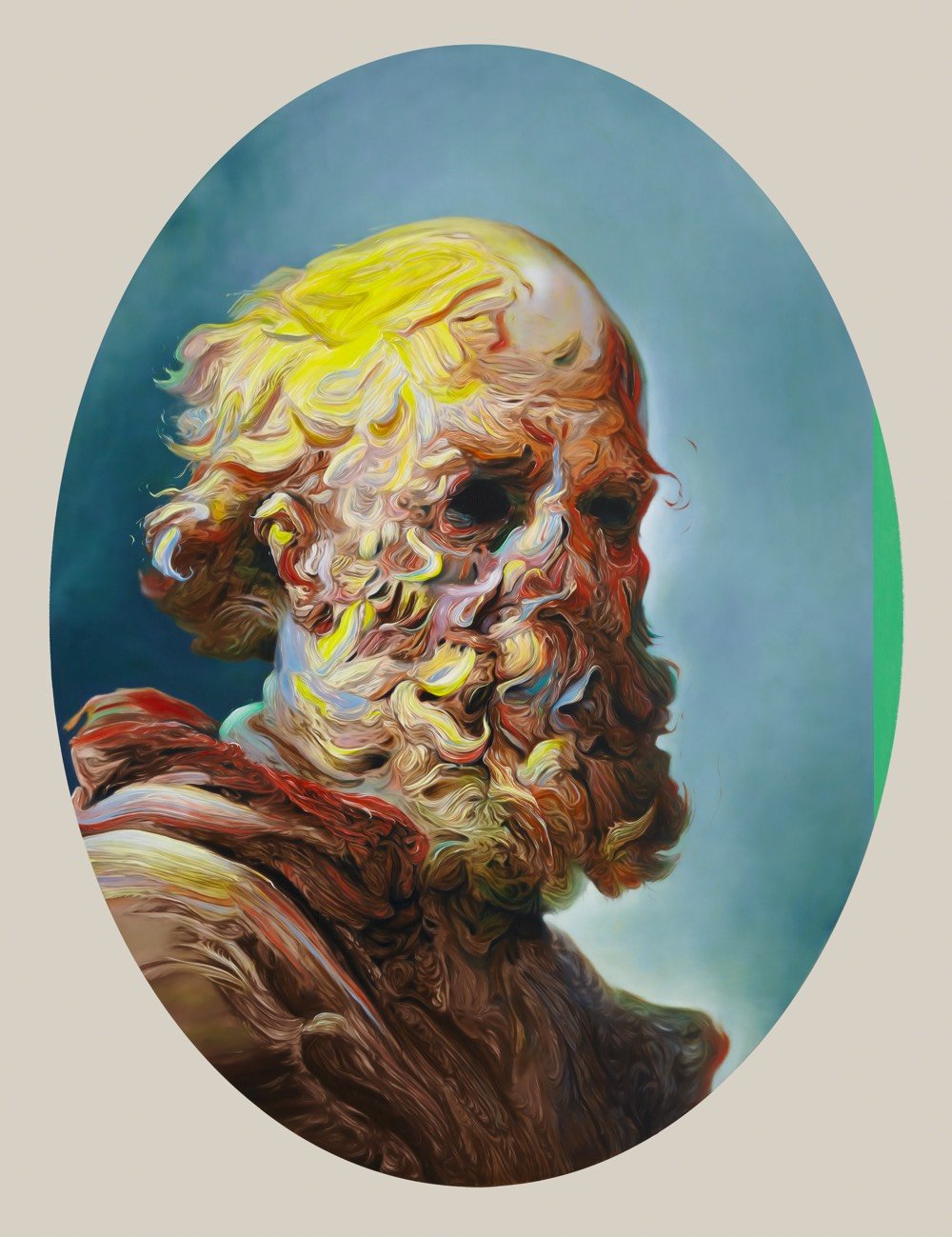
As one of the organizers, writer Philip Hoare, writes in The Guardian, Coleridge’s poem is particularly suited for the present situation, with its subject matter touching on isolation, plague, abolition, and the human impact on the natural world.
Roaring out of the radical 1790s, The Rime of the Ancient Mariner is a founding fable for our time. A fable must by definition revolve around an animal, and in Samuel Taylor Coleridge’s nightmare the slain albatross hangs around the fated sailor’s neck like a broken cross, an emblem of his sin against nature. It is all too relevant today, as a statement of isolation and despair: “Alone, alone, all, all alone, / Alone on a wide, wide sea!” Yet in that forlorn expression is great power; the power of art to change us.
You can watch the entire 41-minute read in this video (embedded above).
The Dystopia of Huge Construction Projects


From Federico Italiano, a thread of photographs of large construction sites that accidentally evoke post-apocalyptic feelings.
Kulning, a Beautiful Medieval Nordic Herding Call
In this hauntingly beautiful video, Jonna Jinton performs an ancient Nordic herding call called kulning to summon a herd of cows.
The herds grazed during the daytime, wandering far from the cottages, and thus needed to be called in each night. Women developed kulning to amplify the power of their voices across the mountainous landscape, resulting in an eerie cry loud enough to lure livestock from their grazing grounds.
One should always take caution when hanging out with someone kulning, as it can’t be done quietly. Rosenberg, who’s researched the volume of kulning, says it can reach up to 125 decibels — which, she warns, is dangerously loud for someone standing next to the source. Comparable to the pitch and volume of a dramatic soprano singing forte, kulning can be heard by an errant cow over five kilometers away.
(via moss & fog)
Overview Timelapse
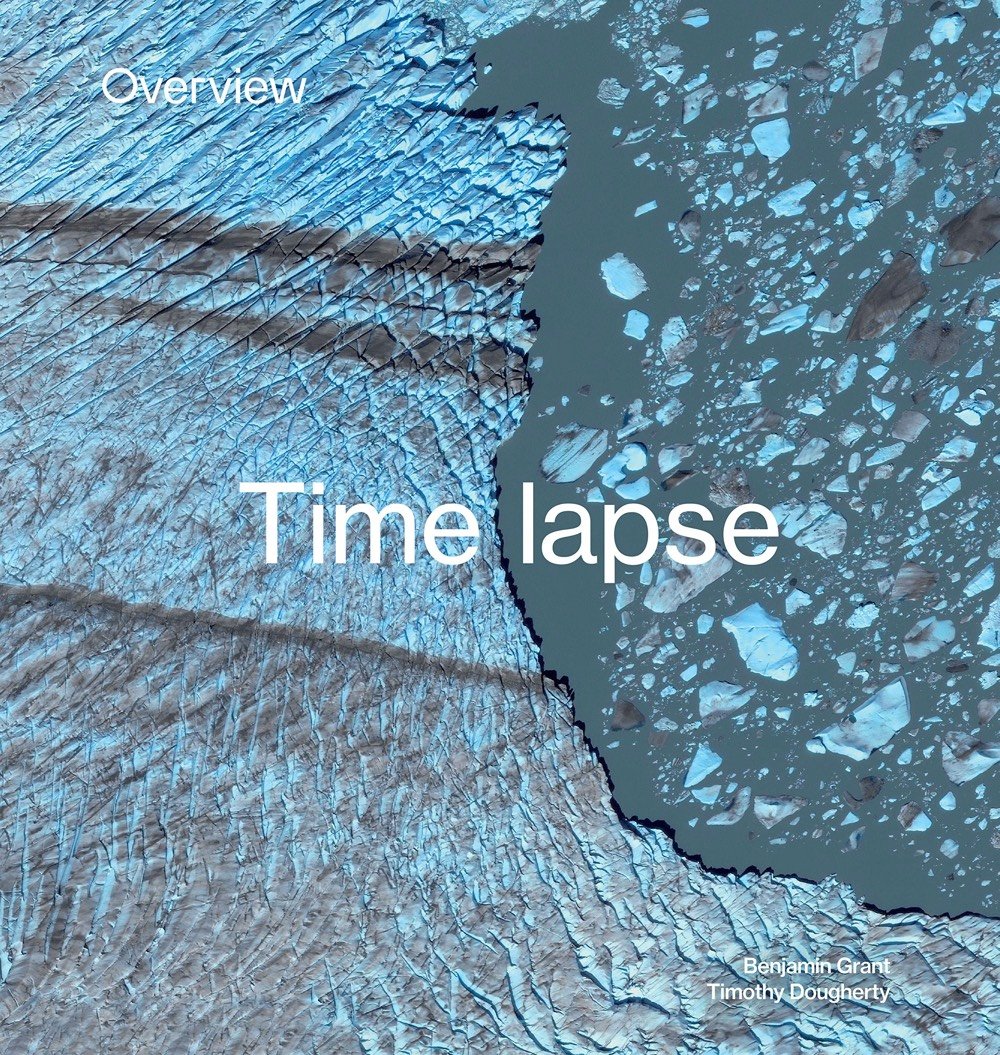
From the creators the Daily Overview website that showcases beautiful & educational satellite imagery of Earth, comes a new book about the Earth’s changing landscape. Overview Timelapse: How We Change the Earth is a book of satellite imagery that shows how landscapes change over time due to things like volcanic eruptions, climate change, population growth, and massive construction projects.
With human activity driving this transformation faster than ever, visible signs can now be seen across the planet. With more than 250 new, mesmerizing images such as sprawling cities and the patterns created by decades of deforestation, this book offers a fresh perspective of change on Earth from a larger-than-life scale.
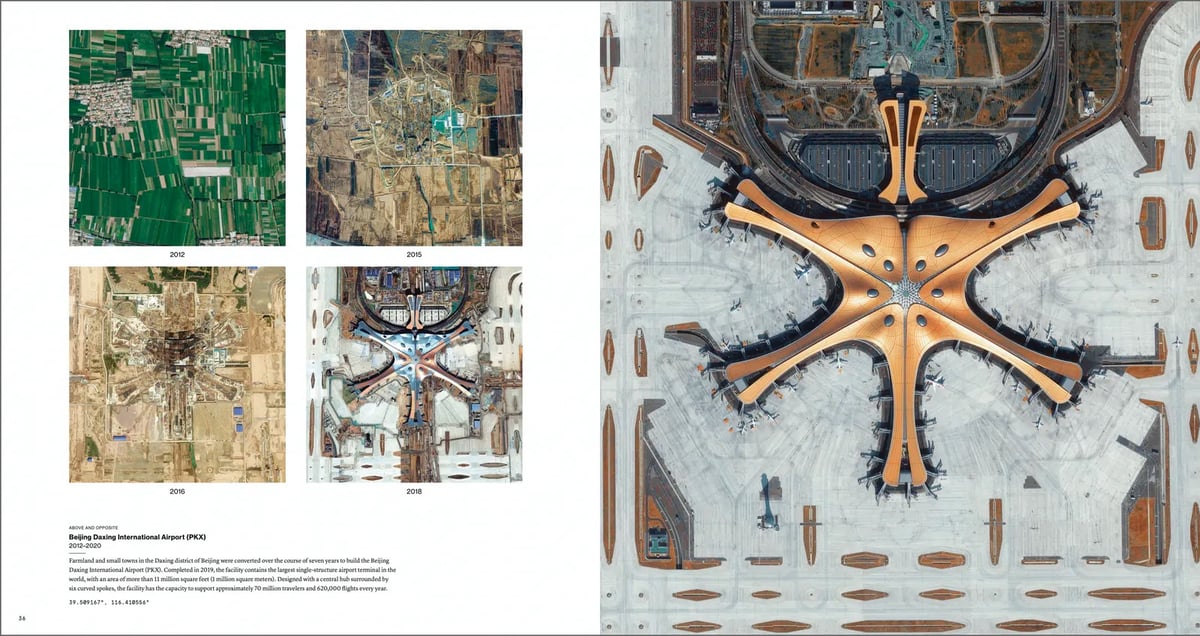
Here’s a layout from the book that shows the construction of the Beijing Daxing International Airport over the course of several years:
You can preorder Overview Timelapse from Bookshop.org and pick up their previous books as well: Overview and Overview, Young Explorer’s Edition.
Coronavirus Brings American Decline Out in the Open. “Without fixes for infrastructure, education, health care and government, the U.S. will resemble a developing nation in a few decades.”
Socials & More