Entries for June 2020
In the second video in his Concatenation series (check out the first one), Donato Sansone edited a bunch of footage of Olympic divers, gymnasts, and track & field athletes together to make a single twisting, jumping, tucking, spinning routine that’s both seamless and completely disorienting. (via colossal)
In a clip from a TV advertisement for the SDP-Liberal Alliance, John Cleese entertainingly talks about the benefits of extremism.
The biggest advantage of extremism is that it makes you feel good — because it provides you with enemies. Let me explain. The great thing about having enemies is that you can pretend that all the badness in the whole world is in your enemies and all the goodness in the whole world is in you.
Even if you don’t believe that moderate politics is the way forward (and I wonder if anyone does anymore), you can appreciate the truth that having external enemies can prevent you from discovering and addressing your views and practices that are harming others and that you need to work on.
Using census data (which she acknowledges can be imperfect in capturing the full range of people’s identities), data scientist/artist Mona Chalabi created a drawing of 100 people who are representative of NYC’s population for a NY Times opinion piece on inequality and coronavirus.
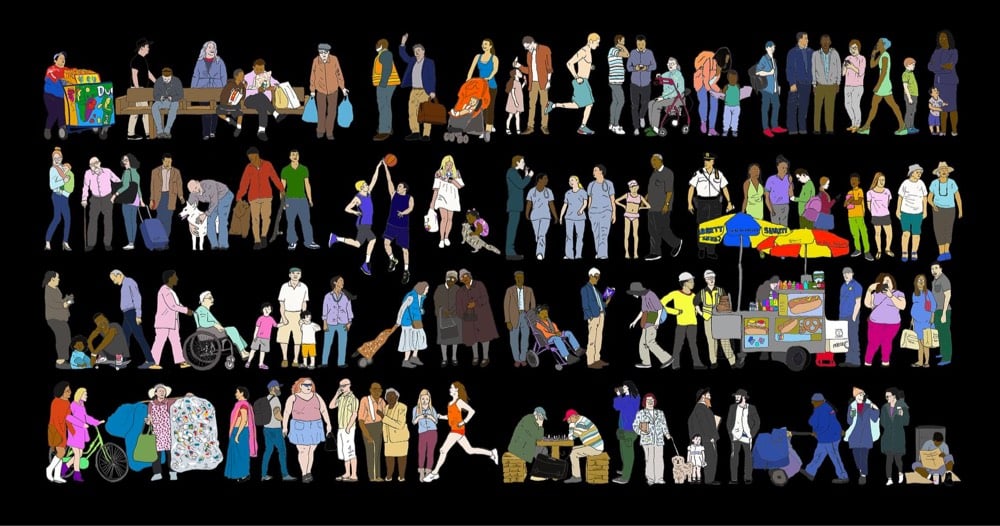
Chalabi writes on Instagram:
When you think about who is most affected by Covid-19, you need to consider inequalities in housing, in access to healthcare, in wealth. And so much of that ends up consistently affecting people of color. You could think of it as overlapping circles in a Venn diagram. Or, you could look at these 100 people.
She’s selling prints of this on her website (pink background, black background), with all profits going towards a Covid-19 rent relief fund for families organized by The Conscious Kid.
See also If Only 100 People Lived on Earth…
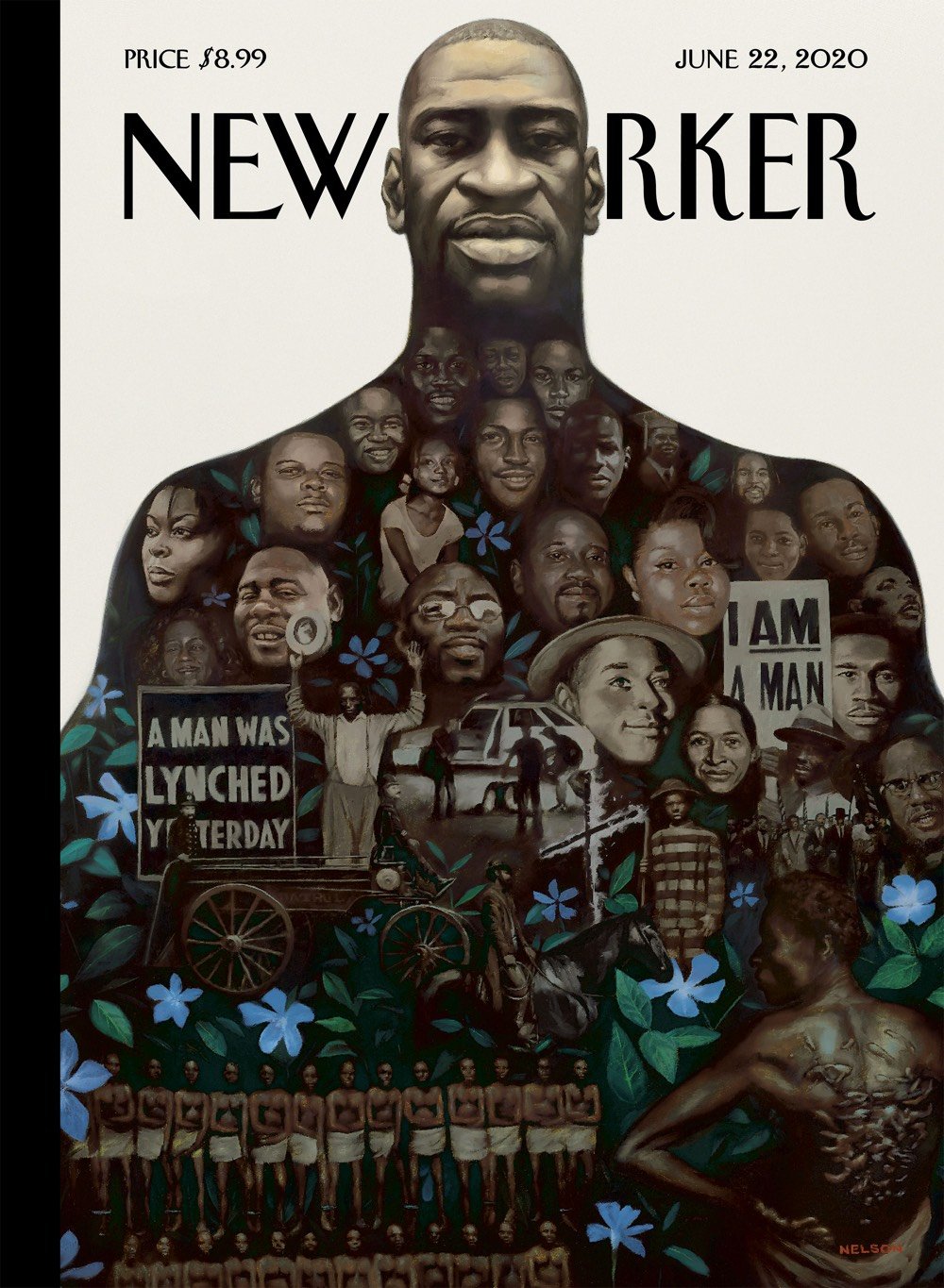
This week’s issue of the New Yorker features a cover designed by artist Kadir Nelson. The magazine has an interactive version of the cover online that identifies the people shown, along with their stories. Along with George Floyd, there’s Tony McDade, Trayvon Martin, Freddie Gray, Sandra Bland, Breonna Taylor, Tamir Rice, Martin Luther King, Jr., Medgar Evers, Emmett Till, Rodney King, the victims of the Tulsa Race Massacre, and too many others. The cover also features periwinkles, which have been used to locate the often unmarked graves of slaves.
The Periwinkle Initiative derives its name from the flower that certain scholars believe was the most common wildflower brought to gravesites of enslaved Americans. This perennial flower has guided researchers to many abandoned burial grounds that would have otherwise gone undetected. The resilient Periwinkle is a perfect symbol to represent the endurance of enslaved Americans and their legacy.
One other thing. According to the NYer, the name of the cover is “Say Their Names”. This is a take on the #SayHerName hashtag that was created to bring “awareness to the often invisible names and stories of Black women and girls who have been victimized by racist police violence”. Phrases and associated hashtags like “Say His Name” and “Say Their Names” have been used over the past few weeks, but some activists say that co-opting specifically takes the spotlight away from the victims the original hashtag was meant to highlight. Here’s Precious Fondren for Teen Vogue:
Since Floyd’s death, there have been uprisings around the country. There’s also been an influx of people using hashtags like #SayHisName and #SayTheirNames to remember the names of other male victims of police violence. While everyone deserves to be honored and remembered, especially when they are being murdered at the hands of those sworn to protect us, it should be noted that such hashtags muddle the very reasoning behind the creation of the #SayHerName.
Conceived in 2014 by the African American Policy Forum and the Center for Intersectionality and Social Policy Studies, the #SayHerName hashtag was meant to amplify the names and narratives of Black women and girls who have also been the victims of police killings; people simply couldn’t name them the way they can name Tamir Rice, Mike Brown, or Freddie Gray.
Mariame Kaba: Yes, We Mean Literally Abolish the Police. “The surest way of reducing police violence is to reduce the power of the police, by cutting budgets and the number of officers.”
In yesterday’s post about police abolition, I linked to a two-part podcast conversation between Chenjerai Kumanyika and Ruth Wilson Gilmore. I listened to the first part yesterday afternoon after posting and it was excellent, full of serious knowledge and deep context about a massive and complex American problem. But I wanted to focus here on something from the closing moments of the episode that I had never heard before: Gilmore’s definition of racism. Acknowledging that it’s a “mouthful”, she defined racism in her book Golden Gulag as “the state-sanctioned and/or extra-legal production and exploitation of group-differentiated vulnerability to premature death”.
I do not have the expertise or desire to wade into the often-contentious debate about what racism is or is not (see here for instance), but what I like about Gilmore’s take is how it explicitly includes the consequence of racism as an integral part of the definition. Racism is death — there’s a sense of moral urgency when you describe it like that, a clarity that’s absent if you’re just talking about a belief in the superiority of one race over another or even the systemic application or sanction of such prejudice.
A previously unpublished short story from Ernest Hemingway. “That year we had planned to fish for marlin off the Cuban coast for a month.”
The role of superspreaders in transmitting SARS-CoV-2. “It’s very difficult to identify an individual superspreader. It is not difficult to identify events that bring a very large number of people together in a small, enclosed space.”
The Virus Will Win. “Americans are pretending that the pandemic is over. It certainly is not.”
Comedian Dave Chappelle has released the video of a set he did recently near Dayton, Ohio. In it, he addresses the death of George Floyd and the resulting protests. From Slate:
Chappelle opens with a thank-you to young protesters — “You all are excellent drivers. I am comfortable in the back seat” — and keeps circling back to his ambivalence about taking a piece of their spotlight, even as he’s heard the calls for people with platforms the size of his to speak out. “This is the streets talking now,” he says. “They don’t need me right now.” But he also keeps coming back to the number that gives the special its title, the eight minutes and 46 seconds during which Derek Chauvin watched George Floyd’s life ebb away while three other police officers stood by “with their hands in their pockets.” “Who are you talking to?” he asks them. “What are you signifying — that you can kneel on a man’s neck for eight minutes and 46 seconds and feel like you wouldn’t get the wrath of God? That’s what is happening right now. It’s not for a single cop. It’s for all of it. Fucking all of it.”
This very much is worth watching. Even though this isn’t a comedy set, Chappelle demonstrates that he and comedians like him are often the most keen observers and skilled translators of culture that we have.
The Unmistakable Black Roots of Sesame Street. “Since its inception, ‘Sesame Street’ has been rooted in African-American culture, more specifically the historically black community of Harlem.”
The Atlantic is releasing their first feature-length documentary later this month.1 The film is called White Noise and it’s about the white nationalist movement in the US. Director Daniel Lombroso spent four years embedded in the “alt-right” movement to figure out how it works.
Progressives like to believe that racism is an opiate of the ignorant. But the alt-right’s leaders are educated and wealthy, groomed at some of America’s most prestigious institutions. The more time I spent documenting the movement, the more ubiquitous I realized it was. I bumped into one subject dancing in Bushwick with his Asian girlfriend, and another walking around DuPont Circle hitting a vape. Their racism is woven into the fabric of New York, Washington, D.C., and Paris, just as much as Birmingham, Alabama, or Little Rock, Arkansas.
During a visit to Richard Spencer’s apartment in Alexandria, Virginia, I began to understand how the alt-right works. Evan McLaren, a lawyer, wrote master plans on a whiteboard. A band of college kids poured whiskey for Spencer, adjusted his gold-framed Napoleon painting, and discussed the coming “Identitarian” revolution. Spencer offered a sense of historical purpose to his bored, middle-class followers. In his telling, they weren’t just “white Americans,” but descendants of the Greeks and Romans. “Myths are more powerful than rationality,” Spencer told me. “We make life worth living.”
White Noise is about the seductive power of extremism. Hatred feels good. But the fix is fleeting. As the film progresses, the subjects reveal the contradictions at the heart of their world. Southern advocates for traditional gender roles, but resents the misogyny and sexism of her peers. Cernovich warns that “diversity is code for white genocide,” but has an Iranian wife and biracial kids. Spencer swears he’ll lead the white-nationalist revolution — until it’s more comfortable for him to move home to live with his wealthy mother in Montana. For so many who feel lost or alone, these avatars of hate offer a promise: Follow us, and life will be better.
I mean, I’d roll my eyes if these assholes weren’t so effective and dangerous.
The film is premiering online at AFI on June 20. There doesn’t seem to be a trailer or any clips available (which seems odd) but I’ll update this post if one materializes.
Spurred by climate change, a rare but deadly mosquito-borne illness is on the rise in the US Northeast. “The mosquito is still the deadliest creature on the planet for our species. In 2018, it killed approximately 830,000 people.”
The conclusion from a recent paper in the Proceedings of the Royal Society A:
We conclude that facemask use by the public, when used in combination with physical distancing or periods of lock-down, may provide an acceptable way of managing the COVID-19 pandemic and re-opening economic activity. These results are relevant to the developed as well as the developing world, where large numbers of people are resource poor, but fabrication of home-made, effective facemasks is possible. A key message from our analyses to aid the widespread adoption of facemasks would be: ‘my mask protects you, your mask protects me’.
From a Reuters report on the paper:
The research, led by scientists at the Britain’s Cambridge and Greenwich Universities, suggests lockdowns alone will not stop the resurgence of the new SARS-CoV-2 coronavirus, but that even homemade masks can dramatically reduce transmission rates if enough people wear them in public.
“Our analyses support the immediate and universal adoption of face masks by the public,” said Richard Stutt, who co-led the study at Cambridge.
A pair of recent papers used the geographic differences in mask usage in Germany to gauge the effectiveness of masks in preventing the spread of Covid-19. Face Masks Considerably Reduce COVID-19 Cases in Germany:
We use the synthetic control method to analyze the effect of face masks on the spread of Covid-19 in Germany. Our identification approach exploits regional variation in the point in time when face masks became compulsory. Depending on the region we analyse, we find that face masks reduced the cumulative number of registered Covid-19 cases between 2.3% and 13% over a period of 10 days after they became compulsory. Assessing the credibility of the various estimates, we conclude that face masks reduce the daily growth rate of reported infections by around 40%.
And Compulsory face mask policies do not affect community mobility in Germany suggests that people don’t go out more or “feel invincible” when they’re wearing masks:
We use anonymised GPS data from Google’s Location History feature to measure daily mobility in public spaces (groceries and pharmacies, transport hubs and workplaces). We find no evidence that compulsory face mask policies affect community mobility in public spaces in Germany. The evidence provided in this paper makes a crucial contribution to ongoing debates about how to best manage the COVID-19 pandemic.
And these are just from the last few days. Why WHY WHY!!!! are we still talking about this? There’s no credible evidence that wearing a mask is harmful, so at worse it’s harmless. If there’s like a 1-in-10 chance that masks are somewhat helpful — and the growing amount of research suggests that both 1-in-10 and “somewhat helpful” are both understatements — isn’t it worth the tiny bit of effort to wear one and help keep our neighbors safe from potential fucking death? Just in case?
I mean, look at where we are as a country right now. Most of the US is reopening while the number of infections continue to rise. Testing is still not where it needs to be in many areas. Tracing and isolation are mostly not happening. According to epidemiologists, those are the minimum things you need to do to properly contain a pandemic like this. Maybe if you’re Iceland you can pooh pooh the efficacy of masks because you test/trace/isolated to near-perfection, but if you’re going to half-ass it like the US has chosen to do, then wearing masks under semi-lockdown conditions is all we have left! Can we do the bare minimum that is asked of us?
Update: And some anecdotal evidence from Missouri: two hairstylists saw 140 clients while symptomatic last month and it resulted in zero infections. Both the hairstylists and their clients wore masks and took other precautions (staggered appointments, chairs spaced apart).
Update: I deleted a reference to this paper that many epidemiologists et al. have flagged as problematic (see here, here, and here for instance). (via @harrislapiroff)
The Masks Masquerade by Nassim Nicholas Taleb is worth a read.
“Libertarians” (in brackets) are resisting mask wearing on grounds that it constrains their freedom. Yet the entire concept of liberty lies in the Non-Aggression Principle, the equivalent of the Silver Rule: do not harm others; they in turn should not harm you. Even more insulting is the demand by pseudolibertarians that Costco should banned from forcing customers to wear mask — but libertarianism allows you to set the rules on your own property. Costco should be able to force visitors to wear pink shirts and purple glasses if they wished.
Note that by infecting another person you are not infecting just another person. You are infecting many many more and causing systemic risk.
Wear a mask. For the Sake of Others.
And finally, obviously, if wearing a mask is not advisable for you — for a genuine medical reason or if it makes you look dangerous to a racist policing system for instance — then you shouldn’t wear one! But the vast majority of us should be able to manage it.
Update: A study in Health Affairs analyzing the infection rates in US states with face mask mandates versus those without finds that a mandate was associated with a decline in the Covid-19 growth rate (italics mine).
Mandating face mask use in public is associated with a decline in the daily COVID-19 growth rate by 0.9, 1.1, 1.4, 1.7, and 2.0 percentage points in 1-5, 6-10, 11-15, 16-20, and 21+ days after signing, respectively. Estimates suggest as many as 230,000-450,000 COVID-19 cases possibly averted By May 22, 2020 by these mandates. The findings suggest that requiring face mask use in public might help in mitigating COVID-19 spread.
In a comparison among countries, those where people wore masks early fared much better than those where people didn’t. This is a pretty stark difference:
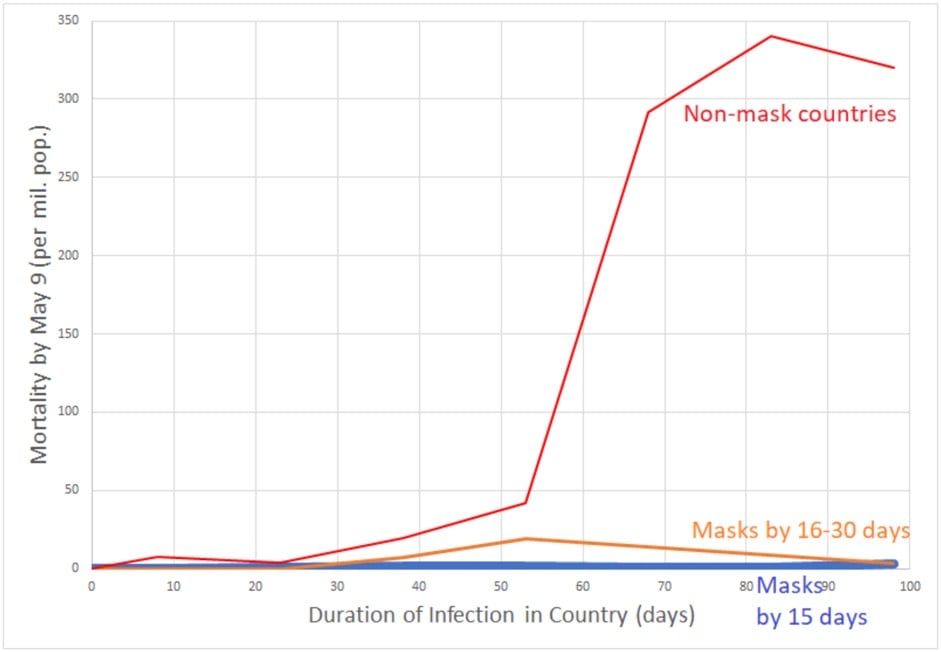
And this study noted that Google search volume of people searching for masks in various countries correlated with the infection rate — in general, the earlier the search volume increased in a given country, the fewer infections recorded in that country.
Update: A list of 70 scientific studies, dating all the way back to 2003, that support the wearing of face masks to prevent disease spread.
Bill Nye recently did a quick mask demonstration featuring a candle to show how effective homemade cloth masks are at blocking exhaled breath. He calls wearing a mask in public to protect other people “literally a matter of life and death”.
Stewart Reynolds shares some reasons to not wear a face mask, including selfish syndrome and chronic dickishness.
And this is a sad and all-too-typical American story in four parts. April: I’m not buying a mask; June: crowded pool party; July: complaining about being sick followed by an obituary. We need to fix this, now. People should not be dying like this — this is a 100% preventable death.
Update: The most recent version of an ongoing review of scientific studies about face mask efficacy was recently published online. From the abstract:
We recommend that public officials and governments strongly encourage the use of widespread face masks in public, including the use of appropriate regulation.
Tulsa Race Massacre. “White mobs invaded [the prosperous African American community of] Greenwood intent on burning, looting and killing. This is what happened in the 1921.”
In recent weeks as antiracism and anti-police violence protests continue around the country, the movement to defund and abolish policing in America has rapidly gained momentum. As Black communities have asserted for decades, people have begun to wonder in earnest what purpose police serve. They’re asking when there’s a problem in our communities, do we really need a person with a gun showing up to solve it? What would a system oriented around public safety look like if it was designed from scratch rather than just piling more responsibility onto and funding into increasingly militarized and unaccountable police departments?
There are a lot of resources out there about police abolition right now, so here are some that I’ve found helpful in understanding it.
Alex Vitale’s The End of Policing, which came out in 2017, is a well-reviewed critique of modern policing.
This book attempts to spark public discussion by revealing the tainted origins of modern policing as a tool of social control. It shows how the expansion of police authority is inconsistent with community empowerment, social justice — even public safety. Drawing on groundbreaking research from across the world, and covering virtually every area in the increasingly broad range of police work, Alex Vitale demonstrates how law enforcement has come to exacerbate the very problems it is supposed to solve.
In contrast, there are places where the robust implementation of policing alternatives—such as legalization, restorative justice, and harm reduction — has led to a decrease in crime, spending, and injustice. The best solution to bad policing may be an end to policing.
Verso, the book’s publisher, is offering the ebook version for free for a limited time. The Paris Review has an excerpt that addresses the difficulties with reforms (such as the #8cantwait initative):
This does not mean that no one should articulate or fight for reforms. However, those reforms must be part of a larger vision that questions the basic role of police in society and asks whether coercive government action will bring more justice or less. Too many of the reforms under discussion today fail to do that; many further empower the police and expand their role. Community policing, body cameras, and increased money for training reinforce a false sense of police legitimacy and expand the reach of the police into communities and private lives. More money, more technology, and more power and influence will not reduce the burden or increase the justness of policing. Ending the War on Drugs, abolishing school police, ending broken-windows policing, developing robust mental health care, and creating low-income housing systems will do much more to reduce abusive policing.
The Intercept interviewed Vitale in October 2017.
We should understand policing as the most coercive form of state power … and the reason is that policing has historically and inherently been at the root of reproducing fundamental inequalities of race, class, and immigration status. Trump, the police, ICE — this is just a continuation of a history of exclusion and repression going back to the exclusion of Chinese immigrants in the 19th century, Texas Rangers driving out Mexican landholders and indigenous populations to make room for white settlers, the transformation of slave patrols and urban slave management systems into what became Jim Crow policing in the South and ghetto policing in the North. Police have historical origins in relation to both the formation and disciplining of the industrial working class; early 19th century forms of policing in Europe and the United States shaped rural agricultural workers into urban industrial workers, and then suppressed their movements to form labor unions and win better living conditions.
The point of all this is to fundamentally question this liberal notion that police exist primarily as a tool for public safety and therefore, we should embrace their efforts uncritically, when in fact, there are lots of different ways to produce safety that don’t come with the baggage of colonialism, slavery, and the suppression of workers’ movements.
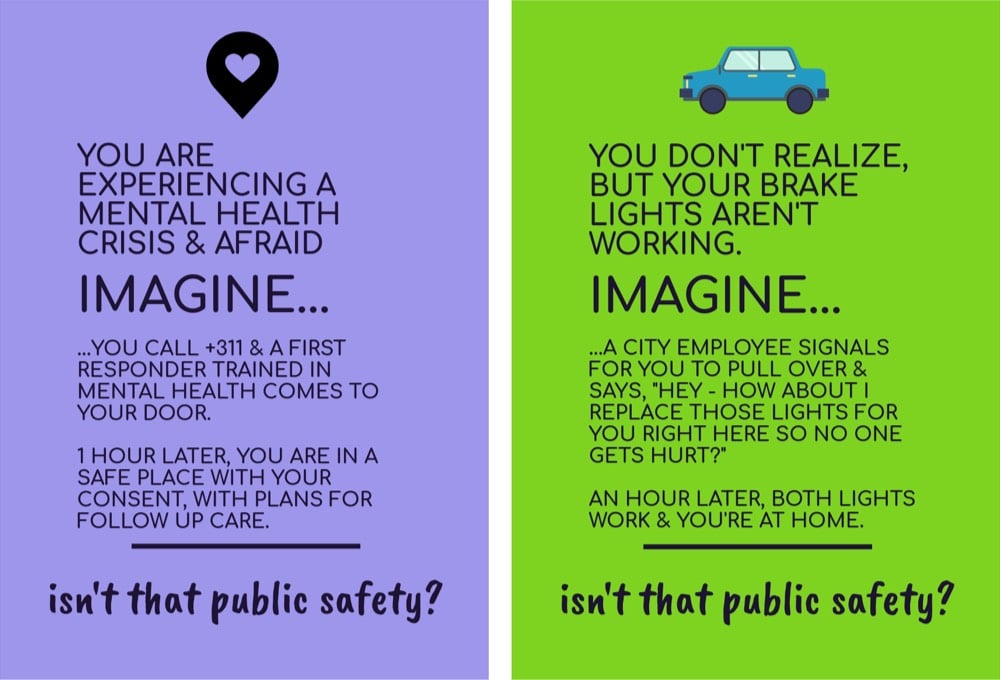
In 2018, Amber Hughson designed a series of flyers outlining some alternatives to policing. The “Isn’t this public safety?” question at the end of each flyer is really compelling.
Christy Lopez (co-director of Georgetown Law School’s Innovative Policing Program) writing in The Washington Post: Defund the police? Here’s what that really means.
To fix policing, we must first recognize how much we have come to over-rely on law enforcement. We turn to the police in situations where years of experience and common sense tell us that their involvement is unnecessary, and can make things worse. We ask police to take accident reports, respond to people who have overdosed and arrest, rather than cite, people who might have intentionally or not passed a counterfeit $20 bill. We call police to roust homeless people from corners and doorsteps, resolve verbal squabbles between family members and strangers alike, and arrest children for behavior that once would have been handled as a school disciplinary issue.
Police themselves often complain about having to “do too much,” including handling social problems for which they are ill-equipped. Some have been vocal about the need to decriminalize social problems and take police out of the equation. It is clear that we must reimagine the role they play in public safety.
MPD150, a grassroots organization working towards a police-free Minneapolis, has a bunch of resources on their website, including What are we talking about when we talk about “a police-free future?” and an 8-page FAQ zine for folks trying to get up to speed on police abolition.
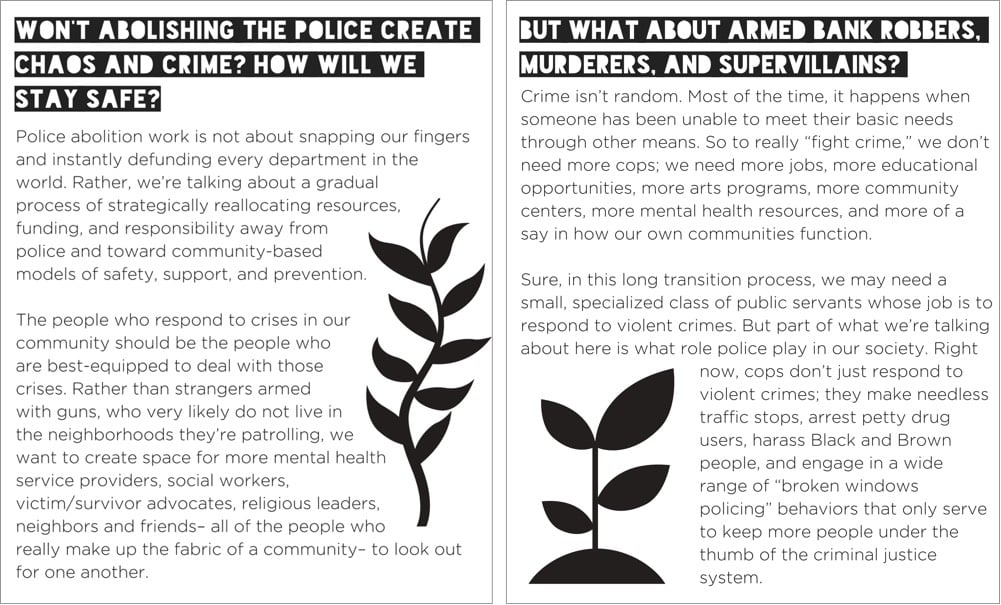
Many people already live in a world without police. If you grew up in a well-off, predominantly white suburb, how often did you interact with cops? Communities with lots of good jobs, strong schools, economies, and social safety nets are already, in some ways, living in a world without police.
Annie Lowrey makes a fiscal argument in Defund the Police.
A thin safety net, an expansive security state: This is the American way. At all levels of government, the country spends roughly double on police, prisons, and courts what it spends on food stamps, welfare, and income supplements. At the federal level, it spends twice as much on the Pentagon as on assistance programs, and eight times as much on defense as on education. The wars in Iraq and Afghanistan will ultimately cost something like $6 trillion and policing costs $100 billion a year. But proposals to end homelessness ($20 billion a year), create a universal prekindergarten program ($26 billion a year), reduce the racial wealth gap through baby bonds ($60 billion a year), and eliminate poverty among families with children ($70 billion a year) somehow never get financed. All told, taxpayers spend $31,286 a year on each incarcerated person, and $12,201 a year on every primary- and secondary-school student.
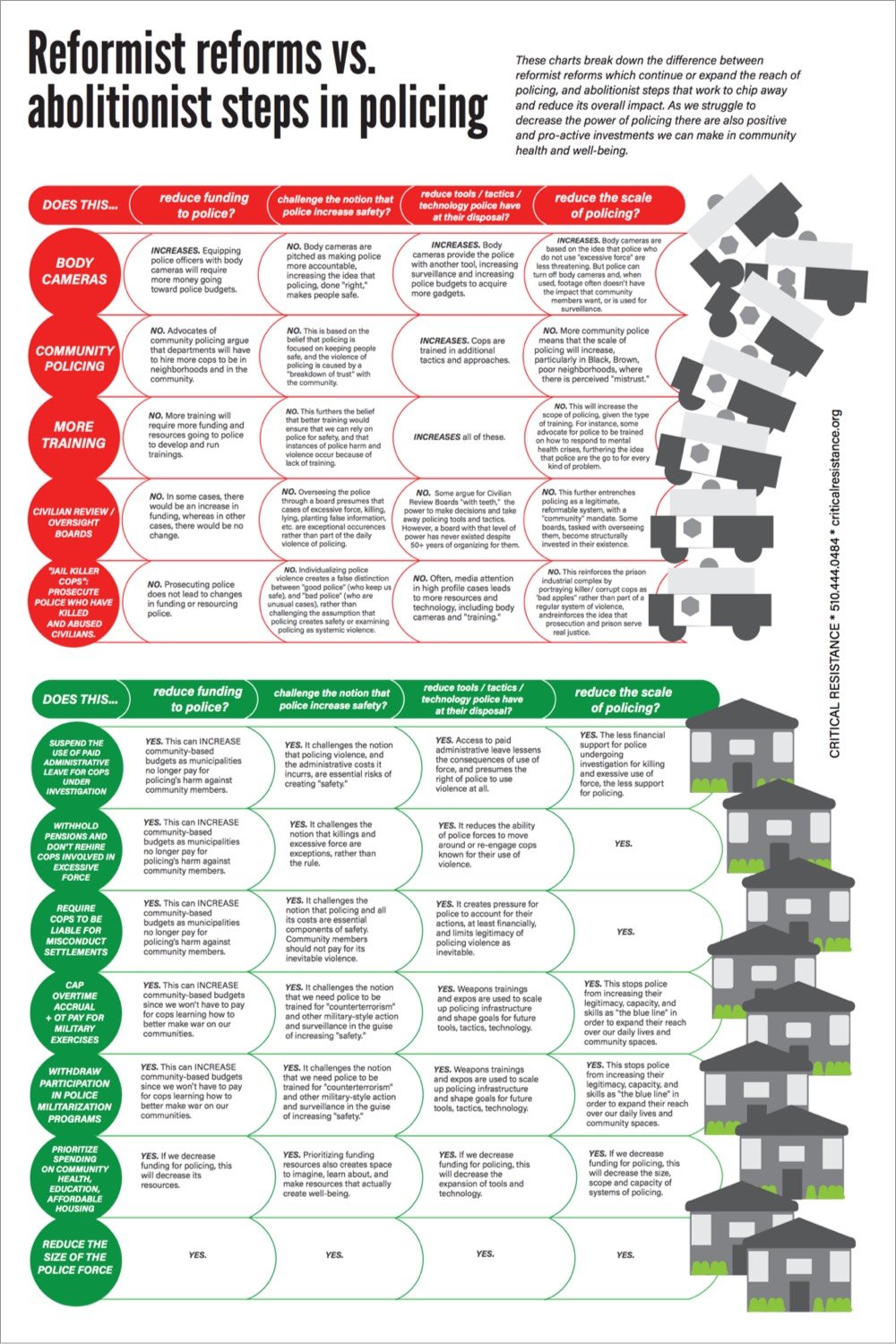
Critical Resistance has a police abolition resources page that many activists are recommending, including this toolkit and this chart comparing reforms vs abolition.
The Marshall Project is maintaining a collection of links about police abolition.
I liked the framing of this Twitter thread by Gabrielle Blair:
This is how I, a 45-year-old white woman and mother of 6, currently at her peak Karen power, went from assuming police work was a necessary part of functional communities, to becoming a passionate advocate for #abolishthepolice #defundthepolice, over the course of one week.
She continues:
“I suppose it is tempting, if the only tool you have is a hammer, to treat everything as if it were a nail.” Do you know that saying? Apply it to police. If you’re always prepared to easily inflict violence, then the chances of inflicting unwarranted violence go way up.
Cat in a tree? Got locked out of your car? Kids prank called 911? Found a brutally murdered body? When called, police will arrive at all four of these scenes equally armed to the teeth. Why would we ever be okay with that? It is INSANE.
Vox’s podcast Today, Explained did an episode on What “abolish the police” means. From the transcript:
SEAN: And for the people who are worried about how this you know, how this might affect the way our society functions, like, let’s just say, you know, it’s a Friday night, 4th of July or something like that, like like the Fourth of July. That’s coming up real soon. And, you know, you’re worried about drunk drivers on the road. Who’s getting your back on drunk drivers?
BRANDON: You’re going to be able to call the police. The police are still going to be out there enforcing traffic violations, maybe not with weapons, though, maybe they have some other tools to de-escalate situations.
SEAN: And what about, like, you’re scared that this jilted ex lover of yours is going to come after you and kill you? Same situation?
BRANDON: You know, we can continue to go through these hypotheticals. I want to be very clear here. Police don’t listen to black women as it exists today. Black women are often the victims of sexual assault, sexual violence, and they are not listened to. They’re not deemed credible by police officers. So we’ve got to ask yourself, is policing working? Maybe it’s working for certain communities, white communities in particular. Now, police are going to be there when you call and say, hey, look, there’s someone harassing me. They’re going to have the better trained police officer come and diffuse the situation if the perpetrator is still there.
I have not listened to this yet, but next up in my podcast queue is a two-episode series of Intercepted with host Chenjerai Kumanyika and long-time prison abolitionist Ruth Wilson Gilmore.
Journalist and lawyer Josie Duffy Rice:
many people in america already exist in a world where police and prisons do not exist. go to any middle to upper class suburb in america. cops arent wandering the streets. people aren’t being arrested. neighbors aren’t being sent to prison. and generally everyone is….fine.
many people say they cannot imagine this world. what most of them cannot imagine is someone not policing black brown and poor people. THAT is what is unimaginable to them. not the absence of law enforcement. if you are lucky, you already functionally live with that absence.
Garrett Felber details the history of the police and prison abolition movements that stretch back for decades: The Struggle to Abolish the Police Is Not New.
Although abolition was not a central demand of the midcentury civil rights movement — despite informing the activism of many of its key figures — it took hold in the 1970s. This revolutionary ethos — what Chicano poet Raul Salinas called the “prison rebellion years” — was linked to mass uprisings in the streets; the state repression, jailing, and murder of black and brown radicals; and opposition to the Vietnam War and imprisonment of conscientious objectors. Quaker Fay Honey Knopp’s pivotal 1976 Instead of Prisons: A Handbook for Prison Abolitionists, for example, had its genesis in her visits to conscientious objectors in prison during the Vietnam War and her participation in feminist, civil rights, gay rights, and prisoners’ rights struggles.
Update: Abolition activist Mariame Kaba writes in a NY Times opinion piece: Yes, We Mean Literally Abolish the Police.
Minneapolis had instituted many of these “best practices” but failed to remove Derek Chauvin from the force despite 17 misconduct complaints over nearly two decades, culminating in the entire world watching as he knelt on George Floyd’s neck for almost nine minutes.
Why on earth would we think the same reforms would work now? We need to change our demands. The surest way of reducing police violence is to reduce the power of the police, by cutting budgets and the number of officers.
But don’t get me wrong. We are not abandoning our communities to violence. We don’t want to just close police departments. We want to make them obsolete.
We should redirect the billions that now go to police departments toward providing health care, housing, education and good jobs. If we did this, there would be less need for the police in the first place.
This is very good – lots of recommendations. “A critical review of films on the Civil Rights Movement and institutionalized racism, with dozens of recommendations of films to watch and those to avoid.”
In The Atlantic, epidemiologists Julia Marcus and Gregg Gonsalves explain why public health officials are not being hypocritical in their support of the antiracism protests around the country.
At its core, the argument being leveled against public-health experts is that the reason for the protests shouldn’t matter. The coronavirus doesn’t care whether it’s attending an anti-lockdown protest or an anti-racism one. But these two kinds of protests are not equivalent from a public-health perspective. Some critics might argue that the anti-lockdown protests promoted economic activity, which can help stave off the health implications of poverty. (On this count, public-health experts were ahead of the curve: Many — including one of us — were advocating for a massive infusion of assistance to individual Americans as early as March.) But these protests were organized by pro-gun groups that believe the National Rifle Association is too compromising on gun safety. Egged on by the president to “save your great 2nd Amendment,” anti-lockdown protesters stormed government buildings with assault rifles and signs reading COVID-19 IS A LIE. The anti-lockdown demonstrations were explicitly at odds with public health, and experts had a duty to oppose them. The current protests, in contrast, are a grassroots uprising against systemic racism, a pervasive and long-standing public-health crisis that leads to more than 80,000 excess deaths among black Americans every year.
If “conservative commentators” cared at all about keeping people safe from Covid-19 infection, they would have denounced the I-Need-A-Haircut protests as reckless and they didn’t. Instead, they engage in these bad faith arguments that are just designed to stir up outrage.
Gonsalves wrote a thread on Twitter a few days ago that’s relevant here as well.
The risk to all of us was inflamed by an absolute decision at the highest levels that this epidemic was not worth an all-out, coordinated, comprehensive national mobilization. It took weeks for the President to even agree that the epidemic wouldn’t go away on its own.
The US, the richest nation in the world, then couldn’t get it together to scale-up the number of tests we needed to understand what was going on in our communities with SARS-COV-2, and in the end said it was up to the states to figure it all out.
And then this is the last word as far as I’m concerned:
We’ve all been put at far more jeopardy during this pandemic by our political leaders than by the people on the streets over the past week or so.
One of the countries with the best response to Covid-19 has been Iceland. The country didn’t lockdown nor do many people wear masks, but they have virtually eliminated the virus through a vigorous program of test, trace, and isolate that was coordinated by public-health authorities. Iceland’s numbers were high in the beginning (the virus was carried into the country from people returning from vacation) but they acted quickly and aggressively — Elizabeth Kolbert has the story for the New Yorker.
Möller pulled up a series of graphs and charts on her laptop. These showed that, per capita, Iceland had had more COVID-19 cases than any other Scandinavian country, and more than even Italy or Britain. There was an outbreak in a nursing home in the town of Bolungarvík, in northwestern Iceland, and one in the Westman Islands, an archipelago off the southern coast, which seemed to have started at a handball game. (In Europe, handball is a team sport that’s sort of a cross between basketball and soccer.)
“The numbers in the beginning were terrible,” Möller said. She attributed the country’s success in bringing the caseload down in part to having got an early start. The “trio,” along with officials from Iceland’s university hospital, had begun meeting back in January. “We saw what was going on in China,” she recalled. “We saw the pictures of people lying dead in emergency departments, even on the street. So it was obvious that something terrible was happening. And, of course, we didn’t know if it would spread to other countries. But we didn’t dare take the chance. So we started preparing.” For example, it was discovered that the country didn’t have enough protective gear for its health-care workers, so hospital officials immediately set about buying more.
Wyatt Cenac’s Problem Areas was an HBO documentary series created and hosted by writer and comedian Wyatt Cenac. The entire run of the show is available for free on YouTube (and on the HBO website) for the next month, but of particular interest is the first season, which was dedicated to the problem of policing in America. The first episode of season one, embedded above, explores police training (specifically “warrior training”) and how it contributed to the death of Philando Castile in Minneapolis. The season’s other episodes cover community policing, police abolition, use of force, and abuse of power.
Cenac says of the show:
The show’s not perfect. You can see when my eyes are reading a teleprompter because HBO’s legal team needed me to say something very specifically so they didn’t get sued. But the show wasn’t about being perfect or even about being right. It was about trying to have a dialogue.
When the smoke clears, we’re still going to need to find a way forward. And we’re going to have to find a way to do it together because this country is a dingy apartment and we’re all just a bunch of Craigslist roommates that have to find a way not to eat each other’s cheese.
See also Ava DuVernay’s Selma and 13th Available to Watch Online for Free.
Confessions of a Former Bastard Cop is an essay allegedly written by a former police officer with ten years of experience in “a major metropolitan area in California with a predominantly poor, non-white population”. In it, he attempts to explain the system under which cops are trained and operate, “not to excuse their behavior, but to explain it and to indict the structures that perpetuate it.” At the very least, this essay corroborates what activists have been saying about the police for decades.
I could write an entire book of the awful things I’ve done, seen done, and heard others bragging about doing. But, to me, the bigger question is “How did it get this way?”. While I was a police officer in a city 30 miles from where I lived, many of my fellow officers were from the community and treated their neighbors just as badly as I did. While every cop’s individual biases come into play, it’s the profession itself that is toxic, and it starts from day 1 of training.
Every police academy is different but all of them share certain features: taught by old cops, run like a paramilitary bootcamp, strong emphasis on protecting yourself more than anyone else. The majority of my time in the academy was spent doing aggressive physical training and watching video after video after video of police officers being murdered on duty.
I want to highlight this: nearly everyone coming into law enforcement is bombarded with dash cam footage of police officers being ambushed and killed. Over and over and over. Colorless VHS mortality plays, cops screaming for help over their radios, their bodies going limp as a pair of tail lights speed away into a grainy black horizon. In my case, with commentary from an old racist cop who used to brag about assaulting Black Panthers.
And this, uh, training doesn’t prepare officers for what their actual job ends up being:
And consider this: my job as a police officer required me to be a marriage counselor, a mental health crisis professional, a conflict negotiator, a social worker, a child advocate, a traffic safety expert, a sexual assault specialist, and, every once in awhile, a public safety officer authorized to use force, all after only a 1000 hours of training at a police academy. Does the person we send to catch a robber also need to be the person we send to interview a rape victim or document a fender bender? Should one profession be expected to do all that important community care (with very little training) all at the same time?
To put this another way: I made double the salary most social workers made to do a fraction of what they could do to mitigate the causes of crimes and desperation. I can count very few times my monopoly on state violence actually made our citizens safer, and even then, it’s hard to say better-funded social safety nets and dozens of other community care specialists wouldn’t have prevented a problem before it started.
Armed, indoctrinated (and dare I say, traumatized) cops do not make you safer; community mutual aid networks who can unite other people with the resources they need to stay fed, clothed, and housed make you safer. I really want to hammer this home: every cop in your neighborhood is damaged by their training, emboldened by their immunity, and they have a gun and the ability to take your life with near-impunity. This does not make you safer, even if you’re white.
His conclusion: “consider abolishing the police” and “creating a society focused on reconciliation and restorative justice instead of punishment, pain, and suffering — a system that sees people in crisis as humans, not monsters”.
As someone who did it for nearly a decade, I need you to understand that by and large, police protection is marginal, incidental. It’s an illusion created by decades of copaganda designed to fool you into thinking these brave men and women are holding back the barbarians at the gates.
How the Coronavirus Compares With 100 Years of Deadly Events. The excess deaths caused by Covid-19 are higher than from hurricanes, 9/11, bad flu seasons, etc. Excess mortalities compared to normal: Stockholm 2.2x, London 3x, Madrid 4.6x, NYC 5.8x.
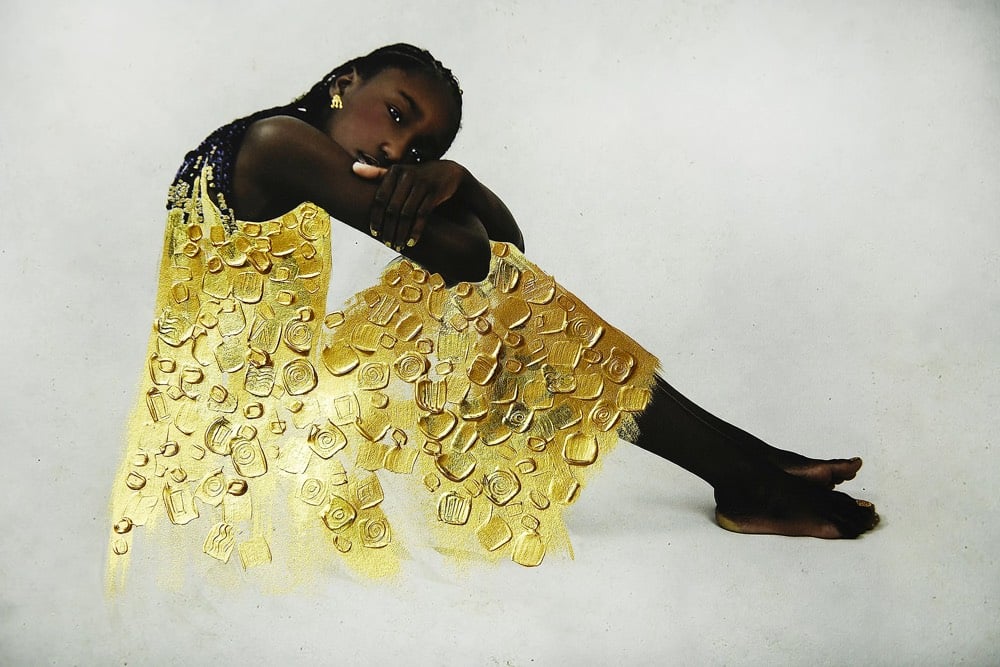
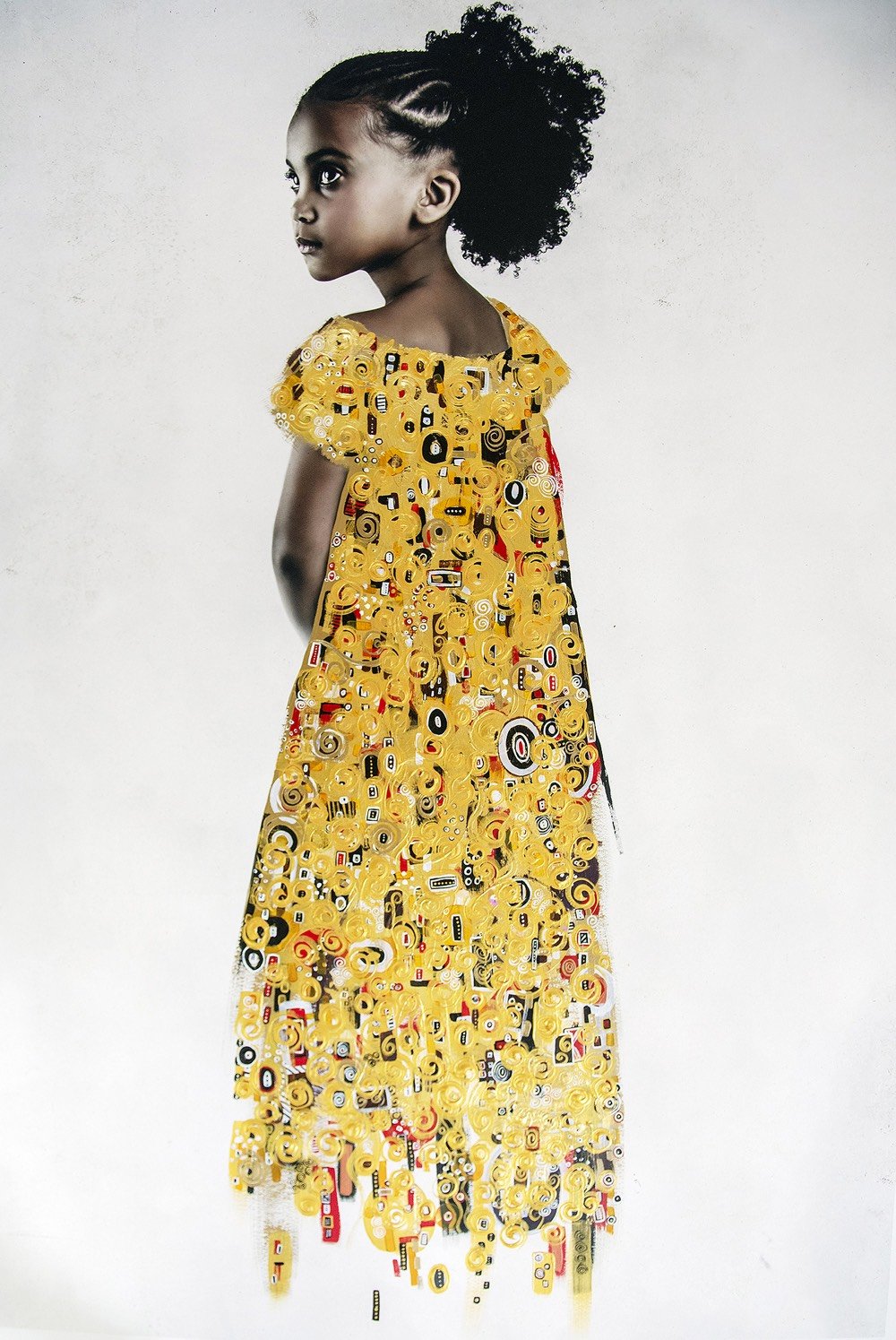
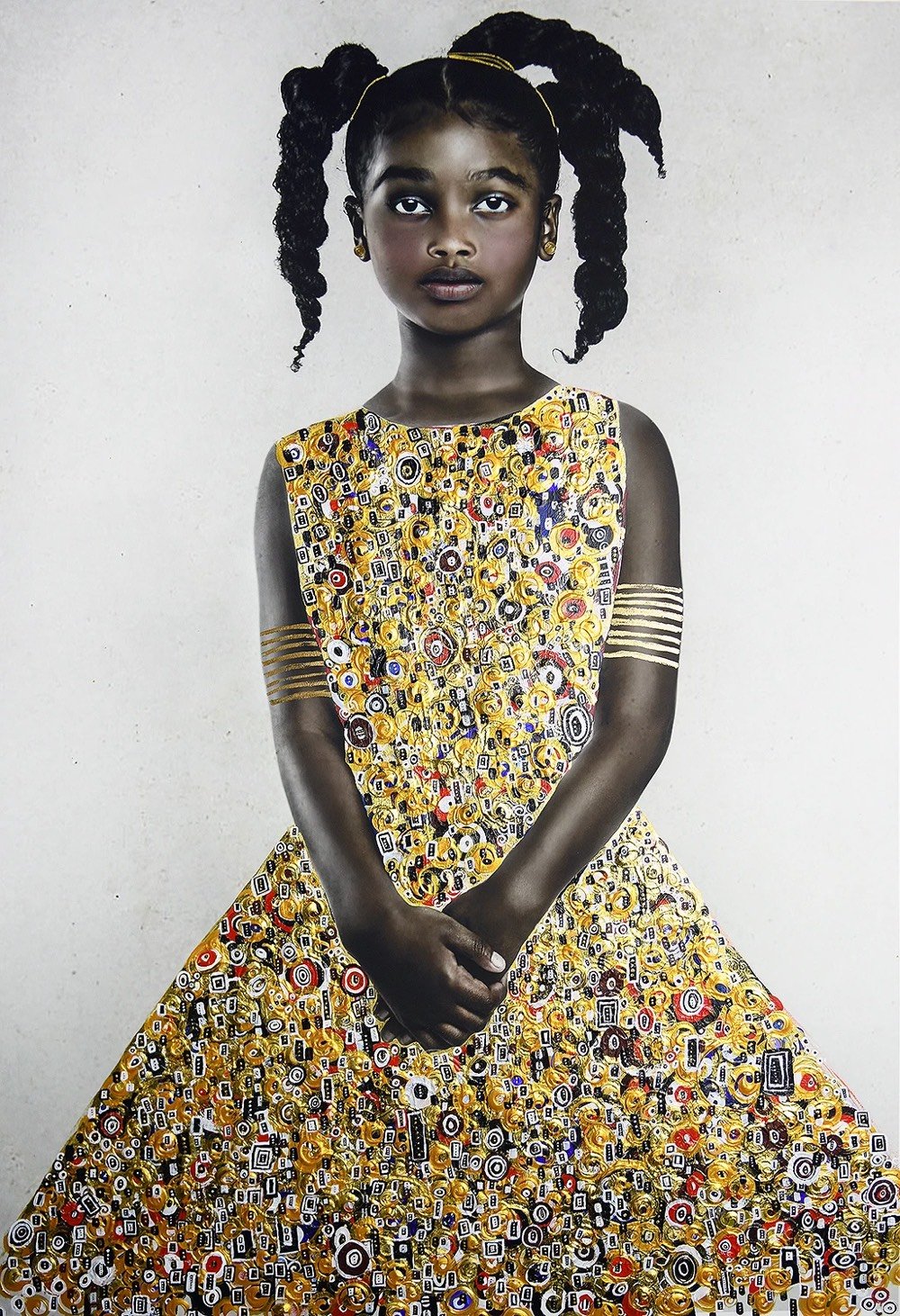
Directly inspired by the paintings of Gustav Klimt’s Golden Phase, the intention of Tawny Chatmon’s project The Redemption is to “celebrate and reinforce the beauty of Black hair, features, life, and culture”.
In the United States and abroad, the hair types and styles that are distinctively akin to Black people and culture continue to be policed and labeled as unkempt, unruly, unattractive, and unprofessional. While we proudly celebrate and adorn these styles with beads, barrettes and other accessories within our cultural norms, they continue to be labeled unacceptable. In schools worldwide, there are rules set in place deeming cornrows, barber designs, hair beads, afros, locs, and protective styles that use hair extensions as “violations of the dress code”. “Violations” that are punishable by ridicule, suspension, exclusion from extracurricular activities and expulsion. Still, in 2019, Black women and men are faced with similar discrimination in the workplace.
Great work — definitely click through to see the entire project. (via colossal)
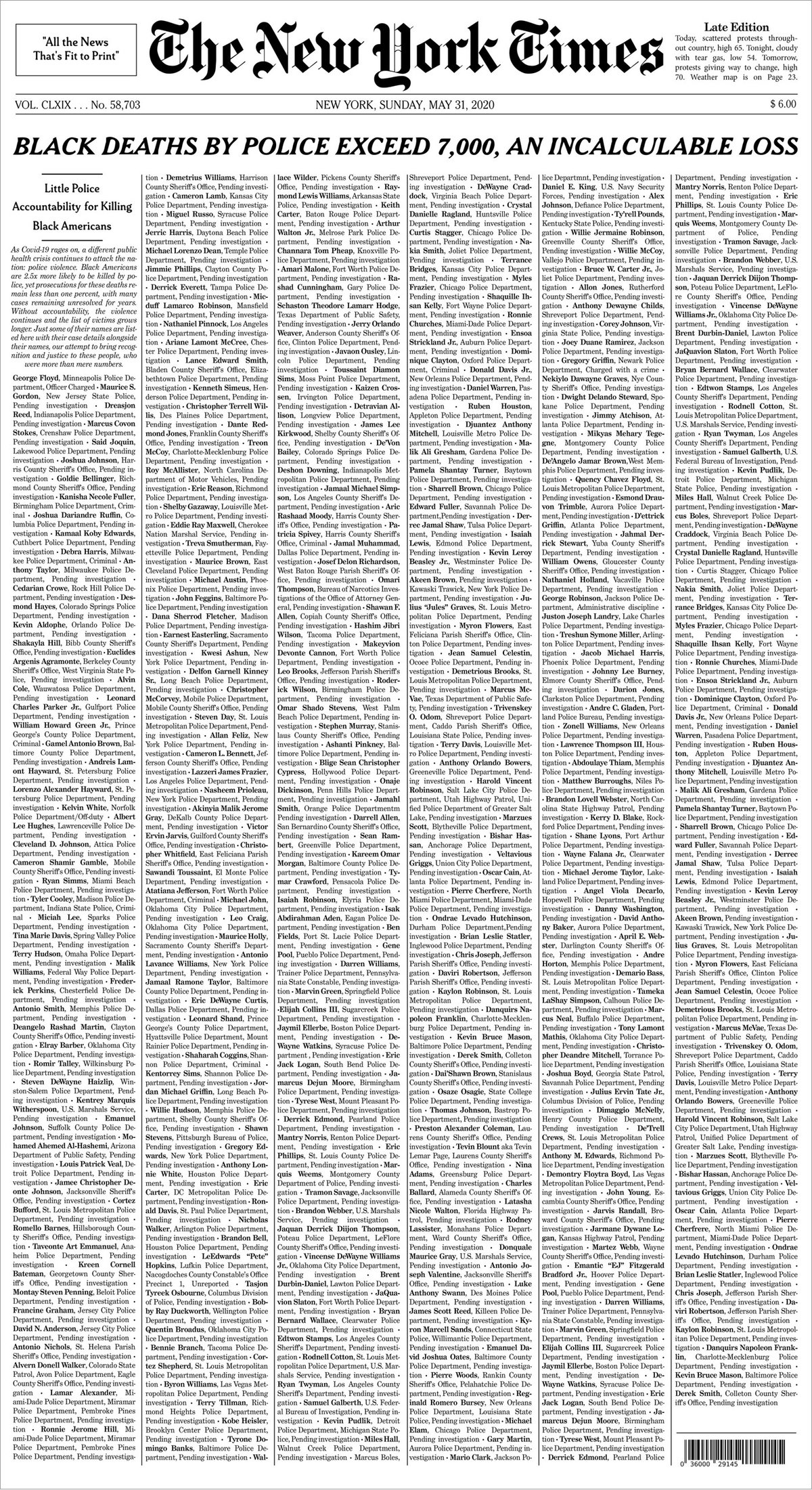
On Sunday May 24, the NY Times gave over their entire front page to listing the names of hundreds of victims of Covid-19 in the US. It was an iconic gesture that focused people’s attention on both the overall death toll and the stories & lives of the individual people who had been killed by the disease.
The Incalculable Loss Project has repurposed this design to honor some of the 7,000 Black Americans killed by police since 2000 and to ask why media outlets like the Times haven’t given “the same attention to this epidemic as they did Covid-19”. Each person’s name is accompanied by the name of the officer’s police department and the current status of the investigation into the killing (overwhelmingly “pending investigation”).
From motion graphics studio Eido, director Joash Berkeley, and educator Riché Richardson, an animated short film about civil rights icon Rosa Parks.
Many people only know of Parks through sanitized stories in school textbooks, documentaries, and the top results on Google: that she was a tired old seamstress who quietly (and almost accidentally) ignited the Montgomery bus boycott by not wanting to move from her seat. But Parks was a political radical who had a long history of fighting for civil rights. Here is Parks’ great niece Urana McCauley on how involved and passionate she was:
One of the things that people don’t understand about my aunt is that she was an activist her whole life and she started questioning things at a young age. I think part of it was her upbringing with her grandfather, Sylvester Edwards. He would sit up at night with a shotgun — in case the KKK might come by and try to kill them — and talk to her about black resistance and the key figures in it: Crispus Attucks, Harriet Tubman, Marcus Garvey. That laid the foundation for my aunt to feel like, “This isn’t right. I should be doing something and becoming an activist.” Her whole life became dedicated to change.
In 2013, political science professor Jeanne Theoharis published a biography called The Rebellious Life of Mrs. Rosa Parks about Parks’ decades of activism.
Presenting a powerful corrective to the popular iconography of Rosa Parks as the quiet seamstress who with a single act birthed the modern civil rights movement, scholar Jeanne Theoharis excavates Parks’s political philosophy and six decades of activism. Theoharis masterfully details the political depth of a national heroine who dedicated her life to fighting American inequality and, in the process, resurrects a civil rights movement radical who has been hidden in plain sight far too long.
Theoharis wrote an article a couple of years later after the Library of Congress opened their Rosa Parks Collection to the public.
Her “life history of being rebellious,” as she put it, comes through decisively in the recently opened Rosa Parks Collection at the Library of Congress. It features previously unseen personal writings, letters, speech notes, financial and medical records, political documents, and decades of photographs.
There, we see a lifelong activist who had been challenging white supremacy for decades before she became the famous catalyst for the Montgomery bus boycott. We see a woman who, from her youth, didn’t hesitate to indict the system of oppression around her. As she once wrote, “I talked and talked of everything I know about the white man’s inhuman treatment of the negro.”
Parks was a seasoned freedom fighter who had grown up in a family that supported Marcus Garvey and who married an activist for the Scottsboro boys. She joined the Montgomery chapter of the NAACP in 1943, becoming branch secretary. She spent the next decade pushing for voter registration, seeking justice for black victims of white brutality and sexual violence, supporting wrongfully accused black men, and pressing for desegregation of schools and public spaces. Committed to both the power of organized nonviolent direct action and the moral right of self defense, she called Malcolm X her personal hero.
(video via print)
Regarding “a few bad apples”: How Apples Go Bad. “The closer an apple is to rot, the more rot it spreads – one spoiling apple…speeds the rot of every apple it touches, and even of ones it doesn’t touch.”
Great thread on how to prepare to have the Why-You-Should-Care-About-Other-People talk w/ family. “The values that you raised me are inconsistent with the ones you’re demonstrating, and that makes me respect you less, and causes me to pull away from you.”
In this video for NPR, Gene Demby summarizes the history of housing segregation in America and how it’s a factor for current differences in health (poorer), wealth (much less), education (underfunded), and policing (much more aggressive) for Black communities in US cities.
If you look at the way housing segregation works in America, you can see how things ended up this way. Once you see it, you won’t be able to unsee it.
When you’re talking about housing policy in America, Kimberly Jones’ Monopoly analogy starts to sound a lot less metaphorical and more literal: if Black people cannot buy houses or can only buy houses on certain streets, they will not be able to build wealth like others can.
For more on housing segregation, check out historian Richard Rothstein’s The Color of Law: A Forgotten History of How Our Government Segregated America. From a 2017 interview with Rothstein:
The federal government pursued two important policies in the mid-20th century that segregated metropolitan areas. One was the first civilian public housing program which frequently demolished integrated neighborhoods in order to create segregated public housing.
The second program that the federal government pursued was to subsidize the development of suburbs on a condition that they be only sold to white families and that the homes in those suburbs had deeds that prohibited resale to African-Americans. These two policies worked together to segregate metropolitan areas in ways that they otherwise would never have been segregated.
Rothstein talked about the book with Ta-Nehisi Coates during a conversation at Politics and Prose Bookstore.
Update: This is excellent: you can explore the maps created by the federal government’s Home Owners’ Loan Corporation at Mapping Inequality by the University of Richmond’s Digital Scholarship Lab.
These grades were a tool for redlining: making it difficult or impossible for people in certain areas to access mortgage financing and thus become homeowners. Redlining directed both public and private capital to native-born white families and away from African American and immigrant families. As homeownership was arguably the most significant means of intergenerational wealth building in the United States in the twentieth century, these redlining practices from eight decades ago had long-term effects in creating wealth inequalities that we still see today.
(via @masonadams)
Some misconceptions about the civil rights movement & protests. “Sorry, guys. MLK wasn’t about going to protest in a designated area and playing by the rules. His goal was to make people uncomfortable and cause chaos. He ADVOCATED breaking the law.”
WNYC editor and critic Rebecca Carroll on what she wants white people to do for Black Americans (besides stop killing them):
The other day, a childhood friend of mine who now lives abroad called me out of the blue in tears: “How can this be happening? I’m so sorry about what’s happening in America, but more so what’s happening to black people in America. I don’t know what to do. I just feel miserable and I can’t stop crying.”
“Lean into that,” I said. “That’s the appropriate response.” Miserable is exactly how the white people who want to help should be feeling right now, and then they should sit with that misery until something breaks in their brain, the narrative changes in their psyche, and the legacy of emotional paralysis lifts entirely. I don’t mean self-serving sadness or performative tears, but rather a bone-deep sense of agony and grief that forces the humanization of black people. We can’t matter unless we are seen as human beings first.
Newer posts
Older posts




Socials & More