



Aardman Animations and Netflix are teaming up for a sequel to Chicken Run

Advertise here with Carbon Ads
This site is made possible by member support. 💞
Big thanks to Arcustech for hosting the site and offering amazing tech support.
When you buy through links on kottke.org, I may earn an affiliate commission. Thanks for supporting the site!
kottke.org. home of fine hypertext products since 1998.
Beloved by 86.47% of the web.
Entries for June 2020
American travelers may be barred from visiting Europe when it reopens to visitors because of our clear failure to contain Covid-19 within our borders. Good job, everyone. So embarrassing.
How to Process Our Collective Global Trauma
Do you feel tired, scared, angry, sad or numb? Are you having trouble concentrating or sleeping? How about all of the above? Because of the events of the last few months — *gestures around at the pandemic, violence against Black people, climate change, global inequality, , etc. etc. etc.* — many people are experiencing trauma on an individual level as well as together on a collective level. Erin Biba interviewed psychologist Dr. Renée Lertzman, an expert on large scale trauma, about what we can do to address how we’re feeling in order to move past feeling like shit and become more useful to ourselves, our families, and our communities.
The next really important piece is stabilizing ourselves with the bigger context. Really putting things in perspective that this is an event that is in fact legitimately destabilizing. It is stretching all of us in ways we haven’t anticipated and it’s important to have that context to make sense of what we’re experiencing and why. This is in fact, my brain is struggling to process what’s going on because it’s on a level that’s so beyond anything I’ve ever experienced before, so I’m struggling to even know how to be. Of course, I’m feeling this way, These are global events that are having all kinds of unexpected and traumatic impacts. How we live with that level of uncertainty is huge. Everyone is outside of their levels of tolerance right now.
“I’m struggling to even know how to be” is a really accurate summary of how I’ve been feeling recently. See also What To Do About Our Collective Pandemic Grief Before It Overwhelms Us and Trouble Focusing? Not Sleeping? You May Be Grieving.
Uncomfortable Conversations with a Black Man
Former NFL linebacker and sports media personality Emmanuel Acho has started a video series on YouTube called Uncomfortable Conversations with a Black Man. From the first episode (of two), here’s his mission statement:
In the midst of all this chaos in our world, so many of y’all have reached out to me. And by y’all, I mean white people have reached out to me asking, “How can I help? How can I join in? How can I stand with you?” So I’ve created this for you because in order to stand with us and people that look like me, you have to be educated on issues that pertain to me. And fully educated so that you can feel the full level of pain so that you can have full understanding. I fervently believe that if the white person is your problem only the white person can be your solution. And so this is made for you my white brothers and sisters to increase your level of understanding so that you can increase your level of compassion and lead ultimately to change.
For the second episode, Acho sat down with fellow Austin resident Matthew McConaughey and yes, the conversation is a little cringe-y at times:
After watching that, you might be interested in reading Langston Hughes’ poem Let America Be America Again.
O, let America be America again-
The land that never has been yet-
And yet must be-the land where every man is free.
The land that’s mine-the poor man’s, Indian’s, Negro’s, ME-
Who made America,
Whose sweat and blood, whose faith and pain,
Whose hand at the foundry, whose plow in the rain,
Must bring back our mighty dream again.
Nile Rodgers Tells the Story of the Iconic Riff on Bowie’s Let’s Dance
In this video from Fender, the legendary producer/composer/guitarist Nile Rodgers sits down with his iconic Stratocaster and talks about how he took a folky tune that David Bowie came up with and turned it into the jazzy backbone of the pop song Let’s Dance, arguably Bowie’s biggest hit. Listening to where the song started off before Rodgers started tweaking, it’s hard for this musical simpleton to recognize that it’s even the same tune.
Update: Rodgers told a variation of this story in 2015.
Who Is Responsible For Climate Change?
In their newest video, Kurzgesagt explores the question of responsibility around climate change: which countries are most responsible for carbon emissions and for fixing the damage they’ve caused. As always, their source material is worth a look.
Novak Djokovic, the world #1 men’s tennis player, has tested positive for Covid-19. He “organised a tennis tournament where adherence to social distancing has been minimal” because “the players went out clubbing…after the tournament finished”.
The Pandemic’s Epidemic of Loneliness
In The Price of Isolation for Rolling Stone, Alex Morris writes about how trends toward increasing social isolation in America left us ill-prepared to face weeks and months of time by ourselves during the pandemic. Studies have shown that humans in isolation are less healthy and less able to fight off disease than when other humans are around. This part in particular really really resonated with me:
Sometimes, though, the body can be tricked. When Cole and his colleagues started looking for ways to combat the physical effects of loneliness, they didn’t find that positive emotions made a difference at all. But one thing did: “It was something called eudaimonic well-being, which is a sense of purpose and meaning, a sense of a commitment to some kind of self-transcendent goal greater than your own immediate self-gratification. People who have a lot of connection to some life purpose? Their biology looked great.” Even when researchers compared lonely people with purpose to social butterflies without it, purpose came out on top. In other words, it’s possible when we’re doing things to better our society, the body assumes there’s a society there to better. We’re technically alone, but it doesn’t feel that way.
Which has profound implications in the moment in which we currently find ourselves, a moment when the physical isolation and disconnection the virus has inflicted is now layered over the clear divisions and systemic inequities that have always plagued our country. In the midst of our solitude, we’ve been confronted with the terrible knowledge that people of color are dying of the virus at the highest rates and that 40 percent of families making less than $40,000 a year have lost their livelihoods. We’ve been confronted with the killings of Ahmaud Arbery, Breonna Taylor, and George Floyd. We’ve been confronted with the lie that the virus is a great equalizer. We’ve witnessed the many ways it isn’t.
See also We’re All Lonely Together and An Epidemic of Middle-aged Male Loneliness.
The Handwritten First Draft of Spike Lee’s Do The Right Thing
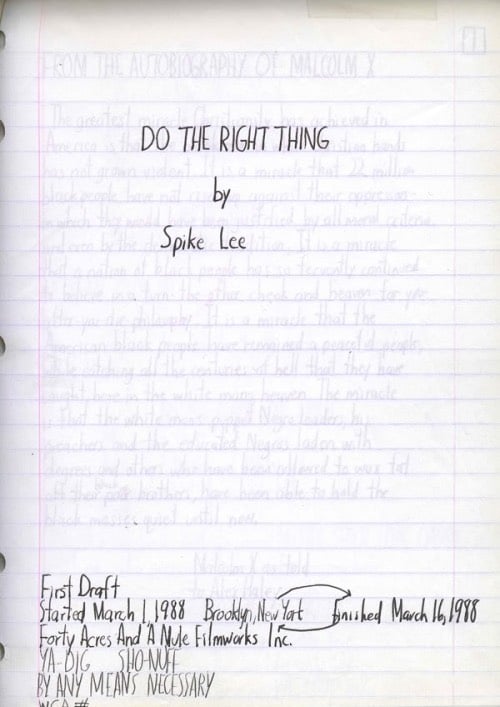
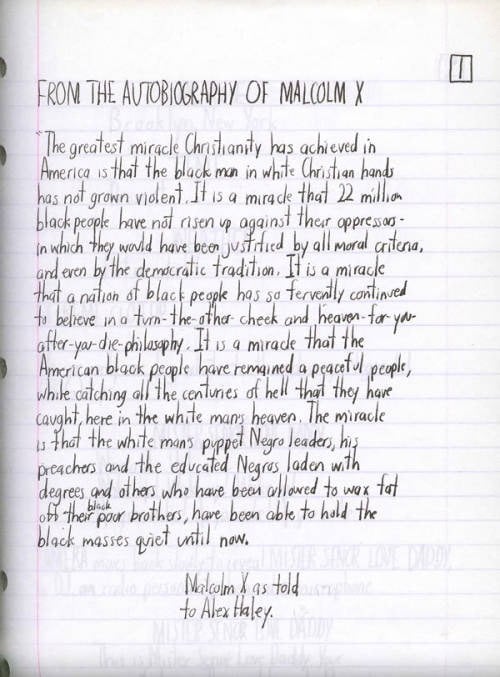
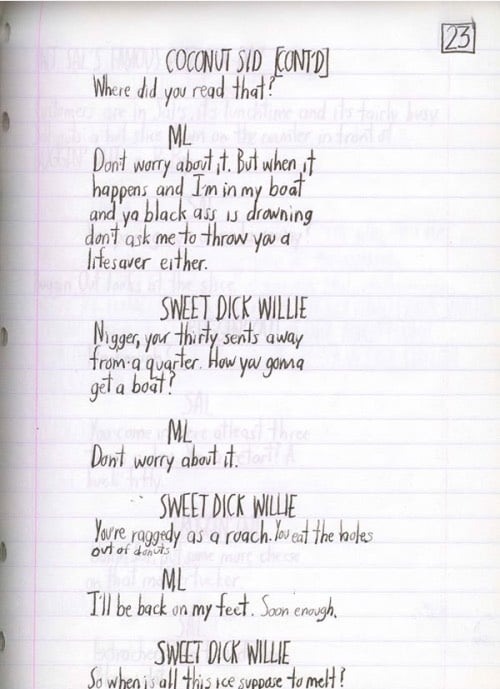
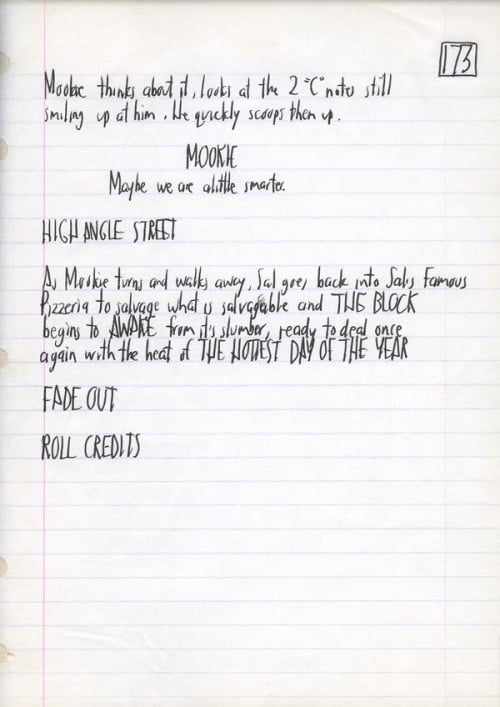
In March 1988, Spike Lee wrote a first draft screenplay for his movie Do The Right Thing in just over 2 weeks. Four pages of this handwritten draft are pictured above. I wasn’t able to track down the entire screenplay, but the typed second draft can be found here. From a book companion to the film, here’s an excerpt from Lee’s journal from the day before he began writing:
Yesterday I began work on the script. Well, actually, I began the last work before the actual writing of the script. I put down all the ideas or scenes and dialogue on three-by-five index cards. TOMORROW, I’ll begin to write this motherfucker.
This morning I got up early to go to my corner store, T and T, to buy the paper. The young guys who work there had a Run-D.M.C. tape on. The owner, an old Italian guy, says, “What da fuck is dat? Turn that jungle music off. We’re not in Africa. It’s giving me a stomach ache.” Sooner or later it comes out. Okay, so you don’t like rap music. But why does it have to be about jungle music and Africa? I should have Sal say the same words to Radio Raheem in the movie.
And sure enough, on page 77 of the second draft:
SAL: Turn that JUNGLE MUSIC off. We ain’t in Africa.
BUGGIN’ OUT: Why it gotta be about jungle music and Africa?
SAL: It’s about turning that shit off and getting the fuck outta my pizzeria.
And on the day after finishing, he wrote:
Tuesday morning I finished the first draft of Do The Right Thing. It came in at roughly eighty-seven typed pages. It’s the fastest script I have ever written. In all, the actual writing of the first draft took fifteen days, but I have been taking notes since December.
(via criterion collection)
The Gaps Between White and Black America, in Charts. “In many parts of the country, black and white Americans continue to live in very different worlds. [This is] a result of policy choices.”
Ava DuVernay’s When They See Us Available to Watch Online for Free
Netflix has put When They See Us, Ava DuVernay’s 4-episode mini-series about the Central Park Five, in front of their paywall for free viewing. Here’s the trailer:
The 2013 Ken Burns documentary The Central Park Five is available to watch on the PBS site and also on Amazon.
As previously noted, DuVernay’s 13th and Selma are also both available to watch online for free.
COVID-19 is ravaging America’s vulnerable Latino communities. “About 65% of positive tests in the county that is home to Chattanooga, Tennessee, are Latinos, even though they make up just 6% of the population.”
Now Streaming - Recorder: The Marion Stokes Project
For 35 years, activist and archivist Marion Stokes recorded television news coverage on VHS tapes, amassing a collection of hundreds of thousands of hours of footage. Matt Wolf has produced a documentary about Stokes called Recorder: The Marian Stokes Project.
For over 30 years, Marion Stokes obsessively and privately recorded American television news twenty-four hours a day. A civil rights-era radical who became fabulously wealthy and reclusive later in life, her obsession started with the Iranian Hostage Crisis in 1979 — at the dawn of the twenty-four hour news cycle. It ended on December 14, 2012 as the Sandy Hook massacre played on television while Marion passed away. In between, Marion filled 70,000 VHS tapes, capturing revolutions, wars, triumphs, catastrophes, bloopers, talk shows and commercials that show us how television shaped the world of today and in the process tell us who we were.
A mystery in the form of a time capsule, Recorder delves into the strange life of a woman for whom home taping was a form of activism to protect the truth (the public didn’t know it, but the networks had been disposing their archives for decades into the trashcan of history) and though her visionary and maddening project nearly tore her family apart, her extraordinary legacy is as priceless as her story is remarkable.
The trailer is above and you can watch the whole thing for free on PBS for a limited time.
Palo Alto, a Previously Unreleased Thelonious Monk Live Album
A Thelonious Monk live album that was recorded in 1968 is set to be released for the first time on July 31, 2020. You can hear the first single from the album on YouTube, Spotify, or several other places. (The song is now unavailable — see the update below.)
The story behind the performance is a little nutty — a student hired Monk to play at his high school and many folks didn’t buy tickets until the jazz great actually pulled into the parking lot.
After the assassination of Dr. Martin Luther King, Jr. in 1968, racial tensions across the country rose. Palo Alto, a largely white college town in California, was not immune to the events of the day. Danny Scher, a rising junior at Palo Alto High School, had a dream to bring Thelonious Monk to Palo Alto to perform and help bring about racial unity in his community as well as raise funds for his school’s International Committee. After somehow securing Monk’s services to perform on Sunday, October 27, Scher initially had trouble selling tickets and convincing people that Monk was even going to show up. With many twists and turns along the way and several hundred people waiting in the school’s parking lot to await Monk’s arrival before purchasing tickets, the concert eventually happened and was a triumph in more ways that Monk or Scher could have imagined. This is a recording of that historic concert.
(via, who else?, @tedgioia)
Update: One of the high school’s custodians took charge of tuning Monk’s piano and recording the session. A crowdsourced effort is underway to identify and recognize his efforts.
Update: The album’s release has been “indefinitely delayed”.
“I received word that there was a dispute between the estate and Monk’s previous label,” Scher said during a phone conversation on Monday, July 27. So the release has been taken off of the schedule indefinitely “due to circumstances beyond the label’s control,” according to a statement by Impulse! Records. Co-producer Feldman was unable to provide any further information at this time.
The album’s first single has been scrubbed from all the streaming services as well.
Today Is Juneteenth, the USA’s Second Independence Day
Today is Juneteenth, a holiday that started in Texas that celebrates the emancipation of enslaved people in the United States. From Vox’s Juneteenth, explained:
A portmanteau of “June” and “nineteenth,” Juneteenth marks the day in 1865 when a group of enslaved people in Galveston, Texas, finally learned that they were free from the institution of slavery. But, woefully, this was almost two and a half years after President Abraham Lincoln signed the Emancipation Proclamation; the Civil War was still going on, and when it ended, Union Maj. Gen. Gordon Granger traveled to Texas and issued an order stating that all enslaved people were free, establishing a new relationship between “former masters and slaves” as “employer and hired labor.” As much as Juneteenth represents freedom, it also represents how emancipation was tragically delayed for enslaved people in the deepest reaches of the Confederacy.
And freedom was further delayed, but the holiday stuck. From What Is Juneteenth? by Henry Louis Gates, Jr.:
When Texas fell and Granger dispatched his now famous order No. 3, it wasn’t exactly instant magic for most of the Lone Star State’s 250,000 slaves. On plantations, masters had to decide when and how to announce the news — or wait for a government agent to arrive — and it was not uncommon for them to delay until after the harvest. Even in Galveston city, the ex-Confederate mayor flouted the Army by forcing the freed people back to work, as historian Elizabeth Hayes Turner details in her comprehensive essay, “Juneteenth: Emancipation and Memory,” in Lone Star Pasts: Memory and History in Texas.
Those who acted on the news did so at their peril. As quoted in Litwack’s book, former slave Susan Merritt recalled, ” ‘You could see lots of n***ers hangin’ to trees in Sabine bottom right after freedom, ‘cause they cotch ‘em swimmin’ ‘cross Sabine River and shoot ‘em.’ ” In one extreme case, according to Hayes Turner, a former slave named Katie Darling continued working for her mistress another six years (She ” ‘whip me after the war jist like she did ‘fore,’ ” Darling said).
Hardly the recipe for a celebration — which is what makes the story of Juneteenth all the more remarkable. Defying confusion and delay, terror and violence, the newly “freed” black men and women of Texas, with the aid of the Freedmen’s Bureau (itself delayed from arriving until September 1865), now had a date to rally around. In one of the most inspiring grassroots efforts of the post-Civil War period, they transformed June 19 from a day of unheeded military orders into their own annual rite, “Juneteenth,” beginning one year later in 1866.
From the NY Times’ collection of articles to mark the Juneteenth holiday, Veronica Chambers writes:
“Recently, I heard Angela Davis talk about the radical imagination,” Ms. [Saidiya] Hartman said. “And a fundamental requirement is believing that the world you want to come into existence can happen. I think that that is how black folks have engaged with and invested in and articulated freedom, as an ideal and as an everyday practice.”
I couldn’t agree more. As someone who has celebrated Juneteenth for a long time, I think we need it now — not in lieu of the freedom, justice and equality we are still fighting for — but in addition, because we have been fighting for so very long.
The elemental sermon embedded into the history and lore of Juneteenth has always been one of hope. The gifts of the holiday are the moments of connection, renewal and joy for a people who have had to endure so much, for so long.
Gina Cherelus shares how folks around the country celebrate, past and present — This Is How We Juneteenth:
Kenneth Timmons, who works for a federal government agency in Houston, said the first thing he usually does before every Juneteenth is take the day off work. Mr. Timmons usually invites friends over to cook and eat together.
“My co-workers know why I’m off, I tell them I don’t work Juneteenth,” Mr. Timmons, 47, said. “I don’t work on my Independence Day.”
Born and raised in Lufkin, Texas, a town more than 100 miles northeast of Houston, Mr. Timmons remembers attending community Juneteenth celebrations as a child, where he would watch rodeo shows, pageants, eat barbecue and participate in calf chasing contests.
“Even though the United States celebrates July 4 as their independence, we were still considered slaves,” said Mr. Timmons. “So for us, that is the day that our ancestors were finally released from servitude and slavery and could escape the South.”
Calls for Juneteenth to be a federal holiday have grown over the past few years. Here’s the case from the staff of The Root and Danielle Young — Juneteenth Is Finally Entering the Mainstream American Consciousness. Now Make It An Official Federal Holiday.
Forget the 4th of July! Juneteenth is the day that should be celebrated by all as a pivotal point in America’s freedom story.
93-year-old Texas resident Opal Lee is working to get Juneteenth recognized as a national holiday. You can follow her efforts here and sign her petition.
And finally, here are some ways to get involved in the movement for Juneteenth, including educational resources, events & protests, suggestions for how to invest in the Black community, places to donate, volunteer opportunities, etc.
Jelani Cobb reflects on the meaning of Juneteenth. “Emancipation is a marker of progress for white Americans, not black ones.”
The 1850s Map that Made Modern Epidemiology
In 1854, Dr. John Snow produced a map of a London cholera outbreak which showed deaths from the disease concentrated around a water pump on Broad Street. The prevailing view at the time was that cholera spread through dirty air, but Snow hypothesized that it was actually spread through water and constructed this early medical data visualization to help prove it.
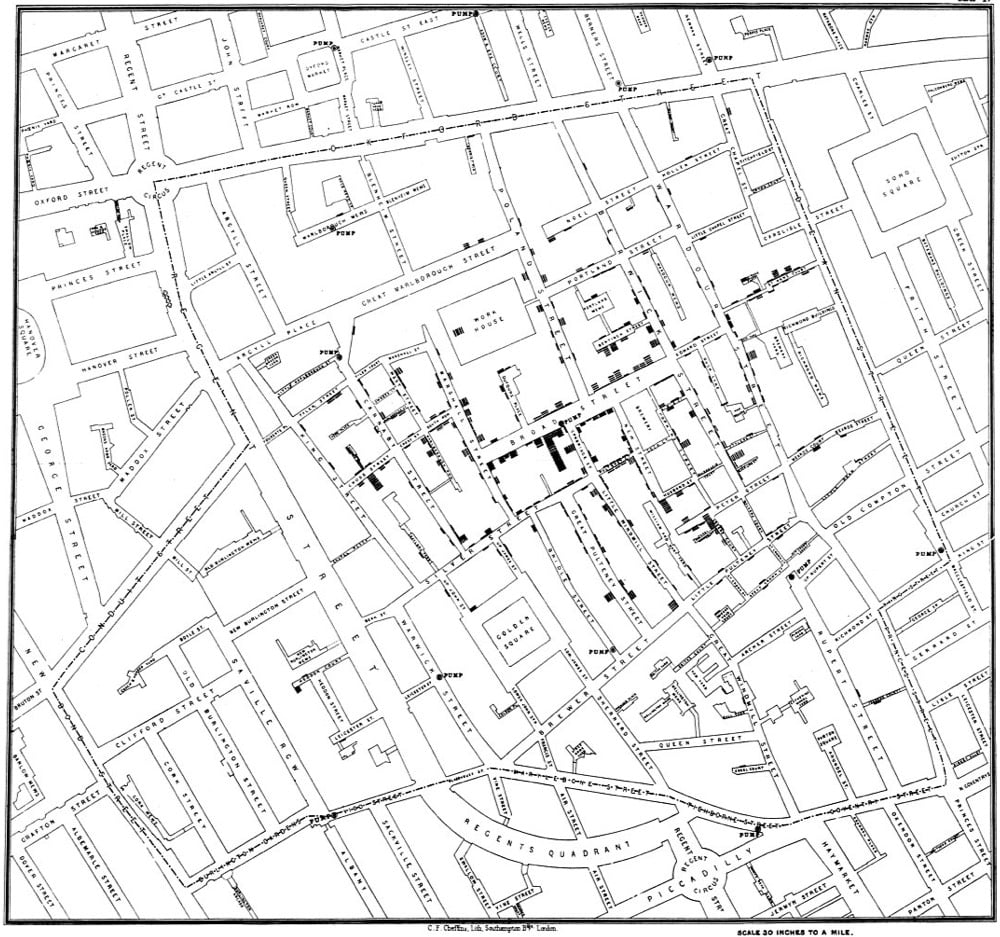
Through a mix of personal interviews, clever detective work, and data analysis that included tables and a famous map, Snow managed to stop the outbreak and convince local public health officials, eventually, that cholera could be transmitted through water, not a miasma. Since his breakthrough study, the map has become an iconic piece of epidemiological history, as an illustration of keen detective work, analysis, and visual representation with a map that, even today, tells a story.
Aside from the cluster of deaths around the pump (which could be argued were the result of a miasma cloud and not contaminated water), stories of nearby people who didn’t get sick (brewers who drank the beer they produced rather than well water, people in buildings with their own wells) and far away people who died because they had drunk water from the well were also essential in proving his theory:
I was informed by this lady’s son that she had not been in the neighbourhood of Broad Street for many months. A cart went from broad Street to West End every day and it was the custom to take out a large bottle of the water from the pump in Broad Street, as she preferred it. The water was taken on Thursday 31st August., and she drank of it in the evening, and also on Friday. She was seized with cholera on the evening of the latter day, and died on Saturday
You can read more about John Snow and how his map changed science and medicine in Steven Johnson’s excellent Ghost Map.
How American Racism Influenced Adolf Hitler
In his 2018 review of several books about Nazism and Adolf Hitler, Alex Ross notes that Hitler took inspiration for the Third Reich’s anti-Semitism and the Holocaust from the United States’ genocide against indigenous peoples, treatment of African Americans (both during and after slavery), and restrictive immigration policies.
The Nazis were not wrong to cite American precedents. Enslavement of African-Americans was written into the U.S. Constitution. Thomas Jefferson spoke of the need to “eliminate” or “extirpate” Native Americans. In 1856, an Oregonian settler wrote, “Extermination, however unchristianlike it may appear, seems to be the only resort left for the protection of life and property.” General Philip Sheridan spoke of “annihilation, obliteration, and complete destruction.” To be sure, others promoted more peaceful-albeit still repressive-policies. The historian Edward B. Westermann, in “Hitler’s Ostkrieg and the Indian Wars” (Oklahoma), concludes that, because federal policy never officially mandated the “physical annihilation of the Native populations on racial grounds or characteristics,” this was not a genocide on the order of the Shoah. The fact remains that between 1500 and 1900 the Native population of U.S. territories dropped from many millions to around two hundred thousand.
America’s knack for maintaining an air of robust innocence in the wake of mass death struck Hitler as an example to be emulated. He made frequent mention of the American West in the early months of the Soviet invasion. The Volga would be “our Mississippi,” he said. “Europe — and not America — will be the land of unlimited possibilities.” Poland, Belarus, and Ukraine would be populated by pioneer farmer-soldier families. Autobahns would cut through fields of grain. The present occupants of those lands — tens of millions of them — would be starved to death. At the same time, and with no sense of contradiction, the Nazis partook of a long-standing German romanticization of Native Americans. One of Goebbels’s less propitious schemes was to confer honorary Aryan status on Native American tribes, in the hope that they would rise up against their oppressors.
Jim Crow laws in the American South served as a precedent in a stricter legal sense. Scholars have long been aware that Hitler’s regime expressed admiration for American race law, but they have tended to see this as a public-relations strategy — an “everybody does it” justification for Nazi policies. Whitman, however, points out that if these comparisons had been intended solely for a foreign audience they would not have been buried in hefty tomes in Fraktur type. “Race Law in the United States,” a 1936 study by the German lawyer Heinrich Krieger, attempts to sort out inconsistencies in the legal status of nonwhite Americans. Krieger concludes that the entire apparatus is hopelessly opaque, concealing racist aims behind contorted justifications. Why not simply say what one means? This was a major difference between American and German racism.
Teacher Tells Off Neil Armstrong for Faking the Moon Landing
In a letter recently published in a new book, A Reluctant Icon: Letters to Neil Armstrong, a teacher wrote a letter to the first human to set foot on the Moon accusing him of making the whole thing up.
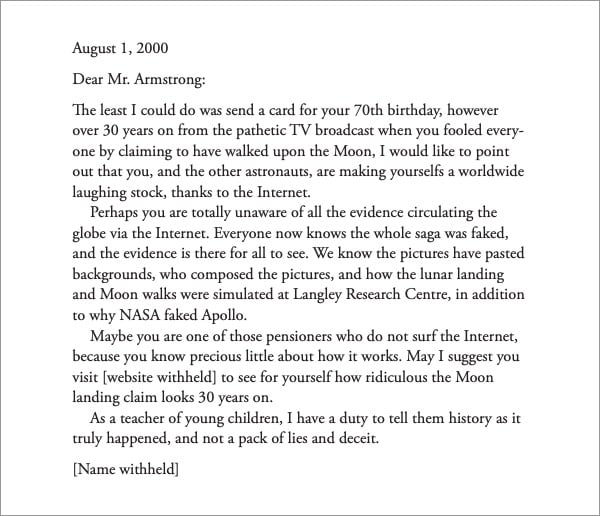
To which Armstrong replied:
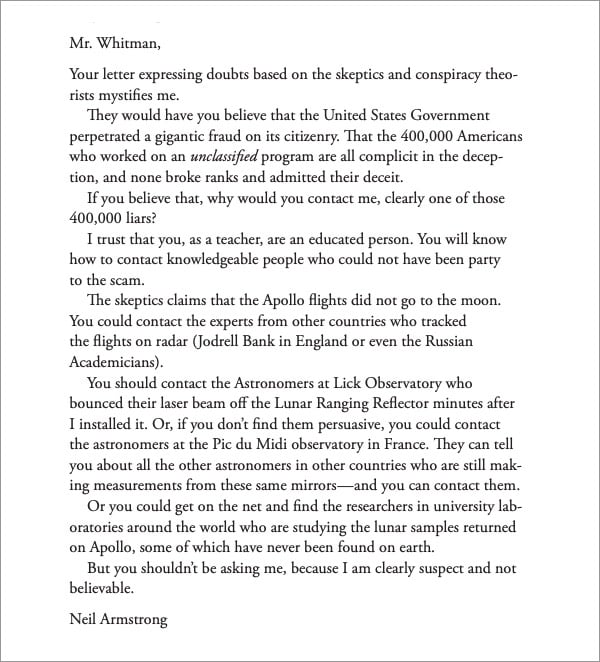
(via the excellent Letters of Note)
A Visual Guide to the SARS-CoV-2 Coronavirus
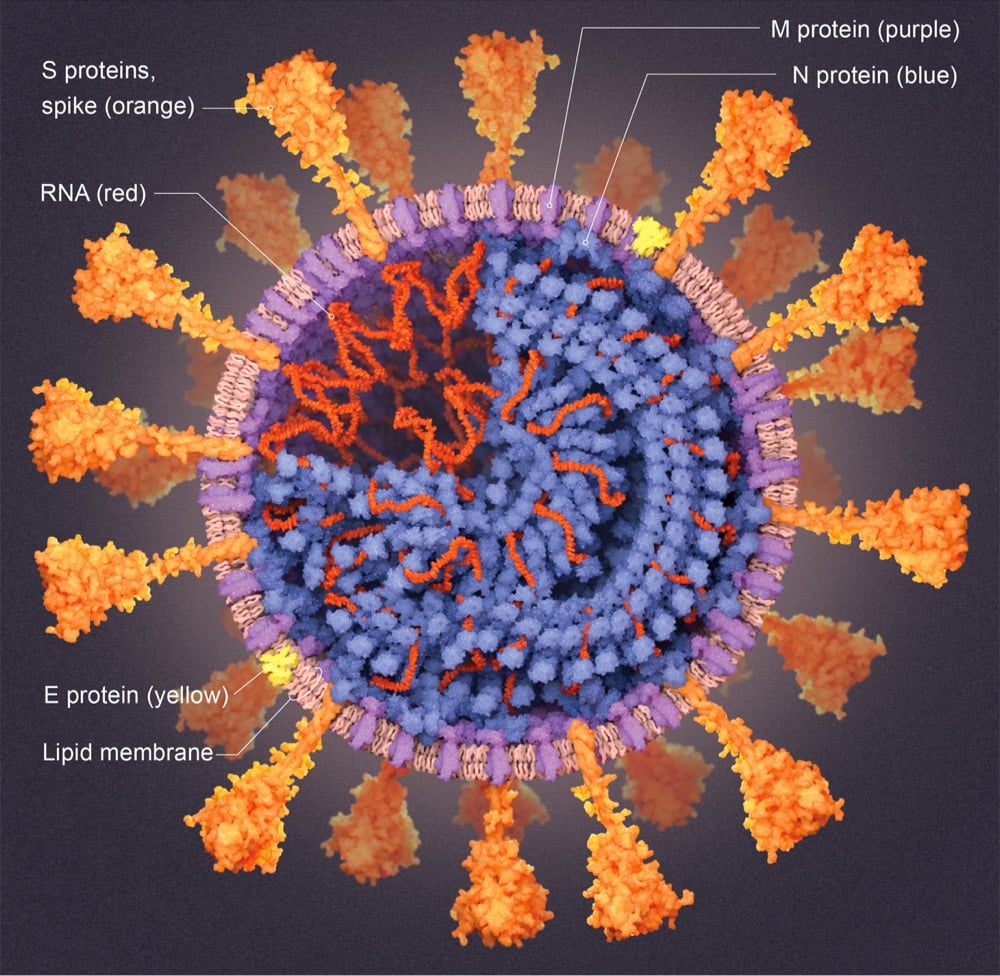
For its July 2020 issue, Scientific American has published A Visual Guide to the SARS-CoV-2 Coronavirus detailing what scientists have learned about this tiny menace that’s brought our world to a halt.
In the graphics that follow, Scientific American presents detailed explanations, current as of mid-May, into how SARS-CoV-2 sneaks inside human cells, makes copies of itself and bursts out to infiltrate many more cells, widening infection. We show how the immune system would normally attempt to neutralize virus particles and how CoV-2 can block that effort. We explain some of the virus’s surprising abilities, such as its capacity to proofread new virus copies as they are being made to prevent mutations that could destroy them. And we show how drugs and vaccines might still be able to overcome the intruders.
Which Country Has the World’s Best Health Care?
In a his book out today, Which Country Has the World’s Best Health Care?, oncologist & bioethicist Ezekiel Emanuel compares the outcomes of several countries’ health care systems.
The US spends more than any other nation, nearly $4 trillion, on healthcare. Yet, for all that expense, the US is not ranked #1 — not even close.
In Which Country Has the World’s Best Healthcare? Ezekiel Emanuel profiles 11 of the world’s healthcare systems in pursuit of the best or at least where excellence can be found. Using a unique comparative structure, the book allows healthcare professionals, patients, and policymakers alike to know which systems perform well, and why, and which face endemic problems. From Taiwan to Germany, Australia to Switzerland, the most inventive healthcare providers tackle a global set of challenges — in pursuit of the best healthcare in the world.
In his ranking of 11 countries profiled, China and the United States are, respectively, dead last and second-to-last in providing health care for their citizens. In the case of the United States at least, that failure is on display with our response to the Covid-19 pandemic.
The Worm is a forthcoming book about NASA’s iconic modernist logo. “The Worm showcases over 300 images from NASA’s archives chosen with one simple criteria: each photograph must feature ‘the worm’.”
Vietnam, Population 95 Million, Has Recorded 0 Deaths from Covid-19
Several countries have been celebrated for their success in curtailing the Covid-19 pandemic — Iceland, New Zealand, Mongolia, Hong Kong, Taiwan — but Vietnam, a nation of 95 million people that borders China, has recorded only 334 total infections and 0 deaths. 0 deaths. They are currently on a 61-day streak without a single community transmission. (For reference, the US has recorded 2.1 million cases and more than 115,000 deaths with just 3.4 times the population of Vietnam.)
How have they done it? They acted early and aggressively.
Experts say experience dealing with prior pandemics, early implementation of aggressive social distancing policies, strong action from political leaders and the muscle of a one-party authoritarian state have helped Vietnam.
“They had political commitment early on at the highest level,” says John MacArthur, the U.S. Centers for Disease Control and Prevention’s country representative in neighboring Thailand. “And that political commitment went from central level all the way down to the hamlet level.”
With experience gained from dealing with the 2003 SARS and 2009 H1N1 pandemics, Vietnam’s government started organizing its response in January — as soon as reports began trickling in from Wuhan, China, where the virus is believed to have originated. The country quickly came up with a variety of tactics, including widespread quarantining and aggressive contact tracing. It has also won praise from the World Health Organization and the CDC for its transparency in dealing with the crisis.
Vietnam enacted measures other countries would take months to move on, bringing in travel restrictions, closely monitoring and eventually closing the border with China and increasing health checks at borders and other vulnerable places.
Schools were closed for the Lunar New Year holiday at the end of January and remained closed until mid-May. A vast and labour intensive contact tracing operation got under way.
“This is a country that has dealt with a lot of outbreaks in the past,” says Prof Thwaites, from Sars in 2003 to avian influenza in 2010 and large outbreaks of measles and dengue.
“The government and population are very, very used to dealing with infectious diseases and are respectful of them, probably far more so than wealthier countries. They know how to respond to these things.”
By mid-March, Vietnam was sending everyone who entered the country - and anyone within the country who’d had contact with a confirmed case — to quarantine centres for 14 days.
Costs were mostly covered by the government, though accommodation was not necessarily luxurious. One woman who flew home from Australia — considering Vietnam a safer place to be - told BBC News Vietnamese that on their first night they had “only one mat, no pillows, no blankets” and one fan for the hot room.
Forced bussing to quarantine centers in the US, could you even imagine? Better that hundreds of thousands of people die, I guess.
The Vietnamese health system also implemented aggressive contact tracing:
Authorities rigorously traced down the contacts of confirmed coronavirus patients and placed them in a mandatory two-week quarantine.
“We have a very strong system: 63 provincial CDCs (centers for disease control), more than 700 district-level CDCs, and more than 11,000 commune health centers. All of them attribute to contact tracing,” said doctor Pham with the National Institute of Hygiene and Epidemiology.
A confirmed coronavirus patient has to give health authorities an exhaustive list of all the people he or she has met in the past 14 days. Announcements are placed in newspapers and aired on television to inform the public of where and when a coronavirus patient has been, calling on people to go to health authorities for testing if they have also been there at the same time, Pham said.
More from Axios and The Guardian.
The Atlantic Slave Trade in Two Minutes
For Slate’s 2015 podcast series The History of American Slavery, Andrew Kahn created an interactive visualization of the 20,000+ voyages that made up the Atlantic slave trade that lasted 315 years. A video of the interactive map is embedded above.
As we discussed in Episode 2 of Slate’s History of American Slavery Academy, relative to the entire slave trade, North America was a bit player. From the trade’s beginning in the 16th century to its conclusion in the 19th, slave merchants brought the vast majority of enslaved Africans to two places: the Caribbean and Brazil. Of the more than 10 million enslaved Africans to eventually reach the Western Hemisphere, just 388,747 — less than 4 percent of the total — came to North America. This was dwarfed by the 1.3 million brought to Spanish Central America, the 4 million brought to British, French, Dutch, and Danish holdings in the Caribbean, and the 4.8 million brought to Brazil.
Roughly 400,000 enslaved Africans were brought to the United States before the practice was banned in 1808. The ban was mostly (but not entirely) enforced and yet in 1860, the population of enslaved persons was almost 4 million in the South. That’s because the 1808 ban, according to Ned & Constance Sublette’s book The American Slave Coast: A History of the Slave-Breeding Industry, was a form of trade protectionism that protected the forced breeding of enslaved peoples by American slaveowners. From a review of the book:
In fact, most American slaves were not kidnapped on another continent. Though over 12.7 million Africans were forced onto ships to the Western hemisphere, estimates only have 400,000-500,000 landing in present-day America. How then to account for the four million black slaves who were tilling fields in 1860? “The South,” the Sublettes write, “did not only produce tobacco, rice, sugar, and cotton as commodities for sale; it produced people.” Slavers called slave-breeding “natural increase,” but there was nothing natural about producing slaves; it took scientific management. Thomas Jefferson bragged to George Washington that the birth of black children was increasing Virginia’s capital stock by four percent annually.
Here is how the American slave-breeding industry worked, according to the Sublettes: Some states (most importantly Virginia) produced slaves as their main domestic crop. The price of slaves was anchored by industry in other states that consumed slaves in the production of rice and sugar, and constant territorial expansion. As long as the slave power continued to grow, breeders could literally bank on future demand and increasing prices. That made slaves not just a commodity, but the closest thing to money that white breeders had. It’s hard to quantify just how valuable people were as commodities, but the Sublettes try to convey it: By a conservative estimate, in 1860 the total value of American slaves was $4 billion, far more than the gold and silver then circulating nationally ($228.3 million, “most of it in the North,” the authors add), total currency ($435.4 million), and even the value of the South’s total farmland ($1.92 billion). Slaves were, to slavers, worth more than everything else they could imagine combined.
You can read more about the economics of slavery in this post from 2016, including how American banks sold bonds that used enslaved persons as collateral to international investors. (via open culture)
The military crackdown on protests in DC reminded Abdallah Fayyad of his experience as a Palestinian living in Jerusalem. “Being in the streets of Washington reminded me of the occupation I endured as a Palestinian.”
During the most intense days of the first wave of the Covid-19 pandemic, nursing homes in some US states were forced to keep accepting residents w/o testing. In NY, 6% of their nursing home residents died of Covid-19. And New Jersey lost 12%. 12%!
163 Years of The Atlantic’s Writing on Race and Racism in America
The Atlantic was founded in 1857 and in its early days was an outlet for prominent voices speaking out against slavery. Editor Gillian White has compiled a list of the magazine’s writing on race and racism in America from deep in the archive to the present day. It includes writing from Julia Ward Howe, Frederick Douglass, W.E.B. Du Bois, Booker T. Washington, Martin Luther King Jr., and Stokely Carmichael along with pieces from modern voices like Bree Newsome, Eve Ewing, Ta-Nehisi Coates, Ibram X. Kendi, and Nikole Hannah-Jones. In introducing the collection, White writes:
Understanding the present moment requires grappling with a history stained by racial inequity, violence, and the constant fight for forward progress. In a century and a half of writing stories about race in America, The Atlantic has published works that have improved the broad understanding of injustice in America, and also works that furthered ideas and theories that ultimately were proved wrong or harmful. To comprehend the current state of the country, we must consider the aftereffects of both categories. We must also take into account the fact that these stories, in aggregate, are overwhelmingly written by men.
And here are a few pieces I picked out for my own personal reading list:
Reconstruction by Frederick Douglass, December 1866. “No republic is safe that tolerates a privileged class, or denies to any of its citizens equal rights and equal means to maintain them.”
The Awakening of the Negro by Booker T. Washington, September 1896. “I wish my readers could have the chance that I have had of going into this community. I wish they could look into the faces of the people and see them beaming with hope and delight.”
The Negro Is Your Brother (Letter From Birmingham Jail) by Martin Luther King Jr., August 1963. “Whatever affects one directly, affects all indirectly. Never again can we afford to live with the narrow, provincial ‘outside agitator’ idea. Anyone who lives inside the United States can never be considered an outsider anywhere within its bounds.”
The Prison-Industrial Complex by Eric Schlosser, December 1998. “The United States now imprisons more people than any other country in the world — perhaps half a million more than Communist China. The American inmate population has grown so large that it is difficult to comprehend: imagine the combined populations of Atlanta, St. Louis, Pittsburgh, Des Moines, and Miami behind bars.”
The Case for Reparations by Ta-Nehisi Coates, June 2014. “And so we must imagine a new country. Reparations — by which I mean the full acceptance of our collective biography and its consequences — is the price we must pay to see ourselves squarely.”
“One of the biggest social changes that the Bubonic Plague did cause was a rise in racial violence.”
City Enters Phase 4 Of Pretending Coronavirus Over. “I’m happy to say we’ve reached the final phases of completely deluding ourselves into thinking that this pandemic has somehow stopped spreading and that we’re safe.”
Socials & More