Panera Bread Co converted one of their St. Louis locations into a cafe without prices. I love this model, but I feel like it probably works better with one of a kind products (art, music, movies, books) that are likely to have passionate fans. I hope it works, though. Ron Shaich Panera’s chairman had this to say:
I’m trying to find out what human nature is all about. My hope is that we can eventually do this in every community where there’s a Panera.
Recently, Mat Williams hand wrote 288 of the lines Bart Simpson writes on the blackboard to open every episode. He used 20 white markers over 2 days to complete the work on the 22m long blackboard at Work Club, a London based ad agency. Clicking here will allow you to zoom in on any part of the blackboard, while clicking here will allow you to watch a video of Mat skateboarding through London and writing on the blackboard in a Bart Simpson mask.
Incidentally, there have been 463 episodes, and Bart doesn’t write on the chalk board in the opening to all of them. To read a list of all the openings, go here. To SEE a list of all the openings, go here. There’s an electrical outlet in front of Bart’s knee in every season except season 1 and season 21. This might only be interesting to me.
Plus, posting it gives me an opportunity to link to one of my favorite photographs of all time. Big Baby Davis is by far my favorite basketball player.
We’re drinking more soda for several reasons. Above all, the inflation-adjusted price has fallen 34 percent since the late 1970s, largely because it can be manufactured more cheaply than in the past. Meanwhile, the average real cost of fruits and vegetables has risen more than 30 percent, according to the Bureau of Labor Statistics.
PS: Alternate titles for this post include:
“What’s that got to do with the price of soda in DC?” (Too obscure?)
“This is why you’re fat.” (Too mean?)
“Ur doing it wrong.” (What is this, the internet?)
Flight of the Conchords star Jemaine Clement has been set to play the villainous Yaz in Men in Black III, the sequel that is being fast-tracked by Columbia Pictures. Will Smith stars with Tommy Lee Jones and Josh Brolin, and Barry Sonnenfeld directs.
When Adam Wheeler got into trouble at Bowdoin, he transferred to Harvard, saying he was an MIT student. When trouble started at Harvard, he attempted to transfer to Yale and Brown. Along the way, he came very close to getting Harvard to endorse his application for a Fulbright Scholarship.
After two years of blending into campus life and racking up academic prizes and tens of thousands of dollars in grants and scholarships, Wheeler allegedly upped the ante: The 23-year-old senior applied for the prestigious Rhodes and Fulbright scholarships last fall using falsified credentials, including a fake transcript and work he plagiarized from a Harvard professor, said investigators.
If you’re going to con a college, you’ve got to aim high, I always say.
I haven’t watched a skateboarding video all the way through in years. I can’t tell if it’s the music or the whimsical pace of the tricks. In any case, let this one take you through the rest of the night.
Jason said not to turn his site into “a dang T Shirt blog while I’m gone”*, but certainly he wouldn’t mind 2 T Shirt posts in a day, right? I hope not. This new shirt by R. Stevens of Diesel Sweeties fame is perfect for all your out of work friends. Or maybe it’s perfect for you? Click through to see.
*Not actually. All conversations between Jason and I quoted this week are imaginary.
Bon Apetit and other high end food magazines expected to gain from Gourmet’s demise 6 months ago, in both subscribers and advertising pages. In an amazing disappearing act, achievable only by the magazine industry, Gourmet’s subscribers and advertisers have mostly disappeared.
Bon Appetit’s circulation was forecast to bloom as it absorbed former readers of Gourmet, and other magazines began eyeing Gourmet’s list of more than 900,000 subscribers…The Gourmet readership and ad base seem to have largely vanished.
He also loves The Misfits. A couple months ago, he mixed The Misfits’ Crimson Ghost logo with a cat to get Cattitude. I thought the Crimson Ghost would go well with Justin Bieber, too, and have been asking Chris to do it for weeks. He finally did, and oh man, he might be making it a T Shirt, as well. 10 points if you get the reference in the title of this post.
Today’s wild space story is brought to us by Bad Astronomy:
We have a stellar cluster with thousands of times the Sun’s mass embedded in a nebula furiously cranking out newborn stars. A lot of them are near the physical upper limit of how big a star can get. The whole thing is only a couple of million years old, a fraction of the galaxy’s lifespan. One beefy star with 90 times the Sun’s mass got too close to some other stars, which summarily flung it out of the cluster at high speed, fast enough to cross the distance from the Earth to the Moon in an hour (it took Apollo three days). The star is barreling through the flotsam in that galaxy, its violent stellar wind carving out a bubble of gas that points right back to the scene of the crime, nearly 4 quadrillion kilometers and a million years behind it.
Click through to see the pictures and read a more thorough write up.
PS: 70% of the reason I linked to this is because of the title, “Rampaging cannonball star is rampaging.”
Thomas Salme turned himself from maintenance engineer into 737 pilot with several hours of flight simulation and some basic license forgery skills. He flew for 13 years without problem until he was busted in the cockpit at Schipol airport with 101 passengers aboard.
The documents look different everywhere in Europe. An Italian airline doesn’t know what a Swedish license looks like. And you can forge all the IDs you need.
I don’t know what it means, but I always get excited when a longstanding equation is solved. It’s as if another puzzle piece of how the world works has been snapped into place… What, too sappy?
Pennsylvania mathematicians have found solutions to a 140-year-old, 7-dimensional equation that were not known to exist for more than a century despite its widespread use in modeling the behavior of gases.
NBC announced on Friday that Law and Order would be canceled after 20 years.* As the New York Times ably put it, “the wheels of TV justice will soon grind to a halt.” City officials estimate that the show pumped about $1 billion into the New York City economy. And won’t someone think of the actors.
Several casting directors for theater, film and television estimated on Friday that the majority of actors’ resumes that came across their desks included “Law & Order” credits. Some actors who worked chiefly in New York theater, drawing weekly salaries of $500 to $1,500 for their stage roles, supplemented those paychecks by playing judges, jurors and police officers on “Law & Order.” Pay for those jobs ranged from a few hundred dollars to $1,000 or so a week for only a few moments of screen time.
*They also announced that Heroes would be canceled, but I didn’t know that was still on.
In a Guardian excerpt from the forthcoming At Home by Bill Bryson, some mysteries of the home are revealed. My favorite was why forks have four tines. Incidentally, eating forks were introduced by Thomas Coryate who also introduced the umbrella
Eating forks were thought comically dainty and unmanly - and dangerous, too, come to that. Since they had only two sharp tines, the scope for spearing one’s lip or tongue was great, particularly if one’s aim was impaired by wine and jollity. Manufacturers experimented with additional numbers of tines - sometimes as many as six - before settling, late in the 19th century, on four as the number with which people seemed most comfortable. Why four should induce the optimum sense of security isn’t easy to say, but it does seem to be a fundamental fact of flatware psychology.
Herzog is a miserable, hateful, malevolent, avaricious, money-hungry, nasty, sadistic, treacherous, blackmailing, cowardly, thoroughly dishonest creep. His so-called ‘talent’ consists of nothing but tormenting helpless creatures and, if necessary, torturing them to death or simply murdering them. He doesn’t care about anyone or anything except his wretched career as a so-called filmmaker. Driven by a pathological addiction to sensationalism, he creates the most senseless difficulties and dangers, risking other people’s safety and even their lives -just so he can eventually say that he, Herzog, has beaten seemingly unbeatable odds.
For his part, Herzog wasn’t quite into Kinski either.
Incredible. I didn’t know how to calm him down, and then I had an inspiration. I went to my hut, where, for months I had hidden a piece of chocolate. We would almost have killed one another for something like that. I went back to him, going right into his face and ate the chocolate. All of a sudden he was quiet. This was utterly beyond him.
Click through because there are about 10 more paragraphs of vitriol just like this.
Thanks for the intro, Jason. I’m thrilled to steer the SS Kottke and excited to share my internet with you guys for a week. Things that might come up: television, movies, books, music, lists, food, the televisionmoviesbooksmusic industry (and its issues), etc. Mostly etc, actually.
I’d like to start the week on a better note, but I’d be remiss if I didn’t mention the passing of Black Sabbath vocalist Ronnie James Dio and Chipwich creator Richard Lamotta.
The problem went beyond some of the local artists’ anger about not making it into the article. Some were angry that I included their arch-enemies. Others were angry that they were in it but not quoted. I had once loved living in Calcata, a fortress town where dinner parties on the square would often erupt in singing and joint smoking; where you could walk 50 feet and eat at an amazing restaurant; where you could make the intimate square your living room. But now, after the article came out, I felt like a persona non grata for at least half of the place. I hated that I was hated.
From 1999, the late great Douglas Adams on How to Stop Worrying and Learn to Love the Internet. You might worry that Adams’ piece is out of date, but it’s one those evergreen bits of wisdom that will apply right up until human consciousness is absorbed into the digital cloud.
So people complain that there’s a lot of rubbish online, or that it’s dominated by Americans, or that you can’t necessarily trust what you read on the web. Imagine trying to apply any of those criticisms to what you hear on the telephone. Of course you can’t ‘trust’ what people tell you on the web anymore than you can ‘trust’ what people tell you on megaphones, postcards or in restaurants. Working out the social politics of who you can trust and why is, quite literally, what a very large part of our brain has evolved to do. For some batty reason we turn off this natural scepticism when we see things in any medium which require a lot of work or resources to work in, or in which we can’t easily answer back — like newspapers, television or granite. Hence ‘carved in stone.’ What should concern us is not that we can’t take what we read on the internet on trust — of course you can’t, it’s just people talking — but that we ever got into the dangerous habit of believing what we read in the newspapers or saw on the TV — a mistake that no one who has met an actual journalist would ever make. One of the most important things you learn from the internet is that there is no ‘them’ out there. It’s just an awful lot of ‘us’.
French photographer and biologist Laurent Ballesta captures the hour- long battle between a 15kg (33lb) carp and his brother at a small lake near Montpellier in southern France.
This photo looks totally fake. Nice job by the photographer for being in the right place with the right camera and the right lens. (via dens)
Until we see that the iPhone is as thoroughly entangled into a network of landscapes as any more obviously geological infrastructure (the highway, both imposing carefully limited slopes across every topography it encounters and grinding/crushing/re-laying igneous material onto those slopes) or industrial product (the car, fueled by condensed and liquefied geology), we will consistently misunderstand it.
Although you might think otherwise, people tend to watch TV live, even when recording shows for later viewing on DVRs is an option. The pull of communal activity for the human social animal is strong.
Like all social activities, television-watching demands compromise. People may have strong ideas about what they want to watch, but what they really want to do is watch together. So the great majority of them first see “what is on” — that is, what is being broadcast at that moment. Restricted choice makes it easier to agree on what to watch. If nothing appeals, they move on to the programmes stored in a DVR. On the very rare occasions when they find nothing there, they will look for an on-demand video.
Conventional wisdom seems to regard foul management as a risk vs. safety decision. You will constantly hear something like, “a big decision here, whether to risk putting Duncan back in with 4 fouls.” This is completely the wrong lens for the problem, since the “risky”* strategy is, with the caveats mentioned, all upside! Coaches dramatically underrate the “risk” of falling behind, or losing a lead, by sitting a star for too long. To make it as stark as possible, observe that the coach is voluntarily imposing the penalty that he is trying to avoid, namely his player being taken out of the game! The most egregious cases are when a player sits even though his team is significantly behind. I almost feel as though the coach prefers the certainty of losing to the “risk” of the player fouling out.
Madonna uses a surprising number of cliches and figures of speech in this interview (conducted by Gus Van Sant).
his Girl Friday
talks the talk
walks the walk
lots of ways to skin the cat
he’s got a fire under his ass
a bee in his bonnet
a trip down memory lane
turn my lemons into lemonade
clotheshorses
so far, so good
reinvent the wheel
The interview itself may not be worth looking at unless you’re already a Madonna, GVS, or cliche fan.
Charles Munger, who works with Warren Buffett as Vice-Chairman of Berkshire Hathaway, gave a talk at USC Business School in 1994 that is very much worth reading. Although the main point of Munger’s talk is how to pick stocks, he spends much of the time talking about “the art of worldly wisdom”…basically what you need to know to be a functional human being who can make informed decisions.
I have a name for people who went to the extreme efficient market theory-which is “bonkers”. It was an intellectually consistent theory that enabled them to do pretty mathematics. So I understand its seductiveness to people with large mathematical gifts. It just had a difficulty in that the fundamental assumption did not tie properly to reality. […]
The model I like — to sort of simplify the notion of what goes on in a market for common stocks — is the pari-mutuel system at the racetrack. If you stop to think about it, a pari-mutuel system is a market. Everybody goes there and bets and the odds change based on what’s bet. That’s what happens in the stock market.
Any damn fool can see that a horse carrying a light weight with a wonderful win rate and a good post position etc., etc. is way more likely to win than a horse with a terrible record and extra weight and so on and so on. But if you look at the odds, the bad horse pays 100 to 1, whereas the good horse pays 3 to 2. Then it’s not clear which is statistically the best bet using the mathematics of Fermat and Pascal. The prices have changed in such a way that it’s very hard to beat the system.
The Chases, who are professors of anthropology at the University of Central Florida in Orlando, had determined from earlier surveys that Caracol extended over a wide area in its heyday, between A.D. 550 and 900. From a ceremonial center of palaces and broad plazas, it stretched out to industrial zones and poor neighborhoods and beyond to suburbs of substantial houses, markets and terraced fields and reservoirs. This picture of urban sprawl led the Chases to estimate the city’s population at its peak at more than 115,000. But some archaeologists doubted the evidence warranted such expansive interpretations.
“Now we have a totality of data and see the entire landscape,” Dr. Arlen Chase said of the laser findings. “We know the size of the site, its boundaries, and this confirms our population estimates, and we see all this terracing and begin to know how the people fed themselves.”
World Cup! World Cup! World Cup! World Cup! World Cup! World Cup! World Cup! World Cup! World Cup! World Cup! World Cup! World Cup! World Cup! World Cup! World Cup! World Cup! World Cup! World Cup! World Cup! World Cup! World Cup! World Cup! World Cup! World Cup!
1. All 64 matches will be broadcast live. 2. In high definition. 3. On either ESPN, ESPN2 or ABC.
Of those 64 matches, 52 will be simulcast online at ESPN360.com. Which means many many Americans with be able to either secretly or not so secretly watch games at work 100% legally and in high quality (although the service is only available via certain internet providers).
Some of the games will also be broadcast in 3D, which…I don’t even know what to say about that.
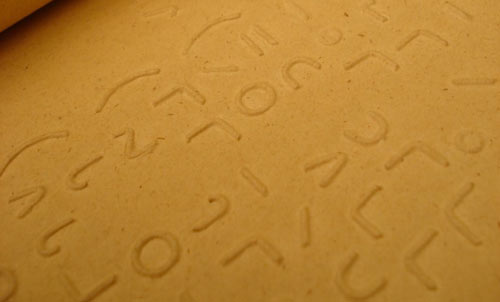
Frustrated by the quality of the embossed reading systems he tried, and eager to improve worldwide literacy and access to the Bible, he set about developing his own system based on roman lettering. Moon’s system was easy to master, particularly for those who had learned to read before they lost their sight, and it became very successful.
Over at New York magazine, the Vulture Reading Room is reading/reviewing David Lipsky’s Although Of Course You End Up Becoming Yourself, an almost straight-up transcript of a 5-day Rolling Stone interview with David Foster Wallace in 1996. Participating are D.T. Max (author of a forthcoming DFW biography), Sam Anderson (New York mag book critic), Laura Miller (Salon book critic), Garth Risk Hallberg (from The Millions), and me (blogger, dad, slacker).
David Foster Wallace’s interviews were always show-stoppers: erudite, casual, funny, passionate, and deeply self-aware — like he wasn’t just answering the questions at hand but also interviewing himself, and his interviewer, and the entire genre of interviews. Last month, David Lipsky published essentially the Platonic ideal of the form: the book-length Although of Course You End Up Becoming Yourself — a sort of DFW version of a DFW interview.
Errol Morris recently gave the commencement address at the Berkeley Graduate School of Journalism; here’s the transcript.
It has become fashionable nowadays to speak of the subjectivity or the relativity of truth. I find such talk ridiculous at best. Let’s go back to Randall Dale Adams. He found himself within days of being executed in “Old Sparky,” the electric chair in Walls Unit, Huntsville Texas.
There is nothing post-modern about the electric chair. It takes a living human being and turns him into a piece of meat. Imagine you — you the young journalists of tomorrow — being strapped into an electric chair for a crime you didn’t commit. Would you take comfort from a witness telling you that it really doesn’t make any difference whether you are guilty or innocent? That there is no truth? “I think you’re guilty; you think you’re innocent. Can’t we work it all out?”
The match between Anand and Topalov was hard fought, partly because Topalov invoked a rule for the contest that forbids the players from offering draws to each other. The rule, named after the city where the match was being played, insured that there would be no short draws. As the match wore on and fatigue took a toll, both players began to make mistakes with greater frequency.
“Anand” was briefly a global Trending Topic on Twitter this afternoon, which was unexpected and nice.
Maybe it’s just an image that pops while I’m connected with Marina. Let’s say it’s an image of someone I love deeply, and then this creates the emotion, the tears just come out. Most of the time it’s tears of joy. You’re just being and thinking about somebody or something that’s important in your life. And then just acknowledging this person or situation and moving on into being present because yeah, the tears come, but I don’t want to cry for the entire sitting. I want to move on and continue to be with Marina, to be present.
Kids in Mind reviews movies with a finer tooth comb than G/PG/PG-13/etc. — it’s basically “won’t somebody please think of the children” for movies. Babies, the documentary that follows four infants through the first years of their lives, didn’t do so well in the Sex/Nudity department.
Children of various ages, from newborns to toddlers, are seen in various states of undress, including unobscured views of both male and female genitals.
This was filed under Violence/Gore:
An infant’s bare buttocks are seen with what appears to be fecal matter; a woman lifts up the child and in the process gets fecal matter on her leg, which she wipes off with a corncob. A stream of urine is seen coming from a baby and landing on a table.
Once an “enjoyable thing” becomes a “meme,” we stop enjoying the thing for its own sake, but consume and regurgitate our enjoyment of it as a symbol of hipness, as if to say: “I am aware of this thing’s popularity — therefore I, too, exist!”
The New Yorker reporter caught up with him as he moved from Moscow to the US…he’s currently living in Palo Alto.
The best way to talk to Ternovskiy is through some kind of digital intermediary. Shy and evasive in person, he fills with a wry swagger when he is just a stream of text. “They have no business no money blablablabla,” he typed to me one afternoon, feigning phlegmatic unconcern with the financial woes of an advertiser he’d been negotiating with-his only one. Like much of his generation, Ternovskiy has an online persona far more developed than his real one.
New norms arise for this environment, norms geared to prevent premature family formation. The new paradigm prizes responsible childbearing and child-rearing far above the traditional linkage of sex, marriage, and procreation. Instead of emphasizing abstinence until marriage, it enjoins: Don’t form a family until after you have finished your education and are equipped for responsibility. In other words, adults form families. Family life marks the end of the transition to adulthood, not the beginning.
If we want to travel into the future, we just need to go fast. Really fast. And I think the only way we’re ever likely to do that is by going into space. The fastest manned vehicle in history was Apollo 10. It reached 25,000mph. But to travel in time we’ll have to go more than 2,000 times faster. And to do that we’d need a much bigger ship, a truly enormous machine. The ship would have to be big enough to carry a huge amount of fuel, enough to accelerate it to nearly the speed of light. Getting to just beneath the cosmic speed limit would require six whole years at full power.
Note: If you are a member and tried to log in, it didn't work, and now you're stuck in a neverending login loop of death, try disabling any ad blockers or extensions. Or try logging out and then back in. Still having trouble? Email me!





Socials & More