



Birds With People Arms
So photos of birds with people arms are pretty funny but videos of birds with people arms are even better. I think my favorites are selfie bird, the ostrich, and the penguins.

This site is made possible by member support. 💞
Big thanks to Arcustech for hosting the site and offering amazing tech support.
When you buy through links on kottke.org, I may earn an affiliate commission. Thanks for supporting the site!
kottke.org. home of fine hypertext products since 1998.
Beloved by 86.47% of the web.
So photos of birds with people arms are pretty funny but videos of birds with people arms are even better. I think my favorites are selfie bird, the ostrich, and the penguins.
For the latest episode of Nerdwriter, Evan Puschak (after briefly introducing his forthcoming book) discusses his favorite Leonardo da Vinci painting, The Virgin and Child with Saint Anne.
In this way, moving from the apex of the pyramid to its bottom right corner is actually a trip through time, from the past to the present to the future. And that timeline also extends along a three-dimensional axis — the lamb is in front of Jesus, who’s in front of Mary, who’s in front of Anne. But on this axis, it goes even further — behind Anne, we’re launched into the geological past. These mountains, these bones of the Earth, suggest a deep time — so deep that it conflicts with the Christian sense of the age of the world. Now that reflects a larger conflict in the Renaissance between religion and a growing appreciation for natural science, which is embodied in no person more than Leonardo da Vinci, the insatiably curious polymath.
Kurt Vonnegut: Unstuck in Time is a feature length documentary on the life and works of the titular author. It’s…been in the works for awhile:
In 1982, a young filmmaker wrote a letter to his literary idol, proposing a documentary on the author’s life and work. Kurt Vonnegut soon met with Robert Weide and authorized the production. Weide thought it would take a few months to raise the needed financing, and figured a film could be completed within the year. That was 33 years ago.
The trailer is embedded above and the film will be released in theaters and on-demand on November 19th. (via austin kleon)
YouTube user FlibidyDibidy took 193 hours of footage of his Super Mario Bros speedrun attempts (that’s 5162 separate attempts) and merged them all into one five-minute video.
This was not easy to do. For instance; when you have 41 million frames — even if something takes only one second — you’re looking at well over a year of computer time alone. Most frames were processed in much less than a second, but some had to be done by hand to train the system and oh man I could go on forever on how it was made.
Here’s a making-of video where you get to see the custom software he built to make the merged speedruns. The best comment on YouTube:
There’s a real “Hundreds of Sea Turtle hatchlings trying to survive their walk to the ocean” vibe to this video
I love these sorts of videos…I did a whole post on “time merge media” back in 2008. (via waxy)
The University of Tasmania recently awarded an honorary doctorate degree to Hannah Gadsby, who then gave an address to the graduating class. Her remarks, in part:
I’m autistic and as such, anxiety is only ever going to be my constant companion. But honestly I don’t know how it’s possible not to be anxious in this world in this moment, unless you’re dead inside and we don’t want that. When my spouse lady Jenney sees me struggling in a whirly gig of anxiety, she has taken to asking me this question: “Don’t panic. Who do you want to be?”
And that is the wisdom I want to share with you today: a question and it’s not even mine. You’re welcome. But I think only a question has the capacity to be flexible enough to be wisdom. Statements are oblivious to the nuance of you and platitudes are nothing but idea corpses you have to reanimate as best you can, but a question always leaves room for you. So please make sure you bring yourself along for this, right?
Don’t panic. Who do you want to be? That is the question.
You can watch Gadsby’s entire address in the video above. I am thankful to Laura Olin for bringing this to my, and now your, attention.
Eight hours of ambient chillout music over images pulled from NASA’s photographic archive of nebulas, galaxies, planets, and other celestial objects? Sure, I’m in.
See also Hours and Hours of Relaxing & Meditative Videos.
Ok you’re going to have to trust me and just watch this — telling you anything else would spoil it. I’ve seen it a couple of times and I am still not 100% convinced how he does it or if it’s actually CGI or something. Solid objects should not behave like this? (thx, john)
Pixar is doing an origin story prequel of Toy Story called Lightyear. The teaser trailer is above. Chris Evans is taking over from Tim Allen as the voice of Buzz. Release date is sometime next summer. Like the folks at Polygon, I too am confused about the time bending that seems to be going on here:
does the existence of a #RealBuzzLightyear zipping through space in the far future imply that the world of Toy Story is also set in the far future
And:
That doesn’t mean he’s a real guy. Toy Story is not set in a world where aliens are just real and that’s fine with everyone. That isn’t a thing in those films. That’s just not the case. We would know if it were.
Is the movie going to explain any of this? Or is everyone just overthinking an (absurdly beautiful and expensive) kids cartoon movie (that likely has themes and humor that will resonate with adults)? Or or am I just yearning for some fun, dumb, low-stakes online arguments to replace the dangerous, dumb, and high-stakes online, uh, discourse? that we’re subjected to 24/7/365/2021/?????? (I think the answer to all of these is “yes”.)
At an event for the release of his recent memoir, The Storyteller, Dave Grohl got behind his drum kit and played along with the original recording of Smells Like Teen Spirit. You might notice that Grohl grimaces a bit right at the beginning — this is maybe the first time (or one of a handful of times) he’s played this song with Kurt Cobain’s vocals since Cobain died. From the video’s description:
It probably wasn’t easy for DG to get to this point where he was willing to share. At the show (and in his book and many interviews) he actually talked about the long path it took to get to not only TALK about Kurt, but to even want to listen to ANY music after his death. Still, a lot of time has passed, which always helps. And in the meantime, Dave has become quite a talented, thoughtful storyteller. I am sure, as difficult as it will always be to him, it probably also now a cathartic experience for him. At least I hope it is.
(via open culture)
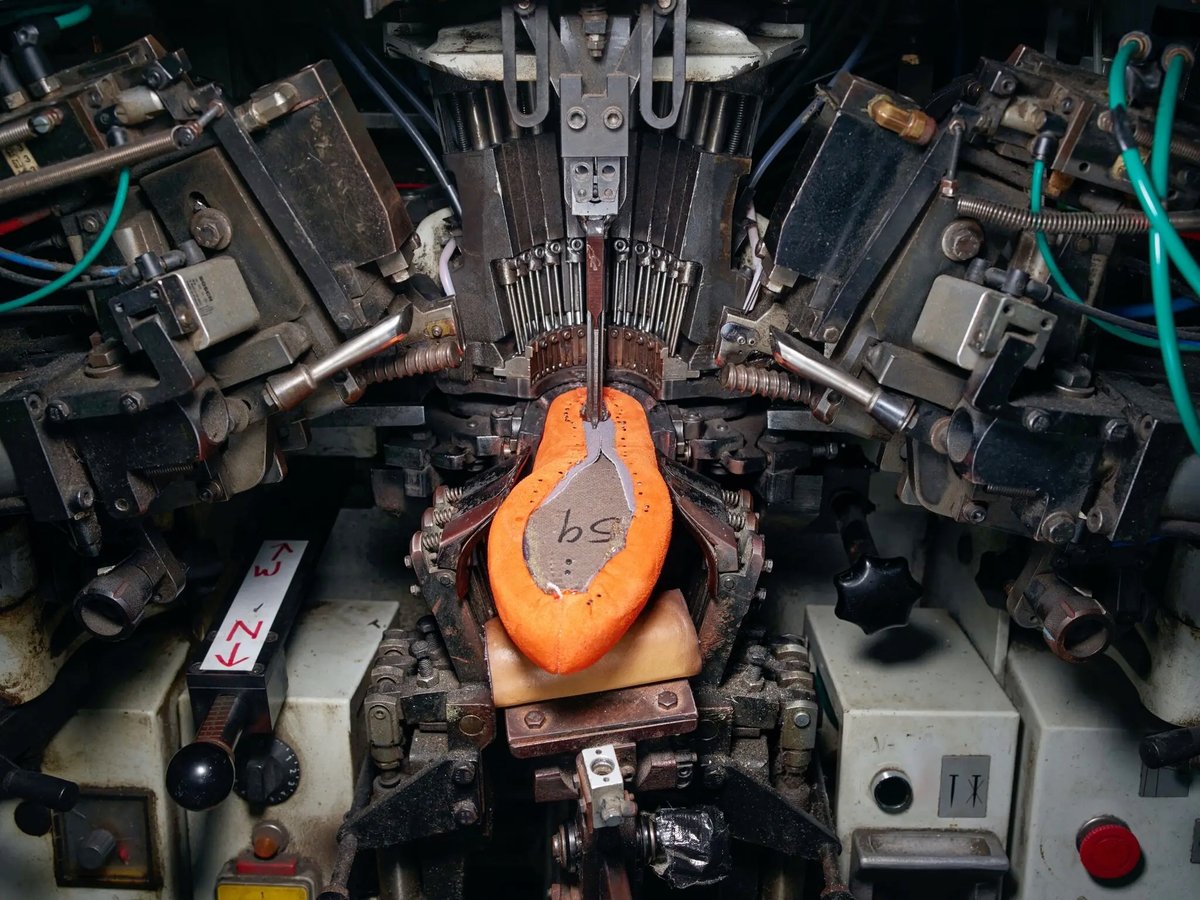
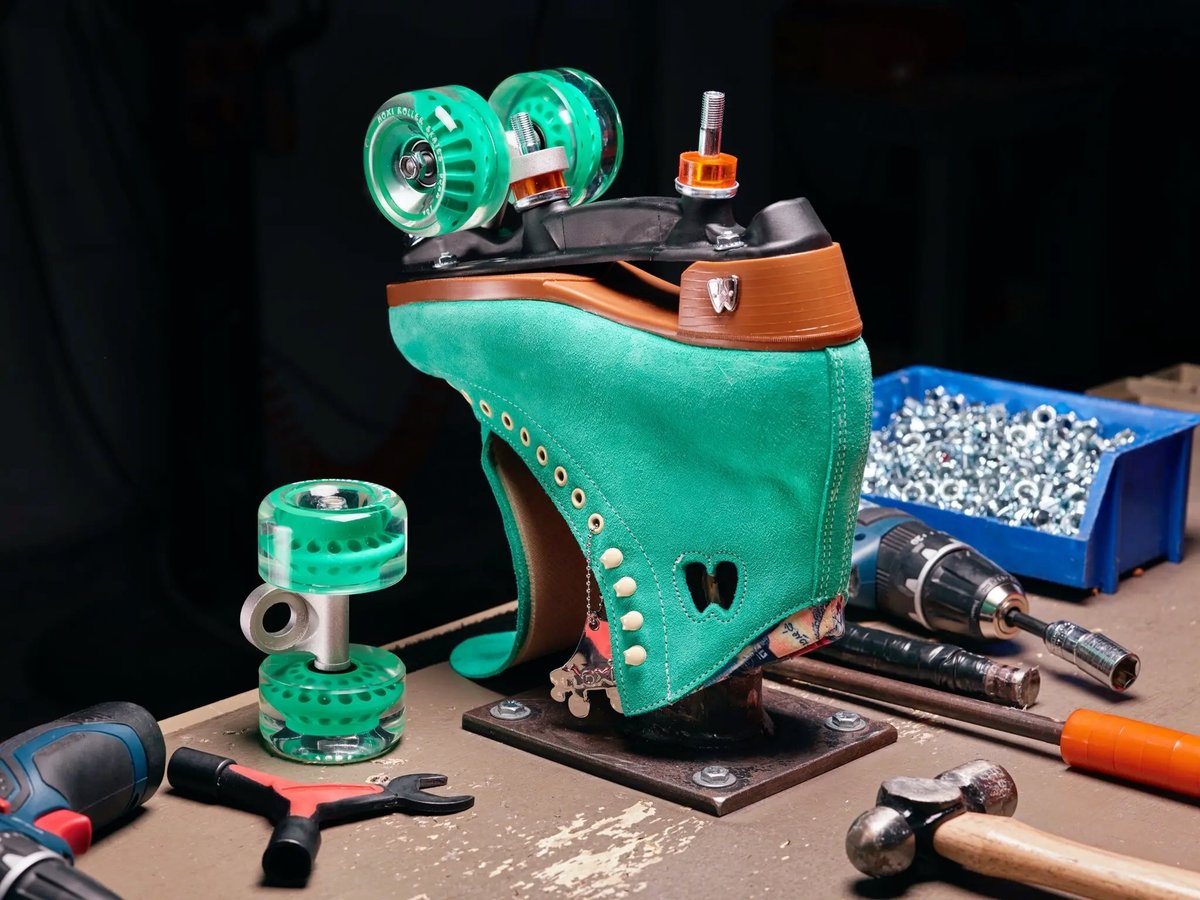
A few weeks ago, the New York Times for Kids section (aka the best section of the newspaper) showed us How to Build Roller Skates.
Among the most sought-after skates are Moxi’s Lolly Skates, rainbow-colored old-school four-wheelers made in Red Wing, Minn. Riedell, the 100-person company that makes the skates, is on track to make almost 80,000 pairs of roller skates this year, about four times as many as before the pandemic.
I poked around YouTube and found a couple of videos about how the skates are made as well:
You can buy your very own pair of Riedell skates direct from the company or from Amazon.
See also Say “No” to Crack and Say “Yes” to Roller Skating!, Dancing on Roller Skates with James Brown’s Style, and The Sweetheart Roller Skating Rink. (via the prepared)
Using photos and films made in the 1910s and 1920s, Myles Zhang made this animated reconstruction of Ford’s Model T assembly line as it would have appeared circa 1915, from start (chassis assembly) to finish (driving it off the floor).
Ford was not the first, but his car and moving assembly line were certainly the most successful and memorable. After creating his version of the automobile in 1896, Ford moved workshops first to Mack Avenue and later to Piquette Avenue in Detroit. These first two factories were small-scale structures for limited car production. Only in 1913 at Ford’s third factory at Highland Park did mass-production begin on a truly large scale. As shown in this film, here Ford applied assembly line methods throughout the factory to all aspects of car production.
There’s also a virtual reality model of the factory you can fly around in.
From Patrick Willems, a history and celebration/defense of movie opening title sequences. They have fallen out of favor over the past decade or two, but Willems argues they serve a needed purpose. For instance, opening title sequences can set the tone or theme of the film before it even gets started — that’s what Saul Bass set out to do:
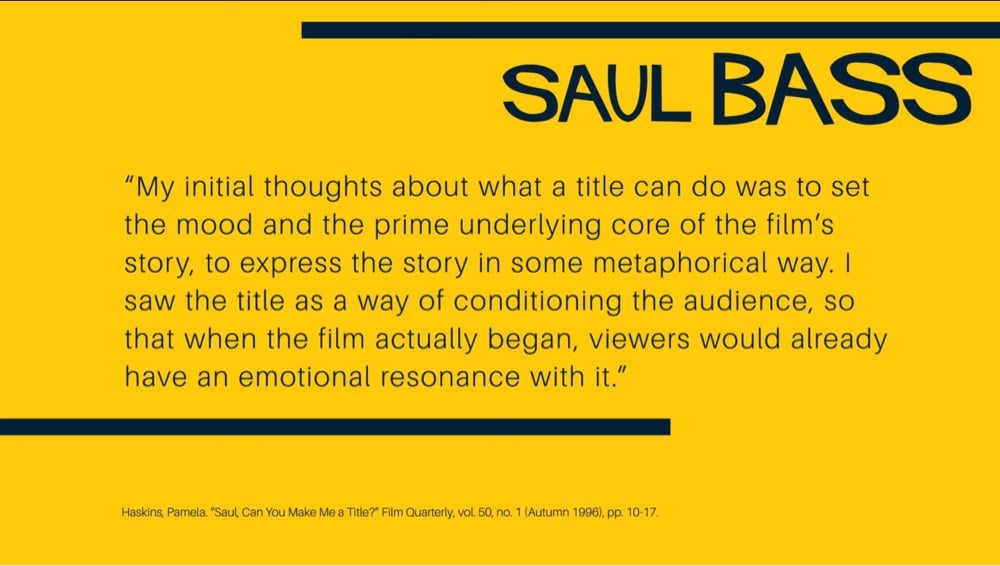
Bass called this “creating a climate for the story”. Here’s one of Willems’ favorite opening sequences by Bass, from 1966’s Grand Prix, which I’d somehow never seen before and is fantastic:
Me? I love opening title sequences. (Except when they are bad and too long.) But I also love when the movie starts right away. And when the movie starts right away and then you get a title card like 8 minutes into it. I’m a fan of anything when it’s done well. *shrugs*
P.S. You can check out hundreds of great examples of opening title sequences at Art of the Title.
After Kathy Brandt was diagnosed with late-stage ovarian cancer, she and her wife Kim Acquaviva, both of whom worked in end-of-life care, started documenting the end of her life on social media. The result was a frank portrait of death, which offered non-medical folks a view of something they rarely get to witness.
Many of the posts deal matter-of-factly with Brandt’s experience of inhabiting a dying body. Did she still crave sex? (“It’s like, for me, at least, there’s nothing there,” she tells Acquaviva, on camera.) Did she remember that she had a diaper on, and that it was time to relieve herself? What were her symptoms today, and how were they different from yesterday’s? The couple’s radical openness extended to a post, the day before Brandt’s death, in which Acquaviva says, “I’m sharing this for nonmedical people who’ve never heard the beginnings of a death rattle. The death rattle is Kathy Brandt’s. … The video is dark and jumpy, but the sound is decent.” The next day, Acquaviva posted a picture of her wife’s face, taken shortly after her death.
Note: this video can be difficult at times (because you’re watching someone dying), but as Acquaviva says, “In a culture were we don’t share almost anything around illness and death, the only way to counter that is for some people to share a little bit more than is probably appropriate.”

Designer Joe Doucet’s Wind Turbine Wall is both a kinetic sculpture and a way to harness wind power to create electricity.
Wind energy has played a key role in helping national grids around the world reduce dependence on fossil fuels to generate energy, but wind turbines for the home have encountered very slow uptake due, in part, to their intrusive physicality.
Designed to be as aesthetically pleasing as it is functional, this “kinetic wall” is made up of an array of rotary blades that spin individually, driving a mini generator that creates electricity. The electricity is utilized in the home or business, can be stored in a wall-mounted battery, or can even be fed back into the national grid to provide revenue for the owner.
Here’s the wall in action:
From a writeup of the project in Fast Company:
Doucet has built a prototype for a single spinning rod and run simulations based on that. The average annual electricity consumption for an American home uses a little over 10,000 kilowatt-hours per year. One of these walls would be enough. But where Doucet sees true potential is in larger-scale commercial buildings and even cities. “Instead of the typical retaining walls along roads and freeways, you’d have an array of these,” says Doucet, who says he’s in conversation with several manufacturers to help him bring the product to market. “With the added wind boost from trucks, our highways could take care of all our energy needs.”
(thx, michael)
Artist & engineer JBV has built a robot artist called Flingbot that works by throwing paint at a canvas according to a number of randomized parameters, e.g. fling strength, scoop shape, paint color, and throwing angles:
The next parameters are the starting and ending fling angles. Randomly chosen by the code, the trajectory and point it hits the canvas is variable creating another factor of uniqueness. This is all controlled by a servo under the base of the catapult, which also happens to be the motor that allows Flingbot to position itself under the paint reservoirs.
This means that every painting Flingbot creates is effectively unique.
All in all, accounting for all the different parameters, there are almost 3 trillion paintings that Flingbot can make. The number is likely even higher than this because there are even more variables to consider that are out of Flingbots control. These include the consistency of the paint, the angle of the canvas, the temperature in the room…the list goes on. It’s safe to say that each one of Flingbot’s painting is truly one of a kind.
(via the morning news)
In these tantalizingly short videos, legendary producer Butch Vig details how the songs on Nirvana’s 1991 breakthrough album Nevermind came together. About Smells Like Teen Spirit, Vig says:
Here comes the guitar solo. He basically copied the vocal melody instead of trying to come up with something punky or frantic or strangled guitar like he usually did. He just copied the exact vocal melody and it works really well.
You can find the breakdowns for Teen Spirit and Drain You embedded above and here are Something In The Way, In Bloom, and Polly. Bonus: Vig describes hearing Smells Like Teen Spirit in person for the first time. (via open culture)
Update: Here’s the whole documentary from which these clips were pulled. (via @tape)
The latest installment in the excellent Almost Famous series from the NY Times and Ben Proudfoot is about Devon Michael, who as a young actor was almost chosen to play Anakin Skywalker in Star Wars: The Phantom Menace.
Growing up, Michael had small roles in commercials, television shows and movies. At 9 years old, he understood that an opportunity like “Star Wars” could change his life. From 3,000, the producers narrowed it down to three, and soon Michael was at Skywalker Ranch doing a test screen with George Lucas and Natalie Portman.
It’s pretty poignant listening to Michael talk about the disappointment and disillusionment that followed his not getting chosen, as well as a different kind of hardship for Jake Lloyd, who was picked for the role.
For his YouTube channel Listening In, Barnaby Martin analyzed the theme that Radiohead wrote for the 2015 Bond film Spectre, a song that he calls “one of the greatest Bond themes ever written”. Somewhat notoriously (at least around these parts), the producers rejected this theme in favor of a lukewarm one by Sam Smith.
After watching Martin’s video, you should watch the Spectre opening credits sequence with the Radiohead theme — it’s so much better than the theme they used in the film.
Oh, I’m excited for this one. I’m not saying The Great was the best show I’ve seen over the past couple of years, but it’s definitely one of the most fun and enjoyable. A synopsis:
The Great is a satirical, comedic drama about the rise of Catherine the Great from outsider to the longest reigning female ruler in Russia’s history. A fictionalized, fun and anachronistic story of an idealistic, romantic young girl, who arrives in Russia for an arranged marriage to the mercurial Emperor Peter. Hoping for love and sunshine, she finds instead a dangerous, depraved, backward world that she resolves to change. All she has to do is kill her husband, beat the church, baffle the military and get the court onside.
The Great was created by Tony McNamara, who co-wrote The Favourite — both have the same punchy, ribald dialogue. You can catch up on season one on Hulu while we wait for the season two premiere on Nov 19.
For the last nine months, NASA’s Perseverance rover has been rolling around on Mars taking photos and doing science. It’s also been recording audio of its environment with a pair of microphones and in this video, a pair of NASA scientists share some of those recordings and what we might learn about Mars from them.
This is one of my absolute favorite sounds. This is the sound of a helicopter flying on Mars. We used this sound to actually understand the propagation of sound in general through the Martian atmosphere, and it turns out that we were totally wrong with our models. The Martian atmosphere can propagate sound a lot further than we thought it could.
And surprisingly for me, that’s my friend Nina in the video! (We eclipse-chased together in 2017.) I knew she was working on the rovers but didn’t know she was going to pop up in this video I found on Twitter this morning. Fun!
Last week, William Shatner finally got a chance to boldly go where he hadn’t actually been before: into space. And upon returning from the 11-minute flight, the 90-year-old TV spaceship captain had come down with more than a touch of the Overview Effect. From the transcript of his post-flight remarks:
If…. Everybody in the world needs to do this…
Everybody in the world needs to see the…” (begins to cry) “…It was unbelievable, unbelievable. I mean, you know the little things… weightlessness… to see the blue color just.. go WHIP by!!! And now you’re staring into blackness. That’s the thing… the covering of blue… this sheet, this blanket, this comforter of blue that we have around us. We think, ‘Oh, that’s blue the sky!’
And then suddenly you shoot up through it all of the sudden… as if you whip off the sheet off you when you are asleep and you’re looking into blackness. Into BLACK UGLINESS… And you look down and there’s the blue down there… and the black up there and it’s… it’s just… there is Mother Earth… and comfort… and there is ….is there death? I don’t know! Is that death? Is that the way death is?? WOOP, and it’s gone! Jesus…
It was so moving to me… this experience …it’s something unbelievable. You see it… yeah, you know… weightlessness… my stomach went up and I thought, ‘God, this is so weird…’ but not as weird as the covering of blue… this is what I never expected. Oh, it’s one thing to say, ‘Oh… the sky and the thing and the… gradual…’ It’s all true… but what isn’t true… what is unknown until you do it is… is this pillow.. There’s this soft blue… look at the the beauty of that color! And it’s so THIN! And you’re through it in an instant…
He continued:
I don’t know, I can’t even begin to express what I …what I would love to do is to communicate as much as possible … the jeopardy… the the the moment you see how… The vulnerability of everything, it’s so… small. This AIR which is keeping us alive is thinner than your skin! It’s… it’s a… it’s a sliver! It’s immeasurably small when you think in terms of the Universe! It’s negligible! This air… Mars doesn’t have it! No… nothing… I mean, this…
They should have sent a poet. Jokes aside, I’m sure that if I’d just returned from a flight into space, I’d would be equally flummoxed and unable to articulate what I’d just experienced. Hell, I couldn’t even talk after seeing a solar eclipse.
Others (like Timothy Snyder) have been saying this for months and years, but in a succinct 8-minute monologue, Bill Maher1 lays out what’s going to happen over the next three years that will pave the way for Donald Trump and the Republicans to take back the White House and set up the biggest political crisis in the United States since the Civil War.
A document came to light a few weeks ago called the Eastman Memo, which was basically a blueprint prepared for Trump on how he could steal the election after he lost it in November 2020. It outlined a plan for overturning the election by claiming that seven states actually had competing state slates of electors, which while not even remotely true, would have given Mike Pence the excuse to throw out those states and thus hand the election to Trump.
But of course the plan required election officials in those states to go along. Trump thought the ones who were Republican would. Most did not. And that’s what he’s been working on fixing ever since.
You might have strong feelings about Bill Maher. Ok, fine. But he’s right about this.↩
If you, like me, haven’t had the opportunity to visit the Giza Pyramid Complex outside of Cairo, Egypt, this 2-hour HD walking tour is probably the next best thing — it feels like walking around about as much as a video can. Strap on those headphones for the full immersive experience. (via open culture)
This is 8 hours of an astronaut floating in a colorful galactic sea accompanied by ambient music, i.e. the sort of thing you would have experienced in the chill-out room at a rave in the 90s but is now selling for $70K even though it’s free? Anyway, it’s relaxing and mesmerizing. See also Hours and Hours of Relaxing & Meditative Videos. (via moss & fog)
In a two-part video series called Trans Dudes From History, Jackson Bird tells us about some historical people who were probably transgender or transmasculine.
Trans people have always existed, even if they didn’t have the same language we do now and even if most history books won’t tell you about them. In this first volume of my Trans Dudes From History series, I give an introduction to talking about people from history who maybe could’ve been trans and share the profiles of three people — a Spanish conquistador, a stagecoach driver, and a bronco buster — who all transgressed gender in some way.
The introduction in the first video (embedded above) — about history and how we even know people were trans before the language around that was even invented — is really interesting. Part two of Trans Dudes From History is right here.
You’ve probably seen it: a dual-tubed generator console that’s appeared in movies and TV shows like Star Trek (all of them, pretty much), Knight Rider, V, Austin Powers, The Last Starfighter, and even Airplane II. This prop was originally built in the 70s and in the decades since has been placed in scenes requiring an impressive piece of high-tech equipment. The video above is a compilation of scenes in which the console has appeared (parts two & three of the compilation).
The fossil record has provided us with so much information about plants, animals, and organisms that lived hundreds, thousands, millions, and even billions of years ago. But we are actually only seeing evidence of a tiny fraction of the species that lived then and even for those we do know about, there’s often much we still don’t know. Traditionally, dinosaurs have been depicted as drab and often terrible lizards but recent finds of soft tissues (skin, feathers, etc.) and an increased sense of imagination based on our current vibrant biodiversity has people thinking differently about how they looked and behaved.
If you’re even just a little bit interested in The Beatles, popular music, or making creative work, The Beatles: Get Back looks really good. Directed by Peter Jackson and utilizing dozens of hours of footage shot in 1969, this six-hour series documents the Beatles recording Let It Be, their final studio album release, and playing their infamous rooftop concert. The series premieres on Disney+ on November 25 and an accompanying book is out now.
Previously: a six-minute preview of the series introduced by Jackson.
In trying to explain what you’re about to see here, I cannot improve upon the Dr. Adrian Smith’s narration at the beginning of this video:
But sometimes I think the most useful thing I can do as a scientist is to point the fancy science cameras at some moths flapping their wings in front of a purple backdrop. I mean, whose day isn’t going to be better after watching a pink and purple rosy maple moth flying in super slow motion? This is a polyphemus moth, a gigantic species of silk moth. What you are seeing, like all the rest of the clips in this video, was filmed at 6,000 frames per second.
Most of the moths in the video are delightfully fuzzy and chonky — if these moths were birds, they’d be birbs. Shall we call them mopfs?
The rest of Smith’s AntLab videos are worth looking through — I’ve previously posted about his slow motion videos here. (via aeon)
The three-point shot has become the focus of the offensive strategy of every successful NBA team. But is it also making the game boring?
The math states that scoring one-third of your shots from behind the 3-point line is as good as scoring half your shots from inside the line. In other words: Shooting as many 3s as possible will likely lead to a higher score.
The league took notice, and teams and players followed suit. 3s have become so prevalent in recent years that fans are criticizing the league for being oversaturated with them. Critics worry that the game is on the verge of becoming boring because everyone is trying to do the same thing. And that’s led some to wonder if the NBA should move the 3-point line back.
Check out the “additional reading” in the YouTube description, like The NBA is at a breaking point with three-point shooting and Is It Time to Move the NBA 3-Point Line Back? (2014).
Socials & More