kottke.org posts about video
From the Atlantic, a quick visual history of human-created light sources over the past ~400,000 years, from wood fires to candles to the electric light.
3,000 BCE: The “rushlight” candle is invented in Ancient Egypt. It is made of a pithy stalk of rush soaked in animal fat.
1500 BCE: Babylonian/Assyrian lamps are created from olive or sesame oil. They had a linen wick and were fashioned from stone, terracotta, metal, or shells.
100 CE: The Romans create the tallow candle, which has a small wick with a thick, hand-formed layer of tallow.
One of the more interesting inventions along the way was the moonlight tower. In the early days of electric lights, mimicking the bright light of the Moon was one of the ways that towns chose to light their streets.
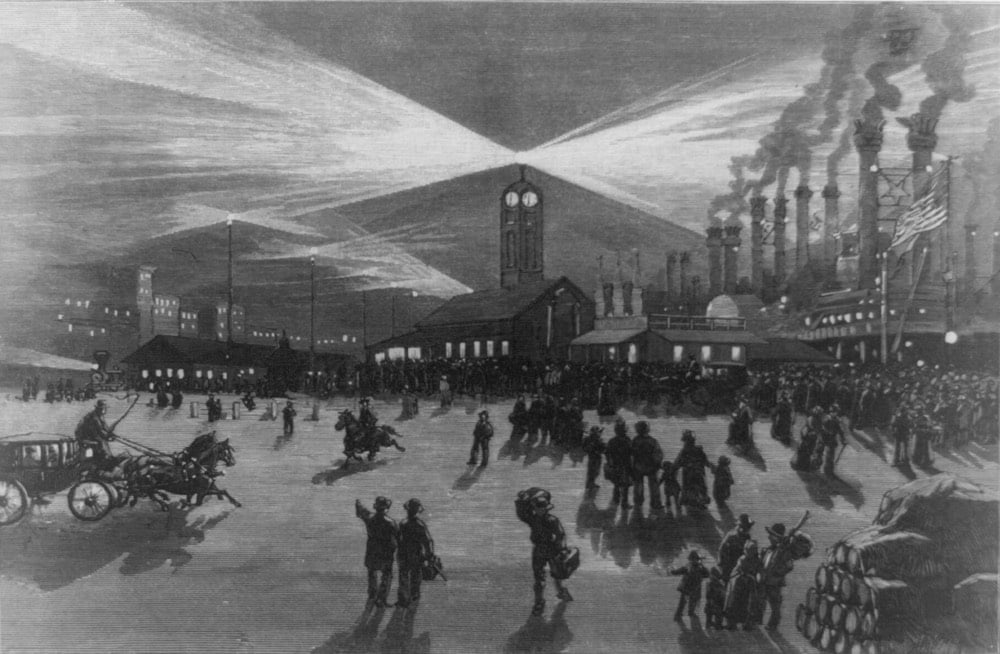
Humans, too, found the high-slung orbs to be as disorienting as they were ethereal. As tall as the towers were, they still left shadows in their wake — shadows tinged with sharp blue light, Freeberg notes, which left pedestrians “dazed and puzzled.” Foggy evenings, combined with the air pollution of a newly industrialized America, could thrust all of Detroit into effective darkness — meaning, Freeberg writes, that “Detroiters could only speculate about the lovely sight that their lights must be creating as they shone down on the blanket of mist and soot that smothered the city.” Even during occasions when the fog broke enough to allow some light to penetrate to the streets below, “many found themselves groping along sidewalks in an eerie gloom.”
In the end, the many costs of the artificial moonlight outweighed its beauty and poetry. The structures meant to inspire awe among outsiders ended up inspiring, ultimately, something more akin to pity. (“It appears to me,” one frank observer put it, “that you are taking a very expensive way of getting a minimum benefit from the electric lights.”)
For this year’s 36 Days of Type project, Ben Huynh submitted this 3D animation of the alphabet from A to Z. You can see animations of the individual letters on Huynh’s Instagram. (via colossal)
In 1923, Inkwell Studios1 released a 20-minute animated explanation of Albert Einstein’s theory of relativity, perhaps one of the very first scientific explainer videos ever made. Films were still silent in those days and the public’s scientific understanding limited (the discovery of Pluto was 7 years in the future, and penicillin 5 years) so the film is almost excruciatingly slow by today’s standards, but if you squint hard enough, you can see the great-grandparent to YouTube channels like Kurzgesagt, Nerdwriter, TED Ed, minutephysics, and the 119,000+ videos on YouTube returned for a “einstein relativity explained” search. (via open culture)
Ama is a short film that was written, directed, and performed by freediver Julie Gautier.
Ama is a silent film. It tells a story everyone can interpret in their own way, based on their own experience. There is no imposition, only suggestions.
I wanted to share my biggest pain in this life with this film. For this is not too crude, I covered it with grace. To make it not too heavy, I plunged it into the water.
I dedicate this film to all the women of the world.
This is really beautiful. Watch it all the way through…the end is not to be missed. (via swissmiss)
As he does every year, voracious reader Bill Gates has recommended five books worth reading this summer. Gates’ recommendations often have a Wizard bent and the video he produced for the list probably had a greater budget than the amount I’ve spent on running kottke.org over the past 5 years:
The book I’m most curious about is Origin Story: A Big History of Everything by David Christian. I’ve long wanted to check out his Big History course (due to another Gates rec) and this seems like a good way to do that.
David created my favorite course of all time, Big History. It tells the story of the universe from the big bang to today’s complex societies, weaving together insights and evidence from various disciplines into a single narrative. If you haven’t taken Big History yet, Origin Story is a great introduction. If you have, it’s a great refresher. Either way, the book will leave you with a greater appreciation of humanity’s place in the universe.
Here are his four other recommendations:
Leonardo da Vinci by Walter Isaacson.
Lincoln in the Bardo by George Saunders.
Everything Happens for a Reason: And Other Lies I’ve Loved by Kate Bowler.
Factfulness: Ten Reasons We’re Wrong About the World - and Why Things Are Better Than You Think by Hans Rosling.
This is a blooper reel from Emmet Otter’s Jug-Band Christmas, a 1977 TV special produced by The Jim Henson Company. Take after take, they’re trying to roll a tiny drum out of a doorway in a very specific way and the Muppet characters get increasingly frustrated and amusing as it goes along. If the voice of the Ma character sounds familiar, that’s Frank Oz, who is also the voice of Yoda, Grover, and Bert from Sesame Street.
Phil Holland shot some aerial footage of NYC that he stitched together into a video with a resolution of 12K. That’s a 100-megapixel image, folks, “48.5 times the resolution of HD 1080p”. Holland has a writeup of the process used to capture the video, which is available at a down-sampled resolution of merely 8K. He shared several down-sampled 4K stills from the video, but I wish he would have included a 12K image as well, just to see what kind of detail is possible.
Is 12K footage of any practical use without 12K displays? My computer screen has 5K resolution, so I can’t even view 8K video or photos at full resolution, much less 12K. Does a 12K image down-sampled to 8K viewed on a 5K display look better than a 5K image on a 5K display? Better than an 8K image down-sampled to 5K on a 5K display?
Update: Cinematographer Steve Yedlin, who most recently was director of photography for The Last Jedi, did a comparison of different resolutions last year and concluded that bigger is no longer better. No Film School has a short summary of Yedlin’s findings.
The biggest takeaway for filmmakers is that we have already likely passed the point where extra resolution is noticeable to an end user. While going from standard definition to high definition was a huge leap in image quality, going from HD to UltraHD won’t even be noticeable for most users, and anything beyond that offers no benefit at all. The goal of these tests it to have technical discussions in a fashion that is understandable by laypeople, and Yedlin does a great job of that.
This is a similar conclusion to where we’ve been with smartphone and other digital cameras for awhile: megapixel count is no longer the thing that matters. (via @byBrettJohnson)
In this short video, Art House Politics goes through all of the characters in Mario Kart 8 and describes their political alignments.
Mario is just your average working class guy, like “oh get the government off my back” kinda guy. Luigi is a Republican, like a nerdy technocratic…like he cares about the debt to GDP ratio. Princess Peach: monarchist. Daisy is an environmentalist. Rosalina is a flat-earther. Tanooki Mario would only care about kink shaming. Cat Peach is alt-right, but one of those female alt-right YouTube personalities that are really popular.
Hot on the heels of the Yanny/Laurel audio illusion, many people shared other illusions that are just as weird and fun.
The McGurk effect pairs different mouth movements with speech, and you tend to hear different things with different mouth movements.
In this video, you hear the word for whatever object is on the screen (bill, mayo, pail) even though the audio doesn’t change:
And in this one, whichever word you focus on, “green needle” or “brainstorm”, that’s what you hear:
What all of these effects demonstrate is that there are (at least) two parts to hearing something. First, there’s the mechanical process of waves moving through the air into the ear canal, which triggers a physical chain reaction involving the ear drum, three tiny bones, and cochlear fluids. But then the brain has to interpret the signal coming from the ear and, as the examples above show, it has a lot of power in determining what is heard.
My kids and I listen to music in the car quite often (here’s our playlist, suggestions welcome) and when Daft Punk’s Get Lucky comes on, my son swears up and down that he hears the mondegreen “up all Mexican lucky” instead of “up all night to get lucky”. If I concentrate really hard, I can hear “Mexican lucky” but mostly my brain knows what the “right” lyric is…as does his brain, but it’s far more convinced of his version.
Update: On the topic of misheard lyrics to Get Lucky, there is this bit of amazingness:
(via @jaredcrookston)
Degrees of Uncertainty is an upcoming documentary by Neil Halloran that “uses data-driven animation to explore the topic of global warming”. It’s based on this XKCD comic of A Timeline of Earth’s Average Temperature.
Halloran is a creator of the excellent The Fallen of World War II interactive documentary, so I’m looking forward to seeing what he does with the topic of climate change.
A 10-part Netflix/ESPN documentary series on Michael Jordan and the 1990s Chicago Bulls? Sure, I will watch the hell out of that. The Bulls were my team1 when I was a kid and for me, Jordan is still the greatest basketball player of all time. Ok, I am admittedly biased and you could probably talk me into Bill Russell (all those championships), Kareem (stats, championships, longevity), or more recently, Tim Duncan (championships, longevity, consistency)…they were certainly all far more decent people than Jordan, an ultra-competitive dick, was.
But you can get out of here with your LeBrons and Steph Currys…until they start stringing together back-to-back-to-back championships, they are not in the conversation. Jordan had the stats and the championships; the Bulls were a proper dynasty. I’ll put it this way: for eight straight years in the NBA, the most intensely competitive sports league in the US, when Michael Jordan played a full season (in six of those years), his team won the NBA championship. They had it on lock. When he didn’t, they didn’t. Case closed.
(Also, I don’t want to tell the filmmakers their business, but if one of these episodes isn’t just 50 straight minutes of Jordan highlights, they’re cheating the American public.)
For the Universe in Verse 2018 poetry event, Kelli Anderson created this wonderful papercraft stop motion animation to accompany Jane Hirshfield’s reading of her short poem, Optimism.
More and more I have come to admire resilience.
Not the simple resistance of a pillow, whose foam
returns over and over to the same shape, but the sinuous
tenacity of a tree: finding the light newly blocked on one side,
it turns in another. A blind intelligence, true.
But out of such persistence arose turtles, rivers,
mitochondria, figs — all this resinous, unretractable earth.
The music is by Zoë Keating…a song called Optimist. Here’s more on the project from Maria Popova.
Black Panther animation supervisor Daryl Sawchuk goes through some of the digital visual effects from the film, with an emphasis on the suits for Black Panther and Killmonger, both of which are extensively digital throughout the film.
I don’t know exactly when this happened, but somewhere in the past few years, the digital visual effects in these big action movies stopped looking fake to me. Either I’m less discerning about my blockbuster entertainment these days or the effects have successfully crossed the uncanny valley. Probably a bit of both. Engadget’s Devindra Hardawar disagrees, btw: ‘Black Panther’ is amazing. Why are its CG models so terrible?
You can see some more of Black Panther’s visual effects in this video and read about them in Art of VFX.
I’m a big fan of Estelle Caswell’s Earworm series for Vox, and this most recent one might be my favorite. It’s about the “orchestra hit” sound that became super popular in the 80s…but which has its origins in an unauthorized sample of Igor Stravinsky included with an influential digital audio workstation invented in the late 70s.
If you listen to the first few seconds of Bruno Mars’ “Finesse” (hint: listen to the Cardi B remix) you’ll hear a sound that immediately creates a sense of 80s hip-hop nostalgia. Yes, Cardi B’s flow is very Roxanne Shante, but the sound that drives that nostalgia home isn’t actually from the 1980s.
Robert Fink and the inventor of the Fairlight CMI, Peter Vogel, help me tell the story of the orchestra hit — a sound that was first heard in 1910 at the Paris Opera where the famed 20th century Russian composer Stravinsky debuted his first hit, The Firebird.
Here’s the isolated sound from the original sample:
I love that all these musicians in the 80s got excited about a bit of classical music composed for a 1910 ballet, to the point where it became perhaps the signature sound of the decade.
The popularity of the orchestra hit is also a good reminder about the power of default settings. The musicians and producers who used the Fairlight CMI could record and sample any sound in the world but they ended up using this one included with the machine. Even the heavyweights — Herbie Hancock, Afrika Bambaataa, etc. — went with a default sample.
Caswell made a playlist of songs that feature the orchestra hit, with songs from Keith Sweat, Britney Spears, Janet Jackson, U2, and The Smiths. Not included is the song it was sampled from…you can listen to that here.
From TED-Ed, Massimo Pigliucci, and Compote Collective, a short animated introduction to the philosophy of Stoicism.
What is the best life we can live? How can we cope with whatever the universe throws at us and keep thriving nonetheless? The ancient Greco-Roman philosophy of Stoicism explains that while we may not always have control over the events affecting us, we can have control over how we approach things.
Pigliucci recorded a 50-minute presentation about Stoicism if you’d like to learn more. (via open culture)
Newer posts
Older posts




Socials & More