kottke.org posts about politics
According to a recent poll, over a third of those polled did not know that Obamacare and the Affordable Care Act were the same thing.
In the survey, 35 percent of respondents said either they thought Obamacare and the Affordable Care Act were different policies (17 percent) or didn’t know if they were the same or different (18 percent). This confusion was more pronounced among people 18 to 29 and those who earn less than $50,000 — two groups that could be significantly affected by repeal.
And that’s perhaps not even the worse part:
For instance, only 61 percent of adults knew that many people would lose coverage through Medicaid or subsidies for private health insurance if the A.C.A. were repealed and no replacement enacted. In contrast, approximately one in six Americans, or 16 percent, said that “coverage through Medicaid and subsidies that help people buy private health insurance would not be affected” by repeal, and 23 percent did not know.
I’ve never liked the Obamacare moniker, but clearly that’s only part of the problem.
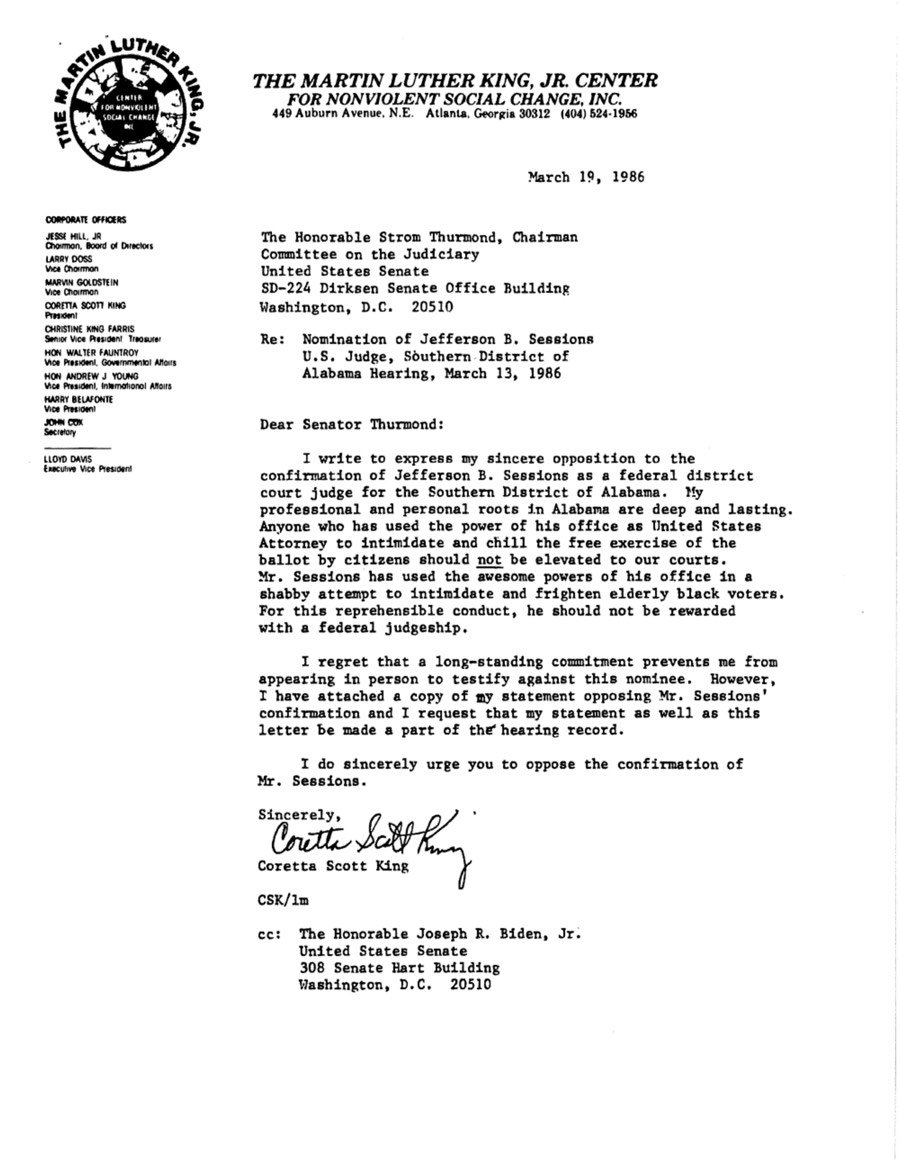
Last night, during the Senate confirmation hearing of Senator Jefferson Beauregard “Jeff” Sessions III1 for Attorney General, Senator Elizabeth Warren attempted to read a letter that Coretta Scott King had written to the Senate Judiciary Committee in 1986 opposing Sessions’ nomination for a federal judgeship (which he did not get).
The first page of the letter appears above and the entire contents may be read here. King pretty plainly states that Sessions abused his position in an attempt to disenfranchise black voters:
Mr. Sessions has used the awesome power of his office to chill the free exercise of the vote by black citizens in the district he now seeks to serve as a federal judge.
Under Senate Rule XIX and after two votes by the full Senate, Warren was barred from speaking and finishing the letter.
When Warren first spoke against Sessions Tuesday night, Sen. Steve Daines, a Republican from Montana, warned her that she was breaking the rules. When she continued anyway, Majority Leader Mitch McConnell retaliated by finding her in violation of Senate Rule XIX — which prevents any senator from using “any form of words [to] impute to another Senator… any conduct or motive unworthy or unbecoming a Senator.”
Warren later read the letter outside of the Senate chambers. How the Senate is supposed to debate the appointment of a Cabinet member without being able to criticize the actions, words, and beliefs of that candidate is left as an exercise to the reader. (Ok, I’ll answer anyway: it’s not supposed to debate. That’s the entire point of the Republicans’ actions w/r/t Trump’s political nominees thus far.)
King’s letter, which Buzzfeed called “a key part of the case against Sessions [in 1986]” was only published earlier this week in part because Judiciary Committee Chairman Strom Thurmond never officially entered it into the congressional record. Thurmond, you may remember, vehemently opposed the civil rights reforms of the 50s and 60s, even going so far as filibustering the Civil Rights Act of 1957 for more than 24 hours and switching political parties because of the Democrats’ support of the 1964 Civil Rights Act.
And Senate Rule XIX? Cornell Law School professor James Grimmelmann notes the precedent:
Let’s be clear on the precedent here: it’s the 1836-44 gag rule that forbade any consideration of abolition in the House.
Racist southern representatives were so frustrated by abolitionist petitions to Congress, that they adopted a series of rules.
All abolitionist petitions would immediately be tabled, and any attempt to introduce them would be prohibited.
From pro-slavery members of the House to Davis to Beauregard to Thurmond to Trump (and Bannon) to Sessions to McConnell (and the nearly all-white Republican majority). Paraphrasing Stephen Hawking, it’s white supremacy all the way down. Gosh, if you’re a black person in America, you might even think the system is tilted against you!
P.S. I like this part of Senate Rule XIX, right at the bottom:
8. Former Presidents of the United States shall be entitled to address the Senate upon appropriate notice to the Presiding Officer who shall thereupon make the necessary arrangements.
I’m not sure what it would accomplish, but seeing a former President address this Senate, after an appropriate period spent kiteboarding, would be pretty fun to watch.
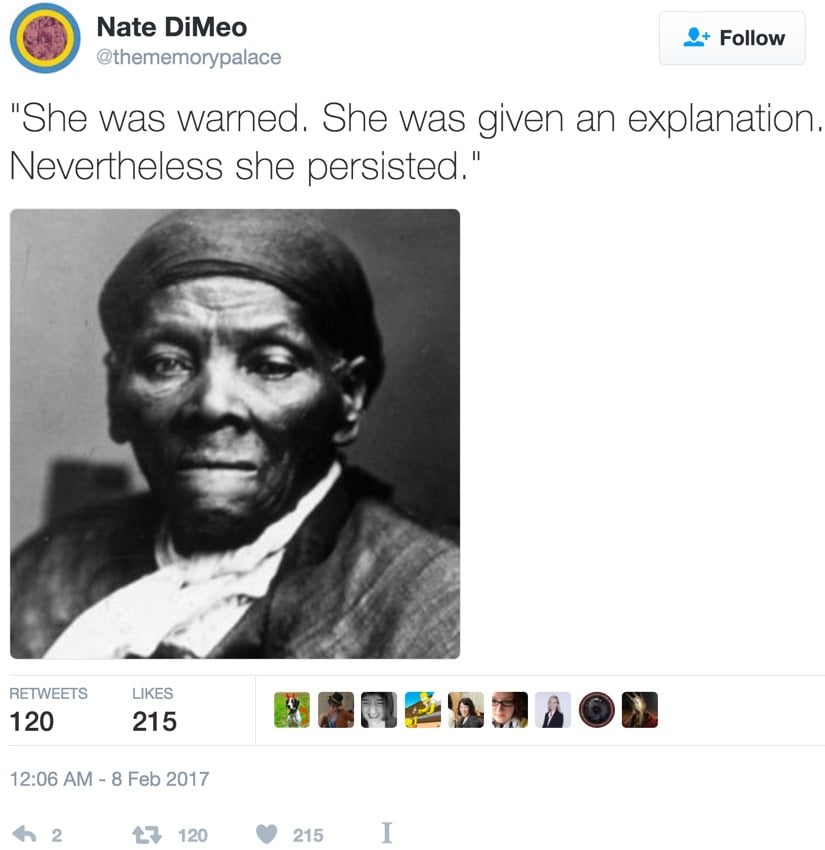
P.P.S. In silencing Warren, McConnell said, “She was warned. She was given an explanation. Nevertheless, she persisted.” Not a bad explanation of the feminist movement in America there, Mitch. Folks on Twitter are having fun with the #shepersisted hashtag.
Update: While the precedent for Senate Rule XIX dates back to the abolition debates in the 1830s and 1840s, the actual rule was made after a fight broke out in the Senate in 1902. From a book called The American Senate: An Insider’s Story:
South Carolina’s “Pitchfork Ben” Tillman accused his South Carolina colleague, John McLaurin, of selling his vote for federal patronage. McLaurin called Tillman a malicious liar. Tillman lunged at him, striking him above the left eye. McLaurin hit Tillman back with an upper-cut to the nose.
Given the history of this rule and how it was recently applied, you will perhaps not be surprised to learn that Tillman was an outspoken advocate of lynching, once remarking in a speech:
“[We] agreed on on the policy of terrorizing the Negroes at the first opportunity by letting them provoke trouble and then having the whites demonstrate their superiority by killing as many of them as was justifiable.” (Tillman boasted during the same speech that his pistol had been used to execute seven black men in 1876.)
So we can squeeze Tillman in-between Beauregard and Thurmond in the abbreviated narrative of how it came to be that a white majority Senate silenced a white woman for reading a letter written by a black woman.
Josh Marshall from Talking Points Memo urges us that when it comes to figuring out what Donald Trump’s up to, we should keep it simple. The media has covered Trump for more than 30 years, he appeared weekly on television for several years, and the coverage of his campaign over the past two years was unprecedented. That, says Marshall, means that we know Trump and his motivations quite well at this point and offers a list of five things we should keep in mind:
1. Trump is a Damaged Personality
2. Trump is a Great Communicator
3. Trump’s Hold on His Base Is Grievance
4. Trump is Possible Because of Partisan Polarization
5. Trump is Surrounded By Extremists and Desperados
Trump is an impulsive narcissist who is easily bored and driven mainly by the desire to chalk up ‘wins’ which drive the affirmation and praise which are his chief need and drive. He needs to dominate everyone around him and is profoundly susceptible to ego injuries tied to not ‘winning’, not being the best, not being sufficiently praised and acclaimed, etc. All of this drives a confrontational style and high levels of organizational chaos and drama. This need for praise and affirmation and a lack of patience for understanding the basic details of governing are a volatile and dangerous mix. They catalyze and intensify each other. Perhaps most importantly, the drive to be the best and right drives promises, claims and policy pronouncements which may contradict his already existing positions or be impossible to fulfill.
Marshall also calls out something I’ve been thinking about recently, the Make America Great Again branding:
‘Make America Great Again’ may be awful and retrograde in all its various meanings. But it captured in myriad ways almost every demand, fear and grievance that motivated the Americans who eventually became the Trump base. It is almost certainly the case that MAGA is entirely Trump’s invention, not the work of any consultant or media specialist but from Trump himself. The Trump Trucker baseball cap, a physical manifestation of Trumpite branding, is similarly ingenious.
As much as I came to admire Pentagram’s work on Hillary Clinton’s campaign branding and loved the Obama campaign’s branding (complete with beautiful typefaces from Hoefler and Frere-Jones), I think the MAGA design easily beats them both. Marshall nailed it…it was exactly right for who it was designed to appeal to. It’s perhaps unlikely to happen, but the Make America Great Again hat should be added to the permanent collections of design museums as an exemplary example of branding, right alongside Got Milk?, Think Different, and Just Do It. (Also, you know who else came up with an extraordinarily effective design for his fascist authoritarian movement?)

In response to the Trump administration’s monumentally cruel immigrant travel ban, the Museum of Modern Art in NYC has retooled its galleries to hang art by artists from countries affected by the ban, noting that if those artists are currently out of the country, they wouldn’t even be able to come to see their works in one of the world’s best art museums.
In one of the strongest protests yet by a major cultural institution, the museum has reconfigured its fifth-floor permanent-collection galleries — interrupting its narrative of Western Modernism, from Cezanne through World War II — to showcase contemporary art from Iran, Iraq and Sudan, whose citizens are subject to the ban. A Picasso came down. Matisse, down. Ensor, Boccioni, Picabia, Burri: They made way for artists who, if they are alive and abroad, cannot see their work in the museum’s most august galleries. (A work from a Syrian artist has been added to the film program. The other affected countries are Somalia, Yemen and Libya.)
The works will be up for several months, and alongside each painting, sculpture, or photograph is a text that makes no bones about why it has suddenly surfaced: “This work is by an artist from a nation whose citizens are being denied entry into the United States, according to a presidential executive order issued on January 27, 2017. This is one of several such artworks from the Museum’s collection installed throughout the fifth-floor galleries to affirm the ideals of welcome and freedom as vital to this Museum, as they are to the United States.”
The travel ban is currently not being enforced due to a temporary restraining order…hopefully that will hold up indefinitely.
Corey Robin is a political scientist whose expertise is the history of conservative movements and the politics of fear. Sounds like the perfect person to predict whether reactionary strongmen are about to swoop in and destroy the democratic institutions we’ve all enjoyed, right?
It’s a little more complicated. We are more complicated.
The worst, most terrible things that the United States has done have almost never happened through an assault on American institutions; they’ve always happened through American institutions and practices. These are the elements of the American polity that have offered especially potent tools and instruments of intimidation and coercion: federalism, the separation of powers, social pluralism, and the rule of law. All the elements of the American experience that liberals and conservatives have so cherished as bulwarks of American freedom have also been sources and instruments of political fear. In all the cases I looked at, coercion, intimidation, repression, and violence were leveraged through these mechanisms, not in spite of them.
Genocide, slavery, Jim Crow, imperialism, internment camps, crushing unions, mass surveillance, torture, lynching, indefinite detention, extrajudicial murder, and on, and on — Americans have inflicted all of this on other Americans and on the rest of the world, not in the distant past, not as an original sin, but right up to the present day.
Which is not so unusual, for great powers of the world, or even most of the smaller ones. What is exceptional about America, if anything, is we have done all of this without once needing a strongman to do it. As Robin says, it’s been done “through lawyers, genteel men of the Senate with their august traditions and practices, and the Supreme Court.”
This is why people like SCOTUS nominee Neil Gorsuch seem almost comforting next to Trump and his inner circle. They seem so familiar.
This is what the “resilience of American institutions” means.
When it comes to the most terrible kinds of repression and violence, Fear, American Style has worked because it has given so many players a piece of the pie.
The storm is called progress.
The truth of the matter is that Trump and Bannon could get most if not all of what they want—in terms of the revanchism of race, gender, and class, the white Christian nation that they seem to wish for—without strongman politics. American institutions offer more than enough resources for revanchism. That they seem not to know this—that they are willing to make opponents of the military and the security establishment, that they are willing to arouse into opposition and conjure enemies out of potential friends—may be their biggest weakness of all. Or, if they do know this, but seek strongman politics anyway, perhaps because it is a surplus, then they’re willing to put strongman politics above and beyond the project of social revanchism that their base seeks. Which may be their other biggest weakness of all.
In my experience with abusers — and the best working explanation I have found for most of Trump’s behavior is not any exotic psychological disorder or espionage-related intrigue, but that he is a self-confessed, well-documented serial abuser — getting what they want is secondary. The abuse itself, the bullying exercise of power, the maintenance of dominance, is the point. Which is the other way in which all of this feels way too familiar.
More than a year ago, before the Iowa caucuses, the story of folk singer/songwriter/activist Woody Guthrie’s hatred for his landlord, Fred Trump (father of Donald) started to circulate. (I believe the first piece was this nicely done essay at The Conversation, by Will Kaufman.)
The story goes like this: Between 1950 and 1952, Guthrie lived in a Federal Housing Administration-funded low-income apartment building in Brooklyn’s Coney Island built by Fred Trump. But Trump (who already had a history of bigotry, including an arrest at a Klan parade that turned into a riot in 1927), quickly worked to segregate even his federal developments, prohibiting black tenants from renting in majority-white complexes or neighborhoods.
Guthrie moved out of the Trump building when his two-year-lease was up, but wrote a song about it called “Old Man Trump”:
I suppose that Old Man Trump knows just how much racial hate
He stirred up in that bloodpot of human hearts
When he drawed that color line
Here at his Beach Haven family project
Beach Haven ain’t my home!
No, I just can’t pay this rent!
My money’s down the drain,
And my soul is badly bent!
Beach Haven is Trump’s Tower
Where no black folks come to roam,
No, no, Old Man Trump!
Old Beach Haven ain’t my home!
And in fact, Donald and his father Fred would eventually be sued for housing discrimination under the Fair Housing Act of 1968; this was 1973, and was the first time Donald Trump ever appeared in the New York Times (“Major Landlord Accused of Antiblack Bias in City”). They settled the lawsuit in 1975.
But that’s not the end of the story. The present-day Trump slogan “America First” is a direct callback to the America First Committee, an isolationist antiwar group that formed after the outbreak of World War 2 in Europe. It included pacifists and farmers and students and socialists and businessmen and a lot of wealthy, anti-Semitic, pro-German, pro-fascist Americans, notably its main spokesman Charles Lindbergh.
As it happens, one of Woody Guthrie’s best protest songs, “Lindbergh” (or “Mister Charlie Lindbergh”) is about America First. It criticizes Lindbergh and the group, but also the devil’s bargain socialist and other workers’ groups across the midwest had made in partnering up with pro-Nazi capitalists:
Hitler said to Lindy: “Stall ‘em all you can,
Gonna bomb Pearl Harbor with the help of old Japan.”
In Washington, Washington.
Then on a December mornin’, the bombs come from Japan,
Wake Island and Pearl Harbor, kill fifteen hundred men.
In Washington, Washington
Now Lindy tried to join the army, but they wouldn’t let him in,
Afraid he’d sell to Hitler a few more million men.
In Washington, Washington
So I’m a-gonna tell you people, if Hitler’s gonna be beat,
The common workin’ people has got to take the seat
In Washington, Washington.
And I’m gonna tell you workers, ‘fore you cash in your checks:
They say “America First,” but they mean “America Next!”
In Washington, Washington.
Easy enough to remember.

This is from Walter Benjamin’s essay “On the Concept of History,” but I’m going to use the old translation back when it was called “Theses on the Philosophy of History,” and mess with the line breaks a little. If you’ve read this a million times, forgive me; it’s always worth reading again.
A Klee painting named “Angelus Novus” shows an angel looking as though he is about to move away from something he is fixedly contemplating. His eyes are staring, his mouth is open, his wings are spread.
This is how one pictures the angel of history. His face is turned toward the past. Where we perceive a chain of events, he sees one single catastrophe which keeps piling wreckage and hurls it in front of his feet.
The angel would like to stay, awaken the dead, and make whole what has been smashed.
But a storm is blowing in from Paradise; it has got caught in his wings with such a violence that the angel can no longer close them. The storm irresistibly propels him into the future to which his back is turned, while the pile of debris before him grows skyward.
This storm is what we call progress.
Benjamin wrote this in 1940, in Paris; he’d left Germany shortly before the Nazis seized power. After the Nazis invaded France, he fled to Spain, with a precious travel visa to the United States. Spain’s government then cancelled all transit papers. The police told Benjamin and all the other Jewish refugees in his group would be returned to France. He killed himself.
His friend Hannah Arendt later made it across the border safely; she had the manuscript of this essay. Which is why it exists.
Why is this useful?
These are chaotic times. But to the angel of history, it’s not a sudden eruption of chaos, but a manifestation of an ongoing vortex of chaos that stretches back indefinitely, without any unique origin. When we’re thrust into danger, in a flash we get a more truthful glimpse of history than the simple narratives that suffice in moments of safety. As Benjamin puts it, “the tradition of the oppressed teaches us that the ‘state of emergency’ in which we live is not the exception but the rule.”
Global refugees, the stubborn pervasiveness of white supremacy, the arbitrary power of the state, the fragility of national and international institutions — we’ve been here for some time now, haven’t we? One day, you stir, and there you are — right where you’ve always been. With nothing under your feet, and ghosts pausing for breath next to your cheek.
This is not normal — and yet it’s the same as it’s always been. Because there is no normal. Not really. Just a series of accidents, a trick of the light, a collective hallucination we’ve all worked to diligently maintain.
Even now, most of us are working to impose an order on the world, to see a plan at work, to sort the chaos into “distractions” and “reality,” whether it’s “real news,” uncovering the secret aims of an unseen puppet master, or articulating the one true politics that can Fix Everything. We can’t help it; it’s what we do.
Remembering the angel helps ameliorate that impulse. Yes, there are opportunists everywhere, and real losses and victories, but the perfect theory that links events into beautiful chains of causality is elusive enough to be a dream for a fallen people. “Only a redeemed mankind receives the fullness of its past — which is to say, only for a redeemed mankind has its past become citable in all its moments.” For now, it’s all part of the storm; we’re all going to have to improvise.
For all his pessimism, rooted in a contempt and longing for a safety he couldn’t enjoy, Benjamin (I think) really did believe in the possibility of a Messiah, who would appear at a moment of great danger. It was a Jewish and a Marxist belief for someone who had great difficulty believing in either Judaism or Marxism in any of their existing forms.
There are a lot of people, on the left and the right, who share a version of this idea as a matter of dogma, without anything like the Kierkegaardian leap of faith Benjamin took in order to suspend his disbelief in it. Better to knock everything down, to build something new to replace it; heighten the stakes, so we have no choice but to take drastic steps to build paradise. I’m a lot less sure. I know what it took to build those things, and the emergencies that forced us to build them. It’s not an algebra problem to me, a clever lecture, a witty conjecture. I like those. Those are fun. This is not fun. This is blood and bones and broken things that do not come back. It would be nice to have a political or religious framework in which all those things can be mended or redeemed. It’s not available to me, except in its absence.
But for all that, I think I do believe in something smaller, more limited:
- I believe that moments of emergency are shot through with new possibilities;
- I believe there are more of us and there is more to us than we know;
- I think that we are always becoming something new;
- and this is because we don’t have a choice in the matter.
I think James Baldwin is right (Baldwin, like Benjamin, is somehow always right) when he writes in “Stranger in the Village” that while so many “American white men still nourish the illusion that there is some means of recovering the European innocence, of returning to a state in which black [and brown] men [and women] do not exist,” that
This is one of the greatest errors Americans can make. The identity they fought so hard to protect has, by virtue of that battle, undergone a change: Americans are as unlike any other white people in the world as it is possible to be. I do not think, for example, that it is too much to suggest that the American vision of the world — which allows so little reality, generally speaking, for any of the darker forces in human life, which tends until today to paint moral issues in glaring black and white — owes a great deal to the battle waged by Americans to maintain between themselves and black men a human separation which could not be bridged. It is only now beginning to be borne in on us — very faintly, it must be admitted, very slowly, and very much against our will— that this vision of the world is dangerously inaccurate, and perfectly useless. For it protects our moral high-mindedness at the terrible expense of weakening our grasp of reality. People who shut their eyes to reality simply invite their own destruction, and anyone who insists on remaining in a state of innocence long after that innocence is dead turns himself into a monster.
The time has come to realize that the interracial drama acted out on the American continent has not only created a new black man, it has created a new white man, too. No road whatever will lead Americans back to the simplicity of this European village where white men still have the luxury of looking on me as a stranger. I am not, really, a stranger any longer for any American alive. One of the things that distinguishes Americans from other people is that no other people has ever been so deeply involved in the lives of black men, and vice versa. This fact faced, with all its implications, it can be seen that the history of the American Negro problem is not merely shameful, it is also something of an achievement. For even when the worst has been said, it must also be added that the perpetual challenge posed by this problem was always, somehow, perpetually met. It is precisely this black-white experience which may prove of indispensable value to us in the world we face today. This world is white no longer, and it will never be white again.
In short, I believe in the future — not a paradise, not a tranquil place, not a reward, but in all its mundane possibility and broken uncertainty. I choose to believe in the future, simply because we have nowhere else to go.
Joshua Glenn and Rob Walker have collected a group of writers to tell stories about political objects they own.
Batches of POLITICAL OBJECTS stories will appear on HILOBROW before, on, and just after the inauguration, and will continue to roll out through the end of March. The objects include overtly political artifacts both charismatic and absurd, and items whose stealthily political nature will surprise you; the stories range from the uplifting to the poignant to the unexpectedly illuminating. It’s a terrific collection.
Stephen Duncombe wrote about a God Bless Hysteria protest sign and Ben Greenman wrote about a Matchbox car.
Soon enough, I found what I didn’t know I was looking for — a Corvette. This was early May of 2016. Prince had just died. I had just started writing a book about him. I knew that I needed a little red Corvette, somehow, as a talisman. The only problem was that the one from the bin was black. I bought it. I took it home. I went into the closet and found the model paints that my sons no longer use. I painted it red.
Back in November, former Obama administration official Cass Sunstein came up with a list of five books that conservatives should read to in order to learn something about contemporary progressivism. On the list is Success and Luck: Good Fortune and the Myth of Meritocracy by Robert Frank:
In Frank’s view, we overstate the role of individual merit and underestimate the massive role of luck in producing individual success or failure — being born into the right family, finding oneself in the right place at the right time, having a good mentor. He makes “there but for the grace of God go I” into a rallying cry.
A month earlier, Sunstein offered a similar list of books liberals should read to learn something about conservatives, including Jonathan Haidt’s The Righteous Mind:
Do conservatives have moral commitments that progressives may not even recognize? Haidt says yes, and he identifies three: authority, loyalty and sanctity. If, for example, someone has betrayed a trust, or treated a boss or a parent disrespectfully, conservatives are far more likely to be outraged than progressives.
Haidt is not himself a conservative, but he offers a sympathetic explanation of why progressives often fail to understand their political adversaries. He also shows that the moral commitments that resonate among conservatives have deep roots in human history — and that it is a form of blindness not to acknowledge and respect those commitments.
Over at Bloomberg, Tyler Cowen provides an explanation as to why Donald Trump and his staff are lying.
By requiring subordinates to speak untruths, a leader can undercut their independent standing, including their standing with the public, with the media and with other members of the administration. That makes those individuals grow more dependent on the leader and less likely to mount independent rebellions against the structure of command. Promoting such chains of lies is a classic tactic when a leader distrusts his subordinates and expects to continue to distrust them in the future.
Another reason for promoting lying is what economists sometimes call loyalty filters. If you want to ascertain if someone is truly loyal to you, ask them to do something outrageous or stupid. If they balk, then you know right away they aren’t fully with you. That too is a sign of incipient mistrust within the ruling clique, and it is part of the same worldview that leads Trump to rely so heavily on family members.
This is interesting throughout, particularly the bit about “higher-status mistruths and lower-status mistruths”.
Note that these tactics do not require a strategic masterplan.1 We know Trump acts mostly on instinct, so all the lying is just how he’s found success doing business in the past. I’ve been listening to The Power Broker on audiobook for the past few months and the similarities between how Robert Moses operated (particularly in NYC at the height of his powers) and Trump’s tactics are downright eerie, right down to the outright lies, ignoring outside counsel, and favoring short-term results over deeper long-term consequences.2 Both men had so much power and (especially in Moses’ case) capability that they could have really helped people and made a difference in the lives of millions but instead used it mainly to get their own way.
The United States Government Manual is the official handbook of the US federal government. Here is the org chart for our government…take notice of what’s right at the top:

I’m no constitutional scholar, but that particular document starts off:
We the People of the United States, in Order to form a more perfect Union, establish Justice, insure domestic Tranquility, provide for the common defence, promote the general Welfare, and secure the Blessings of Liberty to ourselves and our Posterity, do ordain and establish this Constitution for the United States of America.
I realize the current executive administration doesn’t care and the current majority in the legislative branch barely cares, but remembering exactly who our government works for will be helpful over the next few years. (via @monstro)
Robert Hickey is the deputy director of The Protocol School of Washington, which provides etiquette and protocol training. In his book Honor & Respect, he covers the “correct written and oral forms of address for everyone from local officials to foreign heads of state”. For The President of the United States, the proper forms of address are:
Letter salutation: Dear Mr. President:
Complimentary close: Most respectfully,
Announced: The President of the United States
Introduction: Mr. President, may I present …
Conversation: Mr. President
And contrary to how many media outlets refer to former US Presidents, they should not be referred to as “President” (e.g. “President Bush”):
“While it is common practice in the media and elsewhere to address and identify former presidents as ‘President (Name),’ this is a mistake,” said Hickey. “Serving as President of the United States does not grant one the personal rank of ‘President’ for life. The office of President is a one-person-at-a-time role that a specific individual holds and then hands off to the next person.”
“Courtesies, honors, and special forms of address are symbols of the power of the office. They belong to the office and to the citizens, not former office holders.”
Hickey recommends “The Honorable” as an official title (e.g. “The Honorable Jimmy Carter”) and “Mr./Ms.” for conversation or salutation (e.g. “Mr. Clinton”).
While Donald Trump was officially sworn in as the President on Friday, this site will continue to refer to Trump as “Trump” or “Donald Trump”1 and not as “President Trump”. Again and again, almost to a pathological degree, Trump has demonstrated, in word and deed, that he has not earned and does not deserve our respect and the title of his office. It’s a small protest by a small “media outlet”, perhaps petty, but as long as the First Amendment still applies, I will publish what I like on my own damn website.
And since I am all for the “one-person-at-a-time” rule, this site will also continue to refer to Barack Obama as “President Obama”. He’s earned it many times over.
I posted earlier about Atul Gawande’s piece in the New Yorker on the importance of incremental care in medicine. One of the things that the Affordable Care Act1 did was to make it illegal for insurance companies to deny coverage to people with “preexisting conditions”, which makes it difficult for those people to receive the type of incremental care Gawande touts. And who has these preexisting conditions? An estimated 27% of US adults under 65, including Gawande’s own son:
In the next few months, the worry is whether Walker and others like him will be able to have health-care coverage of any kind. His heart condition makes him, essentially, uninsurable. Until he’s twenty-six, he can stay on our family policy. But after that? In the work he’s done in his field, he’s had the status of a freelancer. Without the Affordable Care Act’s protections requiring all insurers to provide coverage to people regardless of their health history and at the same price as others their age, he’d be unable to find health insurance. Republican replacement plans threaten to weaken or drop these requirements, and leave no meaningful solution for people like him. And data indicate that twenty-seven per cent of adults under sixty-five are like him, with past health conditions that make them uninsurable without the protections.
That’s 52 million people, potentially ineligible for health insurance. And that’s not counting children. Spurred on by Gawande, people have been sharing their preexisting conditions stories on Twitter with the hashtag #the27Percent.
The 27% figure comes from a recent analysis by the Kaiser Family Foundation:
A new Kaiser Family Foundation analysis finds that 52 million adults under 65 — or 27 percent of that population — have pre-existing health conditions that would likely make them uninsurable if they applied for health coverage under medical underwriting practices that existed in most states before insurance regulation changes made by the Affordable Care Act.
In eleven states, at least three in ten non-elderly adults would have a declinable condition, according to the analysis: West Virginia (36%), Mississippi (34%), Kentucky (33%), Alabama (33%), Arkansas (32%), Tennessee (32%), Oklahoma (31%), Louisiana (30%), Missouri (30%), Indiana (30%) and Kansas (30%).
36% uninsurable in West Virginia! You’ll note that all 11 of those states voted for Trump in the recent election and in West Virginia, Trump carried the day with 68.7% of the vote, the highest percentage of any state. The states whose people need the ACA’s protection the most voted most heavily against their own interest.
Update: An earlier version of this post unfairly pinned the entire blame for the lack of coverage of those with preexisting conditions on the insurance companies.2 I removed the last paragraph because it was more or less completely wrong. Except for the part where I said we should be pissed at the Republican dickheads in Congress who want to repeal the ACA without replacing it with something better.3 And the part where we should be outraged. And the part where we regulated cars and cigarettes and food to make them safer, forced companies to build products in ways they didn’t want, and saved millions of lives. We can’t make everyone healthier and raise taxes to do it? Pathetic for what is supposedly the world’s most powerful and wealthy nation. (thx @JPVMan + many others)
The Upshot recently conducted a survey about 29 gun control ideas and graphed the results based on the popularity of the ideas with the American public and their potential effectiveness according to experts.

Oh, shit like this makes me SO ANGRY. I didn’t even include the bottom part of the graph because there’s nothing down there. That’s right, the majority of Americans support all sorts of different gun control tactics, especially those likely to be most effective. But a focused and organized minority of gun nuts has somehow made it impossible for any reform to happen, so things like Newtown and Orlando and Charleston and San Bernardino and Aurora and toddlers killing people with guns will just continue to happen all over the nation like it’s completely fucking normal.
Last night, as she accepted a lifetime achievement award at the Golden Globes, Meryl Streep made some comments about the current political situation and about Donald Trump in particular (although she never mentioned him by name). The clip above (which may not last long on YouTube) is worth watching.
But there was one performance this year that stunned me. It sank its hooks in my heart. Not because it was good; there was nothing good about it. But it was effective and it did its job. It made its intended audience laugh, and show their teeth. It was that moment when the person asking to sit in the most respected seat in our country imitated a disabled reporter. Someone he outranked in privilege, power and the capacity to fight back. It kind of broke my heart when I saw it, and I still can’t get it out of my head, because it wasn’t in a movie. It was real life. And this instinct to humiliate, when it’s modeled by someone in the public platform, by someone powerful, it filters down into everybody’s life, because it kinda gives permission for other people to do the same thing. Disrespect invites disrespect, violence incites violence. And when the powerful use their position to bully others we all lose. OK, go on with it.
And the NY Times — in an effort to “get both sides” of the story, I guess? — ran a story that I’m not going to link to called “Donald Trump Says He’s Not Surprised by Meryl Streep’s Golden Globes Speech”. Is it newsworthy, what he thought of Streep’s remarks? Unless he agrees with her and plans to honestly reevaluate how he treats others when he speaks, I would argue it’s not at all worth printing what’s essentially a Trump press release full of bullshit. And news outlets that actually care about the truth and not just printing spin should stop doing it.
Newer posts
Older posts





Socials & More