kottke.org posts about politics

For the past 11 years, the Breakthrough Prize awards have “celebrated outstanding scientific achievements, honoring scientists driving remarkable discoveries in gene editing, human diseases, the search for the fundamental laws of the Universe and pure mathematics”. At this year’s awards, Edward Norton & Seth Rogen presented a prize in fundamental physics and Rogen took the opportunity to remind the audience — including Mark Zuckerberg, Jeff Bezos, and Sam Altman — that the Trump regime is actively destroying the ability for people to pursue science in America.
And it’s amazing that others [who have been] in this room underwrote electing a man who, in the last week, single-handedly destroyed all of American science. It’s amazing how much good science you can destroy with $320 million and RFK Jr, very fast.
Rogen’s remarks were heard during the live presentation but have been scrubbed from the video on YouTube. I haven’t seen the uncensored video anywhere…drop me a line if you run across it?
This is a really interesting essay from Naomi Klein and Astra Taylor about the rise of end times fascism and the far right’s bet against the future.
The governing ideology of the far right in our age of escalating disasters has become a monstrous, supremacist survivalism.
It is terrifying in its wickedness, yes. But it also opens up powerful possibilities for resistance. To bet against the future on this scale – to bank on your bunker – is to betray, on the most basic level, our duties to one another, to the children we love, and to every other life form with whom we share a planetary home. This is a belief system that is genocidal at its core and treasonous to the wonder and beauty of this world. We are convinced that the more people understand the extent to which the right has succumbed to the Armageddon complex, the more they will be willing to fight back, realizing that absolutely everything is now on the line.
Our opponents know full well that we are entering an age of emergency, but have responded by embracing lethal yet self-serving delusions. Having bought into various apartheid fantasies of bunkered safety, they are choosing to let the Earth burn. Our task is to build a wide and deep movement, as spiritual as it is political, strong enough to stop these unhinged traitors. A movement rooted in a steadfast commitment to one another, across our many differences and divides, and to this miraculous, singular planet.
And (emphasis mine):
If policing the boundaries of the bunkered nation is end times fascism’s job one, equally important is job two: for the US government to lay claim to whatever resources its protected citizens might need to get through the tough times ahead. Maybe it’s Panama’s canal. Or Greenland’s fast-melting shipping routes. Or Ukraine’s critical minerals. Or Canada’s fresh water. We should think of this less as old-school imperialism than super-sized prepping, at the level of the national state. Gone are the old colonial fig leaves of spreading democracy or God’s word – when Trump covetously scans the globe, he is stockpiling for civilizational collapse.
But:
In this moment, when end times fascism is waging war on every front, new alliances are essential. But instead of asking: “Do we all share the same worldview?” Adrienne urges us to ask: “Is your heart beating and do you plan to live? Then come this way and we will figure out the rest on the other side.”
The whole thing is a must-read.
Harvard is refusing to comply with Trump’s demands related to his regime’s racist, xenophobic political agenda, including a threat to cut $9 billion in research funding. From the AP:
Harvard President Alan Garber, in a letter to the Harvard community Monday, said the demands violated the university’s First Amendment rights and “exceeds the statutory limits of the government’s authority under Title VI,” which prohibits discrimination against students based on their race, color or national origin.
“No government — regardless of which party is in power — should dictate what private universities can teach, whom they can admit and hire, and which areas of study and inquiry they can pursue,” Garber wrote, adding that the university had taken extensive reforms to address antisemitism.
“These ends will not be achieved by assertions of power, unmoored from the law, to control teaching and learning at Harvard and to dictate how we operate,” he wrote. “The work of addressing our shortcomings, fulfilling our commitments, and embodying our values is ours to define and undertake as a community.”
You can read Garber’s letter and the letter Harvard received from the Trump regime.
I recently attended a virtual talk and Q&A with Timothy Snyder and when he was asked about Columbia and other schools capitulating to Trump’s demands and what needs to happen in order to stop it, he replied something along the lines of: “Some big school is gonna have to stick their neck out and take the hit. Say ‘no’ unequivocally to Trump and get their funding pulled. Lead by example and others will follow. Solidarity is the only way out of this.” Good on Harvard1 for helping to lead the way on this…hopefully more schools will find their backbone after this.
Heather Cox Richardson on where we are right now in terms of what type of government we currently have:
Here’s the thing: Once you give up the idea that we are all equal before the law and have the right to due process, you have given up the whole game. You have admitted the principle that some people have more rights than others. Once you have replaced the principle of equality before the law with the idea that some people have no rights, you have granted your approval to the idea of an authoritarian government. At that point, all you can do is to hope that the dictator and his henchmen overlook you.
They are 100% going to try to do this with citizens:
Make no mistake: as Supreme Court Justices Sonia Sotomayor, Elena Kagan, and Ketanji Brown Jackson recently warned, if the administration can take noncitizens off the streets, render them to prison in another country, and then claim it is helpless to correct the error either because the person is out of reach of U.S. jurisdiction, it could do the same thing to citizens.
Meanwhile, Trump’s approval rating is still well above 40% (and is even higher if you don’t factor in the economy/tariffs). 🤷♂️
Ryan Broderick on how, with the trade war that Trump’s tariffs has unleashed, we are speedrunning Brexit and other hyper-inflationary financial crises (thread) and Americans may soon find out what happens when US dollars don’t buy anything.
So from my uniquely weird perspective after living in the UK through Brexit, being in India during Modi’s demonetization, and living in Brazil when the real tanked during the Bolsonaro administration, I can confidently say that Americans do not and can not understand how bad this is going to be.
To sort of broadly describe what is about to happen if the Trump admin doesn’t reverse course, we are quickly racing towards a world where not only does our money just not work correctly anymore day to day, but the background radiation of a crumbling economy will become impossible to ignore.
After the Brexit referendum, everything in London just got slightly worse. A year or two in, you could feel it. But that’s because it took five years for the country to actually leave the EU. We’re speedrunning that. In Brazil, prices would change overnight, stores just wouldn’t have stuff.
There’s more; read the whole thing. Broderick was reacting to this brief WSJ piece (archive):
The broad selloff in U.S. stocks and bonds, and the continuing decline in the dollar, represents a “simultaneous collapse in the price of all U.S. assets,” analysts at Deutsche Bank said Wednesday. They warned that “unchartered territory” lies ahead.
- Markets are dedollarizing, they said, citing the lack of evidence that investors are hoarding dollar liquidity— a dynamic that in previous market routs fueled Treasury and U.S. dollar rallies but this time is leading to declines in the prices of both.
- The administration is encouraging the Treasury selloff, they said, in a bid to bring down U.S. asset valuations—a decision they said now is exposing the fact that “reducing bilateral trade imbalances is functionally equivalent to lowering demand for U.S. assets as well.”
- A financial war with China could lie ahead, they conclude, contending that “there is little room now left for an escalation on the trade front” and that “there can be no winner to such a war.”
I’ve been saying since his election that Trump was going to drive the economy into the ditch. This is more like driving it off a cliff.
For The Guardian, the film critic Guy Lodge has complied a list of 25 films that “shed light on the US under Trump”. From the introduction by filmmaker Alex Gibney:
This is a dire moment in the US. It’s a moment where there’s an opportunity for people with a lot of money to rip apart all of the guidelines enacted by the Roosevelt administration, way back in the day, to guard against the brutality of unfettered capitalism. Capitalists like to have all the power that they want, whenever they want it. They’re not much interested in democracy either, it turns out. Nor, apparently, the rule of law. The government is not the solution — it’s the problem. And now a vengeful president who just wanted a get-out-of-jail-free card is going to punish his enemies and show us all how to destroy the American administrative state by using the big stick of Elon Musk’s chequebook.
Here are a few of the films and their trailers — you can check out the article for the rest.
I Am Not Your Negro (Raoul Peck, 2016):
Election (Alexander Payne, 1999):
White Noise (Daniel Lombroso, 2020) {Note: this is not the DeLillo adaptation}:
American Factory (Julia Reichert and Steven Bognar, 2019):
I’m curious…what films would you add to the list?
Anne Applebaum writes about how Trump, Bannon and other MAGA conservatives love what Hungarian Prime minister Viktor Orbán is going to his country.
Once widely perceived to be the wealthiest country in Central Europe (“the happiest barrack in the socialist camp,” as it was known during the Cold War), and later the Central European country that foreign investors liked most, Hungary is now one of the poorest countries, and possibly the poorest, in the European Union. Industrial production is falling year-over-year. Productivity is close to the lowest in the region. Unemployment is creeping upward. Despite the ruling party’s loud talk about traditional values, the population is shrinking. Perhaps that’s because young people don’t want to have children in a place where two-thirds of the citizens describe the national education system as “bad,” and where hospital departments are closing because so many doctors have moved abroad. Maybe talented people don’t want to stay in a country perceived as the most corrupt in the EU for three years in a row. Even the Index of Economic Freedom — which is published by the Heritage Foundation, the MAGA-affiliated think tank that produced Project 2025 — puts Hungary at the bottom of the EU in its rankings of government integrity.
Oh, and the corruption:
The Hungarian businessman and a Hungarian economist I spoke with — both of whom insisted on anonymity, for fear of retaliation — had separately calculated that NERistan amounts to about 20 percent of the Hungarian economy. That means, as the economist explained to me, that 20 percent of Hungary’s companies operate “not on market principles, not on merit-based principles, but basically on loyalty.” These companies don’t have normal hiring practices or use real business models, because they are designed not for efficiency and profit but for kleptocracy—passing money from the state to their owners.
An organization called Direkt36 has made an hour-long documentary about the corruption enabled by Orbán…it’s free on YouTube:


On Saturday, millions of Americans flooded the streets of cities, small towns, and every other sized municipality in the nation to protest the illegal and damaging actions of the Trump regime. These photos published by a number of media outlets show the scale, enthusiasm, and creativity of these peaceful protests, in the US and around the world.

On April 5th, a group of prominent national organizations (including 50501, Indivisible, Hands Off, MoveOn, and Women’s March) and many local organizations are all coming together for a day of nationwide action and protest.
This is a nationwide mobilization to stop the most brazen power grab in modern history. Trump, Musk, and their billionaire cronies are orchestrating an all-out assault on our government, our economy, and our basic rights — enabled by Congress every step of the way.
They want to strip America for parts — shuttering Social Security offices, firing essential workers, eliminating consumer protections, and gutting Medicaid — all to bankroll their billionaire tax scam. They’re handing over our tax dollars, our public services, and our democracy to the ultra-rich.
If we don’t fight now, there won’t be anything left to save.
This is gonna be huge. There are events all over the country on April 5, and if there isn’t one near you, you can plan your own. There are signs you can print out to bring (or design/bring your own).
For more information, you can check out the Hands Off! website, the See You In the Streets site, or this informative collection of info from several sites/orgs.
From Aubrey Hirsch, It Could Be Much, Much Worse, an illustrated guide to what health care and insurance was like in the US before the ACA.


You can also find this guide on Instagram.
In this 10-minute video, John Lithgow reads each of the lessons from Timothy Snyder’s On Tyranny: Twenty Lessons from the Twentieth Century (Bookshop).
Number two: defend institutions. It is institutions that help us to preserve decency. They need our help as well. Do not speak of our institutions unless you make them yours by acting on their behalf. Institutions do not protect themselves. They fall one after the other unless each is defended from the beginning. So choose an institution you care about — a court, a newspaper, a law, a labor union — and take its side.
Snyder himself made a series of 20 videos a few years ago in which he reads each lesson and then provides more context on what it means. Here’s the first episode on anticipatory obedience (he starts reading after a short intro, at about the 2:40 mark):
Lesson number one is: do not obey in advance. Most of the power of authoritarianism is freely given. In times like these, individuals think ahead about what a more repressive government will want, and then offer themselves without being asked. A citizen who adapts in this way is teaching power what it can do.
So, this is the first lesson because it’s about the basic choice we make when we confront difficulty. It’s about the choice of all choices: are we going to go with the new flow or are we going to stand — if only a little bit, only hesitantly — as long as we can against the current?
Again, the whole series of 20 videos can be accessed from this playlist.
With the election of Donald Trump in 2016 and, especially, again in 2024, the adjacent possible of American society has shifted dramatically. For the Washington Post, Philip Bump asked a number of people who study systems of government and the erosion of democracy the following question: “Given the country’s trajectory and what’s unfolded in other countries, what can we expect the United States to look like in five or 10 years’ time?”
Steven Levitsky, co-author of How Democracies Die (Bookshop) and Tyranny of the Minority: Why American Democracy Reached the Breaking Point (Bookshop):
I think the most likely scenario is a kind of careening between pretty dysfunctional democracy and an unconsolidated authoritarianism. A kind of back and forth in which the relative good guys win once in a while, they don’t perform well, they don’t last long and the bad guys win power occasionally and also don’t perform well and don’t last long.
But also (emphasis mine):
I think it’s possible the flurry of abuses and attacks, first of all, and secondly, the incredibly weak response by civil society, suggests that the Trump administration can get away with much more than I think almost any of us anticipated. I would have thought it highly unlikely that the Trump administration could really seriously tilt the playing field in terms of media access and resource access, given the wealth and the diversity of the private sector in this country. A Hungary-like tilting of the playing field seemed really unlikely. Now, I think it’s possible.
Ruth Ben-Ghiat, author of Strongmen: Mussolini to the Present (Bookshop):
Domestically, you don’t need to abolish opposition parties today. You just engineer the electoral system to keep Democrats out of power.
Thomas Zimmer, author of Democracy Americana:
A little over two months after Trump returned to power, it seems undeniable that even critical observers underestimated the speed and scope of the Trumpist assault and overestimated democratic resilience in both the political system as well as civil society. In mere weeks, Trumpists have managed to push America into that space somewhere between (no longer) democracy and full-scale autocracy. That means we must recalibrate our expectations. “They are not going to go *that* far” has been proved wrong over and over again. The idea that “they won’t be able to do this” seems similarly unfounded. Let’s finally discard whatever notion of “it cannot happen here” that is still floating around.
God, the “it cannot happen here” argument was so stupid even back in 2016 when people were debating whether Trump was a fascist. If nothing else, it was clarifying to be able to stick anyone who was chastising others for worrying too much into the “I’m highly skeptical of anything you write now” box.
Anyway, the whole piece is worth a read.
I have one kid entering college this fall and one a few years away, so I’ve been thinking (with fury and sadness) about the effect that Trump’s authoritarian regime is having on American colleges and universities. They’re pulling funding from schools; schools are cancelling programs, freezing hiring, and cutting back on admissions; and NIH and NSF funding is being curtailed and withdrawn. College students are being snatched off the streets by ICE & DHS and schools either can’t or won’t do anything to stop it. If these actions persist, US colleges & universities could look quite different in a year or two.
In a piece called The End of College Life, Ian Bogost calls the potential effect of these changes a “calamity” and says “the damage to our educational system could be worse than the public comprehends”.
Any one of the Trump administration’s attacks on research universities, let alone all of them together, could upend the college experience for millions of Americans. What’s at stake is far from trivial: Forget the frisbees on the quad; think of what it means to go to college in this country. Think of the middle-class ideal that has persisted for most of a century: earning a degree and starting a career, yes, but also moving away from home, testing limits, joining new communities, becoming an adult.
This might all be changing for fancy private schools and giant public universities alike. If you, or your son, or your daughter, are in college now, or are planning to enroll in the years ahead, you should be worried.
I am curious to hear from parents of high school and college students, from college faculty & administrators, and from students themselves: how have the actions of the Trump regime changed your thinking about college? What plans are you making or changing? Let me know in the comments. (If you don’t have a membership but would like to leave a comment, just email me your thoughts and I’ll post it for you.)
In this episode of This American Life from a few weeks ago, Masha Gessen read an excerpt from their book Surviving Autocracy about the particular kind of lie used by autocrats like Putin and Trump.
Lies can serve a number of functions. People lie to deflect, to avoid embarrassment or evade punishment by creating doubt, to escape confrontation or lighten the blow, to make themselves appear better, to get others to do or give something, and even to entertain.
However unskilled a person may be at lying, they usually hope that the lie will be convincing. Executives want shareholders to think that they have devised a foolproof path to profits. Defendants want juries to believe that there is a chance that someone else committed the crime.
People in relationships want their partners to think that they have never even considered cheating. Guests want the host to think that they like their fish overcooked. These lies can be annoying or amusing, but they are surmountable. They collapse in the face of facts.
The Trumpian lie is different. It is the power lie or the bully lie. It is the lie of the bigger kid who took your hat and is wearing it while denying that he took it. There is no defense against this lie because the point of the lie is to assert power, to show I can say what I want, when I want to.
The power lie conjures a different reality that demands that you choose between your experience and the bully’s demands. Are you going to insist that you’re wet from the rain or give in and say that the sun is shining?
I believe the bully lie fits into the same general category as fascists seeing hypocrisy as a virtue — it only really makes sense when you think about it in terms of domination or power. (thx, caroline)
A.R. Moxon:
It’s best to understand that fascists see hypocrisy as a virtue. It’s how they signal that the things they are doing to people were never meant to be equally applied.
It’s not an inconsistency. It’s very consistent to the only true fascist value, which is domination.
It’s very important to understand, fascists don’t just see hypocrisy as a necessary evil or an unintended side-effect.
It’s the purpose. The ability to enjoy yourself the thing you’re able to deny others, because you dominate, is the whole point.
For fascists, hypocrisy is a great virtue — the greatest.
Yeah, this is basically why I don’t waste time anymore railing against the many hypocrisies of conservatives — they’re not gotchas that you’re catching them in, they’re part of the domination.
There’s a letter at the end of this post that’s very much worth the read, but I have to explain some context first because otherwise it won’t make any sense. So:
The Trump regime has been targeting law firms “whose lawyers have provided legal work that Trump disagrees with” with executive orders that take away their security clearances and terminate their federal contracts. Yesterday, Trump rescinded his order against the firm of Paul, Weiss, Rifkind, Wharton & Garrison in exchange for a bribe in the form of the firm providing “$40m in free legal services to support his administration’s goals”. The settlement also includes an apparent agreement by Paul Weiss “to disavow the use of diversity, equity and inclusion considerations in its hiring and promotion decisions”.
Another of the law firms targeted by Trump is Perkins Coie, which has filed a lawsuit to fight the EO:
On March 11, 2025, we filed a legal action in response to a recent Executive Order that unlawfully targets Perkins Coie. The order violates core constitutional rights, including the rights to free speech and due process. At the heart of the order is an unlawful attack on the freedom of all Americans to select counsel of their choice without fear of retribution or punishment from the government. We were compelled to take this action to protect our firm and our clients.
In response to the Paul Weiss settlement news, Rachel Cohen, an associate at another law firm, Skadden Arps, sent a company-wide email to her colleagues last night with her “conditional” resignation notice, outlining her frustration with her firm’s unwillingness to support Perkins Coie’s lawsuit and related matters. She posted the letter to LinkedIn in image form — here’s the whole thing as text (boldface mine):
With gratitude and urgency.
Jeremy and colleagues,
Many deals I work on have concepts of conditional notice. This is mine.
Please consider this email my two week notice, revocable if the firm comes up with a satisfactory response to the current moment, which should include at minimum i) signing on to the firm amicus brief in support of Perkins Coie in its litigation fighting the Trump administration’s executive order against it, ii) committing to broad future representation, regardless of whether powerful people view it as adverse to them, iii) refusal to cooperate with the EEOC’s request for personal information of our colleagues clearly targeted at intimidating non-white employees, (iv) public refusal to fire or otherwise force out employees at the Trump administration’s directive or implied directive and (v) public commitment to maintenance of affinity groups and related initiatives.
This is not what I saw for my career or for my evening, but Paul Weiss’ decision to cave to the Trump administration on DEl, representation and staffing has forced my hand. We do not have time. It is now or it is never, and if it is never, I will not continue to work here.
When I went to law school and to Skadden, I did so in pursuit of agency. I was driven by a desire to be in rooms where decision-makers were, to get to play a role in things that mattered, because things felt so needlessly terrible. It never occurred to me that the people in those rooms might feel that they were powerless. I am forced to hope that our lack of response to the Trump administration’s attacks on our peers, both those at other large firms and the many people in this country with far fewer resources, is rooted in feelings of fear and powerlessness, as opposed to tacit agreement or desire to maximize profit. I still hope that is true. But it has not yet been borne out.
It feels mortifying to say “I suspect you know who I am,” but I suspect you know who I am. Over the last few weeks, I have devoted an inordinate amount of time trying to leverage various relationships and privileges to get our firm and broader industry to admit that we are in the throes of early-stage authoritarianism and that we are uniquely positioned to halt it. There is an open letter (now signed by over 600 other AmLaw 200 associates, many of them at this firm), mainstream media coverage and an oped explaining why I feel this way.
To anyone who feels sympathetic to the views I’ve espoused but wonders why I have taken the path I have: on Thursday, March 6, after the issuance of the Perkins Executive Order, I sent emails to multiple trusted partners in management asking to help with whatever response we coordinated.
One of them replied offering to talk and then failed to reply to my email asking for a time until a week later, significantly after I had begun speaking publicly. Know that I attended internal meetings about this topic, sent emails to decision makers, avoided commenting on the EEOC investigation publicly or airing any internal firm discourse publicly.
I did all of these things out of hope that we would do the right thing if given time and opportunity.
The firm has been given time and opportunity to do the right thing. Thus far, we have not. This is a moment that demands urgency. Whether we are failing to meet it because we are unprepared or because we don’t wish to is irrelevant to me — and to the world — where the outcome is the same. If we were going to resist, we would have done so already. If we were not going to respond to the EEOC (a refusal that would be fully legal), the firm would have already told us.
This is the first firmwide email that has been sent on this topic. What. Are. We. Doing.
Colleagues, if you question if it is as bad as you think it is, it is ten times worse. Whether what we measure is the cowardice in face of lost profits, or the proximity to authoritarianism, or the trauma inflicted on our colleagues who are nonwhite, or the disappointment that I feel in this moment, take what you suspect and multiply it by a factor of ten. Act accordingly.
I recognize not everyone is positioned as I am, and cannot act the same way. But do not recruit for this firm if they cannot protect their employees. Do not pretend that what is happening is normal or excusable. It isn’t.
To the many superiors, support staff and friends that I know I disappoint by making this announcement firmwide instead of talking to you first, I sincerely apologize. There are so many thank yous that I have for so many people at this firm. Please know that if you suspect that you have helped me or taught me or cared for me, that I agree and am eternally grateful. In the coming days, I will make every effort to reach out to you separately, but there is urgency here that makes it impossible to go to each of you first. I will do everything in my power to mitigate difficulties caused by my unexpected departure.
Like any self-important adolescent, I spent most of my high school history classes wondering what I would do in the moments before true horror or chaos or where my values were tested and demanded great sacrifice. I do not wonder anymore. I know who I am. I thought I knew who we all were.
Thank you for the opportunity. My personal email is cc’d. I wish each of you the best, and that you use the privileges you hold to work for the best for others.
Rachel
Cohen offered an update shortly after publishing her letter:
As an update, I no longer have access to my firm email, so I guess it’s just notice.
They owe me a payout for 24 accrued vacation days. Thank you and good night.
(via @annabower.bsky.social)
In this video for Wired, historian Ruth Ben-Ghiat, who studies fascism & authoritarianism, answers questions from the internet about dictators.
Why do people support dictators? How do dictators come to power? What’s the difference between a dictatorship, an autocracy, and authoritarianism? What are the most common personality traits found in tyrants and dictators? Is Xi Jinping a dictator? How do dictators amass wealth?
On Inauguration Day in January, Eliza McLamb wrote about her abstention from social media for a month and the challenge of keeping up with current events “without either turning towards ignorance or overwhelming myself with information”:
I’ve been thinking deeply about this idea recently — how much do I really need to know? I by no means think that I (or anyone) should be exempt from keeping up with the political and social going-ons of the world. Certainly, it’s invaluable to remember that one’s personal life is not reflective of the lives of everyone else. But I have recognized an impulse in myself to keep intaking information, as though it were a moral imperative to know every meticulous detail of all Earthly horrors. And, as much as I would like to think that it does, I don’t think that this impulse comes from duty. I think it comes from guilt. If I couldn’t directly help, the least I could do was witness. The least I could do was watch, feeling increasingly helpless, feeling increasingly numb.
Ultimately, I realized that this impulse actually resulted in me feeling less about the things I purported to care about. All the information swelled to a terrifying, dizzying checked-out-ed-ness, where I would make my way through a timeline that showed me children missing limbs in Palestine to an influencer’s makeup tutorial to details about Trump’s incoming cabinet to a house tour in the Hamptons. The bizarre, violent juxtaposition of it all started to turn my brain off. It was simply too much information.
I read this essay a few days after it was published and have been thinking about it (and related articles) more or less constantly ever since, not only in terms of what media & information I am consuming, but also in terms of what I’m sharing here.
Every damn day over the past month an a half, the Trump administration has dropped some new horror in their attempt to speed-run the fascist takeover of American democracy.1 All of it is relevant and all of it matters. Just two days ago, Palestinian student Mahmoud Khalil, who is legally residing in the United States with a green card, was detained and imprisoned by DHS agents on some Trumped up nonsense about “[leading] activities aligned to Hamas” (he was one of the leaders of Columbia University’s Gaza solidarity encampment). This is right out of the fascist playbook; Adam Serwer:
The way it works is that you strip fundamental rights from targets with less political support that people will turn their consciences off to justify persecuting and then eventually the state can do it to anyone, that’s always been the plan. Immigrants, trans people, palestinian rights activists, eventually it’s going to be your turn when the regime decides you are an enemy.
Here’s Representative Alexandria Ocasio-Cortez as reported by the New Republic:
You are shredding the Constitution of the United States to go after political enemies. Seizing a person without reason or warrant and denying them access to their lawyer is un-American and tyrannical,” she continued. “Anyone celebrating this should be ashamed.”
“If the federal government can disappear a legal US permanent resident without reason or warrant, then they can disappear US citizens too,” she wrote in a separate post. “Anyone - left, right, or center - who has highlighted the importance of constitutional rights + free speech should be sounding the alarm now.
Trump said he was going to deport his enemies (i.e. people who oppose him) and you’ve read the fucking poem, so I hope that somehow this can be stopped long before it reaches 50-something, white, male bloggers who live in rural Vermont, not at all for my personal sake but for every preceding person they try this shit on, up to and including Mahmoud Khalil.
And but so anyway, the point is that there’s so much important stuff going on! Fundamental human rights are under fresh attack daily! This is not a drill! But at the same time, the fundamental situation has not materially changed in a few weeks. There was a coup. It was successful. It is ongoing and escalating. Elon Musk retains more or less total control over a huge amount of the federal government’s apparatus and its spending. Protests are building. Congress largely hasn’t reacted. The Democratic Party shows few signs of behaving like an opposition party. Some of the purges are being walked back, piecemeal. The judiciary is weighing in, slowly. There’s talk of cracks in the conservative coalition. We’re in a weird sort of stasis where each day’s events are both extremely significant and also just more of the same.
So, the question I’ve constantly been asking myself is: How should I be covering all this? What is the best use of your attention and my time, platform, and abilities? For the first couple of weeks, getting good information and analysis out about what was going on seemed most important, along with expert contextualization of events, providing actionable information, focusing on the stakes not the odds, and emphasizing the human stories and costs of the coup.
I believe all those things are still important to highlight. And writing about this still feels like something I have to do. However it feels increasingly unproductive for me to keep up with the “day to day” (even when that means something as consequential as the disappearing of legal residents for political reasons) on KDO. Other people and outlets are better equipped to keep you informed about such events. I do not want to contribute to folks feeling helpless or numb from information overwhelm — that won’t do any of us, or our future prospects for democracy, any good.
So yeah, that’s where I am right now — between the opposite poles of too much and not enough — if that makes any sense at all. I don’t know what the answer is just yet, if there even is one, but I suppose I will figure it out.
(I’m gonna open comments on this because I want to hear what you have to say about How Much You Need to Know or What You Want to Hear From Me, but I’m gonna strongly suggest that your personal opinion on our current political situation is better addressed elsewhere. Thanks.)
Disney has uploaded the first three episodes of season one of Andor to YouTube:
No idea how long they will be up or if they’re visible outside of the US. I started an Andor rewatch last week and I am finding it more enjoyable and interesting than I did the first time around. The writers obviously did their research on how fascism, dictatorships, and rebellions work — in almost every scene, you observe characters reacting and interacting with the constraints of bureaucratic totalitarianism. Very interesting to watch in this political moment. (via @rebeccablood.bsky.social)
Building on his walk-and-talk video from a couple of days ago, Jamelle Bouie writes about two of the easiest things to understand about Donald Trump. 1. The way in which “his every executive function exists to satisfy his ego”:
One immediate response to all of this is to say that Trump is operating according to some higher-level political and ideological perspective. And there is a cottage industry of observers who have given themselves the unenviable task of transmuting the president’s tics and utterances into something like a calculated strategy — an intellectually defensible set of doctrines rather than the thoughtless patter of an outer-borough confidence man.
But this has always strained credulity. To ask anyone, for instance, to treat the president’s display of childish pique opposite Zelensky in the Oval Office as some return to Teddy Rooseveltian great-power realism — as opposed to the embarrassing tantrum of a grade-school bully — is to demand that readers administer a self-lobotomy.
2. His desire for revenge:
If this is his psychological state, then it stands to reason that Trump would want revenge against the public that denied him a second term as much as he wants revenge against the officials who have tried to make him answer for his illegal actions.
It is hard to describe Trump’s first month and a half in office as something other than a retribution campaign against the American people.
As I wrote a few days ago about Trump’s Oval Office ambush of Zelenskyy:
It occurs to me after reading about the meeting that Trump’s actions here are partially motivated by a desire for personal retribution against Zelenskyy for not helping him smear Biden in 2019. Zelenskyy told Trump no and Trump wants revenge — and he’s gonna turn his back on Ukraine and Europe to get it.
This is a great post from Mike Masnick about why Techdirt is writing more or less full-time about the Trump regime’s attack on democracy: Why Techdirt Is Now A Democracy Blog (Whether We Like It Or Not).
I agree with every word of it. One of the points he makes is that media outlets like Techdirt (and Wired and 404 Media, etc) and reporters like Masnick that cover tech and the law are uniquely positioned to understand what has been going on, particularly w/r/t to Musk’s seizure of the government’s computer systems:
This is the kind of thing tech and law reporters spot immediately, because we’ve seen this all play out before. When someone talks about “free speech” while actively working to control speech, that’s not a contradiction or a mistake — it’s the point. It’s about consolidating power while wrapping it in the language of freedom as a shield to fool the gullible and the lazy.
This is why it’s been the tech and legal press that have been putting in the work, getting the scoops, and highlighting what’s actually going on, rather than just regurgitation of administration propaganda without context or analysis (which hasn’t stopped the administration from punishing them).
I’m not a legal expert or a reporter, but I have been covering & writing about technology for almost 30 years and when I saw what Musk was doing (in conjunction with Trump’s EOs and what Project 2025 promised), I recognized exactly what was going on and started to cover it almost exclusively:
I keep hearing people saying this is a five-alarm fire but I feel like it’s a 500-alarm fire…we need metaphorical fire trucks coming from thousands of miles away to fight this blaze.
Masnick’s other main point is even closer to my heart:
When the very institutions that made American innovation possible are being systematically dismantled, it’s not a “political” story anymore. It’s a story about whether the environment that enabled all the other stories we cover will continue to exist.
We’ve always covered the intersection of technology, innovation, and policy (27+ years and counting). Sometimes that meant writing about patents or copyright, sometimes about content moderation, sometimes about privacy. But what happens when the fundamental systems that make all of those conversations possible start breaking down? When the people dismantling those systems aren’t even pretending to replace them with something better?
This x 10000. Like Masnick, I’ve gotten lots of feedback about my pivot to covering the coup, the overwhelming majority of it supportive — even the people who have told me they need to tap out from reading (I totally get it!) are generally approving. But there have been a few disapprovals as well, in the vein of “shut up and dribble” or “keep politics out of it” — which I also understand. To an extent. They want the Other Stuff back, the art and beauty and laughter and distraction, and for me to cool it with the politics.
But echoing Masnick, I believe that covering the rapid disassembly of American democracy is not some separate thing from the Other Stuff and never has been. The reason I have been able to write freely about those things for the last 27 years is because the US has had a relatively stable democracy1 under which people feel free to innovate, create art, take risks, and be themselves. Those things become much more difficult under fascist and autocratic rule. In a recent piece, Masha Gessen describes how autocracy stifles creativity:
Life under autocracy can be terrifying, as it already is in the United States for immigrants and trans people. But those of us with experience can tell you that most of the time, for most people, it’s not frightening. It is stultifying. It’s boring. It feels like trying to see and breathe under water — because you are submerged in bad ideas, being discussed badly, being reflected in bad journalism and, eventually, in bad literature and bad movies.
I’m covering politics in this particular moment *because* the actions of the Trump administration are threatening all of that Other Stuff, because I want to be able to go back to covering design & photography & movies & science & food & travel & cities & all the cool things humans can do, and because I want my kids and everyone else’s kids to live in a stable, free society where they can make art, pursue scientific truth, be freely gay or trans, have health care, be able to have families, have a place to live, and, if they want to, write about frivolities on their websites. All of that becomes much more difficult if Trump/Musk get their way, and if I can help push back on their efforts in some small way with this platform that I have, I’m gonna do it. ✊✌️
Lisa Re Dale recently retired after 20 years of federal service. She worked for the Health Care Fraud and Abuse Control Program (which she says returns 10x on its investment) and wrote about what she did at work and why it matters:
I am retiring today after 20 years of federal service working on health care fraud enforcement. I’ve personally worked on cases where patients were raped in nursing homes and others so neglected that maggots grew in their wounds. Pharmaceutical companies paying kickbacks to doctors to prescribe their drugs, fueling the opioid epidemic. Doctors falsely diagnosed patients with cancer or MS to bill for unnecessary treatment. Pediatric dentists doing medically unnecessary root canals on toddlers — without adequate anesthesia — for profit. These are 4 of the thousands of cases I’ve worked on.
And she talks more broadly about what our government does for us:
I’ve realized many Americans have no idea what the federal government does. It pays for the military to protect this nation. Keeps food and medicine safe. Ensures laws are followed and fairly prosecuted. Operates national parks. Cares for the veterans who gave everything for us. Insures the money in your bank. Keeps air travel safe. Rescues children from sex trafficking. People will realize what it does after it’s been burned to the ground.
(thx, jason)
From Angry Staffer on Bluesky on the Trump/Vance/Zelenskyy meeting:
The public nature of the meltdown amplifies the embarrassment. Unlike past Oval Office tensions — like Nixon’s private rants or Clinton’s discreet scandals — this clash unfolded live before cameras, capturing every raised voice and pointed finger.
The world watched as Trump interrupted Zelenskyy’s attempts to discuss Russia’s broken agreements, dismissing him with, “You’ve done a lot of talking,” and Vance chimed in with, “Have you said thank you once?”
The optics were disastrous: a U.S. administration humiliating an ally fighting for survival, all while the Ukrainian ambassador sat with her head in her hands.
This wasn’t a leaked transcript or a hushed rumor; it was a global spectacle, branding the U.S. as impulsive and unstatesmanlike.
Historically, Oval Office embarrassments — like Reagan’s “bombing Russia” quip or Bush’s awkward Merkel shoulder rub — pale in comparison. Those were gaffes, fleeting and unintentional. This was deliberate and sustained, a tag-team assault on a guest that undermined America’s moral authority.
Zelenskyy came seeking security guarantees and a minerals deal, not a lecture on gratitude. Instead, Trump and Vance turned what was supposed to be an olive branch into a cudgel, canceling a joint press conference and effectively kicking him out of the White House.
The message to our allies is chilling: U.S. support comes with a loyalty test, administered publicly and punitively.
America First inexorably drifts towards America Alone. We saw this last night, as world leaders rallied behind Zelenskyy, with figures like the U.K.s Ed Davey labeling it “thuggery.”
America Alone. That really sums up America’s current foreign policy. Trump is remolding the United States in his own image — bigoted, confrontational, erratic, reactionary, greedy, belligerent, vindictive, petty, friendless, authoritarian — and he won’t be content until the US is as lonely and isolated as he is.
Good news: at least for now, Lucy Welch remains employed by Sugarbush. From the Boston Globe (archive):
In a statement to the Globe, Sugarbush spokesperson John Bleh said the resort respects “the voice and opinion” of its employees but “determined that the snow report was not the appropriate medium to share that information.”
He would not comment on whether Welch had faced disciplinary action but said she “remains a member of the snow reporting team.”
JD Vance visited Vermont this weekend and skied at Sugarbush; Welch wrote the widely shared snow report for the resort that, in direct and plain language, detailed her distaste for the administration that Vance represents. Bill McKibben called Welch “a hero for the moment” — here’s a portion of her missive:
I am really scared for our future. Acting like nothing is happening here feels way scarier than losing my job. I want to have kids one day, and I want to teach them to ski. The policies and ideals of the current Administration, however, are not conducive to either of these things, because, at least how things look now, I’d never be able to afford a good life for a child anyway, and snow will be a thing of Vermont history. So please, for the sake of our future shredders: Be Better Here. It has truly been a pleasure writing your morning snow reports — I hope this one sticks with you. With love, peace, and hope, Lucy Welch
Judging from the comments on Sugarbush’s most recent Instagram photo and other social media platforms, Welch has achieved the status of folk hero in the state. Well deserved, IMO. (thx, caroline)
Here’s a straightforward description of Trump’s “ambush” of Volodymyr Zelenskyy from Heather Cox Richardson:
Today, President Donald Trump ambushed Ukraine president Volodymyr Zelensky in an attack that seemed designed to give the White House an excuse for siding with Russia in its war on Ukraine. Vice President J.D. Vance joined Trump and Zelensky in the Oval Office — his attendance at such an event was unusual — in front of reporters. Those reporters included one from Russian state media, but no one from the Associated Press or Reuters, who were not granted access.
In front of the cameras, Trump and Vance engaged in what Josh Marshall of Talking Points Memo called a “mob hit,” spouting Russian propaganda and trying to bully Zelensky into accepting a ceasefire and signing over rights to Ukrainian rare-earth minerals without guarantees of security. Vance, especially, seemed determined to provoke a fight in front of the cameras, accusing Zelensky, who has been lavish in his thanks to the U.S. and lawmakers including Trump, of being ungrateful. When that didn’t land, Vance said it was “disrespectful” of Zelensky to “try to litigate this in front of the American media,” when it was the White House that set up the event in front of reporters.
Unlike many media outlets reporting on this, Richardson ties this into a previous attempt by Trump to negotiate with Zelenskyy, which ended in Trump’s first impeachment:
Zelensky came across Trump’s radar screen when, in July 2019, Trump tried to force Zelensky to say he was opening an investigation into Hunter Biden in order to smear Biden’s father Joe Biden before the 2020 election. Only after such an announcement, Trump said, would he deliver to Ukraine the money Congress had appropriated to help Ukraine fight off Russia’s 2014 invasion.
Zelensky did not make the announcement. A whistleblower reported Trump’s phone call, leading to a congressional investigation that in turn led to Trump’s first impeachment. Schiff led the House’s impeachment team.
Talking Points Memo similarly did not mince words: Trump And Vance Ambush Zelensky In Prelude To Betrayal.
President Donald Trump and Vice President J.D. Vance moved to betray a key U.S. ally that has lost hundreds of thousands of people in fending off a Russian invasion on Friday, taunting Ukrainian President Volodymyr Zelensky at an Oval Office meeting after spending weeks trying to undermine the bilateral relationship.
The Oval Office blowup, in which Trump and Vance berated Zelensky as ungrateful while dismissing the prospect that Russian President Vladimir Putin might renege on a potential ceasefire agreement, is a culmination in a weeks-long campaign to choreograph an end to U.S. support for Ukraine.
It occurs to me after reading about the meeting that Trump’s actions here are partially motivated by a desire for personal retribution against Zelenskyy for not helping him smear Biden in 2019. Zelenskyy told Trump no and Trump wants revenge — and he’s gonna turn his back on Ukraine and Europe to get it.
JD Vance, fresh off of helping his boss ambush & insult a foreign leader in the White House yesterday afternoon, is on vacation in Vermont with his family this weekend and will be skiing at Sugarbush Resort in Warren, VT, a 15-minute drive from where I live.
This morning, Sugarbush snow reporter Lucy Welch took the opportunity to make some good trouble by sending out a message of resistance against Vance and the administration he represents. The message went out via email to all Sugarbush daily report subscribers and appeared on the website for a brief time before it was removed. Here is the text of her message:
Mar 1st, 2025, 6:49 AM: Today of all days, I would like to reflect on what Sugarbush means to me. This mountain has brought me endless days of joy, adventure, challenges, new experiences, beauty, community, and peace. I’ve found that nothing cures a racing mind quite like skiing through the trees and stopping to take a deep breath of that fresh forest air. The world around us might be a scary place, but these little moments of tranquility, moments I’ve been fortunate enough to enjoy as a direct result of my employment here, give me, and I’d guess you, too, a sense of strength and stability.
This fresh forest air, is, more specifically fresh National Forest air. Sugarbush operates on 1745 acres of the Green Mountain National Forest. Right now, National Forest lands and National Parks are under direct attack by the current Administration, who is swiftly terminating the positions of dedicated employees who devote their lives to protecting the land we love, and to protecting us while we are enjoying that land.
This Administration also neglects to address the danger, or even the existence of, climate change, the biggest threat to the future of our industry, and the skiing we all so much enjoy here. Burlington, VT is one of the fastest-warming cities in the country, and Vermont is the 9th fastest-warming state. The National Oceanic and Atmospheric Association (NOAA), a resource I use every day for snow reporting, is crucial in monitoring extreme weather events and informing public safety measures, and is also experiencing widespread layoffs and defunding at the hands of the Administration.
Sugarbush would not be Sugarbush without our wonderful community. Employees and patrons alike, we are made up of some of the most kind hearted, hardworking people I have ever met. Our community is rich with folks of all different orientations, ethnicities, and walks of life, who all contribute to make this place what it is. They all love Sugarbush because it is a place where they can come to move their bodies, to connect with the land, to challenge themselves, to build character, to nourish their souls with the gift of skiing.
Many of these people are part of the LGBTQI+ community. Many (well, that’s a stretch, we all know this is an incredibly white-washed industry) are people of color. Half are women. Many are veterans or adaptive skiers who, through Vermont Adaptive, are able to access snow sports in part thanks to federal grants through the Department of Veterans Affairs, which is also facing devastating cuts. Many of our beloved employees moved across the world through an exchange program on the J1 visa to help this resort run, and they are not US citizens. ALL of these groups are being targeted, undervalued, and disrespected by the current Administration.
The beauty of National Forest land, is that anyone and everyone is welcome to enjoy it. Anyone and everyone can buy a lift ticket. I also imagine it is incredibly difficult, and likely impossible, to say “No” to the Secret Service. I hope that, instead of faulting Sugarbush management or employees for “allowing this to happen”, you can direct your anger to the source — the Administration that, in my oh-so-humble opinion, is threatening our democracy, our livelihoods, our land.
I want to reiterate how much I admire and respect my fellow employees and managers — they work so hard to make this place operate, to keep you coming back and enjoying it and making lifelong memories. Many of them may feel the same way that I do, but their hands are tied, and for good reason. They have families to support, they have benefits and health insurance to receive, they face far greater and more binding pressure from Corporate. I am in a privileged position here, in that I work only seasonally, I do not rely on this job for health insurance or benefits, and hey, waking up at 4:30 AM isn’t exactly sustainable. Therefore, I am using my relative “platform” as snow reporter, to be disruptive — I don’t have a whole lot to lose. We are living in a really scary and really serious time. What we do or don’t do, matters. This whole shpiel probably won’t change a whole lot, and I can only assume that I will be fired, but at least this will do even just a smidge more than just shutting up and being a sheep.
I am really scared for our future. Acting like nothing is happening here feels way scarier than losing my job. I want to have kids one day, and I want to teach them to ski. The policies and ideals of the current Administration, however, are not conducive to either of these things, because, at least how things look now, I’d never be able to afford a good life for a child anyway, and snow will be a thing of Vermont history. So please, for the sake of our future shredders: Be Better Here. It has truly been a pleasure writing your morning snow reports — I hope this one sticks with you. With love, peace, and hope, Lucy Welch
But hey, while we’re here…1-3” of fresh snow to kick off this interesting weekend. Chance of scattered mixed precip showers today, with warmer temps reaching 36 at the base and 28 at the summit. Right now, the snowpack is a mix of machine groomed and frozen granular, with more winter-like conditions near the summits, but the new snow may help nudge conditions into the powder/packed powder category in certain aspects and elevations. Enjoy 60 groomers and 100% open terrain today! For Saturday, we’ll be rocking 111 trails, 484 skiable acres, and 60 groomed runs. Temps are expected to be in the mid-20s and mid-30s under cloudy skies with winds out of the WNW ranging from 15-40 MPH. With all the new snow we saw this month, it is more important than ever to be diligent when skiing and riding in the woods — tree wells pose a greater risk with all this fresh pow.
Thank you, Lucy — that was wonderful.

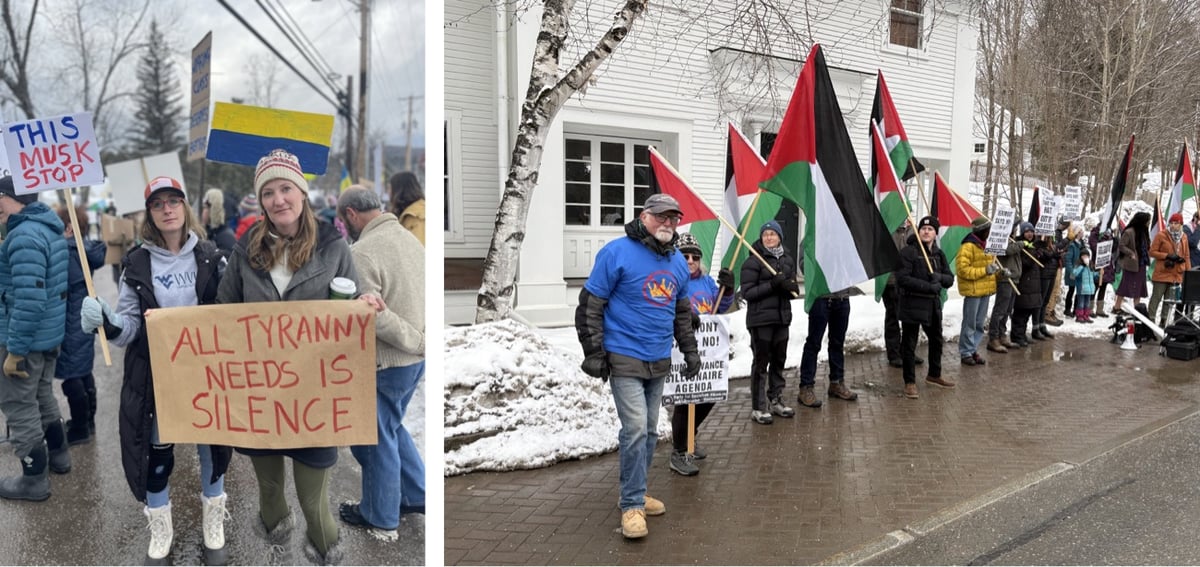
The rest of the towns around here and in the surrounding area have turned out for protests as well…some pics and video here, here, and here. There were some protesters spotted earlier on one of the Sugarbush webcams as well.
Update: There are a bunch of updates on the protests and links to photos and videos in the comments below. Two of the photos embedded above (HIT A TREE and the pride flag one) were taken at the protest yesterday by KDO field reporter Caroline. 🙏
Trump just kicked Ukrainian President Volodymyr Zelenskyy out of the White House after berating him for being “disrespectful” in the Oval Office.
The astonishing turn of events could scramble international affairs in Europe and around the globe. During his visit with Trump, Zelenskyy had planned to sign the deal allowing the U.S. greater access to Ukraine’s rare earth minerals, then hold a joint news conference.
Instead, Ukraine’s leader left the White House shortly after Trump shouted at him, showing open disdain. Untouched salad plates and other lunch items were being packed up outside the Cabinet room, where the lunch between Trump and Zelenskyy and their delegations was supposed to have taken place.
The White House said the Ukraine delegation was told to leave.
“You’re gambling with World War III, and what you’re doing is very disrespectful to the country, this country that’s backed you far more than a lot of people say they should have,” Trump told Zelenskky.
My god, Trump and Vance are just total fucking assholes. The US is openly aligning themselves with Russia against Ukraine and Europe, a major shift in international relations that dates back to the 1940s. I am so embarrassed to be an American right now.
Update: The NY Times has some key excerpts from the meeting in the White House.
Vance: And do you think that it’s respectful to come to the Oval Office of the United States of America and attack the administration that is trying to prevent the destruction of your country?
Zelensky: A lot of questions. Let’s start from the beginning.
Vance: Sure.
Zelensky: First of all, during the war, everybody has problems, even you. But you have nice ocean and don’t feel now, but you will feel it in the future.
Trump: You don’t know that.
Zelensky: God bless, you will not have a war.
Trump: Don’t tell us what we’re going to feel. We’re trying to solve a problem. Don’t tell us what we’re going to feel.
Zelensky: I’m not telling you.
Trump: Because you’re in no position to dictate that. Remember this: You’re in no position to dictate what we’re going to feel. We’re going to feel very good.
Zelenskyy’s English is obviously not super strong but Trump sounds like a 4-year-old in full “you’re not the boss of me” mode here. So glad he has control of America’s armed forces and nuclear arsenal!
This is excellent reporting by the Times (although at times it makes Musk’s actions sound heroic rather than unconstitutional, criminal, and treasonous) on how Elon Musk took over a huge chunk of the US government, which he still controls today. It began at a Republican fundraiser in September of 2023:
Mr. Musk made clear that he saw the gutting of that bureaucracy as primarily a technology challenge. He told the party of around 20 that when he overhauled Twitter, the social media company that he bought in 2022 and later renamed X, the key was gaining access to the company’s servers.
Wouldn’t it be great, Mr. Musk offered, if he could have access to the computers of the federal government?
Just give him the passwords, he said jocularly, and he would make the government fit and trim.
Musk, motivated by the Biden administration’s regulation of his companies, went to work:
Seasoned conservative operatives like Stephen Miller and Russell Vought helped educate Mr. Musk about the workings of the bureaucracy. Soon, he stumbled on an opening. It was a little-known unit with reach across the government: the U.S. Digital Service, which President Barack Obama created in 2014 after the botched rollout of healthcare.gov.
Mr. Musk and his advisers — including Steve Davis, a cost cutter who worked with him at X and other companies — did not want to create a commission, as past budget hawks had done. They wanted direct, insider access to government systems. They realized they could use the digital office, whose staff had been focused on helping agencies fix technology problems, to quickly penetrate the federal government — and then decipher how to break it apart.
They would call it the U.S. DOGE Service, and they would not even have to change the initials.
They began their move on the digital service unit earlier than has previously been reported, The Times found, while President Joseph R. Biden Jr. was still in office — giving them the ability to operate on Mr. Trump’s first day.
And now here we are, an unelected private citizen in charge of the US government:
The team is now moving faster than many of the legal efforts to stop it, making drastic changes that could be hard to unwind even if they are ultimately constrained by the courts. Mr. Musk’s associates have pushed out workers, ignored civil service protections, torn up contracts and effectively shuttered an entire agency established by Congress: the U.S. Agency for International Development.
A month into Mr. Trump’s second term, Mr. Musk and his crew of more than 40 now have about all the passwords they could ever need.
His swift success has been fueled by the president, who handed him the hazy assignment of remaking the federal government shortly after the billionaire endorsed him last summer. Flattered that Mr. Musk wanted to work with him, Mr. Trump gave him broad leeway to design a strategy and execute it, showing little interest in the details.
Read the rest of it for how it was all hurriedly planned out ahead of time.
The central point of Dr. Brooke Harrington’s essay about the destabilization of “basic systems we count on to make our society function” over the past month is bang on:
This promises to be a tough way for Americans to learn a critical fact too often overlooked: that one of our country’s greatest and least-appreciated assets has been public faith and trust in a variety of highly complex systems staffed by experts whose names we’ll never know. In fact, high levels of trust used to be one of our superpowers in the United States: specifically, that meant trust in our government to operate with reasonable competence and stability and without the kind of corruption that has hobbled other societies.
In this video, David Lynch talks about the effect of depression on creativity:
It stands to reason: the more you suffer, the less you want to create. If you’re truly depressed, they say you can’t even get out of bed, let alone create. It occupies the whole brain, poisons the artist, poisons the environment; little room for creativity.
But his assertion can be easily extended to how instability in one’s life leads to an inability to live fully. Stability and lack of corruption allows people to live their lives, make art, engage in commerce with each other, build families, and strive to be their best, authentic selves. The US has never been completely stable or uncorrupt, but we’re at real risk of losing something incredibly valuable here…and it’ll be difficult to get it back when it’s too far gone.
From David Wallace-Wells, a reminder that those who were considered alarmists at the beginning of the pandemic were ultimately proved right — it actually was an alarming situation.
Today, the official Covid death toll in the United States stands at 1.22 million. Excess mortality counts, which compare the total number of all-cause deaths to a projection of what they would have been without the pandemic, run a little higher — about 1.5 million.
In other words, the alarmists were closer to the truth than anyone else. That includes Anthony Fauci, who in March 2020 predicted 100,000 to 200,000 American deaths and was called hysterical for it. The same was true of the British scientist Neil Ferguson, whose Imperial College model suggested that the disease might ultimately infect more than 80 percent of Americans and kill 2.2 million of us. Thankfully, the country was vaccinated en masse long before 80 percent were infected…
I’m also going to point out that those who were labeled alarmists about the impact of Donald Trump’s presidencies were also “closer to the truth than anyone else”, certainly closer than all those centrist “pundits”. I’m particularly thinking of those who knew when they woke up on November 9th to a Trump victory that Roe v Wade was toast and that Americans’ civil rights would be taken away and were called “hysterical” (there’s that word again) for saying so.
Newer posts
Older posts





Socials & More