kottke.org posts about physics
Five quick physics lessons for President-Elect Obama from the author of Physics for Future Presidents (@ Amazon). One of the lessons: nuclear power is the way to go.
It’s true that after 300 years, nuclear waste is still about 100 times more radioactive than the original uranium that was removed from the earth. But even this isn’t as scary as it sounds. If the waste is stored underground in such a way that there’s only a 10 percent chance that 10 percent of it will leak — which should be more than doable — the risk will be no worse than if we had never mined the uranium in the first place.
Muller asserts that safe nuclear power is a solved technical problem and that the use of it is a political issue.
A list of 15 uses of tiny black holes, including hazardous waste disposal, cheap transport, and hanging posters without tacks.
It looks like black holes can grow to be as massive as 50 billion suns. How massive is that? It’s approximately 99 duodecillion kilograms….which is a 99 followed by 39 zeros. (Put another way, if you had 99 duodecillion dollars, you could buy as many PlayStation 3s as you wanted. Blows your mind, right?)
In a Swiss experiment, two entangled photons 18 km away from each other were able to communicate with each other almost instantaneously.
On the basis of their measurements, the team concluded that if the photons had communicated, they must have done so at least 100,000 times faster than the speed of light — something nearly all physicists thought would be impossible. In other words, these photons cannot know about each other through any sort of normal exchange of information.
Update: Hrm, the link above scampered behind Nature’s paywall. Here’s a post on the Scientific American blog instead.
A list of possible discoveries by the Large Hadron Collider and the probability of each discovery being made within the next five years.
The Higgs Boson: 95%. The Higgs is the only particle in the Standard Model of Particle Physics which hasn’t yet been detected, so it’s certainly a prime target for the LHC (if the Tevatron doesn’t sneak in and find it first). And it’s a boson, which improves CERN’s chances. There is almost a guarantee that the Higgs exists, or at least some sort of Higgs-like particle that plays that role; there is an electroweak symmetry, and it is broken by something, and that something should be associated with particle-like excitations. But there’s not really a guarantee that the LHC will find it. It should find it, at least in the simplest models; but the simplest models aren’t always right. If the LHC doesn’t find the Higgs in five years, it will place very strong constraints on model building, but I doubt that it will be too hard to come up with models that are still consistent.
The list also functions as a nice overview of what’s happening at the edges of our physics understanding. (via 3qd)
If physical theories were women.
Quantum mechanics is the girl you meet at the poetry reading. Everyone thinks she’s really interesting and people you don’t know are obsessed about her. You go out. It turns out that she’s pretty complicated and has some issues. Later, after you’ve broken up, you wonder if her aura of mystery is actually just confusion.
Would like to see the list for men as well. (via snarkmarket)
Physicists of the 20th Century on Banknotes (5 MB PDF), including Marie & Pierre Curie on a short-lived 500 franc note, Niels Bohr on a Danish 500 kroner note, and Nikola Tesla on several notes from Yugoslavia and Serbia. The author of the article is Steve Feller, physics professor at Coe College and my college advisor. Feller has a keen interest in numismatics and recently published a book about the money used in WWII camps.
Humans are consuming natural resources so quickly that we’re running out of elements.
The element gallium is in very short supply and the world may well run out of it in just a few years. Indium is threatened too, says Armin Reller, a materials chemist at Germany’s University of Augsburg. He estimates that our planet’s stock of indium will last no more than another decade. All the hafnium will be gone by 2017 also, and another twenty years will see the extinction of zinc. Even copper is an endangered item, since worldwide demand for it is likely to exceed available supplies by the end of the present century.
Many of the elements listed above are used in the construction of computer equipment and flat-panel TVs.
From Harvard Magazine, an appreciation of the work that the Hubble telescope has done since its 1990 launch into orbit.
The “Pillars of Creation” may be the most iconic Hubble photograph ever taken. “Located in the Eagle Nebula, the pillars are clouds of molecular hydrogen, light years in length, where new stars are being born,” says Aguilar. “However, recent discoveries indicate these pillars were destroyed by a massive nearby super nova some 6,000 years ago. This is a ghost image of a past cosmic disaster that we won’t see here on Earth for another thousand years or so-and a perfect example of the fact that everything we see in the universe is history.”
Is the universe fractal-like, even on large scales? A group of Italian and Russian scientists argue that it displays a fractal pattern on a scale of 100 million light years. Other scientists aren’t so sure.
Many cosmologists find fault with their analysis, largely because a fractal matter distribution out to such huge scales undermines the standard model of cosmology. According to the accepted story of cosmic evolution, there simply hasn’t been enough time since the big bang nearly 14 billion years ago for gravity to build up such large structures.
Here’s an update on the effort to solve the Pioneer anomaly, the unexplained deviation in motion of deep space probes from what Newton and Einstein’s theories predict.
As it sped through space, a specialist in radio-wave physics named John Anderson at NASA’s Jet Propulsion Laboratory noticed an odd thing. The spacecraft was drifting off course. The discrepancy was less than a few hundred-millionths of an inch per second for every second of spaceflight, accumulating year after year across billions of miles. Then Pioneer 11, an identical probe escaping the solar system in the opposite direction, also started to veer off course at the same rate.
Ordinarily, such small deviations might be overlooked, but not by Dr. Anderson. He monitored the trajectories six years before calling attention to the matter. “I’m a little like an accountant,” Dr. Anderson said. “We have Newton’s theory and Einstein’s theory, and when you apply them to something like this — and it doesn’t add up — it bothers me.”
The researchers, using data recovered from recently discovered Pioneer records and funded by sources outside of NASA, have figured out part of the problem but the rest remains a mystery.
I missed this earlier this week: physicist John Wheeler has died at the age of 96. A snippet from the NY Times obituary:
At the same time, he returned to the questions that had animated Einstein and Bohr, about the nature of reality as revealed by the strange laws of quantum mechanics. The cornerstone of that revolution was the uncertainty principle, propounded by Werner Heisenberg in 1927, which seemed to put fundamental limits on what could be known about nature, declaring, for example, that it was impossible, even in theory, to know both the velocity and the position of a subatomic particle. Knowing one destroyed the ability to measure the other. As a result, until observed, subatomic particles and events existed in a sort of cloud of possibility that Dr. Wheeler sometimes referred to as “a smoky dragon.”
This kind of thinking frustrated Einstein, who once asked Dr. Wheeler if the Moon was still there when nobody looked at it.
Wheeler recognized that physics is about ideas and the language used to express those ideas, not just mathematics and experimentation. He coined and popularized several phrases during his long career, including black hole, wormhole, and quantum foam.
The airplane on a conveyor belt question was just recently settled and we’re confronted with a related question: will a helicopter on a turntable take off? The image is short on details and likely a joke, but let’s assume that the turntable will match the speed of the helicopter’s rotor (and further that the rotor’s speed is measured relative to the helicopter and the turntable’s speed is relative to the ground, otherwise it doesn’t make much sense). Will the helicopter take off? Does it matter which way the turntable is spinning relative to the rotor? (thx, daniel)
I did embarrassingly bad on this Elements of the Periodic Table quiz. I blanked after naming 17 elements in 2 minutes. Oh, and xylophone is not an element! My physics degree should be retroactively unawarded. (via mouser)
A solar furnace is a structure used to harness the rays of the sun in order to produce high temperatures. This is achieved by using a curved mirror (or an array of mirrors) acting as a parabolic reflector to concentrate light (Insolation) on to a focal point. The temperature at the focal point may reach up to 3,000 degrees Celsius, and this heat can be used to generate electricity, melt steel or make hydrogen fuel.
Whoa! Here’s a great photo of a solar furnace in Uzbekistan and an even better photo of said furnace melting aluminum (close-up).

If you’ve got an old TV, you can use the Fresnel lens to make a solar furnace of your own. Caveats apply:
DANGER! This device is extremely dangerous. It should not be constructed or operated by anyone who does not observe proper safety precautions. It will instantly destroy flesh. It will melt metals, ceramics, and most any other material. Always wear welding goggles when operating this device! DO NOT leave this device unattended.
This DIY solar furnace is capable of melting brick (!!) and will “boil” a quarter in ~25 seconds.
Solar furnaces and the like have been around for centuries. In the 3rd century BC, Archimedes allegedly used a mirror to burn up the entire Roman fleet during the seige of Syracuse:
When Marcellus withdrew them [his ships] a bow-shot, the old man [Archimedes] constructed a kind of hexagonal mirror, and at an interval proportionate to the size of the mirror he set similar small mirrors with four edges, moved by links and by a form of hinge, and made it the centre of the sun’s beams—its noon-tide beam, whether in summer or in mid-winter. Afterwards, when the beams were reflected in the mirror, a fearful kindling of fire was raised in the ships, and at the distance of a bow-shot he turned them into ashes. In this way did the old man prevail over Marcellus with his weapons.
This assertion was tested at MIT and on Mythbusters with mixed results. (via delicious ghost)
NY Times columnist and economist Paul Krugman wrote a paper when he was an assistant professor in 1978 called The Theory of Interstellar Trade. Here’s the abstract:
This paper extends interplanetary trade theory to an interstellar setting. It is chiefly concerned with the following question: how should interest charges on goods in transit be computed when the goods travel at close to the speed of light? This is a problem because the time taken in transit will appear less to an observer travelling with the good than to a stationary observer. A solution is derived from economic theory, and two useless but true theorems are proved.
Why does the woman depicted in the Mona Lisa appear to be both smiling and not smiling at the same time? The smile part of the Mona Lisa’s face was painted by Leonardo in low spatial frequencies. This means that when you look right at her mouth, there’s no smile. But if you look at her eyes or elsewhere in the portrait, your peripheral vision picks up the smile. (via collision detection)
A series of four lectures on physics, specifically quantum electrodynamics, by Richard Feynman. Only Part 1 is available on Google Video and the rest are in streaming Real format (blech)…hopefully they too will make their way onto Google Video.
Update: Another lecture by Feynman, this one about Elementary Particles and the Laws of Physics.
Update: I got an email from the nice folks at Vega Science Trust asking me to change the wording of this entry with regard to encouraging people to put these copyrighted videos up on Google Video. Fair enough…what I really meant by that is I wish the videos were presented in a more useable manner than RealVideo format. If there’s one thing that YouTube has shown us more than anything, it’s that people find watching video in embedded Flash players really convenient.
Starting in about 40 minutes, I’ll be liveblogging the Mythbusters episode where they take on the infamous airplane on a conveyor belt problem. Updates will be reverse chronological (newest at the top) so don’t scroll down if you’re DVRing the episode for later viewing or otherwise don’t want anything spoiled.
Fair warning? Ok here we go.
10:32p I’ve turned comments on. Why not!!
10:04p
The plane took off so easily. The laws of physics are proven correct once again. But I’m not sure this is going to settle anything. I’m getting email as we speak that the test was unfair. Plane was too light. Tarp was pulled too slowly. Etc. But the thing is, it doesn’t matter how large the plane is…given enough runway and a strong enough conveyor belt, it will still take off. Ditto for the speed of the treadmill…it doesn’t matter how fast the treadmill is moving. It could be going 300 mph in the opposite direction and as long as the bearings in the plane’s wheels don’t melt, it’s gonna take off. (For an explanation, try this one by my friend Mouser, who has a MIT Ph.D in Physics Sc.D. in Nuclear Science and Engineering.)
9:58p

Update: Due to popular demand, the above graphic is available on a t-shirt at CafePress. Prices start at $18 and they’re available in men’s and women’s sizes.
9:58p
Heeeeeeeere we go.
9:56p
The pilot flying the ultralight is predicting that he won’t be able to take off.
9:55p
Orville Wright died 60 years ago today.
9:50p
Cockroach mini-myth: cockroaches would survive a nuclear blast longer than humans but there were other kinds of bugs that fared better. Another commercial.
9:47p
Back to the shaving cream in the car prank. Now they’re going to use A-B foam…they’re trying to fill all the space in the car and perhaps explode it. Totally worked.
9:44p
Expedia commercial. Nice synergistic placement. Good work, Discovery Channel’s ad sales team.
9:43p
Ok, to do the large-scale plane test, they’re using a 2000 foot tarp and a 400 pound ultralight. Tarp is pulled in one direction and the plane tries to take off in the other direction. The wind is picking up and blowing the tarp runway all over the place. They’re also having problems with punching holes in the tarp. They’re going to try again after we hear some more about radioactive cockroaches. Aaaand, another commercial.
9:36p
Second mini-myth: if you freeze a can of shaving cream, cut it open, and then put the foam in a car, it will heat and expand to fill the car. One can did almost nothing. 50 cans didn’t do too much either.
9:32p
Off to commercial again. Macbook Air ad. I don’t understand all the whining about how expensive and underpowered it is. You can’t get by with an 80 GB hard drive? Come on.
9:30p
Now a bit of explanation from the boys. (Things are moving faster now, which is welcome.) The thrust from the airplane acts upon the air so it doesn’t matter too much what the runway is doing to the plane’s wheels. And then back to the roach thing. They irradiated them (and some other bugs) and most of the roaches died. Still pending…
9:25p
Ok, they’re dragging paper behind a Segway and trying to take off with the model airplane in the opposite direction. IT JUST TOOK OFF.
9:19p
Back to the roach thing. More recapping and a little bit more setup. I don’t see how people can watch this show…it’s sooooo slooooow. And now another commercial break. Hello picture-in-picture.
9:18p
As expected, the model airplane “flew” off the end of the exercise treadmill. It didn’t have enough room to take off, but if it stayed straight, it probably would have.
9:14p
First recap…they took a solid minute to explain what they’ve already done. Ugh.
9:13p
Going into the first commercial, we’ve caught a glimpse of how they’re going to test the main myth. They’re going to drag a huge plastic sheet long the ground and have the plane sit on the plastic and being going the other way attempting to take off. A reasonable substitute for the treadmill.
9:08p
They’re starting off small with a model airplane on an exercise treadmill. They’re showing the two hosts learning how to fly the tiny airplane. One of them is riding around on a Segway. Oh, and they’re also doing two other mini-myths during the episode. They just switched gears to the first mini-myth: can a cockroach survive a nuclear blast?
9:04p
And we’re off. They’re calling it “the moment we’ve all been waiting for”. My guess: the plane will take off.
8:58p
I’ve only watched one other episode of Mythbusters before today. I found the show to be a little slow and very repetitive; 8 minutes of material stretched into 45 minutes of show. Unfortunately, this practice seems to be common among science programs on television.
8:40p
Watching Family Guy as a warmup. The one with the nudist family. Good stuff.
8:22p
Preemptive answer for the inevitable “Do you realize how boring/stupid/goofy it is to liveblog this?” Most definitely.
For real this time: Mythbusters will air their challenge of the airplane on a conveyor belt puzzle this Wednesday at 9pm ET. (thx, darin)
Absolute Zero looks like an interesting show on cold temperatures, airing on PBS in mid-January. For the Long Zoom fans out there, don’t miss the Sense of Scale widget.
The closure, it draws near. Remember the epic thread about the plane and the conveyor belt from last year…the one that pitted pilot against physicist against random internet commenter? In an upcoming episode of Mythbusters, they’re going to air the results of a test they conducted with an ultralight and a quarter-mile-long conveyor belt:
If a plane is traveling at takeoff speed on a conveyor belt, and that conveyor belt is matching the speed in reverse, can the plane take off? “We put the plane on a quarter-mile conveyor belt and tested it out,” says Savage about the experiment using a pilot and his Ultralight plane. “I won’t tell you what the outcome was, but the pilot and his entire flight club got it wrong.”
Awesome. If the laws of physics hold, that plane should take off. (thx, matt)
Question of the day:
You are shrunk to the height of a nickel and your mass is proportionally reduced so as to maintain your original density. You are then thrown into an empty glass blender. The blades will start moving in 60 seconds. What do you do?
The obvious answer is “die”, but I don’t think that’s they’re after here. I have an idea…but what say you?
Why does your shower curtain do that thing where it blows into you while you’re showering? David Schmidt did some fluid-flow modeling and found that the spray creates a vortex (basically a low pressure region) which sucks the curtain in. (via cyn-c)
Is the search for aliens such a good idea? If/when we find evidence of extraterrestrial intelligent life, will they welcome us as neighbors, treat us as vermin in their universe or something inbetween? “Jared Diamond, professor of evolutionary biology and Pulitzer Prize winner, says: ‘Those astronomers now preparing again to beam radio signals out to hoped-for extraterrestrials are naive, even dangerous.’”
An illustration of how insanely effective water is at absorbing heat: you can hold a water balloon over a candle without popping it. The rest of Robert Krampf’s videos are worth a look as well.
Temporal anomalies in time travel movies, an investigation of how time travel is represented in movies like Donnie Darko, 12 Monkeys, and Back to the Future. (via joshua)
Are there many small galaxies, like the one just discovered just outside our own, orbiting the larger visible galaxies?
Embiggen, the fauxcabulary word created for an episode of The Simpsons, has found its way into string theory. Here’s the usage from a recently published paper on Gauge/gravity duality and meta-stable dynamical supersymmetry breaking:
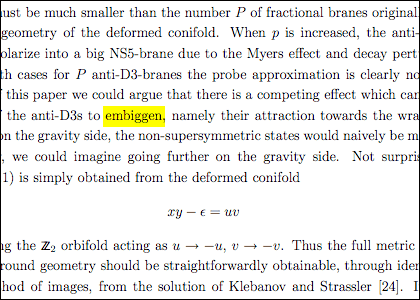
Here’s the original quote from The Simpsons episode, Lisa the Iconoclast:
A noble spirit embiggens the smallest man.
The uses are probably not related, but you never know.
Newer posts
Older posts





Socials & More