kottke.org posts about photography
Andy Baio interviews Alan Taylor, the fellow behind The Big Picture, the journalistic photo blog that’s taken the web by storm.
Internally, externally, everywhere, people are being really thankful to me. I need to make sure (with some link-love in my upcoming blogroll) that the response gets directed to the photographers as well. I’m just a web developer with access to their photos and a blog - they’re the ones out there working hard to get these amazing images. “Photographers” here is a loose term, encompassing photojournalists, stringers, amateurs, scientific imaging teams and more.
For its July 2008 issue, Vogue Italia is featuring only black models and feature articles about black women in arts and entertainment.
Having worked at one time with nearly all the models he chose for the black issue — Iman, [Naomi] Campbell, Tyra Banks, Jourdan Dunn, [Liya] Kebede, [Alek] Wek, Pat Cleveland, Karen Alexander — [photographer Steven] Meisel had his own feelings. “I thought, it’s ridiculous, this discrimination,” said Mr. Meisel, speaking by phone from his home in Los Angeles. “It’s so crazy to live in such a narrow, narrow place. Age, weight, sexuality, race — every kind of prejudice.”
Here’s a slideshow of some of the images from the magazine. As I’ve said before, Vogue Italia is doing some interesting things with the editorial nature of the magazine’s photography (see State of Emergency and Super Mods Enter Rehab, both by Steven Meisel).
1. Perhaps the most playful art I’ve ever seen in a major museum is Olafur Eliasson’s Ventilator, a fan hung on a long cord in the main atrium in the museum. Watching it blow around the huge room, chased by children, is hard-to-beat fun.
[Dead Flash embed of http://www.flickr.com/apps/video/stewart.swf?v=49235]
2. The rest of Eliasson’s show on the third floor. His art seems so conceptually and constructurally simple yet, I dunno, I just wanted to hang out in the gallery all day, like I was required to remain part of the experience. Left me wishing I’d made it to London to see The Weather Project.
3. The typology photos of Bernd and Hilla Becher. Recommended if you like photography and multiples of things.
Irritated that I missed: van Gogh’s Starry Night (out on loan to Yale until Sept…I’ve seen it 20 times at least but still like checking it out whenever I’m there), the exhibition of George Lois’ Esquire covers, and lunch at Cafe 2.
I have to hold off linking to every single entry on Big Picture (best new blog of the year so far, hands down), but these photos of the flooding in Iowa are amazing. I went to college in Cedar Rapids and my mind is boggled seeing so much of downtown under so much water.
Photos of singing/talking stuffed animals, dressed and undressed.
I’ve always been curious about stuffed animals that sing, dance, light up, or talk back. There must be a fascinating robot underneath the fur and fluff, right? Surely the robot hiding in the bear’s clothing, vestimentis ursum, is impressive. So: armed with my childish curiousity and the spurious excuse of ‘product design research,’ I set out to discover what, exactly, these creatures are hiding.
(thx, janelle)
Photographer Sam Haskins, well known for doing in-camera montage, briefly describes how composite photos were made in the time before Photoshop.
Its a single exposure with the model viewed through optical glass at 45° and the fabric positioned to the side. At the time there was zero retouching after the event. Now of course I have the luxury of scanning the transparency to clean and refine the image in Photoshop - God bless its digital socks.
It’s been hot in NYC for the past few days, but I don’t know if it was ice-lickin’ hot.
In July 1968, a train delivered the body of Robert Kennedy from NYC to Washington D.C. so that he could be buried in Arlington National Cemetery next to his brother. Photographer Paul Fusco was on that train and shot a bunch of photos of the hundreds of thousands of people that spontaneously turned up along the train route to mourn Kennedy, photos that were recently rediscovered. Fusco narrates a slideshow of the photos.
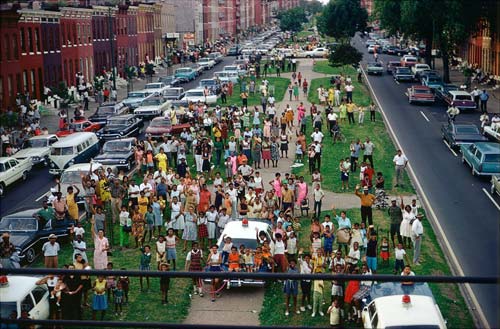
The amazing photos will be on display at Danziger Projects from June 6 - July 31…Danziger has more about the photos — which he calls “my favorite body of work in photography” — on his blog.
I’ll let the pictures speak for themselves, but I’ll also tell you the only area where Paul and I disagreed. For Paul, the event and the photographs represented the end of hope. To me they represent the indomitability of the American spirit.
Either way, the photos are powerful but also show the ordinary American-ness of that time period.
Big Picture is a fantastic and dead-simple new site from boston.com. Each entry tells a story through high-quality newswire images displayed at large sizes; recent entries include a look at Saturn from the Cassini space probe and the daily lives of soldiers in Afghanistan. If you’re frustrated by the tiny news imagery we get spoon-fed to us on the web, this site will be a welcome addition to your daily browse. Alan Taylor, the project’s instigator, has a post on his blog about Big Picture.
The sizes of the photographs are deliberately large - taking advantage of the majority of web users who have screens capable of displaying 1024x768 or larger. The long-held tradition of keeping images online tiny and lightweight is commendable still - when designing a general purpose site. But one dedicated to quality imagery should take full advantage of the medium, and I hope I’ve struck a good balance with The Big Picture.
When I see quality photography consigned to the archives, or when I see bandwidth readily given up to video streams of dubious quality, or when I see photo galleries that act as ad farms, punishing viewers into a click-click-click experience just to drive page views - those times are the times I’m glad I was able to get this project off the ground (many thanks to my friends within boston.com)
Photos of pajamas as outerwear in Shanghai.
The prevalence of pyjamas, Guariglia explained to me, was due to both the extreme summer heat and the lack of plumbing. Most Shanghaians share outdoor communal toilets and thus the boundaries of what was considered one’s home have expanded past people’s houses to the public bathrooms. Once that relaxation of the dress code became acceptable (starting around the 1980s) the perimeter for p.j.-wear just kept expanding until many people were wearing them day in day out.
Newer posts
Older posts





Socials & More