kottke.org posts about photography
You’ve likely seen Dennis Darzacq’s photos of people who look like they’re falling and about to hit the ground at a high velocity. Lens Culture has a video that shows how Darzacq makes those photos; he plays a clever mind trick on viewers that makes jumping look like falling.
Everything had been prepared in advance. Everything was ready. The models launched themselves into space. There is nothing false in these scenes. These moments really occurred. There is no fiction, no retouching or special effects. Photographed in the courtyards of buildings or in streets in the 19th arrondissement of Paris, in Nanterre and in Biarritz, these young people were just being themselves, simply performing jumps in a modern urban setting. And the photographer shot the images, intervening only to give a few guidelines as to their movements. However, at the moment of the leap, chance and gravity also intervened.
It’s been awhile since I’ve checked in on Nick Veasey’s work. Veasey takes x-ray photos of all sorts of items, from feathers to pens to underwear to people to entire buses. Well worth poking around.
André Zucca’s color photographs of Paris during the German occupation of WWII have provoked controversy because Zucca worked for a German propaganda magazine. But Richard Brody argues that Zucca’s photographs are true to the Paris of the time and don’t just show the “cheerful ease” of the city’s residents.
Certainly, Zucca couldn’t get the whole story: he photographed Jews wearing the star but couldn’t show the roundups or the deportation to Auschwitz; he could show German soldiers but couldn’t show the arrest, torture, and execution of resisters. He couldn’t, but nobody could; the problem wasn’t that he worked for a propaganda rag: photographers who actively worked for the Resistance couldn’t do it either. But what he did do was to capture the paradoxes of the Occupation, where horror and pleasure coexisted in shockingly close proximity, where the active resistance to Nazi occupation was in fact far less prevalent than the feigned daily oblivion of those who kept their heads down and tried to cope.
More of Zucca’s photos are here.
A photo gallery of snack foods that sound a bit naughty. Salted Nut Roll, Dutch Crunch, Double Creme Betweens, etc. (via buzzfeed)
For the past two years, photographer Rachel Barrett has been documenting NYC’s vanishing newsstands as the city replaces them in favor of more modern kiosks. Here’s a slideshow.
Until recently, newsstand operators owned their stands and paid the city $1,000 for two-year licenses. In 2003, the city enacted Local Law 64, which required owners to give up their stands but allowed them to operate city-owned structures at no cost. In 2006, the city signed a contract with the Spanish conglomerate Cemusa to build 3,300 bus shelters, 300 newsstands and 20 public toilets.
More photos are available on Barrett’s web site. One of these new stand just went up by my office and has all the personality of a block of concrete. The new stands are also super tall so that the cashier towers over the customer, creating a weird impersonal dynamic and, for those of below average height, a need to stretch to hand your money over.
Dustin Humphrey’s surfing/underwater photography is difficult to explain. Pro surfers + underwater naked steampunk maybe? NSFW. (via avenues)
The Image Fulgurator is an ingenious device that detects the flash from nearby cameras and quickly inserts a message onto whatever is being photographed so that it shows up in any photos being taken.
It operates via a kind of reactive flash projection that enables an image to be projected on an object exactly at the moment when someone else is photographing it. The intervention is unobtrusive because it takes only a few milliseconds. Every photo another photographer takes of an object at which the Fulgurator is also aimed is affected by the manipulation. Hence visual information can be smuggled unnoticed into the images of others.
Check out the results. (thx, red)
I’m fascinated by early color photography…it takes a time we think of being in black & white and makes it accessible and modern. In the hands of Auguste and Louis Lumière, the “lowly, lumpy potato” made color photography possible in the early 1900s. The photos were called autochromes.
The Lumière brothers gathered up their potatoes and ground them into thousands of microscopic particles; they separated this powder into three batches, dying one batch red-orange, one violet and one green; the colored particles were thoroughly mixed and sifted onto a freshly varnished, clear glass plate while the lacquer remained tacky; excess potato bits were swept from the plate, which was pressed through steel rollers to flatten the colored grains, transforming each into a minuscule color filter measuring from .0006 to .0025 millimeters across. Gaps between the colored particles were filled in with carbon black, the plate was varnished again and a thin, light-sensitive emulsion of silver bromide was brushed over that. Now the plate was ready for the camera. When the shutter was opened, light filtered through the translucent potato grains, and a multicolored image was imprinted on the emulsion. After the negative plate was developed in the lab, it was washed and dried, covered with another piece of glass to protect the emulsion and bound with gummed tape. Et voilà! A color photograph unlike any seen before.
Here’s a slideshow of some photos taken by this process. Here’s some autochromes of Mark Twain from 1908.
More early color photography (not necessarily autochromes): Sergei Mikhailovich Prokudin-Gorskii’s stunning photographs of Russia circa 1909-1915, photos of WWI, photos of WWII, and photos of America in the late 30s/early 40s (color corrected). (thx, david)
I’ve not been paying enough attention to Bill Cunningham’s street fashion photography slideshows. Each week, Cunningham goes out on the streets of NYC to find out what people are wearing. Even better than the photos are his enthusiastic descriptions of what he’s found.
This week he looks at women’s handbags, which he calls “the engine carrying the fashion world”. Cunningham finds that bags are growing almost “cartoonishly large” and discovers a unique glove/bag combo. Last week, he looked at the glittery belts that some men are wearing with their saggy jeans. If this was the type of fashion that filled the pages of Vogue, I would subscribe in a second. (thx, alaina)
Update: Cunningham’s video journals are now available on YouTube for easy watching/embedding.
Of all the things that Flickr has done, The Commons project might be the most significant. If, in two years, there are tens or even hundreds of thousands of old photographs previously unavailable to the general public from collections all over the world — all tagged, geocoded, annotated, contextualized, and available to anyone with a web browser — that would be an amazing resource for exploring our recent history.
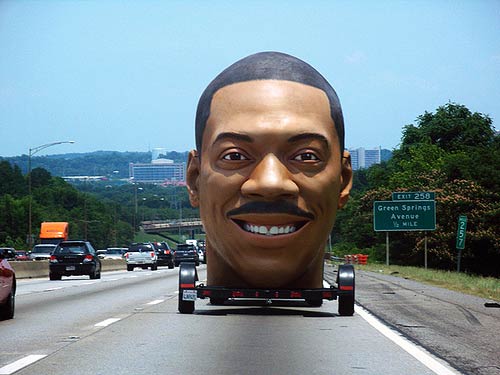
Daniel Barron makes photographs of things that look human but aren’t. Maybe. Sorta. I don’t really know! Can you tell? (via that’s a negative)
Here is today’s dose of surreality.
The iconic photo from 1978 of Microsoft’s founders and early employees has been reshot.
Present for the reunion was office manager Miriam Lubow (center of new picture), who missed the original sitting due to a snowstorm. (When Lubow, now retired, first met Gates, she couldn’t believe that disheveled kid was the president.) Absent for the reshoot was Bob Wallace (top center), who died in 2002; after leaving Microsoft in 1983, he pioneered the idea of shareware.
They should submit this to Ze Frank’s Youngme/Nowme.
Newer posts
Older posts


Socials & More