For his Faces of Evil project, Hans Weishäupl made composite photographs of the world’s worst dictators by photographing hundreds of people in each dictator’s country and stitching them together. The results are a bit disturbing, particularly when viewing very large, clear, vibrant color photos of long-dead monsters like Stalin or Hitler. (via conscientious)
The Natural History Museum in NYC has put a collection of historical photos online, including some fantastic images of the construction of some of their famous displays and dioramas. Pruned pulled out a few of the best for a recent post.
During the first decades of the 20th century, the AMNH posed its T. rex bones in an upright position, propped on its tail. Skeletons were broken, some bent and others removed altogether so that it looked like the “marauding predator” people thought they were. And also so that it didn’t look too diminutive in the large exhibition hall. Natural history as a function of architecture: it had to reach high up to the ceiling, fill up all that space, loom large over the crowds.
In order to create art for the 10,000-year Clock chamber, Edward Burtynsky has been investigating how to make photographic prints that last a long time.
Burtynsky went on a quest for a technical solution. He thought that automobile paint, which holds up to harsh sunlight, might work if it could be run through an inkjet printer, but that didn’t work out. Then he came across a process first discovered in 1855, called “carbon transfer print.” It uses magenta, cyan, and yellow inks made of ground stone-the magenta stone can only be found in one mine in Germany-and the black ink is carbon.
On the stage Burtynsky showed a large carbon transfer print of one of his ultra-high resolution photographs. The color and detail were perfect. Accelerated studies show that the print could hang in someone’s living room for 500 years and show no loss of quality. Kept in the Clock’s mountain in archival conditions it would remain unchanged for 10,000 years.
A year after her husband died, photographer Hilla Becher was interviewed by a German magazine about her work and her husband.
SZ: Why was your husband not interested in such photos?
HB: He rejected them because he was not interested in taking them. Actually, he was never interested in photography.
SZ: That is an unusual statement about a man who spent his whole life on it.
HB: Originally, Bernd did sketches. In the beginning, he sketched industrial landscapes. But he never managed to finish his work, because he was so precise. Often the object was demolished right in front of his eyes, back then heavy industry in the Siegerland was being abandoned for good. The demolishing, the decay happened faster than he could sketch it.
SZ: So then he took photos?
HB: Right. He borrowed a 35mm camera and took photos, to use them for his sketches. That’s how it started, photography as the means to an end.
The Bechers worked tirelessly to photograph all kinds of industrial machinery.
Photos and descriptions of some of the world’s neatest ghost towns. I’ve seen many of these elsewhere but hadn’t heard of this village in France before.
The small village of Oradour-sur-Glane, France, is the setting of unspeakable horror. During World War II, 642 residents were massacred by German soldiers as punishment for the French Resistance. The Germans had initially intended to target nearby Oradour-sur-Vayres and mistakenly invaded Oradour-sur-Glane on June 10th 1944. According to a survivor’s account, the men were herded into barns where they were shot in the legs so they would die more slowly. The women and children, who had been held in a church, all perished when their attempt to escape was met by machine-gun fire. The village was razed by the Germans afterward. Its ruins still stand today as a memorial to the dead and a reminder of the events that took place.
Seed Magazine has posted Noah Kalina’s photos of science labs at night. The Salk Institute is represented of course.
A collection of photos of things from around the world that cost $5.
To explore the relative value of five dollars we are collecting examples from around the world by asking people to submit photos of objects or services that cost the equivalent of $5.
(via clusterflock)
Photos of Mike Tyson’s abandoned mansion. What an odd house. Half of it is bathrooms & an indoor pool and looks like it was designed by Homer Simpson.
From what I can gather from these portraits, librarians are white, bearded if male, and have glasses.
On May 1, 1947, Evelyn McHale leapt to her death from the observation deck of the Empire State Building. Photographer Robert Wiles took a photo of McHale a few minutes after her death.
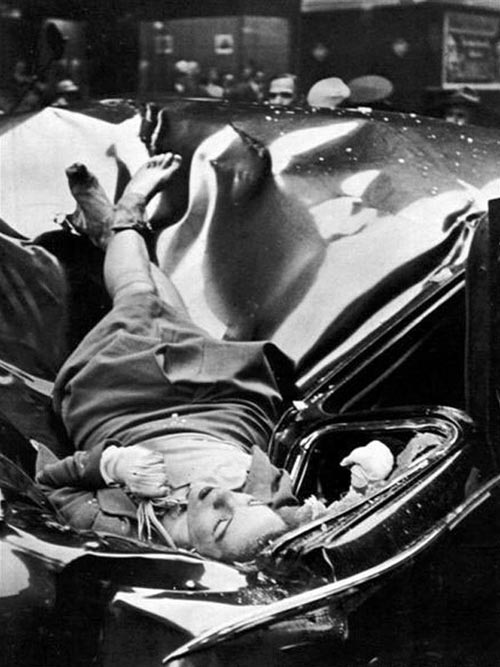
The photo ran a couple of weeks later in Life magazine accompanied by the following caption:
On May Day, just after leaving her fiancé, 23-year-old Evelyn McHale wrote a note. ‘He is much better off without me … I wouldn’t make a good wife for anybody,’ … Then she crossed it out. She went to the observation platform of the Empire State Building. Through the mist she gazed at the street, 86 floors below. Then she jumped. In her desperate determination she leaped clear of the setbacks and hit a United Nations limousine parked at the curb. Across the street photography student Robert Wiles heard an explosive crash. Just four minutes after Evelyn McHale’s death Wiles got this picture of death’s violence and its composure.
From McHale’s NY Times obituary, Empire State Ends Life of Girl, 20:
At 10:40 A. M., Patrolman John Morrissey of Traffic C, directing traffic at Thirty-fourth Street and Fifth Avenue, noticed a swirling white scarf floating down from the upper floors of the Empire State. A moment later he heard a crash that sounded like an explosion. He saw a crowd converge in Thirty-third Street.
Two hundred feet west of Fifth Avenue, Miss McHale’s body landed atop the car. The impact stove in the metal roof and shattered the car’s windows. The driver was in a near-by drug store, thereby escaping death or serious injury.
On the observation deck, Detective Frank Murray of the West Thirtieth Street station, found Miss McHale’s gray cloth coat, her pocketbook with several dollars and the note, and a make-up kit filled with family pictures.
The serenity of McHale’s body amidst the crumpled wreckage it caused is astounding. Years later, Andy Warhol appropriated Wiles’ photography for a print called Suicide (Fallen Body), but I can’t find a copy of it anywhere online. Anyone?
Update: A not-so-great representation of Warhol’s version of this photograph is available at Google Books. (thx, ruben)
Update: Here’s a better photo of Warhol’s print. (thx, lots of people)
Update: Here’s the page as it appeared in Life Magazine.
Update: Codex 99 did some research on McHale and her activities on the day she died.
The sales of stock photographs can tell you a surprising amount about what’s going on in the world but they can’t predict the future.
“We had a bad day when Dolly was cloned,” says Denise Waggoner, vice president of creative research at Getty. “We hadn’t been studying biotechnology, and suddenly everyone wanted a shot of 25 sheep on a seamless white background. So now we try to keep our toes dipped in the water in lots of different fields, so we can be ready.”
An amazing collection of abstract satellite photos, demonstrating the “impressionist, cubist and pointillist” side of the earth’s landscape.
The images you see below were taken at the turn of the Millennium, when NASA’s scientists had a brilliant idea: to scan through 400,000 images taken by the Landsat 7 satellite and display only the most the most beautiful. A handful of the best were painstakingly chosen and then displayed at the Library of Congress in 2000.
You must see these. Bonus: all the images are available in wallpaper size for your computer desktop.




Socials & More