kottke.org posts about photography
Martin Becka and Cedric Delsaux are a pair of photographers who feature Burj Dubai in their work. Becka’s Burj comes from his Dubai, Transmutations project in which he uses the photogravure processing technique to make images of brand-new Dubai that look as though they were taken in 1880.
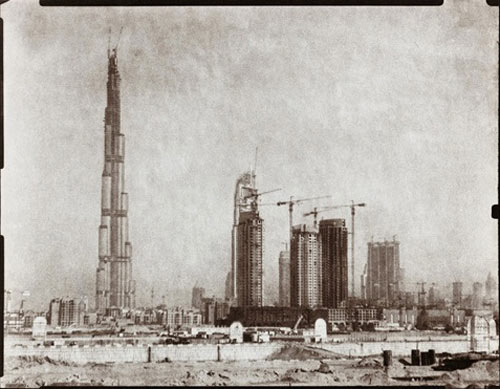
Delsaux’s Burj image comes from a project called The Dark Lens, which features images of Star Wars characters populating the circa-2008 Earth. I believe that’s the Millennium Falcon docking at the Burj:
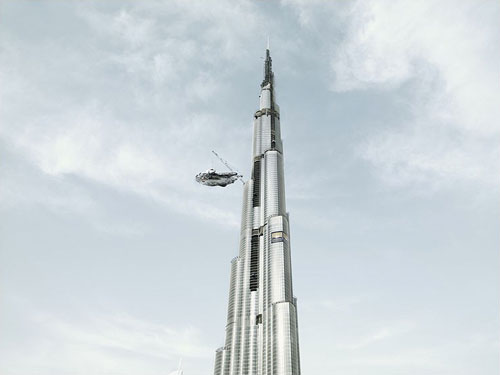
Many more of The Dark Lens images are available on Delsaux’s site.
A 1970 interview with photographer Garry Winogrand on how he’s not trying to say anything with his work. Instead, he sets up photographic challenges for himself, which he then attempts to solve.
My only interest in photographing is photography.
Upcoming at MoMA: a retrospective of the work of Henri Cartier-Bresson.
For more than twenty-five years, he was the keenest observer of the global theater of human affairs — and one of the great portraitists of the twentieth century. MoMA’s retrospective, the first in the United States in three decades, surveys Cartier-Bresson’s entire career, with a presentation of about three hundred photographs, mostly arranged thematically and supplemented with periodicals and books.
After MoMA, the exhibition will visit Chicago, SF, and Atlanta. Quite excited for this one.
Those wildly colorful Hubble telescope photos…how do they get them to look like that?
The colors in Hubble images, which are assigned for various reasons, aren’t always what we’d see if we were able to visit the imaged objects in a spacecraft. We often use color as a tool, whether it is to enhance an object’s detail or to visualize what ordinarily could never be seen by the human eye.
See also this informative Reddit thread.

Well, not so much The Beatles as The Quarrymen, a band formed by John Lennon and some schoolmates that was the precursor to The Beatles. (via @brainpicker)
Vincent Fournier has made a series of photos of astronauts training and of the interiors of the Chinese, Russian and US space agencies.
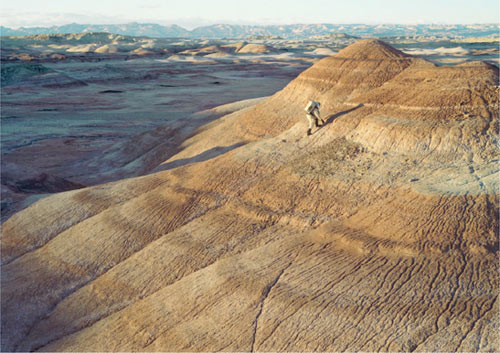
Looks alien, doesn’t it?

American Pixels is a project by Joerg Colberg that uses jpeg compression algorithms to create compelling images. From the technical notes:
ajpeg is a new image compression algorithm where the focus is not on making its compression efficient but, rather, on making its result interesting. As computer technology has evolved to make artificial images look ever more real - so that the latest generation of shooter and war games will look as realistic as possible - ajpeg is intended to go the opposite way: Instead of creating an image artificially with the intent of making it look as photo-realistic as possible, it takes an image captured from life and transforms it into something that looks real and not real at the same time.
Rachel Loshak is posting two photos a day on her A Year in the Day - 2010 blog; one taken in 2000 and one taken in 2010. The juxtaposition, as they say in the art world, is interesting. (via @ironicsans)
Ryan (the intern) from The Office has a photo blog.
Yes, acceptance is a theme of this photo, as well as all my photos; even the photos I take that capture isolationism have a theme of acceptance, a lack of acceptance. It is the ultimate compliment that this photo not only captured my soul, but yours as well.
The apartment that American writer William S. Burroughs inhabited while he lived in New York has been preserved since his death in 1997. Photographer Peter Ross took some photos of some of the contents, including a worn pair of shoes, some nunchucks, and a book called Medical Implications of Karate Blows.
Well, I bet I’ll go through half a dozen iPhones in the time it would have taken Burroughs to resole those shoes. That makes me feel greedy, wasteful, and self-indulgent. Maybe I’d be better off keeping the modern world out. Maybe we all would. Let’s all just grab our nunchucks, put on our shoes and hat and walk the streets of Manhattan.
Photographer Noah Sheldon took a series of photos of Biosphere 2 in Arizona. BLDGBLOG has more info.
The largest sealed environment ever created, constructed at a cost of $200 million, and now falling somewhere between David Gissen’s idea of subnature — wherein the slow power of vegetative life is unleashed “as a transgressive animated force against buildings” — and a bioclimatically inspired Dubai, Biosphere 2 even included its own one million-gallon artificial sea.
Images from Paris cafes and nightlife in 1962, the same week Yves St. Laurent’s runway show vaulted Dior to new heights. Many scenes around Les Halles (which no longer exists as it did then).
From the collection, a photo of some Les Halles butchers enjoying a drink at Au Pied de Cochon:
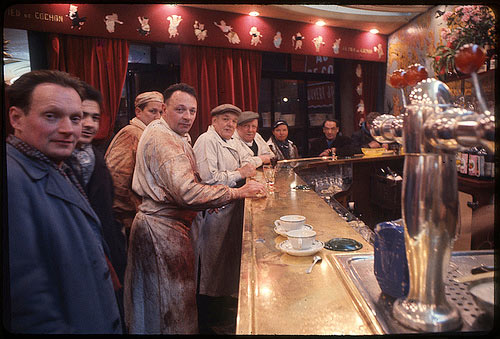
Update: As Wikipedia notes, Saint Laurent’s fabled show took place in 1958; Dior was gone from Dior by ‘62. Not sure whether the caption is wrong or the photos are really from 1958. (thx, alex)
In 1944, Popular Photography magazine asked several people, including photographers Berenice Abbott and László Moholy-Nagy, to speculate about the future of photography.
Their opinions differ. Yet somehow all seem to feel that the second hundred years will see the camera put to use as never before with the amateur often leading the way.
One of the better lists out there: the top astronomy photos of the year. From the list, this is a more detailed view of the Martian landscape than we’re used to seeing:
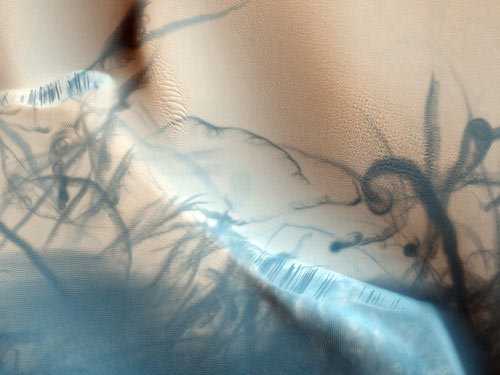
My personal favorite, the photos taken by the LRO of Apollo 11’s landing site, made the list as well.
Newer posts
Older posts



Socials & More