The Image Fulgurator is an ingenious device that detects the flash from nearby cameras and quickly inserts a message onto whatever is being photographed so that it shows up in any photos being taken.
It operates via a kind of reactive flash projection that enables an image to be projected on an object exactly at the moment when someone else is photographing it. The intervention is unobtrusive because it takes only a few milliseconds. Every photo another photographer takes of an object at which the Fulgurator is also aimed is affected by the manipulation. Hence visual information can be smuggled unnoticed into the images of others.
I’m fascinated by early color photography…it takes a time we think of being in black & white and makes it accessible and modern. In the hands of Auguste and Louis Lumière, the “lowly, lumpy potato” made color photography possible in the early 1900s. The photos were called autochromes.
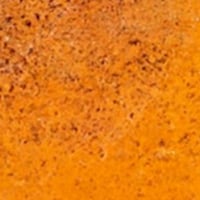
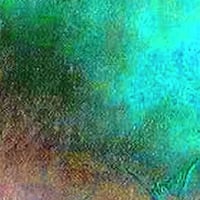
The Lumière brothers gathered up their potatoes and ground them into thousands of microscopic particles; they separated this powder into three batches, dying one batch red-orange, one violet and one green; the colored particles were thoroughly mixed and sifted onto a freshly varnished, clear glass plate while the lacquer remained tacky; excess potato bits were swept from the plate, which was pressed through steel rollers to flatten the colored grains, transforming each into a minuscule color filter measuring from .0006 to .0025 millimeters across. Gaps between the colored particles were filled in with carbon black, the plate was varnished again and a thin, light-sensitive emulsion of silver bromide was brushed over that. Now the plate was ready for the camera. When the shutter was opened, light filtered through the translucent potato grains, and a multicolored image was imprinted on the emulsion. After the negative plate was developed in the lab, it was washed and dried, covered with another piece of glass to protect the emulsion and bound with gummed tape. Et voilà! A color photograph unlike any seen before.
I’ve not been paying enough attention to Bill Cunningham’s street fashion photography slideshows. Each week, Cunningham goes out on the streets of NYC to find out what people are wearing. Even better than the photos are his enthusiastic descriptions of what he’s found.
Of all the things that Flickr has done, The Commons project might be the most significant. If, in two years, there are tens or even hundreds of thousands of old photographs previously unavailable to the general public from collections all over the world — all tagged, geocoded, annotated, contextualized, and available to anyone with a web browser — that would be an amazing resource for exploring our recent history.
Present for the reunion was office manager Miriam Lubow (center of new picture), who missed the original sitting due to a snowstorm. (When Lubow, now retired, first met Gates, she couldn’t believe that disheveled kid was the president.) Absent for the reshoot was Bob Wallace (top center), who died in 2002; after leaving Microsoft in 1983, he pioneered the idea of shareware.
Internally, externally, everywhere, people are being really thankful to me. I need to make sure (with some link-love in my upcoming blogroll) that the response gets directed to the photographers as well. I’m just a web developer with access to their photos and a blog - they’re the ones out there working hard to get these amazing images. “Photographers” here is a loose term, encompassing photojournalists, stringers, amateurs, scientific imaging teams and more.
For its July 2008 issue, Vogue Italia is featuring only black models and feature articles about black women in arts and entertainment.
Having worked at one time with nearly all the models he chose for the black issue — Iman, [Naomi] Campbell, Tyra Banks, Jourdan Dunn, [Liya] Kebede, [Alek] Wek, Pat Cleveland, Karen Alexander — [photographer Steven] Meisel had his own feelings. “I thought, it’s ridiculous, this discrimination,” said Mr. Meisel, speaking by phone from his home in Los Angeles. “It’s so crazy to live in such a narrow, narrow place. Age, weight, sexuality, race — every kind of prejudice.”
2. The rest of Eliasson’s show on the third floor. His art seems so conceptually and constructurally simple yet, I dunno, I just wanted to hang out in the gallery all day, like I was required to remain part of the experience. Left me wishing I’d made it to London to see The Weather Project.
I have to hold off linking to every single entry on Big Picture (best new blog of the year so far, hands down), but these photos of the flooding in Iowa are amazing. I went to college in Cedar Rapids and my mind is boggled seeing so much of downtown under so much water.
I’ve always been curious about stuffed animals that sing, dance, light up, or talk back. There must be a fascinating robot underneath the fur and fluff, right? Surely the robot hiding in the bear’s clothing, vestimentis ursum, is impressive. So: armed with my childish curiousity and the spurious excuse of ‘product design research,’ I set out to discover what, exactly, these creatures are hiding.
Its a single exposure with the model viewed through optical glass at 45° and the fabric positioned to the side. At the time there was zero retouching after the event. Now of course I have the luxury of scanning the transparency to clean and refine the image in Photoshop - God bless its digital socks.
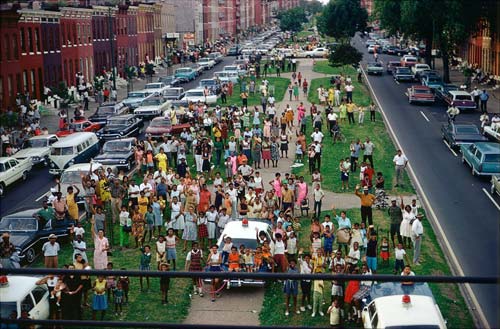
In July 1968, a train delivered the body of Robert Kennedy from NYC to Washington D.C. so that he could be buried in Arlington National Cemetery next to his brother. Photographer Paul Fusco was on that train and shot a bunch of photos of the hundreds of thousands of people that spontaneously turned up along the train route to mourn Kennedy, photos that were recently rediscovered. Fusco narrates a slideshow of the photos.
I’ll let the pictures speak for themselves, but I’ll also tell you the only area where Paul and I disagreed. For Paul, the event and the photographs represented the end of hope. To me they represent the indomitability of the American spirit.
Either way, the photos are powerful but also show the ordinary American-ness of that time period.
The sizes of the photographs are deliberately large - taking advantage of the majority of web users who have screens capable of displaying 1024x768 or larger. The long-held tradition of keeping images online tiny and lightweight is commendable still - when designing a general purpose site. But one dedicated to quality imagery should take full advantage of the medium, and I hope I’ve struck a good balance with The Big Picture.
When I see quality photography consigned to the archives, or when I see bandwidth readily given up to video streams of dubious quality, or when I see photo galleries that act as ad farms, punishing viewers into a click-click-click experience just to drive page views - those times are the times I’m glad I was able to get this project off the ground (many thanks to my friends within boston.com)
The prevalence of pyjamas, Guariglia explained to me, was due to both the extreme summer heat and the lack of plumbing. Most Shanghaians share outdoor communal toilets and thus the boundaries of what was considered one’s home have expanded past people’s houses to the public bathrooms. Once that relaxation of the dress code became acceptable (starting around the 1980s) the perimeter for p.j.-wear just kept expanding until many people were wearing them day in day out.
Can you imagine what it was like to have been photographing a wedding in Sichuan, China when 7.9 earthquake hit and shakes for three minutes? From what I understand, there were thirty-three missing guests in this church.
Over a three-year period, James Mollison attended pop concerts across Europe and the United States with a mobile photography studio, inviting fans of each music star or band to pose for a portrait on their way into the concert. The result is The Disciples, an original and highly entertaining series of fifty-seven panoramic images, each featuring eight to ten music fans mimicking the manners and dress of their particular heroes. Featuring fans of Dolly Parton, Iggy Pop, Madonna, Marilyn Manson, the Rolling Stones, Bob Dylan, Snoop Dogg, and Motorhead, among many others, The Disciples is a surprising, sharp, and hilarious take on popular culture.
He uses long exposures, then shakes the camera while the shutter is still open, causing colors to blur and lights to streak. “I’m not recording what is really happening, but it’s something like what the brain is seeing late at night, especially if maybe you’re drunk or very excited,” he said. “I like that hour between 3 and 4 in the morning when desperation sets in, when you see all the anticipation of going out starting to fade. The masks drop and everybody realizes the night is not going to be everything they were hoping for.”
Even though the sprayers use half the flow of a garden hose, the water shoots out at 3,000 pounds per square inch — more than enough power to send the guy behind the hose flying. “One thing we say is, it doesn’t necessarily have to be fun to be fun. There are definitely times when I’m spinning in free space and I’m like, holy cow this is terrifying and I can’t believe this is my job,” said Matt Henry, rope technician.
The company doing the work, Karcher GmbH & Co., has done similar high-profile jobs around the world, all at no cost…their web site says that these projects are good publicity for their cleaning products. Here’s a sampling of some other projects they’ve done, including the Statue of Liberty and Berlin’s Brandenburg Gate. (via girlhacker)
John Toll is an Academy Award-winning cinematographer who has had limited exposure to HD photography, but who understands the impact of it on the business. “Film tends to be more kind,” he said. “Now with HD, they’re doing things like more filtration, or softening of the light, or degrading the image so it’s not so highly defined. It’s sort of what they used to do in movie star close-ups, an over-diffused style to try to make them look glamorous. Now they do it so you don’t see every pore in a close-up on skin.”
Any photograph used in a magazine, a billboard, an album cover, whatever — can only be presumed to be a photo-based illustration. The issue, which Dove’s well-intentioned campaign addressed, is the effect these illustrations have on the psyche, self-esteem, and well-being of women (in particular) not to mention the unrealistic view men might have of women. It brings to mind the shock the eminent Victorian art critic John Ruskin experienced upon discovering his wife’s pubic hair, after which he was unable to consummate the marriage. Divorce followed shortly.
Fashion photo retouching (i.e. high-brow Photoshopping) gets the New Yorker treatment with this story on retoucher Pascal Dangin, one of the best in the business.
In the March issue of Vogue Dangin tweaked a hundred and forty-four images: a hundred and seven advertisements (Estée Lauder, Gucci, Dior, etc.), thirty-six fashion pictures, and the cover, featuring Drew Barrymore. To keep track of his clients, he assigns three-letter rubrics, like airport codes. Click on the current-jobs menu on his computer: AFR (Air France), AMX (American Express), BAL (Balenciaga), DSN (Disney), LUV (Louis Vuitton), TFY (Tiffany & Co.), VIC (Victoria’s Secret).
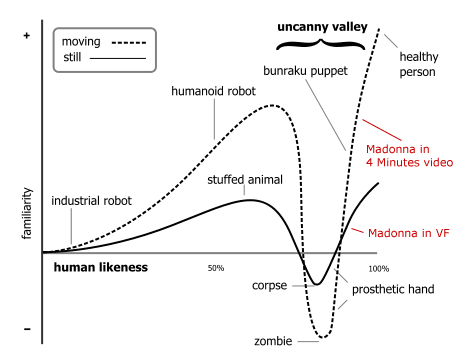
The article touches too briefly on the tension between reality and what ends up in the magazines and advertisements. As Errol Morris points out on his photography blog, it is often difficult to find truth in even the most vérité of photographs. Even so, the truth seems to be completely absent from Madonna’s recent photo spread in Vanity Fair that was retouched by Dangin, especially this one in which a 50-year-old Madonna looks like a recent college graduate who’s never lifted a weight in her life.
The uncanny valley comes into play here, which we usually think of in terms of robots, cartoon characters, and other pseudo anthropomorphic characters attempting and failing to look sufficiently human and therefore appearing creepy and scary. With an increasing amount of photo retouching, postproduction in film, plastic surgery, and increasingly effective makeup & skin care products, we’re being bombarded with a growing amount of imagery featuring people who don’t appear naturally human. People who appear often in media (film & tv stars, models, cable news anchors & reporters, miscellaneous celebrities, etc.) are creeping down into the uncanny valley to meet up with characters from The Polar Express. I don’t know about you but a middle-aged Madonna made to look 24 gives me the heebie-jeebies. Perhaps the familar uncanny valley graph needs revision:
Note: If you are a member and tried to log in, it didn't work, and now you're stuck in a neverending login loop of death, try disabling any ad blockers or extensions. Or try logging out and then back in. Still having trouble? Email me!




Socials & More