kottke.org posts about music
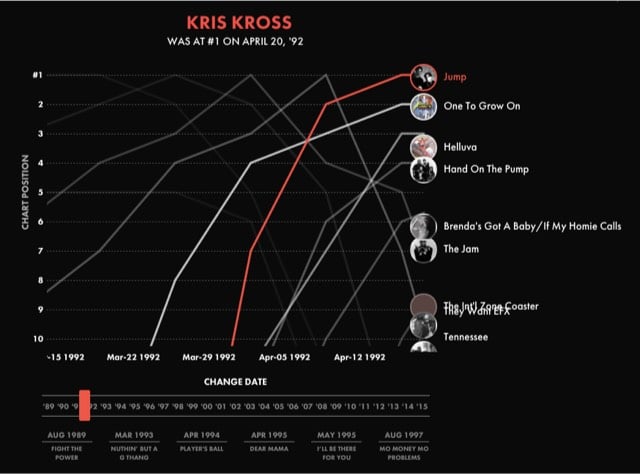
The product of a collaboration between Polygraph and Billboard, this interactive timeline lets you listen to the top rap song in the US from 1989 to 2015 as you see the single jockeying in the top 10.
James Corden does this thing on the Late Late Show where he drives around with singers doing karaoke in a car. Yesterday, he picked up Adele and they drove around singing a few of her songs and then she did, without dropping a word, Nicki Minaj’s verses from Monster1 (starts at about the 10:15 mark). Soooo good. (via @djacobs)
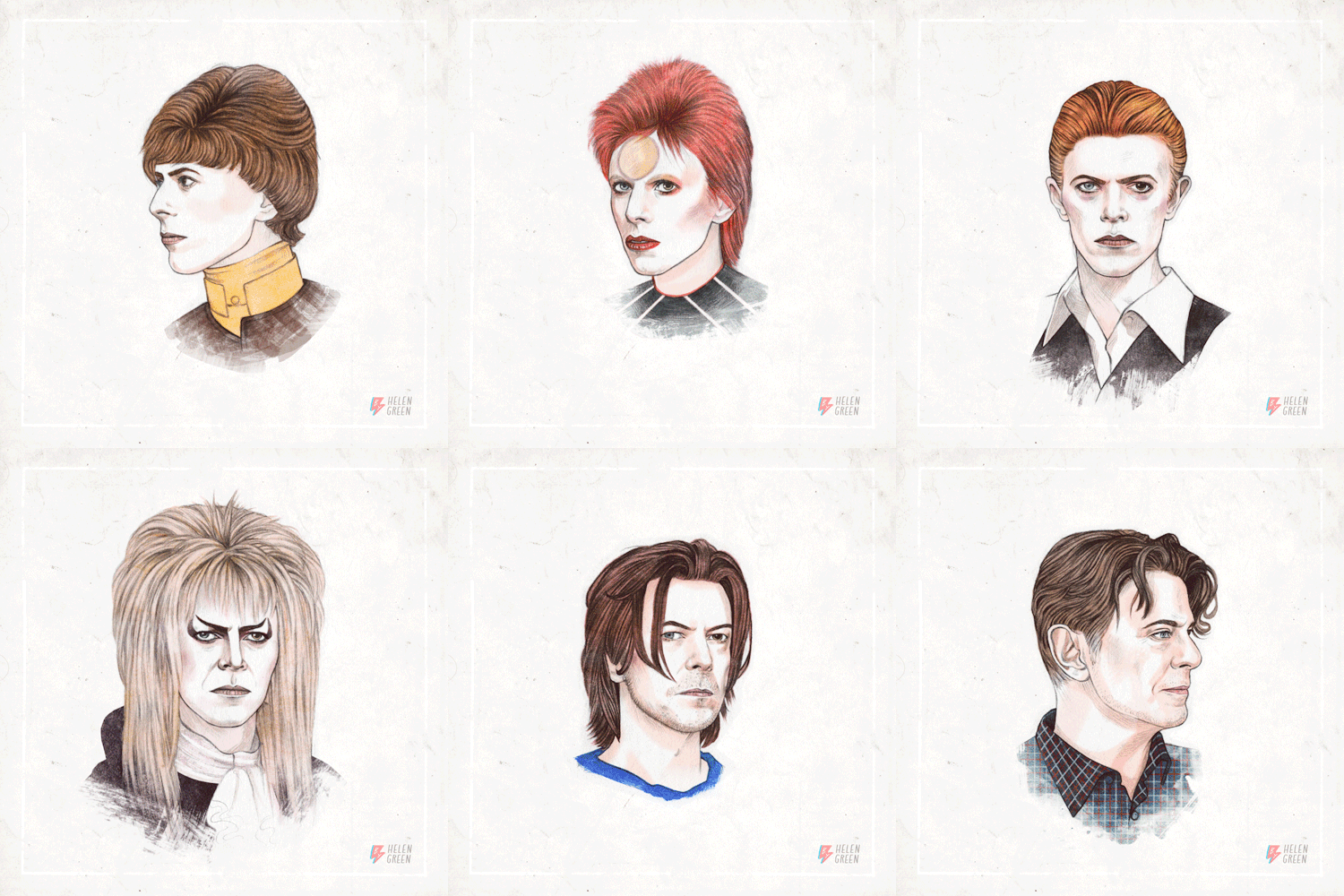
David Bowie died Sunday from cancer. Dave Pell at Nextdraft has a nice roundup of links, writing:
In the NYT obituary, Jon Pareles writes: “Mr. Bowie wrote songs, above all, about being an outsider: an alien, a misfit, a sexual adventurer, a faraway astronaut.” Maybe that’s why there is such an outpouring of emotion at the news of David Bowie’s death at the age of 69. Everyone feels like an outsider and Bowie made being an outsider feel more like being ahead of the curve. Today, there are people who are famous for nothing. David Bowie was famous for everything.
Bowie was also quite keen on the Internet:
Quartz calls him a tech visionary, and there’s this from a 1999 Rolling Stone article: “David Bowie has pulled another cyber-coup by becoming the first major-label artist to sell a complete album online in download form.”
He didn’t get the future exactly right, but authorship and intellectual property has been “in for such a bashing” lately and music sales are down down down:
“Music itself is going to become like running water or electricity,” he added. “So it’s like, just take advantage of these last few years because none of this is ever going to happen again. You’d better be prepared for doing a lot of touring because that’s really the only unique situation that’s going to be left. It’s terribly exciting. But on the other hand it doesn’t matter if you think it’s exciting or not; it’s what’s going to happen.”
Spotify is the running water and YouTube is the electricity. (Illustration by Helen Green.)
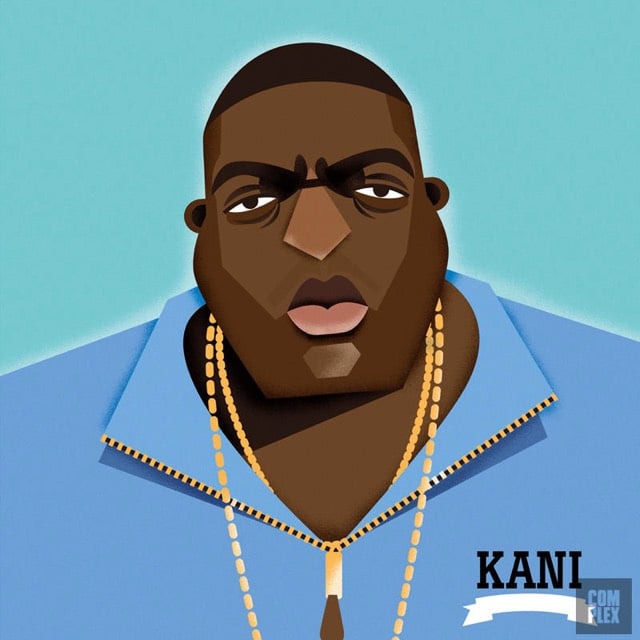
From Complex, a listing of the best rapper alive for each year since 1979, from Grandmaster Caz to Biggie to Nicki to Drake.
Christopher Wallace was only alive for 67 days in 1997, but with a talent so immense, that’s all it took for him to be the most dominant rapper of the year. In the months after Biggie’s March 9 death, it’s almost as if his stock rose. The untimely loss of someone so young, with so much heft in the language of hip-hop, was like a call to reflection. Infatuation with his wit, wordplay, and delivery soared, and 1997, in spite of tragedy, was Biggie’s biggest year.
Life After Death was released just over two weeks after Biggie passed and peaked at No. 1 on the Billboard 200. The album was an ambitious two-disc set with a tracklist comprised of every type of song imaginable. While the diverse styles and subject matter — his daughter’s college plan, kinky sex, hotel heists, a fully-sung ballad — were an organic product of Biggie’s incomparable range, the strategy of Life After Death’s sequencing has become the de facto approach for rap albums in the years since. It’s an incredibly influential project, before you even press play.
In the first few seconds of this video, Margaret Leng Tan introduces herself:
I’m the first woman to graduate with a doctorate from Juilliard and now I play the toy piano. Life works in mysterious ways.
You can hear more of Tan’s toy piano music on Spotify. (via @robinsloan)
Radiohead were commissioned to write the theme song for Spectre, the newest James Bond movie. The movie’s producers decided to go in a different musical direction, so the band recently put the rejected song up on Soundcloud. Enjoy. (via df)
Update: They took the full version down from Soundcloud but it’s up on Spotify.
I have really been digging this Burning Man sunrise DJ set from Tycho. (via @arainert)
Prince covered Radiohead’s Creep at the Coachella music festival in 2008. The video got yanked due to copyright infringement but it’s back up. For the moment anyway and perhaps forever…Prince’s Twitter account linked to it. (via @anildash (who else??))
At the risk of turning this into an Adele fan site, here are the isolated vocals for her performance of “Hello” for Saturday Night Live. They are raw and flawless and real and everything pop music isn’t these days.
Update: That YouTube video got yanked, but I found the vocals on Soundcloud. We’ll see how long that’ll last.
Update: Welp, that lasted about 10 minutes. Digg has embedded their own video. How fast will that one disappear?
This is all sorts of charming. BBC held an Adele impersonator contest and arranged for Adele to compete in disguise as a woman named Jenny. I love the looks on the women’s faces when they realize what’s going on.
See also Jewel’s undercover karaoke and Macklemore and Ryan Lewis surprising a bus full of passengers with a performance.
This long interview with former Oasis songwriter Noel Gallagher is a goldmine of rock star swagger, a master class in not giving a shit, and the dictionary definition of unfiltered. I mean:
Am I aware of a hierarchy? I’m aware that Radiohead have never had a fucking bad review. I reckon if Thom Yorke fucking shit into a light bulb and started blowing it like an empty beer bottle it’d probably get 9 out of 10 in fucking Mojo. I’m aware of that.
I used to put us at number seven. It went The Beatles, the Stones, the Sex Pistols, The Who, The Kinks… who came in at six? I don’t know. We were at seven. The Smiths were in there, The Specials. Where would I put us now? I guess I’d probably put us in the top 10. We weren’t as great as the greats but we were the best of the rest. We did more than The Stone Roses could fucking even fathom. We’re better than The Verve: couldn’t fucking keep it together for more than six months at a time. If all the greats are in the top four, we’re in the bottom of the top four, we’re kind of constantly fighting for fifth, just missing out. Just missing out on the top four, I’d say.
He just has opinions on everything and everyone and says them on the record:
I fucking hate whingeing rock stars. And I hate pop stars who are just… neh. Just nothing, you know? “Oh, yeah, my last selfie got 47-thousand-million likes on Instagram.” Yeah, why don’t you go fuck off and get a drug habit, you penis?
This one just made me laugh:
My fragrance? Oh it’s coming, it’s coming. Toe-Rag it’s going to be called. And the bottle’s going to be a massive toe.
Ahhhhhhh, I can’t stop quoting:
I guaran-fucking-tee you this: The Stone Roses never mentioned “career” in any band meetings. Ever. Or Primal Scream, or The Verve. Oasis certainly never mentioned it. I bet it’s mentioned a lot by managers and agents now: “Don’t do that, it’s bad for your career.” “What? Fuck off!” Like when we went to the Brits and we’d won all those awards and we didn’t play. The head of the Brits said, “This’ll ruin your career.” Fucking, wow. I say to the guy, “Do you know how high I am? You know who’s going to ruin my career? Me, not you. Bell-end. More Champagne. Fuck off.”
Ok, that’s enough. Just go read the thing.
The University of California, Santa Barbara library is digitizing its collection of wax cylinders from the late 19th and early 20th centuries. Over 10,000 audio files from the collection are now available online.
The UCSB Library, with funding from the Institute of Museum and Library Services, the Grammy Foundation, and donors, has created a digital collection of more than 10,000 cylinder recordings held by the Department of Special Collections. To bring these recordings to a wider audience, the Library makes them available to download or stream online for free.
This searchable database features all types of recordings made from the late 1800s to early 1900s, including popular songs, vaudeville acts, classical and operatic music, comedic monologues, ethnic and foreign recordings, speeches and readings.
(thx, greg)
BBC Radio One got David Attenborough to narrate the first minute or so of Adele’s video for Hello as if it were a nature documentary. Solid gold. Although I am a little cross they made Attenborough say the words “hashtag flip phone”. :|
Bonus pseudo-Attenborough: the episode of Human Planet on The Douche.
Did you know The Beatles have a YouTube channel? On which they have only posted three videos in the past year? Do you even know who The Beatles are? I mean, they aren’t on Spotify or any other streaming music service so maybe that won’t be an absurd question soon. After all, current and future generations will have a lot to say about the future popularity of the band and if they don’t hear the music, well…
For now, enjoy a live performance of Revolution from 1968. (Update: I have been informed by music nerds that only the vocals are live on this.)
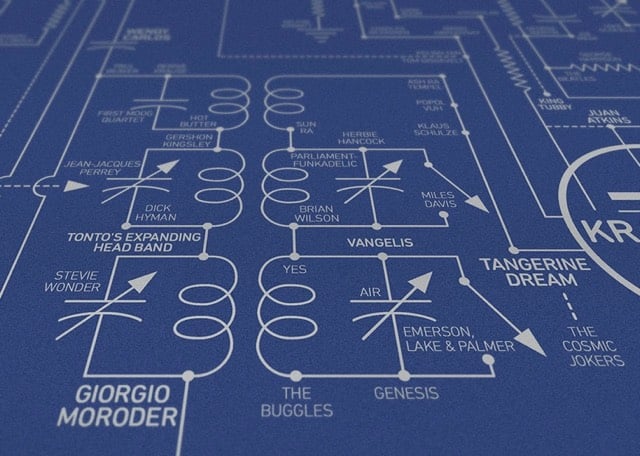
From Dorothy, a beautiful print of the history of electronic music mapped onto the circuit board of a theremin, one of the first electronic instruments.
Our Electric Love Blueprint celebrates over 200 inventors, innovators, composers and musicians who (in our opinion) have been pivotal to the evolution of electronic music from the invention of the earliest known sound recording device in 1857 to the present day. Key pioneers featured include Léon Theremin, Bob Moog, Karlheinz Stockhausen, Brian Eno, Kraftwerk, John Cage, New Order and Aphex Twin.
Some amazing person has collected the full tracks of the songs that were sampled by the Beastie Boys on six of their best-known albums and provided them as a downloadable zip file. That’s 286 tracks, 22 hours of music, and encoded between 256kbps and 320kbps.
Obviously not every sample or drum break can or ever will be identified, but this is about as close as it’s gonna get! With the completion of this eighteen year long ongoing project, I want to personally thank each and every single person out there that has lent insight, shared knowledge, or provided me with any of the tracks that were used to compile this amazing piece of history. It goes without saying that much love, gratitude, and respect is owed to the Beastie Boys for introducing me (and you) to some amazing music via sampling that may otherwise not be heard, let alone acknowledged in this light.
Some of the included tracks:
Led Zeppelin - When The Levee Breaks
Kurtis Blow - Christmas Rappin’
Johnny Cash - Folsom Prison Blues
The Beatles - Sgt. Pepper’s Lonely Hearts Club Band
Jimi Hendrix - Foxey Lady
Stephen Sondheim - Act I: Company
Peggy Lee - Sittin’ On The Dock Of The Bay
See also Paul’s Boutique Without Paul’s Boutique, where Tim Carmody provides some context behind the Beasties’ sampling:
The remix is fun to listen to, but mostly, it just reminds you that Paul’s Boutique sounds amazing because its sampled sources were amazing. Like De La Soul’s Three Feet High and Rising, released the same year, Paul’s Boutique lifts tracks that would cost a small mint to borrow from today. (Three Feet High has never had an official digital release because the rights holders still can’t sort out the royalties.) The Beatles, The Supremes, The Ramones, Curtis Mayfield, Dylan, Hendrix, Sly, Bernard Hermann, and James Brown (of course) are all there. But mostly, it’s a love letter to old-school New York City hip hop: Kurtis Blow, Afrika Bambaataa and the Jazzy 5, The Sugarhill Gang, The Funky 4 +1, and contemporaries like Run-DMC, Boogie Down Productions, and Public Enemy are the glue that holds the whole project together.
Now, if you know Paul’s Boutique well, you can’t hear those older songs any more without hearing Paul’s Boutique. There’s specific moments in those songs that hide there waiting for you to trip over them, like quotations of ancient Greek in an Ezra Pound or TS Eliot poem. Beastie Boys didn’t just find a way to make older music sound new; they found a way to invent their own precursors.
(via @tcarmody)
The Hood Internet has released their ninth mixtape. Ninth! The highlight so far as I listen for the first time: Daft Punk’s Around the World mixed with The Weeknd’s Can’t Feel My Face. (via @mathowie)
Update: Downloads and track listing are available on The Hood Internet’s website.
Kent Jones has directed a documentary on the 1962 meeting where a young François Truffaut interviewed a seasoned Alfred Hitchcock about his films (the output of which was a beloved book). As the narration from the trailer says, “[Truffaut] wanted to free Hitchcock from his reputation as a light entertainer”, to which Peter Bogdanovich adds, “it conclusively changed people’s opinions about Hitchcock”.
In 1962 Hitchcock and Truffaut locked themselves away in Hollywood for a week to excavate the secrets behind the mise-en-scène in cinema. Based on the original recordings of this meeting — used to produce the mythical book Hitchcock/Truffaut — this film illustrates the greatest cinema lesson of all time and plummets us into the world of the creator of Psycho, The Birds, and Vertigo. Hitchcock’s incredibly modern art is elucidated and explained by today’s leading filmmakers: Martin Scorsese, David Fincher, Arnaud Desplechin, Kiyoshi Kurosawa, Wes Anderson, James Gray, Olivier Assayas, Richard Linklater, Peter Bogdanovich and Paul Schrader.
Truffaut’s recontextualization of Hitchcock and his work reminds me of the point Matt Daniels recently made about younger generations deciding how work from older artists is remembered in his post about timeless music:
Biggie has three of the Top 10 hip-hop songs between 1986 and 1999. This is a strong signal that future generations will remember Biggie as the referent artist of 80s and 90s hip-hop. And there’s No Diggity at the top — perhaps it’s that glorious Dr. Dre verse.
Hip hop heads will lament the omission of Rakim, Public Enemy, or Jay-Z’s Reasonable Doubt. It’s a depressing reality that exists for every genre and generation: not every artist will be remembered. The incoming generation will control what’s relevant from the 90s and carried into the future, independent of quality and commercial success. For rock, that might be Blink-182. For electronica, that might be Sandstorm.
Take Star Wars as another example. I’ve had conversations recently with other parents whose young kids are really into the series. The way they experience Star Wars is different than my generation. We saw Episodes IV-VI in the theater, on VHS, and on DVD and then saw Episodes I-III in the theater accompanied by various degrees of disappointment and disregard. Elementary school-aged kids today might have watched the prequels first. They read the comics, play the video games, and watch the Clone Wars animated series. To many of them, the hero of the series is Anakin, not Luke.1 And Generation X, as much as we may hate that, there’s not a damn thing we can do about it.2 Unless… there is… another… (via subtraction)
Hip-hop group Run the Jewels have released a remix album called Meow the Jewels of their second album that features various meows, purrs, yowls, and other cat noises. Congratulations Internet, we have achieved Peak Cat.
Julia Nunes is a musician who 1) first developed a following for her music on YouTube, and 2) is putting out her latest album, which drops tomorrow. This summer, Nunes took down a bunch of the videos that started her on this path and explained why.
I took down a bunch of videos bc I don’t want what I’m doing now to be lost amongst what I’ve done for the past 8 years. I don’t want the best thing I’ve ever done to be 10% of what you can find if you’re looking. I want anyone who is just finding me now to see who I really am. Later, they can dig deep into the internet and find my nose ring but until then I wanna greet the world as I am now.
Nunes had changed and she wanted her online persona to reflect the shift.
There will always be resistance to change and the first roadblock is usually yourself. I think I was putting myself in a box there for a little bit, too beholden to the image I started with.
One of my favorite posts, which I think about often, is this one about social media and self-reinvention. In it, I quote a post1 from Scott Schuman’s The Sartorialist about a woman named Kara who significantly remade her image after moving to NYC.
Actually the line that I think was the most telling but that she said like a throw-away qualifier was “I didn’t know anyone in New York when I moved here…”
I think that is such a huge factor. To move to a city where you are not afraid to try something new because all the people that labeled who THEY think you are (parents, childhood friends) are not their to say “that’s not you” or “you’ve changed”. Well, maybe that person didn’t change but finally became who they really are. I totally relate to this as a fellow Midwesterner even though my changes were not as quick or as dramatic.
I bet if you ask most people what keeps them from being who they really want to be (at least stylistically or maybe even more), the answer would not be money but the fear of peer pressure — fear of embarrassing themselves in front of a group of people that they might not actually even like anyway.
Taking down those videos is Nunes’ way of trying for a fresh online start. Makes me think about whether having more than 17 years of archives on kottke.org still hanging around is such a good idea.
A brand-new, free-to-listen/download covers/mashup medley EP from Roman GianArthur, featuring labelmate Janelle Monae on the beautiful duet “NO SURPR:SES.”
D’Angelo and Radiohead: it’s two great late-90s/early-00s/still-pretty-damn-good-in-10s tastes that taste great together!
(via Wired and elsewhere)
Why are there so many cover versions of hit songs on Spotify, YouTube, and other streaming music services? It’s not just because of searches and the artistic equivalent of SEO, but because there is an economic engine to support them:
Every time one of Scofield’s songs is downloaded on iTunes, she makes around 60 cents, after paying a processing fee and, when it’s a cover song, royalties to the original artist. But if one of her songs is streamed on Spotify, she’ll make just a fraction of a cent. Both Scofield and Young have done the math: “You would have to play one of my songs on Spotify 150 to 400 times in order to equal what I would make from one iTunes download,” Young says. Scofield agreed that to balance revenue on the platforms, she needed at least several hundred times more Spotify streams than iTunes downloads…
Spotify’s microeconomy of cover artists gave rise to a cottage industry of easy-to-use online licensing services. Over the past several years, dozens of these services have emerged, like SongFile and Easy Song Licensing, an amateurish-looking website that promises it can clear a cover song for you in one to two days. Jonathan Young uses Loudr, a licensing and digital distribution startup that operates in the same way most of these companies do. For $15 per song, plus royalty fees (calculated by the number of times a song is streamed), Loudr will do the work of securing a license and putting the song up online. All Young has to do is pay and wait.
This is essentially an updated throwback to pop music in the 1940s and 1950s (and to a lesser extent the 1960s), where publishers would push hit songs on as many artists as possible to get maximum exposure/run it into the ground. It’s fun to look at the recording history of a standard like “Baby, It’s Cold Outside”:
The following versions were recorded in 1949:
- The song in its original form was released on the soundtrack for Neptune’s Daughter sung by Ricardo Montalban and Esther Williams.
- The recording by Dinah Shore and Buddy Clark was recorded on March 17 and released by Columbia Records as catalog number 38463. It first reached the Billboard Best Seller chart on May 6, 1949, and lasted 19 weeks on the chart, peaking at number four.[8]
- The recording by Margaret Whiting and Johnny Mercer was recorded on March 18 and released by Capitol Records as catalog number 567. It first reached the Billboard Best Seller chart on May 6, 1949, and lasted 19 weeks on the chart, peaking at number four.[8]
- The recording by Don Cornell and Laura Leslie with the Sammy Kaye orchestra was recorded on April 12 and released by RCA Victor Records as catalog number 20-3448. It first reached the Billboard Best Seller chart on June 24, 1949, and lasted 10 weeks on the chart, peaking at number 13.[8]
- The recording by Ella Fitzgerald and Louis Jordan was recorded on April 28 and released by Decca Records as catalog number 24644. It first reached the Billboard magazine Best Seller chart on June 17, 1949 and lasted seven weeks on the chart, peaking at number 17.[8]
- A parody recording was made by Homer and Jethro with June Carter; it went to number 9 on the country charts and number 22 on the pop charts.
Non-charting recordings were made:
- By Esther Williams and Ricardo Montalban on April 7, 1949 released by MGM Records as catalog number 30197.
- By Pearl Bailey and Hot Lips Page on June 23, 1949 released by Harmony Records as catalog number 1049.
- By Louis Armstrong and Velma Middleton.
I mean, look at the cluster of dates! March 17, March 18, April 7, April 12, June 23. Some of the cover versions beat “the original” to market.
Then as now, the money isn’t in the performance, especially on the record; it’s in the song.
Today, the [star] artist retains more power than in the 1940s, and there’s a stigma against artists who don’t write their own material. But I wouldn’t be surprised if at some point, we start to see more established artists get into the game of covering new (and old) hit songs, not just young artists looking for a little exposure. The economics of the thing line up the same way for everybody.
Matt Daniels of Polygraph used playcount data from Spotify to identify the most played songs from the past, which he labeled The Most Timeless Songs of All Time. The most timeless song of the 90s, by a wide margin? Nirvana’s Smells Like Teen Spirit.1
Out of the entire catalog of music from the 90s, these are the tracks on the trajectory to survive. Some of my friends were deeply disturbed by what’s been lost in time (e.g., Pearl Jam). And No Diggity isn’t just anecdotally timeless, it’s the fifth most-played song from the 90s.
Note the tracks that hardly charted on Billboard, in their day. Smells Like Teen Spirit, a track that never reached the Billboard Top 5 when it was released in 1992, is now the most-played song from the 90s.
Daniels makes the point that it is not the generation that made the music that will determine its long-term prospects for being remembered, but subsequent generations, which sounds obvious when it’s put that way, but I’d never really thought about it.1
Biggie has three of the Top 10 hip-hop songs between 1986 and 1999. This is a strong signal that future generations will remember Biggie as the referent artist of 80s and 90s hip-hop. And there’s No Diggity as the top - perhaps it’s that glorious Dr. Dre verse.
Hip hop heads will lament the omission of Rakim, Public Enemy, or Jay-Z’s Reasonable Doubt. It’s a depressing reality that exists for every genre and generation: not every artist will be remembered. The incoming generation will control what’s relevant from the 90s and carried into the future, independent of quality and commercial success. For rock, that might be Blink-182. For electronica, that might be Sandstorm.
I made a playlist on Spotify of the top 30 most timeless songs from the article. Enjoy!
Update: Mike Harris made a Spotify playlist with all 1001 songs from the article. 66+ hours of timelessness is a lot of timelessness.
Here’s your workday sorted, then: every studio album Wilco has recorded, all in one go.
(Except, for some reason, the tracks from 2011’s The Whole Love are unavailable on the compilation even though that whole album is available elsewhere on Rdio. Music licensing/promotion makes zero sense.)
This is an epic display of top-notch lip syncing and world-class shade throwing. I smiled the whole way through this.
Songs performed include Wannabe by The Spice Girls, The Sign by Ace of Base, Thong Song by Sisqo, and Orinoco Flow by Enya.
Update: A playlist of the songs sung in the video are now available on Rdio and Apple Music.
(via @jemaleddin & @murtaugh)
Obama’s off for a couple of vacation weeks on Martha’s Vineyard and is taking the following books with him on vacation: All That Is by James Salter, All The Light We Cannot See by Anthony Doerr, The Sixth Extinction by Elizabeth Kolbert, The Lowland by Jhumpa Lahiri, Between The World and Me by Ta-Nehisi Coates, and Washington: A Life by Ron Chernow. Solid.
My summer reading list so far: Quiet, The Antidote, The Martian, Ready Player One, and the kids and I are slowly working our way through Harry Potter and the Order of the Phoenix.
Update: POTUS has also made a Spotify playlist of his favorite summer songs. The Temptations, Dylan, Coldplay, and Aretha. No Jay or Bey?
Update: Ah, he also made a list for a summer night and there’s some Beyonce on there. Thank you, Mr. President.
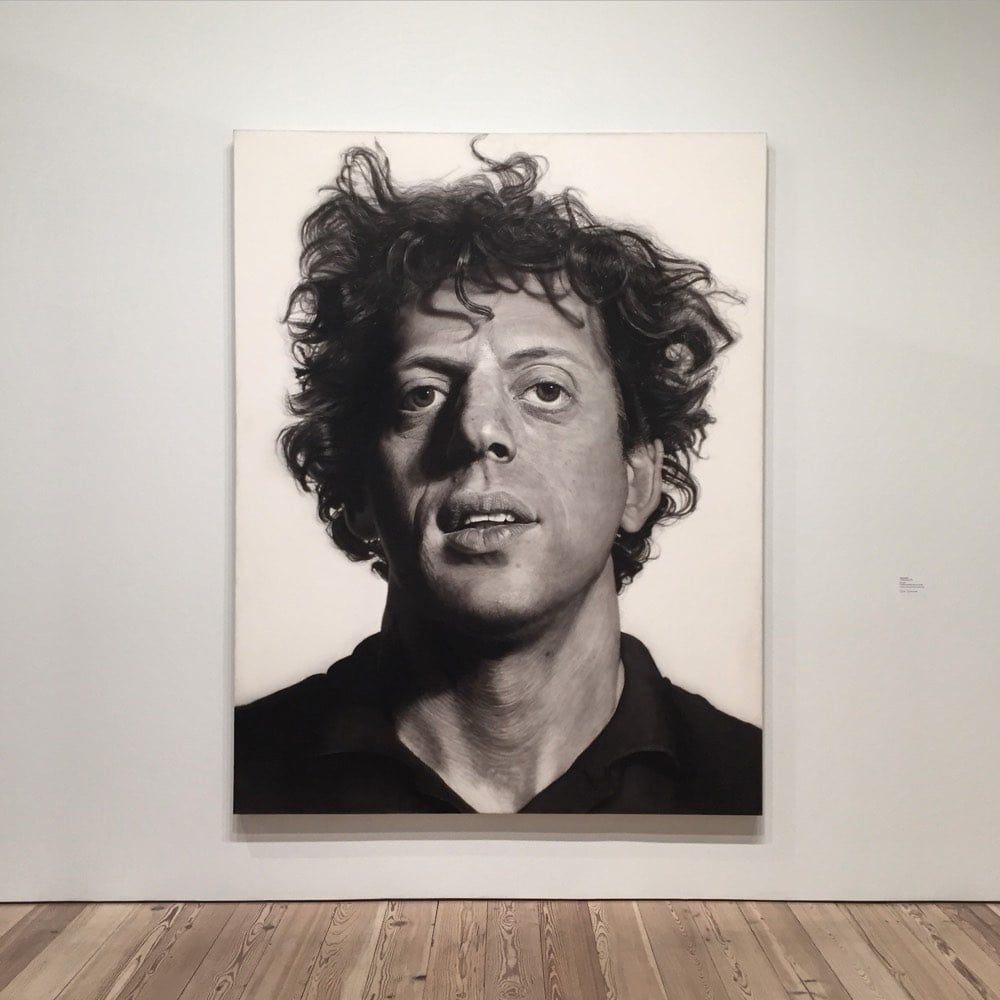
I thought I’d posted about Philip Glass’ new memoir, Words Without Music, when it came out back in April, but I can’t find anything in the archives, so let’s do it right now. I was reminded of it after reading this review by Dan Wang, which pushed Glass’ book to the top of my queue.
These biographical details are manifestations of a quality I admire. Glass never needed much convincing to drop everything in his life to go on a risky venture. I’m not familiar with the many plot twists in his life, and found the book engaging because I had no idea what new adventure he was going to go on next. It’s astonishing how open-minded he is. Consider: His decision to go to India was based entirely on seeing a striking illustration in a random book he grabbed off a friend’s shelf. In addition, he never hesitated to go into personal debt, at times quite steep, because his music couldn’t wait. The book is filled with instances of him saying “sure, when?” to improbable proposals without dwelling on their costs.
He seemed uninterested in stabilizing his position with more regular income. He never took up an honorary conductor position. He never ensconced himself in a plush conservatory professorship. And he didn’t even apply for grants because he didn’t like that they imposed terms.
See also the 2007 documentary Glass: A Portrait of Philip in Twelve Parts. (via mr)
When they were launched in 1977, the two Voyager spacecraft each carried with them a 12-inch gold-plated copper record containing images and sounds of Earth for the viewing pleasure of whichever aliens happened across them. NASA has put the sounds of the Golden Record up on Soundcloud. Here are the greetings in 55 different languages (from English1 to Hittite to Polish to Thai):
And the sounds of Earth (wild dogs, Morse code, trains):
What’s missing from the two playlists is UN Secretary General Kurt Waldheim’s greeting:
…as well as several other UN greetings overlaid with whale sounds:
Due to copyright issues, also missing are the 90 minutes of music included on the record. Among the songs are Johnny B. Goode by Chuck Berry, The Rite of Spring by Stravinsky, and Dark Was the Night, Cold Was the Ground by Blind Willie Johnson. Here Comes the Sun by The Beatles was originally supposed to be included, but their record company wouldn’t allow it, which is pretty much the most small-minded thing I have ever heard.
In 1981, ABC’s news program 20/20 aired a segment on the rising phenomenon of rap music called Rappin’ to the Beat. It is painful to watch in parts, but ultimately worth it for the footage of street scenes and artist performances.
Here is part 2. (via open culture)
While the members of On A Friday, the band that later became Radiohead, were on a break as they attended college, Thom Yorke was a member of a band called Headless Chickens. This is a video of a circa-1989 performance by the band of “High and Dry”, a song that later on Radiohead’s second album, The Bends, released in 1995.
Newer posts
Older posts



Socials & More