kottke.org posts about movies
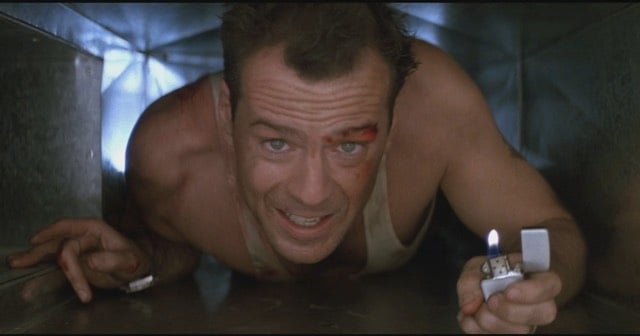
Now available as a Kindle single (71 pages): Die Hard: An Oral History.
In this definitive oral history of “Die Hard,” writers, actors, producers, and studio executives reveal behind-the-scenes stories, from the curious origins of the film’s title, to the script’s evolution from a depressing ’70s character study to an optimistic Reagan-era blockbuster, to the seminal negotiations between 20th Century Fox and Willis’s then-agent which sent his client’s career into the stratosphere, to details of moguls Lawrence Gordon and Joel Silver’s famously tumultuous relationship while developing some of the ’80s most successful franchises.
The Daily Beast has an excerpt on the casting of John McClane.
They went to Arnold [Schwarzenegger]. They went to Sly, who turned it down. They went to Richard Gere-turned it down. They went to James Caan-turned it down. They went to Burt Reynolds, and all of these people rejected it because, remember, this is 1987. You had all these Rambo movies. We’ve had Commando, Predator, and in the wake of all of these, the hero, they said, was like a pussy. The reaction? “This guy’s no hero.” Right? In desperation, they went to Bruce Willis.
This storyboarded scene from Zootopia shows an early and much darker direction for the plot: the predators need to wear collars that shock them if they get too excited. This reminds me that Woody was a “sarcastic jerk” in the early drafts of Toy Story. Oh, and Lightning McQueen was an asshole in Cars whose redemption the audience didn’t completely buy, which Pixar didn’t end up fixing.
Update: There’s more about how Zootopia’s story evolved in Fusion’s 45-minute feature about the production of the film. (via @luketonge)
Watch how far Pixar’s skill in animation has come over the past 30+ years, from their initial shorts to the nearly photorealistic animation in last year’s The Good Dinosaur to Finding Dory.
It’s incredible how dated the original Toy Story looks now. It’s going to look positively prehistoric in 20 years and it’ll be impossible for anyone who didn’t see it at the time to understand how astounding and groundbreaking it was.
Gary Hustwit, director of Helvetica and Objectified, is directing a movie on legendary product designer Dieter Rams. Here’s the Kickstarter campaign.
This Kickstarter campaign will fund the film and also help to preserve Dieter’s incredible design archive for the future. There’s a trove of drawings, photographs, and other material spanning Dieter’s fifty plus years of work, and it needs to be properly conserved.
To that end, we’re working with the Dieter and Ingeborg Rams Foundation to help them catalog, digitize, and save these documents. The public has never seen most of this material, and we intend to share some of these discoveries with our backers during the process of making the film.
Rams’ designs have influenced an entire generation of designers, including one Jony Ive from a small company called Apple.
The Bear Jew. Hugo Stiglitz. The Jew Hunter. Bridget von Hammersmark. Names, identity, and personal reputation management are important elements in Inglourious Basterds, as they are in all of Tarantino’s films (Vincent Vega, our man in Amsterdam; Mr. Pink; The Bride / Beatrix Kiddo / Black Mamba). In this video essay, Drew Morton shows how Tarantino’s characters assert their identities over and over again, with varying results.
Adam Summers is a biomechanist who worked as a consultant on fish behavior and anatomy for Pixar’s Finding Nemo and its sequel, Finding Dory. How do you figure out where and how to stick to the known science (or sneak it in sideways) in a movie about talking fish? It’s not an easy question to answer.
This question is very important for the entertainment industry: does it matter whether you’re right, when you’re telling a story to entertain? Under some circumstances, I don’t think it matters. But with an animated movie about real, living systems, when you use the truth — their complexity and beauty — as a springboard for the story, you add a level of gravitas that is vitally important to creating a broad and deep appeal. A young audience is much more sophisticated than you think, and a story informed by a lot of facts alerts them to the presence of real concepts. I got an e-mail from an eight-year-old about Finding Nemo, explaining that characters could not emerge from a whale’s blowhole if they were in its mouth, because there is no link between the trachea and the oesophagus.
There are over 100 inaccuracies in Finding Nemo, but Summers says only one is a genuine error. (He doesn’t name it, but it might be Mr. Ray, who lists names of classes in his song about aquatic species.) Everything else, from the whale’s blowhole to ignoring clownfish’s ability to switch between male and female (although what if Marlin does become female, but just never spawns again?) is an intentional gloss or omission for storytelling purposes.
Or aesthetic ones. “The claspers — external, stick-like sexual organs on sharks — were cut off Bruce the great white shark,” says Summers, “not because of family values, but because he’s spherical, and when you add a bunch of sticks to spherical sharks, they look really stupid.” Noted.
Summers admits there’s also just a lot about the species in Pixar’s fish movies that nobody really knows.
They did ask me some questions about the biology of whale sharks (Rhincodon typus) that we just don’t know the answers to. It’s the largest fish in the sea, yet I think there’s just one record of a pregnant female, which revealed that they can have more than 300 pups at a time. That’s not much to know about the reproductive biology of such an iconic fish.
Luc Bergeron’s Space Story is a mashup of more than 20 movies that take place in space, from Alien to Apollo 13 to 2001 to Star Trek to Moon. Stick with it for a couple minutes…it starts slow but gets going around then.
See also Star Wars x Star Trek: The Carbonite Maneuver.
Bhautik Joshi took 2001: A Space Odyssey and ran it through a “deep neural networks based style transfer” with the paintings of Pablo Picasso.
See also Blade Runner in the style of van Gogh’s Starry Night and Alice in a Neural Networks Wonderland.
From Cinefix, a list of 10 movies (plus dozens more runners-up) that broke the rules of filmmaking most effectively by using jump cuts, nonlinear narrative, lack of plot, surrealism, and breaking the fourth wall.
Jarrett Fuller examines the video essay, typically used for film criticism (e.g. Every Frame a Painting, F is for Fake), and argues for its use in design criticism. (via @tonyszhou)
The films of Wes Anderson and Stanley Kubrick share some interesting visual similarities. Any influence was a one-way street, of course. With the exception of Bottle Rocket, which was cinematically spare compared to his later work, all of Anderson’s films were shot after Kubrick finished shooting Eyes Wide Shut.
A collection of super sad moments from movies like The Iron Giant, E.T., Wrath of Khan, Up, and Old Yeller. This’ll have you sobbing in 3 minutes or your money back.
Cass Sunstein, author of the recently published The World According to Star Wars, says that while most people might dislike the three Star Wars prequels, they function well as “a quick guide to current political struggles”.
A long time ago, in a galaxy far, far away, paralyzing political divisions threatened democratic governments. Disputes over free trade, and the free movement of people and goods, were a big reason. Stymied by polarization and endless debates, the Senate proved unable to resolve those disputes.
As a result, nationalist sentiments intensified, leading to movements for separation from centralized institutions. People craved a strong leader who would introduce order — and simultaneously combat growing terrorist threats.
A prominent voice, Anakin Skywalker, insisted, “We need a system where the politicians sit down and discuss the problem, agree what’s in the interest of all the people, and then do it.” And if they didn’t, “they should be made to.”
Eventually, something far worse happened. The legislature voted to give “emergency powers” — essentially unlimited authority — to the chief executive. An astute observer, Padme Amidala, noted, “So this is how liberty dies… with thunderous applause.”
Well, that was kind of terrifying to read. My ill-feeling peaked at “a democratic body, a senate, not being able to function properly because everybody’s squabbling” as a cause of Hitler’s rise in Germany. As Sunstein notes, the parallels between that situation and our do-nothing Congress & the authoritarian gentleman currently running for President are obvious and possibly significant.
Slate gathered a panel — made up of people like film critic Dana Stevens, Selma director Ava DuVernay, and historian Henry Louis Gates Jr. — to choose The Black Film Canon, the 50 greatest movies by black directors.
We must recognize that even with the financial and systemic odds stacked against them, black filmmakers have long been creating great and riveting stories on screen. The academy’s failure may have inspired a memorable hashtag, but that failure is deeply linked to the way nearly all movie fans remember cinematic history. In our never-ending conversation — or argument — about which films deserve to be remembered, which films are cultural touchstones, which films defined and advanced the art form, we habitually overlook stories by and about black people.
Included on the list are 12 Years a Slave, Boyz n the Hood, Killer of Sheep, and Do the Right Thing.



Swiss illustrator Martin Panchaud created a massive infographic that tells the entire story of the first Star Wars movie. How massive? It’s 465152 pixels long.
This long ribbon reminds the ancient Chinese script rolls that had to be rolled in and rolled out simultaneously in order to be read. I like this stretch between ages, cultures, and technologies.
So cool. The style reminds me a bit of Chris Ware in places.
There are tons of movie references in The Simpsons, but the show leans more heavily on referencing Stanley Kubrick’s films than perhaps any other director. As you can see in the video, there are dozens of references to 2001, Dr. Strangelove, The Shining, and even Eyes Wide Shut sprinkled throughout the series.
In Ex Machina, Oscar Isaac’s Nathan Bateman performs a dance number with one of his AI robots, played by Sonoya Mizuno. It’s the scene where I decided I was going to like the movie. Mizuno is a ballerina as well as an actress, but Isaac has no problem keeping up with her as the pair dance to Get Down Saturday Night.
Now, Twitter account @oscardances is showing how you can plug pretty much any song into that scene and the dance still works. Here’s Michael Jackson’s Thriller:
Intergalactic by the Beastie Boys:
And Oops I Did It Again by Britney Spears:
And there are dozens more here. (via @gavinpurcell)
In his latest video, Evan Puschak argues that intertextuality in movies — you know, fan service: “hey look, that thing you know from the previous thing!” — is increasingly doing the heavy lifting of creating drama and excitement, resulting in weaker stories.
I loved seeing the Millennium Falcon for the first time in The Force Awakens, the use of the original Jurassic Park vehicles in Jurassic World, and hearing Dumbledore’s name in the trailer for Fantastic Beasts and Where to Find Them, but yeah, those things have to be the cherry on top of good storytelling elements, not the whole sundae.
In 2015, BBC Culture polled critics around the world and came up with a list of the best 100 American films. The video above offers a visual look at the list. Hitchcock, Kubrick, and Spielberg each have several films on the list. Although many of the films were edited by women, only one was directed by a woman.
In Drive 2, Ryan Gosling trades his robbery getaway driving gig for driving for Uber.
I was just thinking about Hamilton1 and Captain America: Civil War, two of pop culture’s current obsessions, and thought, hmm, what if you made a superhero movie about the early years of American democracy? And then I quickly realized that Civil War in some ways echoes the political battle between Hamilton’s Federalists and Jeffersonian Republicans.
In the film (or at least the first part of it), Tony Stark is a Federalist; he realizes the need for regulation and oversight of the Avengers by the government. Captain America is a Republican; he believes in the rights of the smaller group (states’ rights!) and that regulation comes at the cost of essential freedoms. Karen Walsh wrote much more about the parallels between the two.
Captain America: Civil War begins with a focus on the Sokovia Accords. As the Avengers split into two groups, Iron Man and his cronies focus on granting the Accords validity in order to remain a unified front and gain popular trust. Cap and his cohorts determine that sacrificing their freedom to the government allows for errors that overshadow the purpose of their ability to protect the people who most need them.
In essence, Iron Man and his team represent the Federalist belief that a strong central government is essential to aggregating the trust and the will of the people.
Update: Two more takes on the parallels between Hamilton and Captain America: Captain America, Aaron Burr, And The Politics Of Killing Your Friends and Best of Frenemies. (via @Chan_ing)
Not content with mere 3D, some movie theaters are outfitting themselves with what’s being called 4DX technology, which makes going to the movies more like a theme park ride. The chairs can move, vibrate, and tickle, and the system can also generate wind, lightning, snow, and even smells1 from the movie.
With only the best technologies, 4DX motion chairs are equipped with three base movements of heave (move up and down), roll (move left and right) and pitch (tilt backward and forward) which can create an endless expanse of possible combinations to mimic such actions as flying and driving. The skilled team of 4DX editors, “i-Studio”, are experts in maximizing the feeling of immersion within every movie without overstepping comfort bounds.
Yes, it actually snows in the theater:
There are only three theaters in the US with this system installed, including the Regal in Union Square, where you can currently catch Batman vs. Superman in 4DX. It’ll cost you though. A regular screening of BvS at Union Square is $15.60 per ticket, 3D is $20.10, and 4DX is $28.10.
When it came out in December, Star Wars: The Force Awakens made a shed-load of cash, garnered positive reviews from critics and fans alike, but also got dinged for borrowing too much from the previous films, particularly the original. In this edition of Everything is a Remix, Kirby Ferguson considers JJ Abrams’ remix settings on The Force Awakens and wonders if the essential elements of such an undertaking (copying, transforming, combining) were properly balanced.
Werner Herzog has made more than 70 films during his career of 50+ years. This summer, Herzog will be teaching an online filmmaking class at Masterclass. The fee for the course is $90 and includes 5 hours of video lessons about documentary and feature filmmaking, a class workbook, and the chance to get your student work critiqued by the man himself. The trailer above offers a little taste of what you’ll be getting.
For example, I do not use a storyboard. I think it’s an instrument of the cowards.
See also 24 pieces of life advice from Werner Herzog, including “carry bolt cutters everywhere” and “take revenge if need be”.
Fifty films critics weighed in on their favorite movies directed by women and Fandor tallied the results into a top 20 list.
I think this might be my favorite Every Frame a Painting yet: Taylor Ramos and Tony Zhou explore how a film editor does what she does. Or as Zhou puts it, “how does an editor think and feel?” The point about emotions taking time is especially interesting, as is the accompanying comparison between similar scenes from The Empire Strikes Back and Ant Man.
Emotions take time. When we watch people onscreen, we feel a connection to them. And that’s because we have time to watch their faces before they speak and time to watch them afterwards. Editors have to decide, “how much time do I give this emotion?”
Pedro Herrero celebrates The Universe of Christopher Nolan by showcasing the themes, both visual and not, that run through Nolan’s films, like manipulating time and space, the malleability of memory and perception, and fear. (via one perfect shot)
Rope is a 1948 film by Alfred Hitchcock that appears to be shot in realtime using one unbroken take.1 But since film camera magazines at the time could only hold 10 minutes of film, there are actually ten cuts. Five of these cuts were carefully disguised and the other five occurred every 20 minutes or so during reel changes when the movie was shown at theaters (and which don’t appear seamless when you watch the movie all the way through on DVD, etc.). This video shows all ten cuts (spoilers, obviously).
This video is a quick look at how Pixar thinks about its characters and storytelling. It focuses on one item on this loose list of Pixar’s rules for storytelling:
Why must you tell THIS story? What’s the belief burning within you that your story feeds off of? That’s the heart of it.
Newer posts
Older posts





Socials & More