kottke.org posts about medicine
Working under the direction of The Edmond J. Safra Center for Ethics at Harvard University, a bipartisan group of experts in public health, economics, technology, and ethics have produced a plan for a phased reopening of public life in the United States through testing, tracing, and supported isolation. The video above summarizes the plan and here’s the full plan in the form of a 56-page PDF.
“Roadmap to Pandemic Resilience: Massive Scale Testing, Tracing, and Supported Isolation (TTSI) as the Path to Pandemic Resilience for a Free Society,” lays out how a massive scale-up of testing, paired with contact tracing and supported isolation, can rebuild trust in our personal safety and re-mobilize the U.S. economy.
Among the report’s top recommendations is the need to deliver at least 5 million tests per day by early June to help ensure a safe social opening. This number will need to increase to 20 million tests per day by mid-summer to fully re-mobilize the economy.
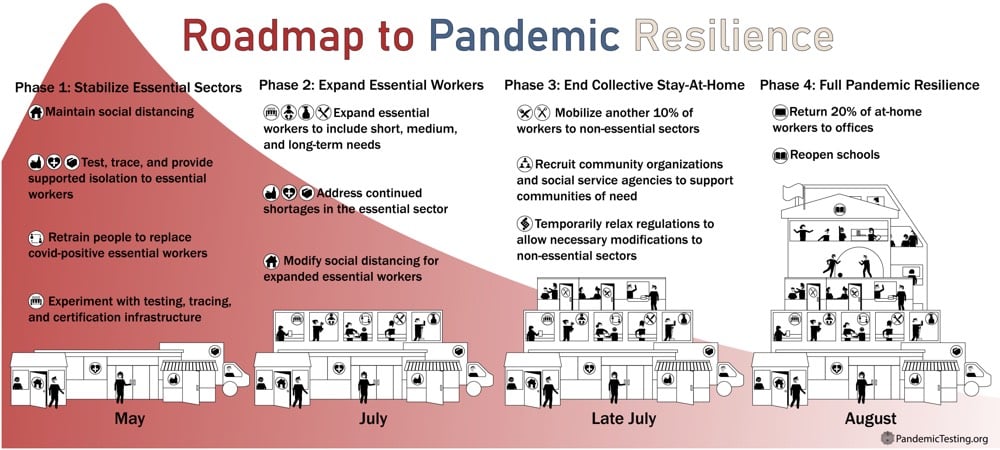
From the paper, here’s a quick overview:
What we need to do is much bigger than most people realize. We need to massively scale-up testing, contact tracing, isolation, and quarantine-together with providing the resources to make these possible for all individuals.
Broad and rapid access to testing is vital for disease monitoring, rapid public health response, and disease control.
We need to deliver 5 million tests per day by early June to deliver a safe social reopening. This number will need to increase over time (ideally by late July) to 20 million a day to fully remobilize the economy. We acknowledge that even this number may not be high enough to protect public health. In that considerably less likely eventuality, we will need to scale-up testing much further. By the time we know if we need to do that, we should be in a better position to know how to do it. In any situation, achieving these numbers depends on testing innovation.
Between now and August, we should phase in economic mobilization in sync with growth in our capacity to provide sustainable testing programs for mobilized sectors of the workforce.
The great value of this approach is that it will prevent cycles of opening up and shutting down. It allows us to steadily reopen the parts of the economy that have been shut down, protect our frontline workers, and contain the virus to levels where it can be effectively managed and treated until we can find a vaccine.
We can have bottom-up innovation and participation and top-down direction and protection at the same time; that is what our federal system is designed for.
This policy roadmap lays out how massive testing plus contact tracing plus social isolation with strong social supports, or TTSI, can rebuild trust in our personal safety and the safety of those we love. This will in turn support a renewal of mobility and mobilization of the economy. This paper is designed to educate the American public about what is emerging as a consensus national strategy.
The plan seems consistent with what economist Paul Romer has been saying — Without More Tests, America Can’t Reopen (And to make matters worse, we’re testing the wrong people) — and with the approach Hong Kong has been taking — Test and trace: lessons from Hong Kong on avoiding a coronavirus lockdown. See also the 4 plans to end social distancing, explained.
Unfortunately for this plan and for all of us, I have a feeling that the first true step in any rational plan to reopen the United States without unnecessary death and/or massive economic disruption that lasts for years is the removal of Donald Trump from office (and possibly also the end of the Republican-controlled Senate). Barring that, the ineffectual circus continues. (via @riondotnu)
Thousands of scientific research papers on Covid-19 and SARS-CoV-2 are being published each week and with them comes a clearer picture of the virus and the disease it causes. There’s still a lot we don’t know, but this piece from Science magazine is the best synthesis of the emerging science that I have read. It details a virus that “acts like no microbe humanity has ever seen” and affects not only the lungs but also the kidneys, heart, brain, and the intestines.
As the number of confirmed cases of COVID-19 surges past 2.2 million globally and deaths surpass 150,000, clinicians and pathologists are struggling to understand the damage wrought by the coronavirus as it tears through the body. They are realizing that although the lungs are ground zero, its reach can extend to many organs including the heart and blood vessels, kidneys, gut, and brain.
“[The disease] can attack almost anything in the body with devastating consequences,” says cardiologist Harlan Krumholz of Yale University and Yale-New Haven Hospital, who is leading multiple efforts to gather clinical data on COVID-19. “Its ferocity is breathtaking and humbling.”
Understanding the rampage could help the doctors on the front lines treat the fraction of infected people who become desperately and sometimes mysteriously ill. Does a dangerous, newly observed tendency to blood clotting transform some mild cases into life-threatening emergencies? Is an overzealous immune response behind the worst cases, suggesting treatment with immune-suppressing drugs could help? What explains the startlingly low blood oxygen that some physicians are reporting in patients who nonetheless are not gasping for breath? “Taking a systems approach may be beneficial as we start thinking about therapies,” says Nilam Mangalmurti, a pulmonary intensivist at the Hospital of the University of Pennsylvania (HUP).
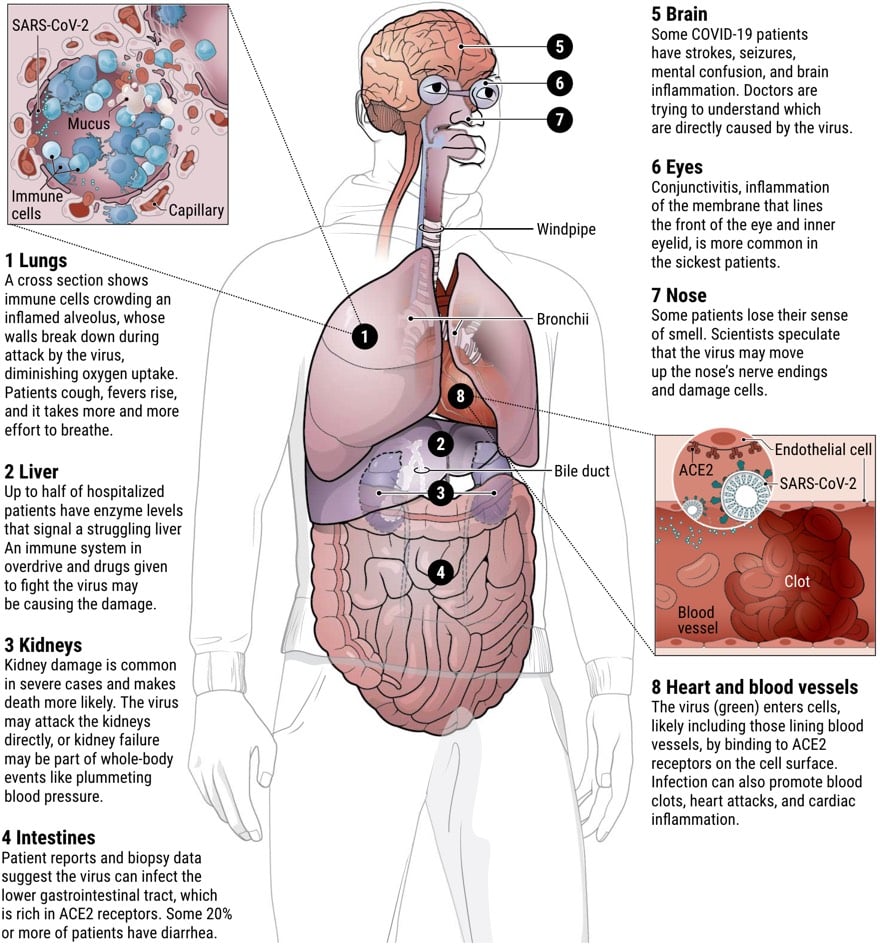
I’ve been hearing that although Covid-19’s attack begins in the lungs, it is as much a vascular disease as it is a respiratory disease — and there is some evidence emerging to support this view:
If COVID-19 targets blood vessels, that could also help explain why patients with pre-existing damage to those vessels, for example from diabetes and high blood pressure, face higher risk of serious disease. Recent Centers for Disease Control and Prevention (CDC) data on hospitalized patients in 14 U.S. states found that about one-third had chronic lung disease-but nearly as many had diabetes, and fully half had pre-existing high blood pressure.
Mangalmurti says she has been “shocked by the fact that we don’t have a huge number of asthmatics” or patients with other respiratory diseases in HUP’s ICU. “It’s very striking to us that risk factors seem to be vascular: diabetes, obesity, age, hypertension.”
What struck me most about this piece is the sheer energy of the vast network of minds bent towards understanding this thing with the hope of beating it as soon as possible. This is the scientific method at work right here, in all its urgent & messy glory.
From Retro Report, a short video about how epidemics, past and present, have been represented in music. Blues musicians sang about the 1918 flu pandemic and pop stars wrote songs about HIV/AIDS.
A disease that killed tens of millions of people, more than the number who died in World War I, might not seem like a promising subject for a song, but the legendary Texas bluesman Blind Willie Johnson didn’t see it that way. In Dallas in 1928, Johnson recorded “Jesus Is Coming Soon,” an intense chronicle of the ravaging influenza pandemic of 1918-1919. In a growl that conveyed the horror of the illness, as well as its scarifying ubiquity, Johnson declared that the “great disease was mighty and the people were sick everywhere / It was an epidemic, it floated through the air.”
Other lines seem as if they could have been written yesterday: “Well, the nobles said to the people, ‘You better close your public schools / Until the events of death has ended, you better close your churches, too.’”
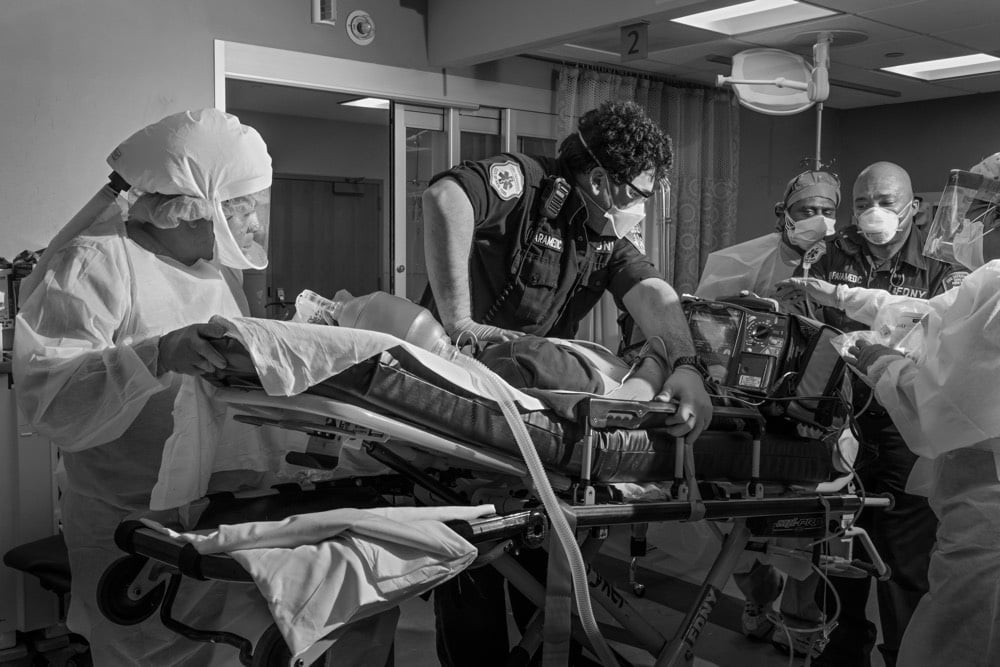
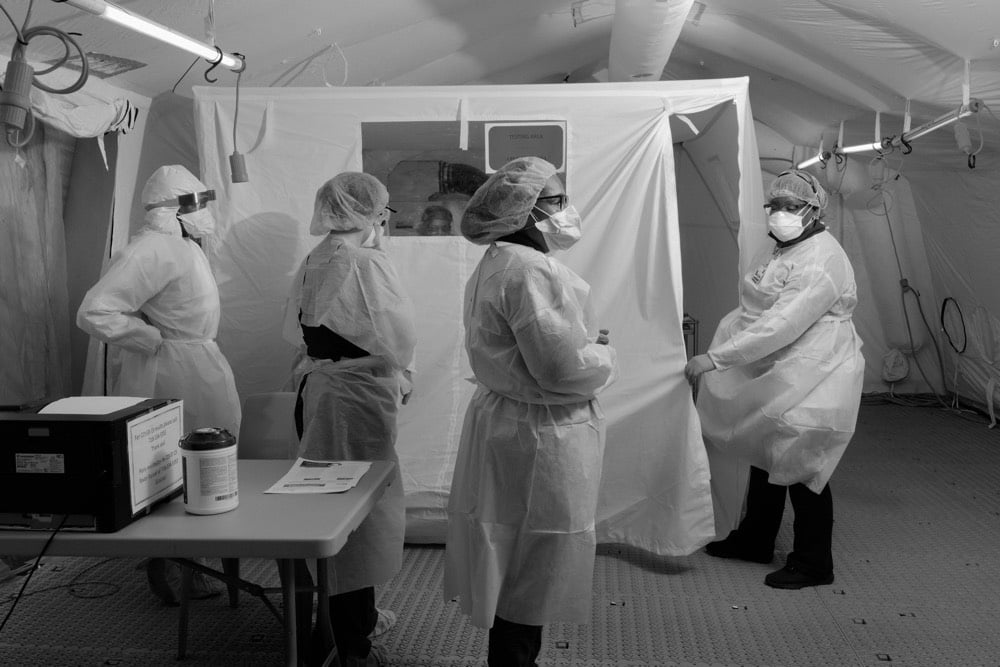
Clad in full PPE, photographer Philip Montgomery visited seven different NYC public hospitals over the course of a week for the NY Times Magazine, documenting the hospital workers’ fight against Covid-19, supply shortages, and intense working conditions.
At Elmhurst, the improvisation began as soon as the first surge of coronavirus patients started arriving in the middle of March. In order to more efficiently sift through the crowds and find the most severe cases, the staff set up a divider at the entrance. Medical workers armed with thermometers and oxygen monitors steered people with milder symptoms to a separate treatment tent. Those who were seriously ill went into critical care. Thirteen patients at the hospital died over a 24-hour stretch during the fourth week in March. A refrigerated trailer was parked behind the building to store dead bodies.
In a short behind-the-scenes video about his photos and the piece, Montgomery says “I think if the general public could stand where I was for at least 10 to 30 seconds, I think everyone would be staying home.”
From the same issue of the magazine, Dr. Helen Ouyang: I’m an E.R. Doctor in New York. None of Us Will Ever Be the Same. What initially started as an article about the situation in Italy rapidly escalates into NYC hospitals fighting those same battles.
Family members weren’t allowed into the hospital because they, too, could get infected or spread the virus to others if they themselves were sick. But Duca asked for permission from his supervisor to let the man’s wife and daughter in, just for a few minutes. “I saw his face when he looked at his wife coming inside this room,” Duca recalls. “He smiled at her. It was a fraction of a second. He had this wonderful smile.” He continues: “Then I saw that he was looking at me. He realized that there was something wrong if only his relatives were coming inside.” The man knew in that instant that he was going to die, Duca says. As the man’s breathing worsened, morphine was started. He died 12 hours later.
Read the whole thing; it’s upsetting, terrifying, and deeply humanizing. I wish Americans watched less TV news and read more — if everyone in the US read these articles, I believe the entire tone of this crisis would change and become more urgent.
The Atlantic’s Ed Yong has written his second long article about the Covid-19 pandemic about what happens next and what a roadmap to dealing with the next phase of the crisis might look like.
As I wrote last month, the only viable endgame is to play whack-a-mole with the coronavirus, suppressing it until a vaccine can be produced. With luck, that will take 18 to 24 months. During that time, new outbreaks will probably arise. Much about that period is unclear, but the dozens of experts whom I have interviewed agree that life as most people knew it cannot fully return. “I think people haven’t understood that this isn’t about the next couple of weeks,” said Michael Osterholm, an infectious-disease epidemiologist at the University of Minnesota. “This is about the next two years.”
The pandemic is not a hurricane or a wildfire. It is not comparable to Pearl Harbor or 9/11. Such disasters are confined in time and space. The SARS-CoV-2 virus will linger through the year and across the world. “Everyone wants to know when this will end,” said Devi Sridhar, a public-health expert at the University of Edinburgh. “That’s not the right question. The right question is: How do we continue?”
Nicky Case, working with security & privacy researcher Carmela Troncoso and epidemiologist Marcel Salathé, came up with this fantastic explanation of how we can use apps to automatically do contact tracing for Covid-19 infections while protecting people’s privacy. The second panel succinctly explains why contact tracing (in conjunction with quick, ubiquitous testing) can have such a huge benefit in a case like this:
A problem with COVID-19: You’re contagious ~2 days before you know you’re infected. But it takes ~3 days to become contagious, so if we quarantine folks exposed to you the day you know you were infected… We stop the spread, by staying one step ahead!

It’s based on a proposal called Decentralized Privacy-Preserving Proximity Tracing developed by Troncoso, Salathé, and a host of others. Thanks to Case for putting this comic in the public domain so that anyone can publish it.
Update: About two hours after posting this, Apple and Google announced they are jointly working on contact tracing technology that uses Bluetooth and makes “user privacy and security central to the design”.
A number of leading public health authorities, universities, and NGOs around the world have been doing important work to develop opt-in contact tracing technology. To further this cause, Apple and Google will be launching a comprehensive solution that includes application programming interfaces (APIs) and operating system-level technology to assist in enabling contact tracing. Given the urgent need, the plan is to implement this solution in two steps while maintaining strong protections around user privacy.
Update: Based on information published by Google and Apple on their contact tracing protocols, it appears as though their system works pretty much like the one outlined about in the comic and this proposal.
Also, here is an important reminder that the problem of what to do about Covid-19 is not primarily a technological one and that turning it into one is troublesome.
We think it is necessary and overdue to rethink the way technology gets designed and implemented, because contact tracing apps, if implemented, will be scripting the way we will live our lives and not just for a short period. They will be laying out normative conditions for reality, and will contribute to the decisions of who gets to have freedom of choice and freedom to decide … or not. Contact tracing apps will co-define who gets to live and have a life, and the possibilities for perceiving the world itself.
Update: Security expert Bruce Schneier has some brief thoughts on “anonymous” contact tracing as well as some links to other critiques, including Ross Anderson’s:
But contact tracing in the real world is not quite as many of the academic and industry proposals assume.
First, it isn’t anonymous. Covid-19 is a notifiable disease so a doctor who diagnoses you must inform the public health authorities, and if they have the bandwidth they call you and ask who you’ve been in contact with. They then call your contacts in turn. It’s not about consent or anonymity, so much as being persuasive and having a good bedside manner.
I’m relaxed about doing all this under emergency public-health powers, since this will make it harder for intrusive systems to persist after the pandemic than if they have some privacy theater that can be used to argue that the whizzy new medi-panopticon is legal enough to be kept running.
And I had thoughts similar to Anderson’s about the potential for abuse:
Fifth, although the cryptographers — and now Google and Apple — are discussing more anonymous variants of the Singapore app, that’s not the problem. Anyone who’s worked on abuse will instantly realise that a voluntary app operated by anonymous actors is wide open to trolling. The performance art people will tie a phone to a dog and let it run around the park; the Russians will use the app to run service-denial attacks and spread panic; and little Johnny will self-report symptoms to get the whole school sent home.
The tie-a-phone-to-a-dog thing reminds me a lot of the wagon full of smartphones creating traffic jams. (via @circa1977)
This week, Covid-19 passed heart disease and cancer as the leading cause of death per day in the United States. In this graph made by Dr. Maria Danilychev using data from Worldometer and the CDC, you can see that Covid-19 overtook heart disease sometime on Monday or Tuesday.
If the data in NYC is any indication, the number of nationwide Covid-19 deaths may be undercounted, so this transition probably happened sooner.1 Hopefully through the social distancing and other measures put in place to flatten the curve, the number of daily Covid-19 deaths won’t start beating out all other causes combined before it starts declining.
I do not know if hearing about other people’s quarantine experiences makes going through one yourself any easier, but the story of how NASA sequestered the returning Apollo 11 astronauts away from the rest of the world for 21 days is interesting for other reasons as well. The worry was that some sort of “moon bug” or “lunar plague” was going to make its way from the Moon to the Earth in the spacecraft or the astronauts’ bodies.
From the moment the Apollo 11 astronauts arrive back on earth from their epochal visit to the moon, they will be treated not as heroes but as bearers of the most virulent, devastating plague the world has ever known.
So NASA quarantined Armstrong, Aldrin, and Collins in a series of specially designed suits and environments until August 10, 1969. At one point, the three of them lived in a modified Airstream trailer in which the air pressure was lower on the inside than outside so if there was a leak, air would rush into the trailer, not out. Armstrong even celebrated a birthday in quarantine.
After Apollo 11, NASA did similar quarantines for 12 and 14 but abandoned them after that because they figured it was safe.
Oh, and if you were curious about the Soyuz launch yesterday that sent three astronauts to the ISS and how they were going to mitigate the chances of sending any SARS-CoV-2 up there, crews on all missions are subject to a mandatory 2 week quarantine before they leave (according to this press release).
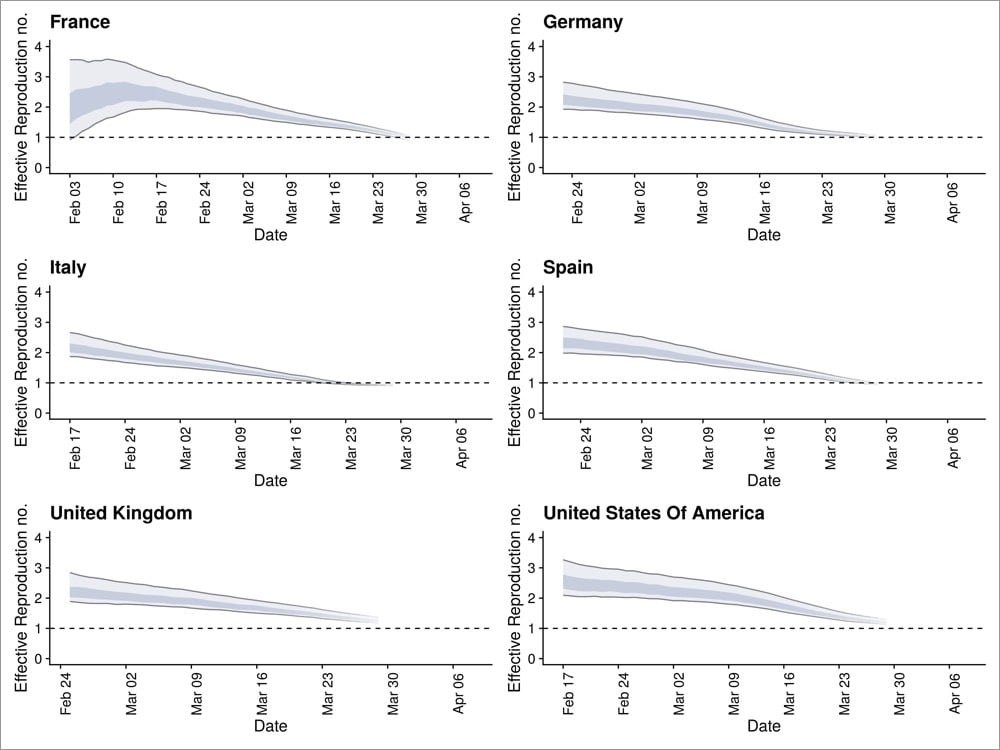
Trevor Bedford, who does research on epidemics and infectious diseases, has compiled a number of papers and data sets with “strong evidence” that social distancing measures have slowed Covid-19 transmission rates around the world.
This report (from the Imperial College team who produced the sobering report that has been the blueprint for pandemic responses around the world) estimates that measures taken in several European countries have lowered their effective reproduction numbers (the R value) to close to 1.
Overall, we estimate that countries have managed to reduce their reproduction number. Our estimates have wide credible intervals and contain 1 for countries that have implemented all interventions considered in our analysis. This means that the reproduction number may be above or below this value. With current interventions remaining in place to at least the end of March, we estimate that interventions across all 11 countries will have averted 59,000 deaths up to 31 March [95% credible interval 21,000-120,000]. Many more deaths will be averted through ensuring that interventions remain in place until transmission drops to low levels. We estimate that, across all 11 countries between 7 and 43 million individuals have been infected with SARS-CoV-2 up to 28th March, representing between 1.88% and 11.43% of the population. The proportion of the population infected to date — the attack rate — is estimated to be highest in Spain followed by Italy and lowest in Germany and Norway, reflecting the relative stages of the epidemics.
And this was published on March 30 — here’s the latest data. The paper goes on to say (italics mine):
We cannot say for certain that the current measures have controlled the epidemic in Europe; however, if current trends continue, there is reason for optimism.
An Institute for Disease Modeling report from March 29 shows a similar reduction in their effective reproduction number in King County, Washington (the 12th most populous county in the US).
The graphs at the top of the post are from the latest data compiled by the Centre for the Mathematical Modelling of Infectious Diseases. Lots of countries looking like they are headed for an effect R value of 1, which would indicate a slowing (rather than growing) epidemic.
As I’m writing this, according to Johns Hopkins’ Covid-19 tracker, Germany has recorded 100,186 confirmed cases of Covid-19 (fourth most in the world) and 1590 deaths — that’s a death rate of about 1.6%. Compare that to Italy (12.3%), China (4%), the US (2.9%), and even South Korea (1.8%) and you start to wonder how they’re doing it. This article from the NY Times details why the death rate is so low in Germany.
Another explanation for the low fatality rate is that Germany has been testing far more people than most nations. That means it catches more people with few or no symptoms, increasing the number of known cases, but not the number of fatalities.
“That automatically lowers the death rate on paper,” said Professor Kräusslich.
But there are also significant medical factors that have kept the number of deaths in Germany relatively low, epidemiologists and virologists say, chief among them early and widespread testing and treatment, plenty of intensive care beds and a trusted government whose social distancing guidelines are widely observed.
This article is a real punch in the gut if you’re an American. Obviously there are bureaucracies and inefficiencies in Germany like anywhere else, but it really seems like they listened to the experts and did what a government is supposed to do for its people before a disaster struck.
“Maybe our biggest strength in Germany,” said Professor Kräusslich, “is the rational decision-making at the highest level of government combined with the trust the government enjoys in the population.”
This whole crisis is really laying bare many of the worst aspects of American society — it’s increasingly obvious that the United States resembles a failed state in many ways. I can’t be the only American whose response to the pandemic is to think seriously about moving to a country with a functioning government, good healthcare for everyone, and a real social safety net.
This is an interesting piece by The Daily Beast’s Laura Bradley, who is one of a number of people who have seen their symptoms of anxiety and depression actually lessen during the pandemic. Part of it is the odd sense of joy experienced by some people going through disasters, but there are other possible explanations:
“I’m used to being in a room alone with my thoughts for an extended period of time,” Weinstein said, adding that under quarantine, “You kind of run through the gamut of, ‘OK what if I’m not out of here in 20 days; what if I’m not out of here in 40 days; what if I’m not out here in 60 days? What will happen to me?” Due to her history of depression and anxiety, Weinstein is also used to, as she put it, “shrinking away from life” for a period of time.
“These are thought processes I am used to having and welcome — and know how to cut off in a kind, loving way after they’ve been around a little too long,” Weinstein said.
It would also make sense that if your depression or anxiety focuses on being out in a busy and complicated world, dealing with a greatly simplified situation might be beneficial. Either way, this is another reminder of the infinite number of ways that different people can react to a crisis.
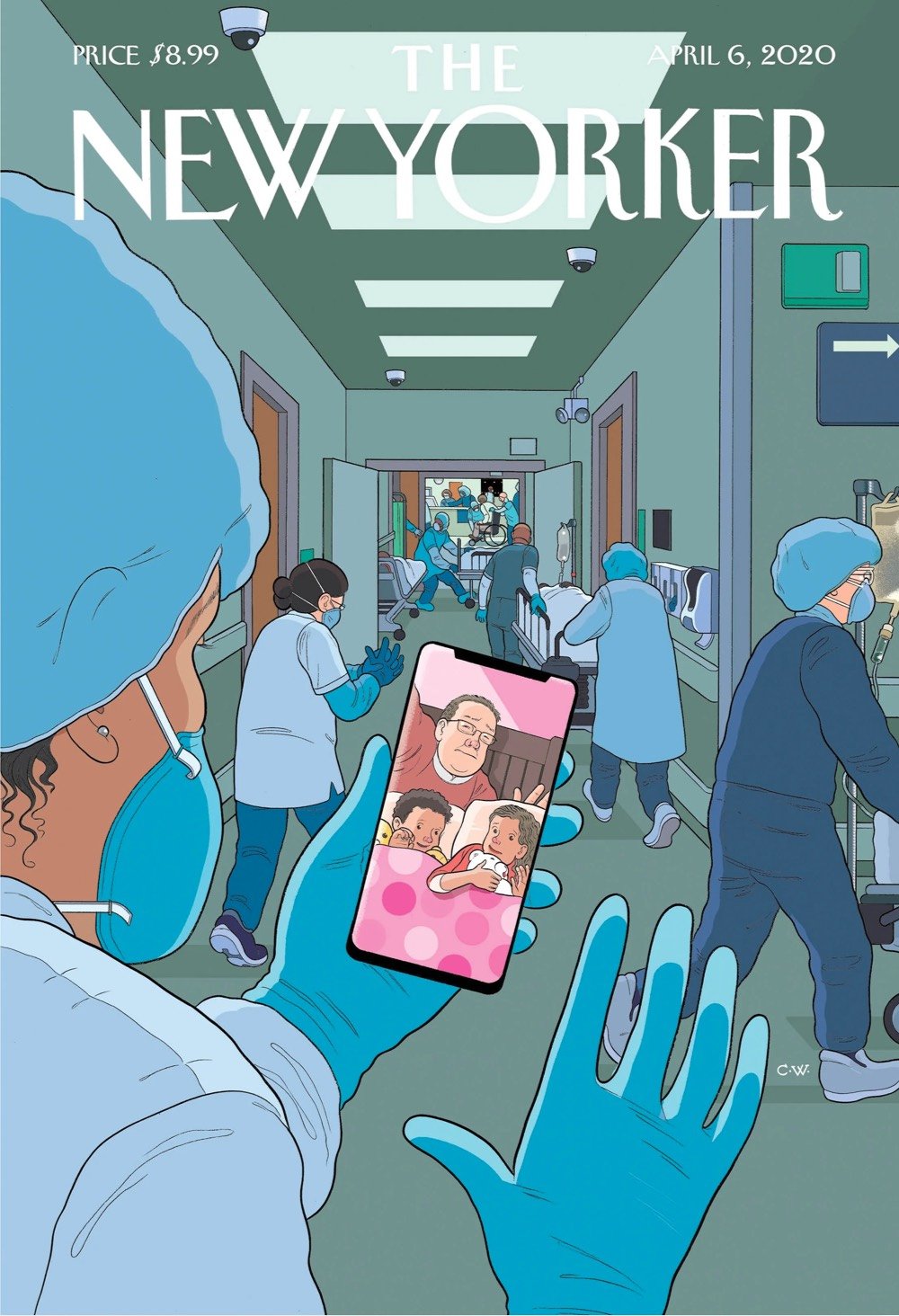
This is Chris Ware’s illustration for the cover of this week’s New Yorker, the magazine’s annual Health Issue. The pandemic had to be the topic for the cover, and Ware’s daughter suggested that the specific theme focus on the families of the healthcare workers on the front lines of the crisis.
“As a procrastination tactic, I sometimes ask my fifteen-year-old daughter what the comic strip or drawing I’m working on should be about — not only because it gets me away from my drawing table but because, like most kids of her generation, she pays attention to the world. So, while sketching the cover of this Health Issue, I asked her.
“‘Make sure it’s about how most doctors have children and families of their own,’ she said.
“Good idea. And a personal one: one of her friend’s parents are both doctors; that friend, now distilled into a rectangular puddle of light on my daughter’s nightstand, reported that her mom had temporarily stopped going to work, pending the results of a COVID-19 test.

Have you been wearing a face mask when going out in public recently? There’s been a lot of debate recently about whether they are effective in keeping people safe from COVID-19 infection, and it’s been really challenging to find good information. After reading several things over the past few days, I have concluded that wearing a mask in public is a helpful step I can take to help keep myself and others safe, with the important caveat that healthcare workers need access to masks before the rest of us (see below). In particular, I found this extensive review of the medical and scientific literature on mask & respirator use helpful, including why research on mask efficacy is so hard to do and speculation on why the CDC and WHO generally don’t recommend wearing them.
I was able to find one study like this outside of the health care setting. Some people with swine flu travelled on a plane from New York to China, and many fellow passengers got infected. Some researchers looked at whether passengers who wore masks throughout the flight stayed healthier. The answer was very much yes. They were able to track down 9 people who got sick on the flight and 32 who didn’t. 0% of the sick passengers wore masks, compared to 47% of the healthy passengers. Another way to look at that is that 0% of mask-wearers got sick, but 35% of non-wearers did. This was a significant difference, and of obvious applicability to the current question.
See also this review of relevant scientific literature, this NY Times piece, this Washington Post opinion piece by Jeremy Howard (who is on a Twitter mission to get everyone to wear masks):
When historians tally up the many missteps policymakers have made in response to the coronavirus pandemic, the senseless and unscientific push for the general public to avoid wearing masks should be near the top.
The evidence not only fails to support the push, it also contradicts it. It can take a while for official recommendations to catch up with scientific thinking. In this case, such delays might be deadly and economically disastrous. It’s time to make masks a key part of our fight to contain, then defeat, this pandemic. Masks effective at “flattening the curve” can be made at home with nothing more than a T-shirt and a pair of scissors. We should all wear masks — store-bought or homemade — whenever we’re out in public.
At the height of the HIV crisis, authorities did not tell people to put away condoms. As fatalities from car crashes mounted, no one recommended avoiding seat belts. Yet in a global respiratory pandemic, people who should know better are discouraging Americans from using respiratory protection.
I have to admit that I have not been wearing a mask out in public — I’ve been to the grocery store only three times in the past two weeks, I go at off-hours, and it’s rural Vermont, so there’s not actually that many people about (e.g. compared to Manhattan). But I’m going to start wearing one in crowded places (like the grocery store) because doing so could a) safeguard others against my possible infection (because asymptomatic people can still be contagious), b) make it less likely for me to get infected, and c) provide a visible signal to others in my community to normalize mask wearing. As we’ve seen in epidemic simulations, relatively small measures can have outsize effects in limiting later infections & deaths, and face masks, even if a tiny bit effective, can have a real impact.
Crucially, the available research and mask advocates stress the importance of wearing masks properly and responsibly. Here are some guidelines I compiled about responsible mask usage:
Don’t buy masks (or use new masks you might have at home) while there is a shortage for healthcare workers, especially not N95 respirators (which are difficult to use properly anyway). Make a mask at home. Skiers & snowboarders, wear your buffs or ski masks. Donate any unused masks or respirators you may have to healthcare workers.
Make sure your mask fits properly — limit any gaps between the mask and your face as much as you can. (Facial hair can limit mask effectiveness.)
While wearing your mask in public, don’t fuss with it — touching your face is bad, remember? Wear it at home for a few hours to get used to the sensation. Then when you’re ready to go out, put it on properly and don’t touch it again until you’re back home (or in the car or whatever). Part of the point of the mask is for you to touch your face less.
Limit reuse of potentially contaminated masks. Discard or, if possible, wash or disinfect masks after public usage or at the end of the day.
Wearing a mask doesn’t mean you can safely go do a bunch of things without fear of getting infected. The idea here is to protect yourself while engaging in necessary activities in public. Wearing a mask doesn’t mean you can visit grandma safely or discard the six-feet-away rule.
Don’t do anything stupid like spraying your mask with a household cleaner that contains bleach and put it on. Come on.
So that’s what I’ve personally concluded from all my reading. I hope wearing masks can help keep us a little safer during all of this.
Update: From Ferris Jabr at Wired, It’s Time to Face Facts, America: Masks Work.
It is unequivocally true that masks must be prioritized for health care workers in any country suffering from a shortage of personal protective equipment. But the conflicting claims and guidelines regarding their use raise three questions of the utmost urgency: Do masks work? Should everyone wear them? And if there aren’t enough medical-grade masks for the general public, is it possible to make a viable substitute at home? Decades of scientific research, lessons from past pandemics, and common sense suggest the answer to all of these questions is yes.
Update: The Atlantic’s Ed Yong weighs in on masks:
In Asia, masks aren’t just shields. They’re also symbols. They’re an affirmation of civic-mindedness and conscientiousness, and such symbols might be important in other parts of the world too. If widely used, masks could signal that society is taking the pandemic threat seriously. They might reduce the stigma foisted on sick people, who would no longer feel ashamed or singled out for wearing one. They could offer reassurance to people who don’t have the privilege of isolating themselves at home, and must continue to work in public spaces. “My staff have also mentioned that having a mask reminds them not to touch their face or put a pen in their mouth,” Bourouiba noted.
He also writes about something I’ve been wondering about: is the virus airborne, what does that even mean, when will we know for sure, and how should that affect our behavior in the meantime?
These particles might not even have been infectious. “I think we’ll find that like many other viruses, [SARS-CoV-2] isn’t especially stable under outdoor conditions like sunlight or warm temperatures,” Santarpia said. “Don’t congregate in groups outside, but going for a walk, or sitting on your porch on a sunny day, are still great ideas.”
You could tie yourself in knots gaming out the various scenarios that might pose a risk outdoors, but Marr recommends a simple technique. “When I go out now, I imagine that everyone is smoking, and I pick my path to get the least exposure to that smoke,” she told me. If that’s the case, I asked her, is it irrational to hold your breath when another person walks past you and you don’t have enough space to move away? “It’s not irrational; I do that myself,” she said. “I don’t know if it makes a difference, but in theory it could. It’s like when you walk through a cigarette plume.”
And from the WHO, here’s a video on how to wear a mask properly.
Update: One of the reasons I started to wear a mask when I go out in public was to “provide a visible signal to others in my community to normalize mask wearing”. Maciej Cegłowski’s post touches on this and other reasons to wear a mask that don’t directly have to do with avoiding infection.
A mask is a visible public signal to strangers that you are trying to protect their health. No other intervention does this. It would be great if we had a soap that turned our hands gold for an hour, so everyone could admire our superb hand-washing technique. But all of the behaviors that benefit public health are invisible, with the exception of mask wearing.
If I see you with a mask on, it shows me you care about my health, and vice versa. This dramatically changes what it feels like to be in a public space. Other people no longer feel like an anonymous threat; they are now your teammates in a common struggle.
Back when the COVID-19 pandemic was beginning to be taken seriously by the American public, 3blue1brown’s Grant Sanderson released a video about epidemics and exponential growth. (It’s excellent — I recommend watching it if you’re still a little unclear on how things are got so out of hand so quickly in Italy and, very soon, in NYC.) In his latest video, Sanderson digs a bit deeper into simulating epidemics using a variety of scenarios.
Like, if people stay away from each other I get how that will slow the spread, but what if despite mostly staying away from each other people still occasionally go to a central location like a grocery store or a school?
Also, what if you are able to identify and isolate the cases? And if you can, what if a few slip through, say because they show no symptoms and aren’t tested?
How does travel between separate communities affect things? And what if people avoid contact with others for a while, but then they kind of get tired of it and stop?
These simulations are fascinating to watch. Many of the takeaways boil down to: early & aggressive actions have a huge effect in the number of people infected, how long an epidemic lasts, and (in the case of a disease like COVID-19 that causes fatalities) the number of deaths. This is what all the epidemiologists have been telling us — because the math, while complex when you’re dealing with many factors (as in a real-world scenario), is actually pretty straightforward and unambiguous.
The biggest takeaway? That the effective identification and isolation of cases has the largest effect on cutting down the infection rate. Testing and isolation, done as quickly and efficiently as possible.
See also these other epidemic simulations: Washington Post and Kevin Simler.
Note: Please keep in mind that these are simulations to help us better understand how epidemics work in general — it’s not about how the COVID-19 pandemic is proceeding or will proceed in the future.
Note: Please check the updates below for some important corrections to some of the information in this video.
From Dr. Jeffrey VanWingen MD, a video on how to ensure that your grocery shopping experience is as safe as possible and to avoid potential COVID-19 infection from plastic and metal surfaces. I’m going to be honest with you: a lot of this seems like overkill (as it should — see the Paradox of Preparation). However, this is also pretty much what I’ve been doing after grocery shopping for the past 2 weeks because I am a fastidious motherfucker1 with plenty of time to wipe down groceries. If it comes down to a choice between watching 7 more minutes of The Mandalorian or wiping down my groceries before putting them in the fridge, I’m gonna wipe them groceries. Baby Yoda can wait.
See also this PDF from Crumpton Group about how to keep your household free of the outside effects of the COVID-19 pandemic.
Household members should understand that their principal effort should be directed towards isolating the inside of the home from the pandemic effects outside. All physical thresholds of the home will serve as a cordon sanitaire. Strive to decontaminate everyone and everything to the best practical degree before entering.
Many of Dr. VanWingen’s recommendations mirror those in the PDF. See also expert guidance on COVID-19 and food safety. (thx, meg)
Update: I have not had a chance to read it yet (was attending to some other things this evening — family, trying to have some normalcy), but I’ve been told that this thread is a good response to the video above. I’ll have a closer look at it tomorrow.
Update: Ok, I’ve read Don Schaffner’s thread criticizing this video. At least I think this is the video he’s referring to because he never says it outright — which I’ll get to in a minute. (Schaffner is a professor in the food science department at Rutgers who I linked to the other day in my post on COVID-19 and food safety.) As he notes, there are a couple of factual errors and VanWingen does offer some dubious advice, particularly about washing food with soap (which I didn’t take seriously). I do not believe, however, that VanWingen was suggesting that people leave frozen items and perishables in a warm garage for 3 days and that the normal rules of food safety are somehow countermanded by potential coronavirus contamination. If you want to leave that box of Cheerios that you don’t need in the car for 3 days, go right ahead. He definitely should have been clearer on that point though.
But the bulk of VanWingen’s video was about how to handle your groceries and takeout food coming into your house to minimize the chance of infection. (And as I mentioned, much of it mirrors the advice in this document and in Dr. Michael Lin’s document from a couple of weeks ago — this isn’t just his opinon or my opinion.) If we are to take seriously a) the assumption that anyone could have COVID-19 (including yourself & grocery workers) that we are operating under w/r/t to handwashing & keeping a 6-foot distance, b) the preliminary results that suggest that SARS-CoV-2 can last on some surfaces for days, and c) that person-to-surface-to-person transfer of SARS-CoV-2 might result in infection (i.e. the reason we are doing all this handwashing and face not-touching), then we should be disinfecting surfaces that other people have been touching recently. Right? We should assume that all surfaces are contaminated. This doesn’t seem outlandish, especially when grocery stores are restocking shelves continuously — that bag of chips that you put into your cart may have been placed on the shelf only 30 minutes before. How is disinfecting your Oreos package when you get home from the store a bad idea? Sure, wash your hands before you eat, but if you have kids, you know how futile that can be sometimes, especially when Oreos are involved. So why not just clean the package? Ditto with transferring takeout food to new containers and giving it a blast in the microwave to warm it up.
Schaffner’s stance is that most surfaces aren’t contaminated to a high degree, which is undoubtably true. Having watched the video & read Schaffner’s advice (and other advice by other experts), where your personal comfort level with making sure the surfaces you and your family come into contact to are disinfected is up to you. Ultimately, advice from experts is still advice and you have to figure out whether it works for you. It’s easy to believe you should wash your hands frequently because that’s universal advice. But “you should disinfect surfaces you touch” and “you don’t have to worry too much about disinfecting your grocery packages” are genuinely conflicting bits of advice from well-meaning experts! You’ve gotta use your noggin and make up your own mind, based on your personal idea of risk and safety. It’s gonna land differently with different people.
Finally, I’m going to get a little cranky here, but I found Schaffner’s overall tone in the first few tweets of that thread mocking, ungenerous, and unhelpful. Instead of gently offering alternative authoritative advice, he subtweeted (by refusing to link to the video and calling Dr. VanWingen not by his name but referring to him as “the video MD”) and made fun of VanWingen’s outfit. I know it must be frustrating to see what you perceive as misinformation out there, but we do not need Doctor vs Doctor battles here. Everyone’s just going to get defensive and dig their heels in.
Update: From Joseph Allen of Harvard’s School of Public Health, Don’t panic about shopping, getting delivery or accepting packages.
Yes, the virus can be detected on some surfaces for up to a day, but the reality is that the levels drop off quickly. For example, the article shows that the virus’s half-life on stainless steel and plastic was 5.6 hours and 6.8 hours, respectively. (Half-life is how long it takes the viral concentration to decrease by half, then half of that half, and so on until it’s gone.)
And here’s how to take reasonable precautions when getting a package delivery or going to the grocery store:
You can leave that cardboard package at your door for a few hours - or bring it inside and leave it right inside your door, then wash your hands again. If you’re still concerned there was any virus on the package, you could wipe down the exterior with a disinfectant, or open it outdoors and put the packaging in the recycling can. (Then wash your hands again.)
What about going to the grocery store? The same approach applies.
Shop when you need to (keeping six feet from other customers) and load items into your cart or basket. Keep your hands away from your face while shopping, and wash them as soon as you’re home. Put away your groceries, and then wash your hands again. If you wait even a few hours before using anything you just purchased, most of the virus that was on any package will be significantly reduced. If you need to use something immediately, and want to take extra precautions, wipe the package down with a disinfectant. Last, wash all fruits and vegetables as you normally would.
Important caveat: the coronavirus half-life times are for room temperature. For colder temperatures (like in the fridge or especially the freezer), the virus will last longer. So maybe wipe down that bag of frozen peas even if you’re not going to use them for a couple of days.
Newer posts
Older posts






Socials & More