



Mugshots from the 1920s
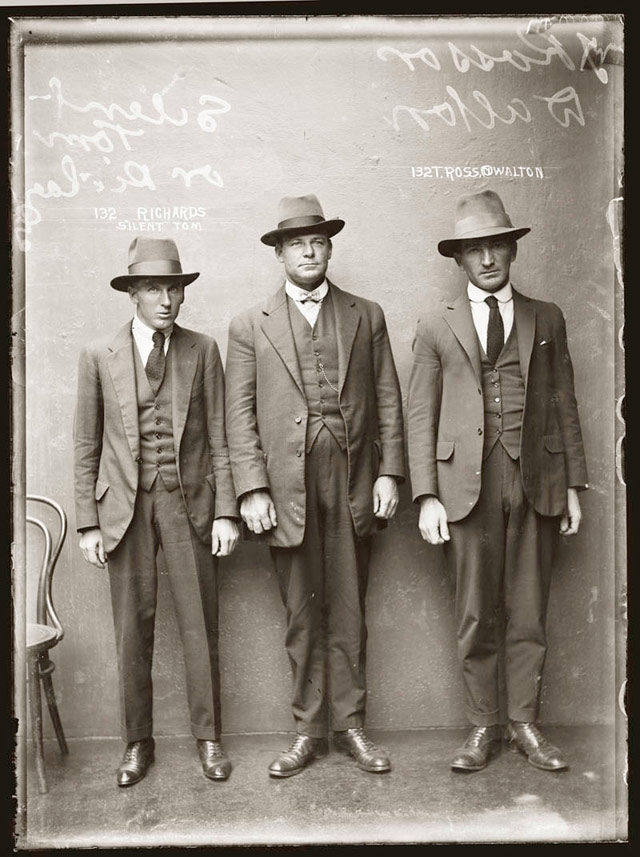
A collection of vintage mugshots from the 1920s. Crime used to be a lot more civilized.
(thx, david)

This site is made possible by member support. 💞
Big thanks to Arcustech for hosting the site and offering amazing tech support.
When you buy through links on kottke.org, I may earn an affiliate commission. Thanks for supporting the site!
kottke.org. home of fine hypertext products since 1998.
Beloved by 86.47% of the web.
A collection of vintage mugshots from the 1920s. Crime used to be a lot more civilized.
(thx, david)
Flint and Tinder is attempting to reintroduce American-made underwear back into US stores with a Kickstarter project. They’ve raised $39,000+ so far.
The factory I’m working with is family owned and operated. It’s over 100 years old. Just before the recession hit, they moved into a larger facility and invested in some of the capital improvements shown in the video (solar power etc.).
At that time they had 300+ employees and were hoping to double or triple in size. When we started this project however, with the economy in free-fall, they were down to just 90.
They’ve agreed to learn to make this new, high-end brand of American-made underwear. Here’s the fun part though: For ever 1000 pair we sell per month, 1 full-time job has to be added back to the assembly line. Hopefully, with your support, it will help them keep the doors open.
The Intimacy 2.0 fashion garments become see-through when the wearer’s heart rate increases.
I think my pants are broken. They should be fully transparent at the moment… (via ★warrenellis)
The first episode of the second season of Put This On is out (as funded on Kickstarter). The episode takes place in NYC and features a segment on Lo Heads, a subculture of Polo Ralph Lauren enthusiasts.
With roots in 1980s street gangs, these Polo Ralph Lauren enthusiasts have made “aspirational apparel” a lifestyle. They once had to boost their Polo from stores and fight to keep it on the streets. Today, their culture is worldwide, promulgated by hip-hop. Their hero is Ralph Lauren — a working class New Yorker who understood that the fantastical power of style can be transformative. Dallas Penn from The Internets Celebrities, a dedicated Lo Head (and former member of the Decepts crew) with a collection of over 1000 pieces of Polo apparel takes us on a tour of this remarkable fashion subculture.
Over at Sew Weekly, Mena Trott predicts what some of the characters will be wearing in the coming season of Mad Men.
Oh, Betty. For years, she has been immaculately dressed and presented as the facade of the perfect 1950s/1960s wife. With her cinched waists and billowing skirts, she’s held onto late 1950s and early 1960s fashion the longest. In season four, she’s married to the anti-Don, the boring Henry Francis and is getting a little too familiar with the bottle. When you’re married to Henry Francis, you just don’t care any more. That should be embroidered on a pillow.
Available at Etsy, prints of Star Wars characters wearing designer clothes by John Woo (not the director). A stormtrooper wearing Thom Browne, Boba Fett wearing Supreme Visvim, and my favorite, Jango Fett wearing Comme des Garçons.
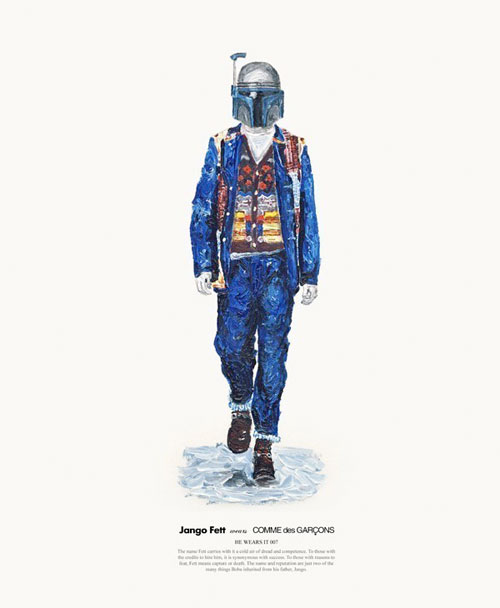
Woo does similar illustrations outside the Star Wars universe…here’s the T-1000 from Terminator 2 wearing Thom Browne. (via flavorwire)

Last year, Vice travelled to Matehuala, Mexico in search of dance crews who wear extremely pointy cowboy boots called botas vaqueras exóticas.
In Matehuala, guarachero has become an unlikely style of music where a bunch of people who in theory should not get along come together and get along. It’s also the music preferred by the men and boys in the long and pointed boots.
Participants in these dance contests spend the days and weeks prior choreographing intricate footwork routines and fabricating their own outfits with cheap paint and fabric. The grand prize, beyond the enthusiastic crowd’s affection, is either a bottle of whiskey or a few bucks.
(via mlkshk)
In a piece for Vanity Fair, Kurt Andersen argues that for the first time in recent history, American pop culture (fashion, art, music, design, entertainment) hasn’t changed dramatically in the past 20 years.
Since 1992, as the technological miracles and wonders have propagated and the political economy has transformed, the world has become radically and profoundly new. (And then there’s the miraculous drop in violent crime in the United States, by half.) Here is what’s odd: during these same 20 years, the appearance of the world (computers, TVs, telephones, and music players aside) has changed hardly at all, less than it did during any 20-year period for at least a century. The past is a foreign country, but the recent past — the 00s, the 90s, even a lot of the 80s — looks almost identical to the present. This is the First Great Paradox of Contemporary Cultural History.
Think about it. Picture it. Rewind any other 20-year chunk of 20th-century time. There’s no chance you would mistake a photograph or movie of Americans or an American city from 1972-giant sideburns, collars, and bell-bottoms, leisure suits and cigarettes, AMC Javelins and Matadors and Gremlins alongside Dodge Demons, Swingers, Plymouth Dusters, and Scamps-with images from 1992. Time-travel back another 20 years, before rock ‘n’ roll and the Pill and Vietnam, when both sexes wore hats and cars were big and bulbous with late-moderne fenders and fins-again, unmistakably different, 1952 from 1972. You can keep doing it and see that the characteristic surfaces and sounds of each historical moment are absolutely distinct from those of 20 years earlier or later: the clothes, the hair, the cars, the advertising — all of it. It’s even true of the 19th century: practically no respectable American man wore a beard before the 1850s, for instance, but beards were almost obligatory in the 1870s, and then disappeared again by 1900. The modern sensibility has been defined by brief stylistic shelf lives, our minds trained to register the recent past as old-fashioned.
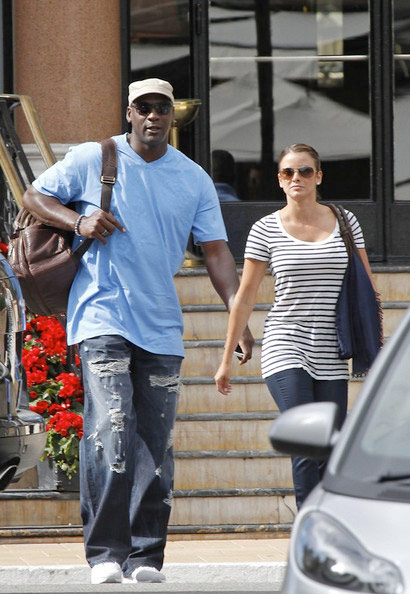
Men hate shopping so they buy their favorite shoes/coats/pants/shirts in bulk. Here are interviews with some of those men. Guess who this might be:
I hate to shop. For the last 20 years I only shopped once every two or three years. I would go to the big and tall store and buy only what I could find in 20 minutes, tops - usually a few dozen briefs, T-shirts and sweaters. If there was time left, I would try on a jacket. Nothing needed to be perfect: just fit and be black.
Now I am buying African block-print shirts and pants in a riot of colors and patterns from an African street merchant. I visit him every few weeks to see what’s new. I buy 10 or 15 at a time.
I like Mike but his wardrobe is pure WTF. Like these jeans:
This is sort of the opposite of the NBA fashion nerds.
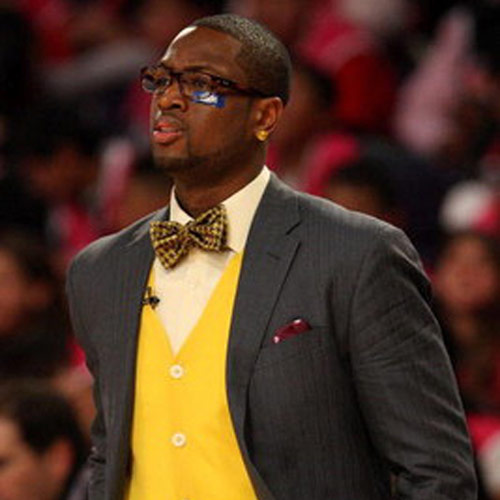
NBA players, especially the younger ones, are dressing like nerds.
In their tandem press conferences, LeBron James and Dwyane Wade, of the Miami Heat, alternate impeccably tailored suits with cardigans over shirts and ties. They wear gingham and plaid and velvet, bow ties and sweater vests, suspenders, and thick black glasses they don’t need. Their colors conflict. Their patterns clash. Clothes that once stood as an open invitation to bullies looking for something to hang on the back of a bathroom door are what James now wears to rap alongside Lil Wayne. Clothes that once signified whiteness, squareness, suburbanness, sissyness, in the minds of some NBA players no longer do.
If you happen to be someone who looks at Durant, James, or Amar’e Stoudemire’s Foot Locker commercials — in which he stalks along a perilously lit basketball court wearing a letterman’s cardigan, a skinny tie, and giant black glasses (his are prescription) — and wonders how the NBA got this way, how it turned into Happy Days, you’re really wondering the same thing about the rest of mainstream black culture. When did everything turn upside down? Who relaxed the rules? Is it really safe to look like Carlton Banks?
See also Kanye West and his entourage circa 2009. (thx, sveinn)
Nike has designed a soccer shoe for Real Madrid’s Cristiano Ronaldo that uses a striped pattern on one side of the shoe designed to confuse opponents as to which way Ronaldo might be moving his feet.
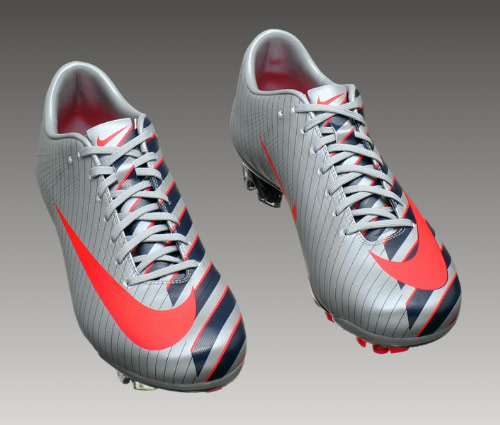
The cleats look remarkably different from each side of Ronaldo. From the right, they have a clean look with pinstripes. From the left, though, there are thick stripes with a red accent line. Furthermore, the asymmetrical design makes a defender’s judgment that much harder, as the visual effect of Ronaldo turning his foot in one direction may not come across exactly the same as reality.
Reminds me of the dazzle camouflage used on military ships in WWI and WWII.
Dress like your favorite nerdy folk: Nerd Girlfriend is a companion site to the excellent Nerd Boyfriend.
If you were thinking that all of H&M’s clothing models are looking pretty much the same these days, that’s because the bodies are computer generated with heads pasted on in post-production.
But man, isn’t looking at the four identical bodies with different heads so uncanny? Duly noted that H&M made one of the fake bodies black. You can’t say that the fictional, Photoshopped, mismatched-head future of catalog modeling isn’t racially diverse.
Got this from several people yesterday: are these people dressed up for Halloween or just live in Williamsburg? It’s surprisingly difficult to tell.
Monsters of Grok offers “fake band t-shirts for history’s greatest minds”. The Tesla/Edison send-up of AC/DC is nearly genius, but I like the Machiavelli/Metallica one better for some reason.

These remind me of IFC’s Cinemetal shirts. (via many different vectors)
A couple dances their way through 100 years of fashion, from 1911 to 2011.
The seventh episode of Put This On covers personal style…for which they interviewed Gay Talese.
A short and charming documentary about fashionable seniors who are very much young-at-heart.
I’m not ready for a convent or anything, so I can wear leopard glasses.
If you like that, check out the portraits on Advanced Style, which is like a Sartorialist for the AARP set.
Jerry Seinfeld seemingly wore a different pair of sneakers (mostly Nikes) on his TV show each week…here are 50 pages of analysis of Jerry’s shoe choices. For 90s athletic shoe and Seinfeld superfans only. (via @cory_arcangel)
The gender-specific colors we have today for kids — pink for girls and blue for boys — didn’t come about until the 1940s…before that, pink was recommended as a color for boys.
But nowadays people just have to know the sex of a baby or young child at first glance, says Jo B. Paoletti, a historian at the University of Maryland and author of Pink and Blue: Telling the Girls From the Boys in America, to be published later this year. Thus we see, for example, a pink headband encircling the bald head of an infant girl.
Why have young children’s clothing styles changed so dramatically? How did we end up with two “teams” — boys in blue and girls in pink?
“It’s really a story, what happened to neutral clothing,” says Paoletti, who has explored the meaning of children’s clothing for 30 years. For centuries, she says, children wore dainty white dresses up to age 6. “What was once a matter of practicality — you dress your baby in white dresses and diapers; white cotton can be bleached-became a matter of ‘Oh my God, if I dress my babies in the wrong thing, they’ll grow up perverted,’” Paoletti says.
It is nearly impossible, even in NYC, to find girls clothes that are not pink unless you pay through the nose for imported European kids clothes. See also vocabulary in boys and girls toy advertising. (via megnut, who is fighting to keep our kids in gender neutral clothing)
These are the people who pay full price for the clothes that appear on the runways of Paris, NY, Milan, etc.
Christine Chiu wears most items only once. The 28-year-old, who is married to the founder of Beverly Hills Plastic Surgery, goes to events every night of the week-often making multiple wardrobe changes in a single night.
“If you’re going to a gala for some kind of disease and then you go to a hip art event, you can’t wear the same thing,” Ms. Chiu says.
(via mr)
Hermes has a handy PDF file that shows you how to tie their famous scarves into all sorts of configurations, like so:

You can even fold some of the larger scarves into handbags.
Looks like Bill Cunningham New York will be showing around the US starting with New York on March 16th. (Film Forum!) And hark, a trailer.
If you don’t take money, they can’t tell you what to do. That’s the key to the whole thing.
This is a hoot: in want of slacks, President Lyndon Johnson called up the Haggar clothing company and requested several pairs be made in the style of a pair he already owned. Except a little bigger in the crotch…”down where your nuts hang” as Johnson put it. Just listen:
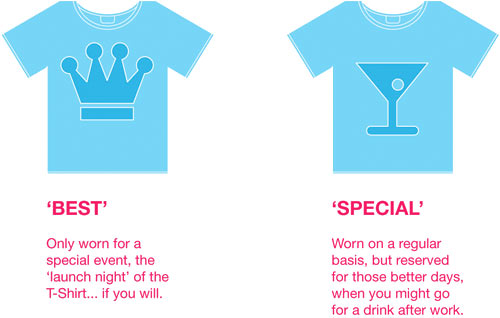
While organizing his closet, Nick Foster came up with a categorization scheme for his many t-shirts.
A really lovely seven-minute documentary about Scott Schuman, aka The Sartorialist.
Watching the concentration, focus, and determination in Schuman’s eyes and body as he walks around looking for photographic subjects immediately reminded me of an elite athlete; that same look was documented at length in Zidane, A 21st Century Portrait. And that’s no accident…what Schuman does is an athletic pursuit as much as anything else. The way he holds his camera while walking, down by his side, slightly behind his back, hiding it from his potential subjects until he sees an opening…he’s like a running back cradling a football, probing for an opening in the defensive line.
After ten years, she’s stepping down as editor-in-chief.
“I had so much freedom to do everything I wanted. I think I did a good job.” But she added, “When everything is good, maybe I think it’s the time to do something else.” She expects to complete issues through March. She said she was not sure what she would do after that. “I have no plan at all,” she said.
On Monday night, at a screening of the movie “Due Date,” Courtney Love told a reporter from Style.com that she was trying to take better care of herself.
Or, perhaps not:
Shortly after 8 p.m., Ms. Love burst into the room with the Marchesa dress slung on one arm and the noted German Neo-Expressionist artist Anselm Kiefer on the other. She was entirely naked and leaning on Mr. Kiefer for support. She made one lap around the room, walking in front of a photographer, an assistant, a hairstylist and me. She pulled over her head a transparent lace dress that covered up nothing, and demanded my assistance — “Not you,” she said to Mr. Kiefer, who was bent over trying to help her — to stuff her feet into a pair of black Givenchy heels that were zipped up the back and tied with delicate laces in the front. Then she applied a slash of red lipstick in the vicinity of her mouth.
“I really must get out of here,” Mr. Kiefer said.
“Just a minute,” Ms. Love said, as she pushed her feet, shoes and all, through a pair of pink knickers that she said cost $4,000. She grabbed a trench coat, walked through the hotel lobby with her breasts exposed to an assortment of prominent fashion figures, including Stefano Pilati, the Yves Saint Laurent designer, and then exited the hotel.
Like Ms. Love, this profile of her is anything but boring.
Nerd Boyfriend, a site that details the sartorial choices of desirable nerds, shows us where to buy the outfit Carl Sagan wore in Cosmos.

Socials & More