kottke.org posts about education
Tyler Cowen once gave the following final test to one of his classes:
Tyler [Cowen] once walked into class the day of the final exam and he said. “Here is the exam. Write your own questions. Write your own answers. Harder questions and better answers get more points.” Then he walked out.
Love it.
A wonderful comment over at Ask Metafilter by rumposinc about how valuable her nursing school cadaver was.
You have to take really exceptional care of your cadaver, so that it stays workable, free of pathogens, and easy to learn from. Towards the end, this care became very ritualistic for my lab team, and nearly reverent. She had been a very small lady, and so we had to be so careful. In the end, there is a very simple ceremony students can attend honoring the life, contribution, and cremation of our subjects. It was overwhelmingly emotional and I remember my lab partner reached over and held my hand, and though I almost hesitate to say so, there is a way that we felt like her family. She had shared so much of herself. It wasn’t something we talked about, but it was a palpable feeling.
(via ★choire)
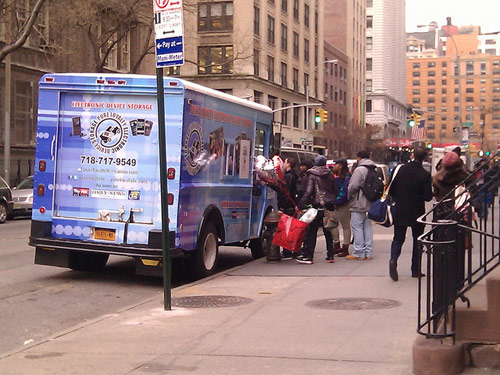
Mobile phones are banned in NYC public schools so a company called Pure Loyalty parks trucks outside of several schools so that students can check their phones, iPods, and other devices for the duration of the school day.
Pure Loyalty LLC is the originator in electronic device storage. We put student safety first and work together with school safety to make sure that phones are checked in and out in a timely fashion for students to go straight to class and then home after school.
Each student is given a security card to ensure that their device is only returned to them!!!! If a student with a security card loses their ticket, not to worry. We have a system in place that secures their phone. Each student is given a FREE security card. Replacement cards are $1.
(photo by Jesse Chan-Norris)
In late 2009, after Penn State was named the #1 party school in America by The Princeton Review, This American Life devoted an entire show to the school and its festive status.
Most of the This American Life production staff spent the weekend at Penn State, and found that drinking is the great unifier at the school. Ira Glass, Sarah Koenig, Lisa Pollak and Jane Feltes report on tailgating parties, frat parties, an article of clothing known as a “fracket,” and a surprising and common drunken crime.
(via ricky van veen)
Paul Lukas came into possession of hundreds of report cards from the Manhattan Trade School for Girls from the 1920s but never knew what to do with them.

Recently, he started trying to track down the families of the women they belonged to in a series for Slate.
I discovered the cards in 1996 (more on that in a minute). I found them fascinating, but I didn’t have a good sense of what to do with them, so for a long time I just kept them as curios and occasionally showed them to friends. Eventually, though, I decided to track down some of the students’ families (including Marie’s). Even after doing it numerous times, I still find it a bit surreal to call a stranger on the phone and hear myself saying, “Hi, you don’t know me, but I have your mother’s report card from 1929. Would you like to see it?”
A NY Times foreign correspondent formerly stationed in Russia tells the story of placing his three kids into an unusual school in Moscow where all the instruction is done in Russian.
My three children once were among the coddled offspring of Park Slope, Brooklyn. But when I became a foreign correspondent for The New York Times, my wife and I decided that we wanted to immerse them in life abroad. No international schools where the instruction is in English. Ours would go to a local one, with real Russians. When we told friends in Brooklyn of our plans, they tended to say things like, Wow, you’re so brave. But we knew what they were really thinking: What are you, crazy? It was bad enough that we were abandoning beloved Park Slope, with its brownstones and organic coffee bars, for a country still often seen in the American imagination as callous and forbidding. To throw our kids into a Russian school — that seemed like child abuse.
Be sure to watch the video.
After reading the fantastic Tom Junod piece on Fred Rogers earlier in the week, I poked around on YouTube for some Mister Rogers clips and shows. There are only a few full episodes on there but two of them are particularly relevant as kids across the nation go back to school for the fall:
I watched the first episode with Ollie yesterday (he was a big fan of the trolley, which was always my favorite part of the show too) and then we watched how crayons are made and how people make trumpets.
After our YouTube supply is exhausted, we’ll move on to DVDs (here’s a music compilation and episodes from the first week of the show), Netflix, or Amazon Instant Video, which has a bunch of episodes available for free (!!) for Prime subscribers.
Harvard tracked down three people who dropped out of the school in the late 60s to see what had happened to them in the meantime.
“I knew I didn’t want to do city planning, to play in that bureaucratic world,” he continues. “I also knew that if I stayed another semester they would hand me a diploma, and that diploma is going to open a whole lot of doors that I don’t want to go through. And I know that I am not real strong, and if I have that key, at some point I’m going to be seduced and want to go through one of those doors. So by not having the diploma, I will remove the temptation. That actually worked out very well, because I was tempted, more than once.”
That’s from a man who became a world-renowned knife expert.
The Morning News has a piece today on KidZania, a theme park for kids where they work and buy stuff just like grown-ups.
But at the heart of the concept and the business of KidZania is corporate consumerism, re-staged for children whose parents pay for them to act the role of the mature consumer and employee. The rights to brand and help create activities at each franchise are sold off to real corporations, while KidZania’s own marketing emphasizes the arguable educational benefits of the park.

Each child receives a bank account, an ATM card, a wallet, and a check for 50 KidZos (the park’s currency). At the park’s bank, which is staffed by adult tellers, kids can withdraw or deposit money they’ve earned through completing activities — and the account remains even when they go home at the end of the day. A lot of effort goes into making the children repeat visitors of this Lilliputian city-state.
A US outpost of KidZania is coming sometime in 2013.
Researchers at Princeton have found evidence that making something more difficult to learn improves long-term learning and information retention. More specifically, changing the typeface from something legible (like Helvetica) to something more difficult to read (like Monotype Corsiva or Comic Sans) increased retention in actual classroom settings.
This study demonstrated that student retention of material across a wide range of subjects (science and humanities classes) and difficulty levels (regular, Honors and Advanced Placement) can be significantly improved in naturalistic settings by presenting reading material in a format that is slightly harder to read…. The potential for improving educational practices through cognitive interventions is immense. If a simple change of font can significantly increase student performance, one can only imagine the number of beneficial cognitive interventions waiting to be discovered. Fluency demonstrates how we have the potential to make big improvements in the performance of our students and education system as a whole.
I agree with Lehrer…get David Carson on the horn. (thx, lara)
Parents these days go crazy worrying about their kids’ progress: Should she be reading? Should he be writing? She can’t catch a ball! The kid down the street can say her numbers up to 100 but mine only knows 1 through 14. Magical Parenthood posted an article about what a four-year-old should know and it doesn’t have anything to do with how well your kid can spell.
1. She should know that she is loved wholly and unconditionally, all of the time.
2. He should know that he is safe and he should know how to keep himself safe in public, with others, and in varied situations. He should know that he can trust his instincts about people and that he never has to do something that doesn’t feel right, no matter who is asking. He should know his personal rights and that his family will back them up.
3. She should know how to laugh, act silly, be goofy and use her imagination. She should know that it is always okay to paint the sky orange and give cats 6 legs.
This advice for parents is gold:
That being the smartest or most accomplished kid in class has never had any bearing on being the happiest. We are so caught up in trying to give our children “advantages” that we’re giving them lives as multi-tasked and stressful as ours. One of the biggest advantages we can give our children is a simple, carefree childhood.
Using statistical analysis, University of Central Florida professor Richard Quinn determined that dozens of students had cheated on a test, told them in a lecture (video below), and over 200 students confessed after the lecture.
I don’t want to have to explain to your parents why you didn’t graduate, so I went to the Dean and I made a deal. The deal is you can either wait it out and hope that we don’t identify you, or you can identify yourself to your lab instructor and you can complete the rest of the course and the grade you get in the course is the grade you earned in the course.
From The Chronicle of Higher Education, a fascinating piece by a person who makes his living writing essays for college and graduate students.
In the past year, I’ve written roughly 5,000 pages of scholarly literature, most on very tight deadlines. But you won’t find my name on a single paper.
I’ve written toward a master’s degree in cognitive psychology, a Ph.D. in sociology, and a handful of postgraduate credits in international diplomacy. I’ve worked on bachelor’s degrees in hospitality, business administration, and accounting. I’ve written for courses in history, cinema, labor relations, pharmacology, theology, sports management, maritime security, airline services, sustainability, municipal budgeting, marketing, philosophy, ethics, Eastern religion, postmodern architecture, anthropology, literature, and public administration. I’ve attended three dozen online universities. I’ve completed 12 graduate theses of 50 pages or more. All for someone else.
You’ve never heard of me, but there’s a good chance that you’ve read some of my work. I’m a hired gun, a doctor of everything, an academic mercenary. My customers are your students. I promise you that. Somebody in your classroom uses a service that you can’t detect, that you can’t defend against, that you may not even know exists.
His kind of service attracts three types of student:
From my experience, three demographic groups seek out my services: the English-as-second-language student; the hopelessly deficient student; and the lazy rich kid.
For the last, colleges are a perfect launching ground-they are built to reward the rich and to forgive them their laziness. Let’s be honest: The successful among us are not always the best and the brightest, and certainly not the most ethical. My favorite customers are those with an unlimited supply of money and no shortage of instructions on how they would like to see their work executed. While the deficient student will generally not know how to ask for what he wants until he doesn’t get it, the lazy rich student will know exactly what he wants. He is poised for a life of paying others and telling them what to do. Indeed, he is acquiring all the skills he needs to stay on top.
Here’s an interesting theory from Sam Arbesman: the wizards from the Harry Potter books aren’t that bright because their education neglects the basics.
As near as I can tell, if you grow up in the magical world (as opposed to be Muggle-born, for example), you do not go to school at all until the age of eleven. In fact, it’s entirely unclear to me how the children of the wizarding world learn to read and write. There is a reason Hermione seems much more intelligent than Ron Weasley. It’s because Ron is very likely completely uneducated.
My take is that wizards are jocks, not nerds; Hogwarts is not so much a secondary school as a sports academy. What’s odd about that is that quidditch is an extracurricular…
Wired has a go at defining liberal arts 2.0.
It’s the 21st century. Knowing how to read a novel, craft an essay, and derive the slope of a tangent isn’t enough anymore. You need to know how to swing through the data deluge, optimize your prose for Twitter, and expose statistics that lie.
Newer posts
Older posts





Socials & More