kottke.org posts about education
On a strong recommendation from Meg, I have been reading Peter Gray’s Free to Learn: Why Unleashing the Instinct to Play Will Make Our Children Happier, More Self-Reliant, and Better Students for Life. Gray is a developmental psychologist and in Free to Learn he argues that 1) children learn primarily through self-directed play (by themselves and with other children), and 2) our current teacher-driven educational system is stifling this instinct in our kids, big-time.
I have a lot to say about Free to Learn (it’s fascinating), but I wanted to share one of the most surprising and unsettling passages in the book. In a chapter on the role of play in social and emotional development, Gray discusses play that might be considered inappropriate, dangerous, or forbidden by adults: fighting, violent video games, climbing “too high”, etc. As part of the discussion, he shares some of what George Eisen uncovered while writing his book, Children and Play in the Holocaust.
In the ghettos, the first stage in concentration before prisoners were sent off to labor and extermination camps, parents tried desperately to divert their children’s attention from the horrors around them and to preserve some semblance of the innocent play the children had known before. They created makeshift playgrounds and tried to lead the children in traditional games. The adults themselves played in ways aimed at psychological escape from their grim situation, if they played at all. For example, one man traded a crust of bread for a chessboard, because by playing chess he could forget his hunger. But the children would have none of that. They played games designed to confront, not avoid, the horrors. They played games of war, of “blowing up bunkers,” of “slaughtering,” of “seizing the clothes of the dead,” and games of resistance. At Vilna, Jewish children played “Jews and Gestapomen,” in which the Jews would overpower their tormenters and beat them with their own rifles (sticks).
Even in the extermination camps, the children who were still healthy enough to move around played. In one camp they played a game called “tickling the corpse.” At Auschwitz-Birkenau they dared one another to touch the electric fence. They played “gas chamber,” a game in which they threw rocks into a pit and screamed the sounds of people dying. One game of their own devising was modeled after the camp’s daily roll call and was called klepsi-klepsi, a common term for stealing. One playmate was blindfolded; then one of the others would step forward and hit him hard on the face; and then, with blindfold removed, the one who had been hit had to guess, from facial expressions or other evidence, who had hit him. To survive at Auschwitz, one had to be an expert at bluffing — for example, about stealing bread or about knowing of someone’s escape or resistance plans. Klepsi-klepsi may have been practice for that skill.
Gray goes on to explain why this sort of play is so important:
In play, whether it is the idyllic play we most like to envision or the play described by Eisen, children bring the realities of their world into a fictional context, where it is safe to confront them, to experience them, and to practice ways of dealing with them. Some people fear that violent play creates violent adults, but in reality the opposite is true. Violence in the adult world leads children, quite properly, to play at violence. How else can they prepare themselves emotionally, intellectually, and physically for reality? It is wrong to think that somehow we can reform the world for the future by controlling children’s play and controlling what they learn. If we want to reform the world, we have to reform the world; children will follow suit. The children must, and will, prepare themselves for the real world to which they must adapt to survive.
Like I said, fascinating.
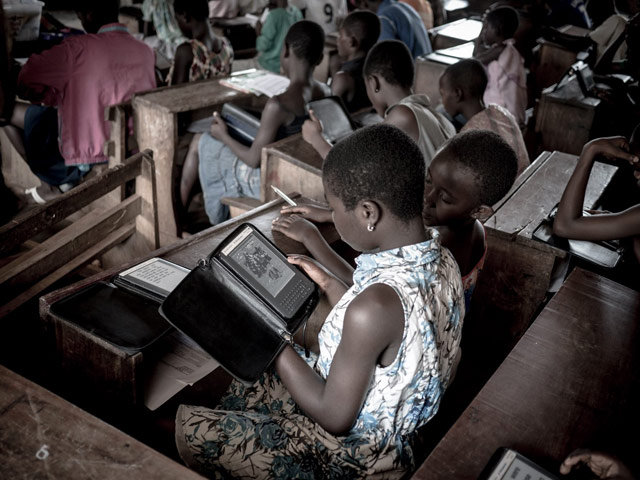
Craig Mod visited Ghana recently to check on the progress of Worldreader, an organization dedicated to distributing digital books to children and families in places like Rwanda, Ghana, and South Africa.
Those of us who work in technology tend to take religious-like stances over its ability to change the world, always for the better. My paranoia of trickery comes from an inherent suspicion towards technology, and an even deeper suspicion of presuming to know better. It’s too easy to fall into the first-world trope of “all the poor need is a little sprinkling of silicon and then everything will be fine.” It’s never that simple. Technology is, at best, the tip of the iceberg. A very tiny component of the work that needs to be done in the greater whole of reforming or impacting or increasing accessibility to education, first-world and third-world alike. Technology deployed without infrastructure, without understanding, without administrative or community support, without proper curriculum is nearly worthless. Worse than worthless, even — for it can be destructive, the time and budget spent on the technology eating into more fundamental, more meaningful points of badly needed reform.
“My kids used to love math! Now it makes them cry.” So tweeted Louis C.K. earlier this week. His opinion of the new math and standardized tests is echoed by a lot of parents who “have found themselves puzzled by the manner in which math concepts are being presented to this generation of learners as well as perplexed as to how to offer the most basic assistance when their children are struggling with homework.” Rebecca Mead in the The New Yorker: Louis C.K. Against the Common Core.
Don’t do your kid’s homework. Try not to even help them that much. It’s better for their development. And it’s better for you not to have to relive your school years. That seems like sensible advice. Until all the other parents in the school start helping their kids on their homework. That’s when you’ll be tempted. But still, really, don’t.
What they found surprised them. Most measurable forms of parental involvement seem to yield few academic dividends for kids, or even to backfire-regardless of a parent’s race, class, or level of education.
Do you review your daughter’s homework every night? Robinson and Harris’s data, published in The Broken Compass: Parental Involvement With Children’s Education, show that this won’t help her score higher on standardized tests. Once kids enter middle school, parental help with homework can actually bring test scores down, an effect Robinson says could be caused by the fact that many parents may have forgotten, or never truly understood, the material their children learn in school.
They’re changing the SAT and the New Yorker’s Cora Frazier has a rundown of some of the modifications made to better reflect “skills they need to succeed in college and afterward”.
11. Improving sentences. You receive the following text message: “You’re an animal.” This is an autocorrection of:
(a) “You’re almost at Ludlow.”
(b) “Young Leo DiCaprio.”
(c) “Do we need eggs?”
(d) No autocorrection.
In 1976, legendary cosmologist and astronomer Carl Sagan tried to recruit a 17-year-old Neil deGrasse Tyson to Cornell University. In April of that year, Tyson wrote Sagan a letter informing him of his intention to enroll at Harvard instead:
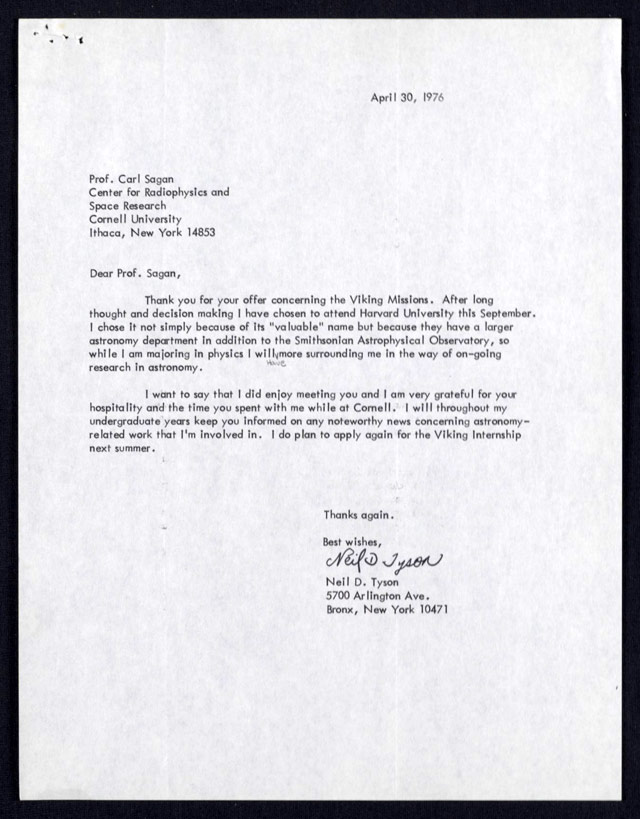
The Viking Missions referred to in the letter were the two probes sent to Mars in the mid-1970s.
Tyson occupies a role in today’s society similar to Sagan’s in the 1980s as an unofficial public spokesman of the wonderous world of science. Tyson is even hosting an updated version of Sagan’s seminal Cosmos series for Fox, which debuts on March 9th. Here’s a trailer:
Letter courtesy of The Seth Macfarlane Collection of the Carl Sagan and Ann Druyan Archive at the Library of Congress, which is chock full of great Sagan stuff. And yeah, that’s Seth Macfarlane, creator of Family Guy and much-maligned host of the Oscars. Macfarlane was a big fan of the original Cosmos series and was instrumental in getting the new series made. (via @john_overholt)
In 1999, Sugata Mitra left a computer in a New Delhi slum and watched what the neighborhood kids would do with it. With no prior computer experience, they quickly figured out how to work it. In subsequent experiments, Mitra used computers and very little adult oversight (what we refer to as “education”) to teach children all sorts of different things.
Over the years, Mitra got more ambitious. For a study published in 2010, he loaded a computer with molecular biology materials and set it up in Kalikuppam, a village in southern India. He selected a small group of 10- to 14-year-olds and told them there was some interesting stuff on the computer, and might they take a look? Then he applied his new pedagogical method: He said no more and left.
Over the next 75 days, the children worked out how to use the computer and began to learn. When Mitra returned, he administered a written test on molecular biology. The kids answered about one in four questions correctly. After another 75 days, with the encouragement of a friendly local, they were getting every other question right. “If you put a computer in front of children and remove all other adult restrictions, they will self-organize around it,” Mitra says, “like bees around a flower.”
It’s tempting to conclude that the computer is the magical ingredient here: just add computers and children can learn anything. But if the story of Sergio Juárez Correa’s fifth-grade class is any indication, the secret is the kids organizing themselves to learn.
For Juárez Correa it was simultaneously thrilling and a bit scary. In Finland, teachers underwent years of training to learn how to orchestrate this new style of learning; he was winging it. He began experimenting with different ways of posing open-ended questions on subjects ranging from the volume of cubes to multiplying fractions. “The volume of a square-based prism is the area of the base times the height. The volume of a square-based pyramid is that formula divided by three,” he said one morning. “Why do you think that is?”
He walked around the room, saying little. It was fascinating to watch the kids approach the answer. They were working in teams and had models of various shapes to look at and play with. The team led by Usiel Lemus Aquino, a short boy with an ever-present hopeful expression, hit on the idea of drawing the different shapes-prisms and pyramids. By layering the drawings on top of each other, they began to divine the answer. Juárez Correa let the kids talk freely. It was a noisy, slightly chaotic environment-exactly the opposite of the sort of factory-friendly discipline that teachers were expected to impose. But within 20 minutes, they had come up with the answer.
“Three pyramids fit in one prism,” Usiel observed, speaking for the group. “So the volume of a pyramid must be the volume of a prism divided by three.”
Earlier this year, Hogwarts School of Witchcraft and Wizardry was subjected to a review by the Board of Education and was found wanting in several areas.
Pupils at Hogwarts have access to a reasonably wide range of esoteric qualifications, suited to its key demographic. As an independent school, it does not have to follow the National Curriculum closely; however, it is disappointing to note that basic requirements such as English, Mathematics and Religious Education are all lacking or entirely missing from the school’s syllabus. This has had adverse effects on all students, many of whom have never even been taught basic KS1 or 2 literacy. A few students have attended state or independent primary schools, and these students typically perform very well in contrast to their peers.
The majority of students appear to be under-performing, with most pupils struggling in all their lessons, most of which appear to be set at too challenging a level. One particular class, which seemed to be based on A-Level chemistry, proved too difficult for even the most proficient students. Only one pupil managed to complete the lesson objectives, mainly thanks to his use of an annotated text book.
(via slate)
Older kids generally succeed better in sports, but holding kids back in school seems to have the opposite effect when it comes to academic achievement.
The researchers discovered that relatively more mature students didn’t have an academic edge; instead, when they looked at their progress at the end of kindergarten, and, later, when they reached middle school, they were worse off in multiple respects. Not only did they score significantly lower on achievement tests — both in kindergarten and middle school — they were also more likely to have been kept back a year by the time they reached middle school, and were less likely to take college-entrance exams. The less mature students, on the other hand, experienced positive effects from being in a relatively more mature environment: in striving to catch up with their peers, they ended up surpassing them.
I was the second youngest kid in my class growing up; only our valedictorian was younger. Meg was young too. And both our kids are among the youngest in the class…we didn’t redshirt them because they seemed ready for the grades they’re in. As the article states, the differences are starker now than they were…some kids in their groups are more than a year older than they are and most are several months older. NYC preschools have trouble finding a wide range of ages for each class because so many people are holding their kids back to gain a supposed competitive edge against their peers…fall kindergarten classes are full of 6-year-olds but few just-turned-fives. It’s crazy…but so much of New York is competitive like this, why wouldn’t kids’ preschool education be the same?
So says education researcher Teresa Belton:
The academic, who has previously studied the impact of television and videos on children’s writing, said: “When children have nothing to do now, they immediately switch on the TV, the computer, the phone or some kind of screen. The time they spend on these things has increased.
“But children need to have stand-and-stare time, time imagining and pursuing their own thinking processes or assimilating their experiences through play or just observing the world around them.”
It is this sort of thing that stimulates the imagination, she said, while the screen “tends to short circuit that process and the development of creative capacity”.
A long piece in this week’s New Yorker by Marc Fisher about more alleged sexual abuse at The Horace Mann School, a prep school in the Bronx. Fisher’s piece focuses on Robert Berman, an English teacher at the school for many years.
One group of boys stood apart; they insisted on wearing jackets and ties and shades, and they stuck to themselves, reciting poetry and often sneering at the rest of us. A few of them shaved their heads. We called them Bermanites, after their intellectual and sartorial model, an English teacher named Robert Berman: a small, thin, unsmiling man who papered over the windows of his classroom door so that no one could peek through.
Assigned to Berman for tenth-grade English, I took a seat one September morning alongside sixteen or seventeen other boys. We waited in silence as he sat at his desk, chain-smoking Benson & Hedges cigarettes and watching us from behind dark glasses. Finally, Mr. Berman stood up, took a fresh stick of chalk, climbed onto his chair, and reached above the blackboard to draw a horizontal line on the paint. “This,” he said, after a theatrical pause, “is Milton.” He let his hand fall a few inches, drew another line, and said, “This is Shakespeare.” Another line, lower, on the blackboard: “This is Mahler.” And, just below, “Here is Browning.” Then he took a long drag on his cigarette, dropped the chalk onto the floor, and, using the heel of his black leather loafer, ground it into the wooden floorboards. “And this, gentlemen,” he said, “is you.”
The next day, I asked to be transferred. I was not alone. By the end of the week, Berman’s class had shrunk by about half. The same thing happened every year; his classes often ended up as intimate gatherings of six to eight. Many students found Berman forbidding, but some of the teachers referred to him as a genius. Boys competed to learn tidbits about him. It was said, with little or no evidence, that he was an artist and a sculptor, that he knew Sanskrit, Russian, and Urdu, and that his wife and child had been killed in a horrific car crash. Though he was only in his mid-thirties, a graduate of the University of Michigan, it was rumored that he had been a paleontologist and had taught at Yale. Administrators told students and their parents that Horace Mann was incredibly lucky to have him, however odd he might be. The boys who remained in his classes were often caught up in his love of art, music, and literature, and in his belief that every moment of life should be spent reaching for the transcendence of the Elgin Marbles, of a fresco by Fra Angelico, even of an ordinary sunset. The boys absorbed the lists he made. “Take this down,” he’d say. “The ten greatest racehorses of all time.” Or, “This is the list of the ten greatest movies ever made-but you won’t find ‘Lawrence of Arabia’ on it, because it’s off the charts!” One day, he mounted a rearview mirror on the far wall of the classroom so that he could stare at the portrait of Milton behind his back.
Chris Ware designed the Newtown-themed cover for the New Yorker last week and describes the process that went into it.
On December 14th, I helped chaperone my daughter’s second-grade-class field trip to a local production of “The Nutcracker,” where I spent most of my time not watching the ballet but marvelling at the calm efforts of the teacher to keep the yelling, excited class quieted down. Teaching was not, I concluded at one point, a profession in which I could survive for even one day. Our buses came back to the school at midafternoon, and I and the other volunteer parents left our children for another hour of wind-down time (for us, not them) before returning for the regular 3-P.M. pickup. I came home, however, not to any wind-down but to the unfolding coverage of the Newtown shooting. Shaken to the core, I returned to the school, where a grim quiet bound myself and the other parents together, the literally unspeakable news sealing our smiles while, at a lower strata, our happy, screaming children ran out of the building into our arms still frothed up by sparkling visions of the Sugar Plum Fairy.
The Roots drummer, ?uestlove, will be schooling kids left and right this spring as he teaches a class on classic albums at NYU. It’s too bad this isn’t a high school class so my Young MC ‘Principal’s Office’ reference would fit better.
The course will include lectures on albums such as Sly & The Family Stone’s There’s a Riot Goin’ On, Aretha Franklin’s Lady Soul, Led Zeppelin’s IV, Prince’s Dirty Mind, Michael Jackson’s Off the Wall, and the Beastie Boys’ Paul’s Boutique.
They’ll also cover what constitutes a “classic” or “seminal” album, looking at the music, lyrics, production, and business behind great albums.
Billboard reports that the course was inspired by an NPR blog post over the summer where an intern reviewed Public Enemy’s It Takes A Nation of Millions To Hold Us Back, an album he’d never heard before. ?uestlove responded to the dismissive review in the comments, prompting NYU’s Jason King to invite ?uestlove and Weinger to teach the course.
Excellent NYT Magazine piece on the impact of The Kalamazoo Promise, an initiative by anonymous donors to pay the college tuition of every graduating senior in Kalamazoo. The Promise, which is intended by the donors to be an experiment in urban investment has had several amazing results in only a few years. High school test scores have improved continuously, and the promise of help with tuition has lead to families moving to and staying in Kalamazoo. The 2,450 new students has allowed the school district to hire 92 additional teachers. It’s not all rosy, and the Promise hasn’t solved every problem yet, but Kalamazoo seems to be headed in the right direction.
Under the terms of the program, students who start in the Kalamazoo school district as kindergartners receive enough money to cover their entire tuition to public in-state schools. Students who enter the district in later grades get less, based on a sliding scale; entering high-school freshmen, for example, get 65 percent of their tuition covered. (Those who move to Kalamazoo after that or who enroll in colleges that are private or located outside the state are not covered by the Promise.) To date, the Kalamazoo Promise has paid out $35 million for postsecondary study for 2,500 students. On average, about $4,200 is spent on each student per semester. Students are responsible for their own room and board.
(via @graysky)
Tyler Cowen and Alex Tabarrok of Marginal Revolution are starting an online education platform.
We think education should be better, cheaper, and easier to access. So we decided to take matters into our own hands and create a new online education platform toward those ends. We have decided to do more to communicate our personal vision of economics to you and to the broader world.
The first course is Development Economics.
Development Economics will cover the sources of economic growth including geography, education, finance, and institutions. We will cover theories like the Solow and O-ring models and we will cover the empirical data on development and trade, foreign aid, industrial policy, and corruption. Development Economics will include not just theory but a wealth of historical and factual information on specific countries and topics, everything from watermelon scale economies and the clove monopoly to water privatization in Buenos Aires and cholera in Haiti.
A piece of unsolicited advice: change the name to Revolution University.
Newer posts
Older posts





Socials & More