kottke.org posts about business
Are you ready for a new level of discomfort in air travel? A major US airline is considering a seating class called Economy Minus, which would offer smaller seats at a lower price.
Now a major airline may be considering another breakthrough idea: “Economy Minus,” a seat that offers less legroom at a discount price.
Before you scoff, consider that a new survey found that 42% of airline travelers said they would be very likely or somewhat likely to book a seat with less legroom if it means getting a cheap fare.
See also Why Airlines Want to Make You Suffer. (A: maximizing shareholder value)
My kids and I went to the new Lego Store in the Flatiron this weekend, and I again noticed how freaking expensive Lego sets are. The Death Star set is $400 + tax and even small sets are $30-40. Afterward I wondered if renting Lego sets would be an economically viable business and sure enough, someone is giving it a go: Pley. It works a bit like Netflix’s DVD service: you pay a flat subscription fee each month and can check out as many sets as you want, one at a time. Doesn’t look like they rent out Lego Stephen Hawking or Lego Mona Lisa though.
Last week, Emily Dreyfuss wrote a piece at about Why I’m Giving Wikipedia 6 Bucks a Month.
“Give me money, Emily,” Wales begged, “then go back to researching Beyonce lyrics.”
“Excuse me, Jimmy,” I wanted to say, “I don’t appreciate being watched as I read about how her song “Baby Boy” includes a lyrical interpolation of “No Fear” by O.G.C.”
Later, Wikipedia replaced Wales with other employees of the Wikimedia Foundation, which maintains Wikipedia with grants and donations. They moved me about as much as Wales did, which is to say not at all.
Today, while scanning my third Wikipedia article in as many hours, I saw the beggi…. er, note was back. It’s at the bottom now, without the pleading visage of a Wikipedian, and now includes an option to pay monthly.
I was annoyed, again. That’s the first instinct of anyone who spends time on the Internet and is constantly bombarded by pleas for money. But then I realized something: My annoyance was a symptom of my dependence on Wikipedia. I rely on it utterly. I take it completely for granted.
I found her argument persuasive, so much so that I just signed up to give Wikipedia a monthly amount as well. I consider it a subscription fee to an indispensable and irreplaceable resource I use dozens of times weekly while producing kottke.org. It’s a business expense, just like paying for server hosting, internet access, etc. — the decision to pay became a no-brainer for me when I thought of it that way.
Do other media companies subscribe to Wikipedia in the same fashion? How about it Gawker, NY Times, Vox, Wired, ESPN, WSJ, New York Magazine, Vice, Washington Post, The Atlantic, Buzzfeed, Huffington Post? Even $500/month is a drop in the bucket compared to your monthly animated GIF hosting bill and I know your writers use Wikipedia as much as I do. Come on, grab that company credit card and subscribe.
Casey Neistat visited several Apple Stores in NYC on the eve of the iPhone 6 launch to observe the folks standing in line. He found that many of those in line, particularly right in the front, were Chinese resellers.
The iPhone 6 won’t be available in China for several months, so a lively and lucrative black market has sprung up. The video shows several typical transactions: two phones (the maximum allowed per person) are purchased with cash and then the people sell those phones to men who presumably have them shipped to China for resale.
I remember last year, when the iPhone 5s came out, there was always a line of mostly Asian people outside the Soho store in the morning, even months after the launch. (via @fromedome)
Mojang’s popular game Minecraft has sold over 54 million copies. But that, and the $2.5 billion that Microsoft just paid to acquire the company, dramatically understates the impact that this game has had on [Dave Pell’s] third grader and his friends. They all wear Minecraft gear and watch Minecraft videos on YouTube. And several of them completed a week of Minecraft Camp over the summer. The way I see it, $2.5 billion just became the most anyone has ever spent on a babysitter.
The Verge: Why parents are raising their kids on Minecraft.
Markus Persson, the founder of Mojang (known as Notch), explains why he’s selling — and leaving — the company: “It’s not about the money. It’s about my sanity.”
Dang! It looks as though the Shake Shack is gonna IPO at a value of $1 billion. (BTW, $1 billion would buy you about 210 million ShackBurgers.)
At that level, Shake Shack would debut at 50 times projected earnings of about $20 million this year, the people said, asking not to be named because the details are private. The company has tapped JPMorgan Chase & Co. and Morgan Stanley to manage the share sale, said the people.
That valuation would put it in line with other dining chains that have tapped into investor appetite for new stocks in recent years. El Pollo Loco Holdings Inc. (LOCO), which raised $123 million in July, now trades at about 60 times projected 2014 earnings, while Potbelly (PBPB) Corp. trades at over 64 times estimated earnings, data compiled by Bloomberg show.
The Shack has about 50 locations worldwide. But their flagship Madison Square Park location will be closing for a few months soon for renovations…hopefully they’ll have it back open for the IPO.
Update: And the Shack filed for their IPO on Dec 29, 2014.
Shake Shack is a modern day “roadside” burger stand serving a classic American menu of premium burgers, hot dogs, crinkle-cut fries, shakes, frozen custard, beer and wine. Founded by Danny Meyer’s Union Square Hospitality Group, LLC (“USHG”), Shake Shack was created leveraging USHG’s expertise in community building, hospitality, fine dining, restaurant operations and sourcing premium ingredients. Danny’s vision of Enlightened Hospitality guided the creation of the unique Shake Shack culture that, we believe, creates a differentiated experience for our guests across all demographics at each of the 63 Shacks around the world. As Shake Shack’s Board Chairman and USHG’s Chief Executive Officer, Danny has drawn from USHG’s experience creating and operating some of New York City’s most acclaimed and popular restaurants, including Union Square Cafe, Gramercy Tavern, Blue Smoke, The Modern, Maialino and Marta, to build what we believe is a new fine casual restaurant category in Shake Shack.
There are now 63 Shake Shacks. 63! I just wish the one across from the office would reopen. (via @caseyjohnston)
Update: From Tyler Cowen, Does the Shake Shack IPO mean you should stop eating there?:
A simple theory of IPOs suggests that they arrive when a product or company is experiencing “peak buzz,” or at least when the insiders in the privately held company think they are at or near peak buzz. This will maximize the expected returns on the IPO when it comes to market.
When it comes to food, peak buzz usually arrives a wee bit after peak quality, given reputational lags. So if you are seeing peak buzz, it is probably time to bail on the restaurant, at least on a restaurant which is going to be sold. Bailing on the restaurant may in fact be slightly overdue.
To test Cowen’s theory1, I went to the Shake Shack in Grand Central today (12/31/14). I stood in line for 10 minutes, ordered my customary Shack burger with fries (long live the crinkle cut), and then waited an additional 10 minutes for my food. Verdict: as delicious as ever. Service was snappy and friendly. Well worth the wait and price for me: I got exactly what I wanted.
Using Motorola, Nokia, and Nintendo as examples, Tero Kuittinen explains how dominant tech companies are lulled into “a comfy trip to the grave” by huge but ultimately short-lived successes before new paradigms take over.
For years, Nintendo has believed it could reject smartphone and tablet apps, yet still flourish. The reason for this delusion is familiar — it’s the toxic Last Blockbuster Syndrome that doomed the consumer electronics divisions of Motorola in 2004 and Nokia in 2007. Often at the start of a massive trend shift in consumer electronics, dominant dinosaurs get one massive hit built on a nearly obsolete paradigm, and that allows them to be lulled into a comfy trip to the grave.
The best example from the past few years is when Motorola, Nokia, and RIM were flying high with their phone products when the iPhone came along and changed the game.
A new study finds that insider trading is much worse than commonly thought: a quarter of all public company deals may involve some kind of insider trading. From the NY Times:
The professors examined stock option movements — when an investor buys an option to acquire a stock in the future at a set price — as a way of determining whether unusual activity took place in the 30 days before a deal’s announcement.
The results are persuasive and disturbing, suggesting that law enforcement is woefully behind — or perhaps is so overwhelmed that it simply looks for the most egregious examples of insider trading, or for prominent targets who can attract headlines.
The professors are so confident in their findings of pervasive insider trading that they determined statistically that the odds of the trading “arising out of chance” were “about three in a trillion.” (It’s easier, in other words, to hit the lottery.)
Only about 5% of the deals are ever litigated by the SEC. (via mr)
An instant classic John Gruber post about the sort of company Apple is right now and how it compares in that regard to its four main competitors: Google, Samsung, Microsoft, and Amazon. The post is also about how Apple is now firmly a Tim Cook joint, and the company is better for it.
When Cook succeeded Jobs, the question we all asked was more or less binary: Would Apple decline without Steve Jobs? What seems to have gone largely unconsidered is whether Apple would thrive with Cook at the helm, achieving things the company wasn’t able to do under the leadership of the autocratic and mercurial Jobs.
Jobs was a great CEO for leading Apple to become big. But Cook is a great CEO for leading Apple now that it is big, to allow the company to take advantage of its size and success. Matt Drance said it, and so will I: What we saw last week at WWDC 2014 would not have happened under Steve Jobs.
This is not to say Apple is better off without Steve Jobs. But I do think it’s becoming clear that the company, today, might be better off with Tim Cook as CEO. If Jobs were still with us, his ideal role today might be that of an eminence grise, muse and partner to Jony Ive in the design of new products, and of course public presenter extraordinaire. Chairman of the board, with Cook as CEO, running the company much as he actually is today.
This bit on the commoditization of hardware, and Apple’s spectacularly successful fight against it, got me thinking about current events. Here’s Gruber again:
Apple’s device-centric approach provides them with control. There’s a long-standing and perhaps everlasting belief in the computer industry that hardware is destined for commoditization. At their cores, Microsoft and Google were founded on that belief - and they succeeded handsomely. Microsoft’s Windows empire was built atop commodity PC hardware. Google’s search empire was built atop web browsers running on any and all computers. (Google also made a huge bet on commodity hardware for their incredible back-end infrastructure. Google’s infrastructure is both massive and massively redundant - thousands and thousands of cheap hardware servers running custom software designed such that failure of individual machines is completely expected.)
This is probably the central axiom of the Church of Market Share - if hardware is destined for commoditization, then the only thing that matters is maximizing the share of devices running your OS (Microsoft) or using your online services (Google).
The entirety of Apple’s post-NeXT reunification success has been in defiance of that belief - that commoditization is inevitable, but won’t necessarily consume the entire market. It started with the iMac, and the notion that the design of computer hardware mattered. It carried through to the iPod, which faced predictions of imminent decline in the face of commodity music players all the way until it was cannibalized by the iPhone.
And here’s David Galbraith tweeting about the seemingly unrelated training that London taxi drivers receive, a comment no doubt spurred by the European taxi strikes last week, protesting Uber’s move into Europe:
Didn’t realize London taxi drivers still have to spend years learning routes. That’s just asking to be disrupted http://en.wikipedia.org/wiki/Taxicabs_of_the_United_Kingdom#The_Knowledge
Here’s the relevant bit from Wikipedia about The Knowledge:
It is the world’s most demanding training course for taxicab drivers, and applicants will usually need at least twelve ‘appearances’ (attempts at the final test), after preparation averaging 34 months, to pass the examination.
Uber, in this scenario, is attempting to be Microsoft in the 1980s and early 90s. They’re implementing their software layer (the Uber service) on commodity hardware, which includes not only iPhones & Android phones, mass-produced cars of any type, and GPS systems but also, and crucially, the drivers themselves. Uber is betting that a bunch of off-the-shelf hardware, “ordinary” drivers, and their self-service easy-pay dispatch system will provide similar (or even better) results than a fleet of taxi drivers each with three years of training and years of experience. It is unclear to me what the taxi drivers can do in this situation to emulate the Apple of 1997 in making that commoditization irrelevant to their business prospects. Although when it comes to London in particular, Uber may have miscalculated: in a recent comparison at rush hour, an Uber cab took almost three times as long and was 64% more expensive than a black cab.
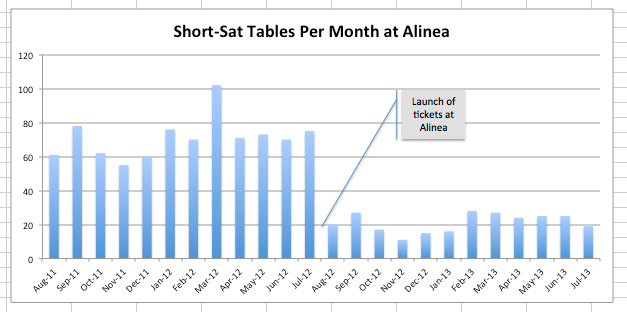
For three years, Nick Kokonas’s trio of eating/drinking establishments in Chicago (Next, Alinea, and Aviary) has been using a ticketed reservation system. In this epic piece, Kokonas details why they started using tickets and what the effect has been (emphasis mine):
Our ticket implementation strategy at Alinea was to create a “higher-touch” system than we had previously used at Next. Every customer buying a ticket at Alinea must include a cell phone number where we can reach them. About a week before they dine with us we call every customer to thank them for buying a ticket to Alinea, ask if they have any dietary restrictions or special needs, and generally get a feel for their expectations and whether it is a special occasion. We can, in fact, spend more time (not less) with every single one of our customers because we are only speaking with the customers we know are coming to dine with us. Previously, we answered thousands of calls from people we had to say ‘no’ to. Now we can take far more time to say ‘yes’.
The results on Alinea’s business are staggering. Bottom line EBITDA profits are up 38% from previous average years. No shows of full tables are almost non-existent and while partial no-shows still occur they are only a handful of people per week at most. That allows us to run at a far greater capacity with less food waste and more revenue.
Will be interesting to see if more restaurants adopt this model…I bet a bunch of restaurateurs’ eyes lit up at the 38% increase in profit. But not every restaurant is Alinea and not every restaurateur is a clever former derivatives trader.
Let’s talk cultural mesofacts. You likely recall 50 Cent as a rapper In Da Club but much has happened since then. 50 diversified like crazy: started a record label, parlayed a possible Vitaminwater endorsement into an investment worth $100 million, and, relevant to the matter at hand, wrote several books, including a pair of self-improvement books: Formula 50: A 6-Week Workout and Nutrition Plan That Will Transform Your Life and The 50th Law. Zach Baron recently recruited 50 Cent to be his life coach for a GQ piece and it ends up going way better than he expected.
50 Cent thinks for a minute. Actually, he says, my girlfriend — the one I just mentioned, the one I’d just moved in with? 50 Cent would like her to make a vision board, too. Then we’re going to compare. “Take things out of your folder and things out of her folder to create a folder that has everything,” he says. “Now the vision board is no longer your personal vision board for yourself: It’s a joint board.” That joint board will represent what we have in common. It will be a monument to our love.
But there will be some leftover unmatched photos, too, in each of our folders. And that’s what the joint board is really for — what it’s designed to reveal. “The things that end up on your vision board that aren’t in hers are the things that she has to accept,” 50 Cent says. “And the things that she has that you don’t are the things that you have to make a compromise with.” In a healthy relationship, he explains, your differences are really what need talking about. This is how you go about making that conversation happen.
This article just keeps getting better the more you read it. (via @ystrickler)
Internet mega-retailer Amazon is trying, mob-style, to pressure Hachette for better terms on ebooks by disappearing the publisher’s book from amazon.com.
The retailer began refusing orders late Thursday for coming Hachette books, including J.K. Rowling’s new novel. The paperback edition of Brad Stone’s “The Everything Store: Jeff Bezos and the Age of Amazon” — a book Amazon disliked so much it denounced it — is suddenly listed as “unavailable.”
In some cases, even the pages promoting the books have disappeared. Anne Rivers Siddons’s new novel, “The Girls of August,” coming in July, no longer has a page for the physical book or even the Kindle edition. Only the audio edition is still being sold (for more than $60). Otherwise it is as if it did not exist.
No question about it: this sucks on Amazon’s part and demonstrates the degree to which the company’s top priority isn’t customer service. Better customer service in this case would be to offer these books for sale. I noticed another less nefarious instance of this the other day: because Amazon is offering a streaming version of The Lego Movie (which presumably has a high profit margin), they are not currently taking pre-orders of the The Lego Movie Blu-ray (out on June 17), even though Barnes and Noble has it for pre-order and Amazon has no problem offering for pre-order a Blu-ray of The Nutty Professor that isn’t out until September. I guess it makes sense to drive sales to the high-margin streaming offering but not letting people pre-order what is likely to be a very popular Blu-ray is baffling.
Anyway, if this trend continues, I’d look for Amazon to start more aggressively promoting the Kindle editions of books, to the point of manipulating available inventory as with Hachette. That is, if they’re not doing it already.
In recent years, Chipotle has worked to promote their managers from within the company. And the tactic seems to be working.
The common element among the best-performing stores was a manager who had risen up from crew. So Moran started to outline a program that would retain and train the best managers, and reward them to the point where they would be thrilled to stay on.
After Flores expressed his frustration, Moran showed him his early notes for the restaurateur program, which is unique among fast food restaurants in that it ties pay and promotion to how well you mentor people, rather than store sales.
“It was a great meeting but I didn’t know what was going to happen. At most companies you meet the top execs and then you never hear from them again,” Flores says.
A few weeks after the October meeting, while vacationing in Houston, Flores got a call on his cell from Ells and Moran letting him know that he had been promoted to restaurateur and was getting a $3,000 bonus. Rather than waiting until he returned to Milwaukee to get him the check, it was delivered to him in Houston the following day. At the time his salary was around $38,000, and the bonus was meaningful.
“That’s when I knew the company was special,” Flores said.
Interesting bits of business wisdom throughout this piece.
Well, they do sometimes but not very often. Left turns cross traffic, which wastes time and causes accidents. So UPS routes are designed with mostly right turns…three rights make a left, you know.
UPS engineers found that left-hand turns were a major drag on efficiency. Turning against traffic resulted in long waits in left-hand turn lanes that wasted time and fuel, and it also led to a disproportionate number of accidents. By mapping out routes that involved “a series of right-hand loops,” UPS improved profits and safety while touting their catchy, environmentally friendly policy.
I wonder though, does this make the drivers unhappy?
Fast Company talked to a number of ex-Pixar employees about how they are using lessons learned at Pixar in their new endeavors.
“Delight” may be an intangible concept, but it’s a useful term to describe Pixar’s relationship with its audience, and one that any company can strive for even if they don’t make heartwarming cartoons.
It seems counterintuitive that simple pleasure would be a core principle of something as elaborate as a Pixar production, but Suzanne Slatcher says she has translated this idea directly to her new career.
“Food is a bit like cartoons,” says Slatcher. “It’s not some high-minded thing that people will make themselves like because they think they ought to. The food has to work on that very simple level of just someone is watching TV and they’re shoving it in their mouths.”
The idea that “everybody deserves quality” is a fundamental Pixar concept that Slatcher applies equally to snack foods.
“Pixar makes amazing, beautiful, hilarious, deep, wise films for kids, and adults can watch them and everybody watches them 25 times if they’ve got kids, and it’s still funny. It’s really, really great quality, where most things made for kids are made very cheaply. A lot of time and money is spent making the most accessible thing possible, and that’s such an inspiration and so not what you learn at art school,” Slatcher says. “The Good Bean could choose to be the darlings of the foodie world, using obscure, exotic spices, trying to be clever, but we’d rather make affordable, accessible food.”
Newer posts
Older posts





Socials & More