kottke.org posts about books
David Shenk is writing a book about genius, specifically “how science is unveiling a rich new understanding of talent, ‘giftedness,’ and brilliance — and the lessons we can all apply to our own lives”, and he’s using a blog to help him while he researches and writes it.
Long audio interview with Michael Lewis by economist Russ Roberts on “the hidden economics of baseball and football”. “Michael Lewis talks about the economics of sports — the financial and decision-making side of baseball and football — using the insights from his bestselling books on baseball and football: Moneyball and The Blind Side. Along the way he discusses the implications of Moneyball for the movie business and other industries, the peculiar ways that Moneyball influenced the strategies of baseball teams, the corruption of college football, and the challenge and tragedy of kids who live on the streets with little education or prospects for success.”
Finally, a book unafraid to speak the truth: MySpace for Dummies. I keed, I keed.
One of the most interesting articles I’ve read in the New Yorker in recent months is Raffi Khatchadourian’s piece on Adam Gadahn, an American who is a member of Al Qaeda and “one of Osama bin Laden’s senior operatives”. In it, Khatchadourian describes how a kid from Southern California coverts to Islam, becomes a radical activist, and ends up making anti-American videos in Pakistan for ObL. Near the end of the article, we’re told about the work of forensic psychiatrist Marc Sagemam, whose study of Al Qaeda members and their motivations formed the basis of his book, Understanding Terror Networks (on Google Book Search):
Sageman discovered that most Al Qaeda operatives had been radicalized in the West and were from caring, intact families that had solidly middle- or upper-class economic backgrounds. Their families were religious but generally mainstream. The vast majority of the men did not have criminal records or any history of mental disorders. Moreover, there was little evidence of coordinated recruitment, coercion, or brainwashing. Al Qaeda’s leaders waited for aspiring jihadists to come to them — and then accepted only a small percentage. Joining the jihad, Sageman realized, was like trying to get into a highly selective college: many apply, but only a few are accepted.
Perhaps his most unexpected conclusion was that ideology and political grievances played a minimal role during the initial stages of enlistment. “The only significant finding was that the future terrorists felt isolated, lonely, and emotionally alienated,” Sageman told the September 11th Commission in 2003, during a debriefing about his research. These lost men would congregate at mosques and find others like them. Eventually, they would move into apartments near their mosques and build friendships around their faith and its obligations. He has called his model the “halal theory of terrorism” — since bonds were often formed while sharing halal meals — or the “bunch of guys” theory. The bunch of guys constituted a closed society that provided a sense of meaning that did not exist in the larger world.
Within the “bunch of guys,” Sageman found, men often became radicalized through a process akin to oneupmanship, in which members try to outdo one another in demonstrations of religious zeal. (Gregory Saathoff, a research psychiatrist at the University of Virginia and a consultant to the F.B.I., told me, “We’re seeing in some of the casework that once they get the fever they are white-hot to move forward.”) Generally, the distinction between converts and men with mainstream Islamic backgrounds is less meaningful than it might seem, Sageman said, since “they all become born again.” Many Muslims who accept radical Salafist beliefs consider themselves “reverts.” They typically renounce their former lives and friends — and often their families.
It’s easy to see the power of this approach. A recruiter only needs to use the potential recruit’s own feelings of isolation, loneliness, and social alienation against him and after that it’s like a stone rolling downhill. Reading this, I thought about similar the situation sounds to recruitment at college fraternities or the armed forces. Different ends of course, but the technique is similar: give a guy in a tough spot a comforting social framework, some self-esteem, and a bit of responsibility and eventually he’ll go to war with you, sometimes literally. Anyway, fascinating article.
Jargon watch: “book” as a synonym for “cool”. Sample usage: “That YouTube video is so book.” As books are decidedly uncool, you might wonder how this usage came about. Book is a T9onym of cool…both words require pressing 2665 on the keypad of a mobile phone but book comes up before cool in the T9 dictionary, leading to inadvertent uses of the former for the latter. (thx, david)
On the site for his new novel, The End As I Know It, Kevin Shay is blogging pre-Y2K internet postings. “On This Day Pre-Y2K is updated daily with one or more verbatim quotations drawn from a variety of online sources, from today’s date, eight years ago.” One of my favorite posts describes “the great geek exodus from the cities late next year”.
Ethics books gets stolen more often than non-ethics books. “Missing books as a percentage of those off shelf were 8.7% for ethics, 6.9% for non-ethics, for an odds ratio of 1.25 to 1.” (via mr)
Back in the late 60s and early 70s, the New Yorker serialized the first chapter of James Joyce’s Ulysses in the theater listings for long-running productions. “In 1970, New Yorker edidor Gardner Botsford explained to Time magazine that he began the serialization of Ulysses because he got bored writing the same straight capsule reviews week after week.”
Nice interview (particularly the last half) with Steven Johnson about his books and “interdisciplinary zeal”. His next book will be about “creativity that will involve the long zoom idea: thinking about creativity that’s not necessarily something that happens between you and your notepad, but everything from the neurons in your brain all the way up to the city you’re thinking in the middle of”…which sounds great.
Interview with Ben Schott, author of the Schott’s Miscellany books. It sounds like we have a lot in common, job-wise. “One of the metaphors of what I do that I like is a sort of curator. Often it’s a question of finding information that might’ve otherwise been undiscovered or neglected or not focused upon. What’s fun — and I think this is one of the great joys of curating — is making juxtapositions.” I liked this bit too: “I think it’s easier to be snarky than it is to be decent. Anything to get a smile. It doesn’t last. And actually, it does date.”
Hillel Cooperman purchased a small autograph book dating from the 1940s in a Hong Kong shop and has posted scans of the book online in hopes that people will help translate it. A commenter says: “This book is used to leave comments — quite popular at graduation time when your classmates left you good wishes of your future. The owner of the book is named ‘Xi Rao’, and the college he graduated from in Spring 1942 is ‘Jiao Tong’ university.”
Over the holidays, Mike Monteiro discovered there was a Nacho Libre game for the Nintendo DS. Thinking that an arbitrary choice for a movie tie-in game, he started the DS Tie-In Games I Wanna Play group on Flickr to showcase other possible odd media tie-ins for the DS. Some of my favorite submissions so far include: The Passion of the Christ, Birth of a Nation, Empire, Remains of the Day, My Dinner with Andre (Bon Mot controller sold separately), Super Mario Bros, Learning GNU Emacs, Requiem for a Dream, The Cremaster Cycle, and Getting Things Done.
Here’s a couple of ones that I’ve done: Dancer in the Dark and The New Yorker Draw Your Own Cover Electronic Entertainment (with noncompulsory coöperative mode), pictured below.
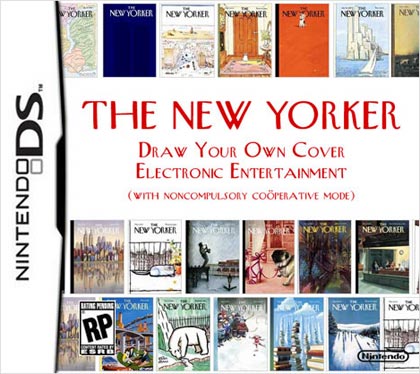
If you join the group, there’s a Photoshop kit you can download to join in the fun.
John Hodgman reports that the audiobook for The Areas of My Expertise is available for free at the iTunes Music Store.
Update: From what I can tell from the first 3:34, THIS IS THE WORLD”S BEST AUDIOBOOK!1!!
What would happen if poets and playwrights wrote works whose titles were anagrams of their names? Here’s one by Basho called Has B.O: “Swamp mist, eyes water- / Why is that monk still wearing / Winter robes in June?”
Prospect Magazine lists the most overrated and most underrated books of 2006. Top 3 overrated are The God Delusion, The Blunkett Tapes, and Everyman. I so agree about Everyman…it’s the only book I read this year where I genuinely wanted my money back at the end of it. (via mr)
At The Art of the Book event last week, the panel was asked why there were so few female superstar designers. Milton Glaser took a shot at answering the question (many women choose family over work during the crucial superstar career development years) but judging by the reaction afterwards online, his comments were not appreciated by some. To be fair, Glaser’s comments were taken out of context, I think, and what he said is a part of the overall answer to the question. On Design Observer, Michael Beirut, who was the moderator for that evening’s event, takes a closer look at the issue. “The real question was the unspoken one: ‘Why is it that you guys up there are always…guys?’” Oh, and here’s a list of women speakers for your conference.
10 Zen Monkeys has an interview with Gina Smith about iWoz, her book on Steve Wozniak. “Another misconception that bothered him was the idea that he and Steve Jobs had designed the Apple I and the Apple II together. The sole designer of both those computers was Steve Wozniak. The sole designer.” (thx, david)
An increasing number of novels contain bibliographies, once the domain of the nonfiction book. I love bibliographies…bring them on.
Newer posts
Older posts







Socials & More