

Comet time lapse
A short time lapse of Comet Lovejoy appearing in the pre-dawn sky over the Andes. Wait for the last sequence…it’s the best one.
Lovejoy was only discovered in Nov 2011 by an amateur astronomer. (via ★interesting)

This site is made possible by member support. 💞
Big thanks to Arcustech for hosting the site and offering amazing tech support.
When you buy through links on kottke.org, I may earn an affiliate commission. Thanks for supporting the site!
kottke.org. home of fine hypertext products since 1998.
Beloved by 86.47% of the web.
A short time lapse of Comet Lovejoy appearing in the pre-dawn sky over the Andes. Wait for the last sequence…it’s the best one.
Lovejoy was only discovered in Nov 2011 by an amateur astronomer. (via ★interesting)
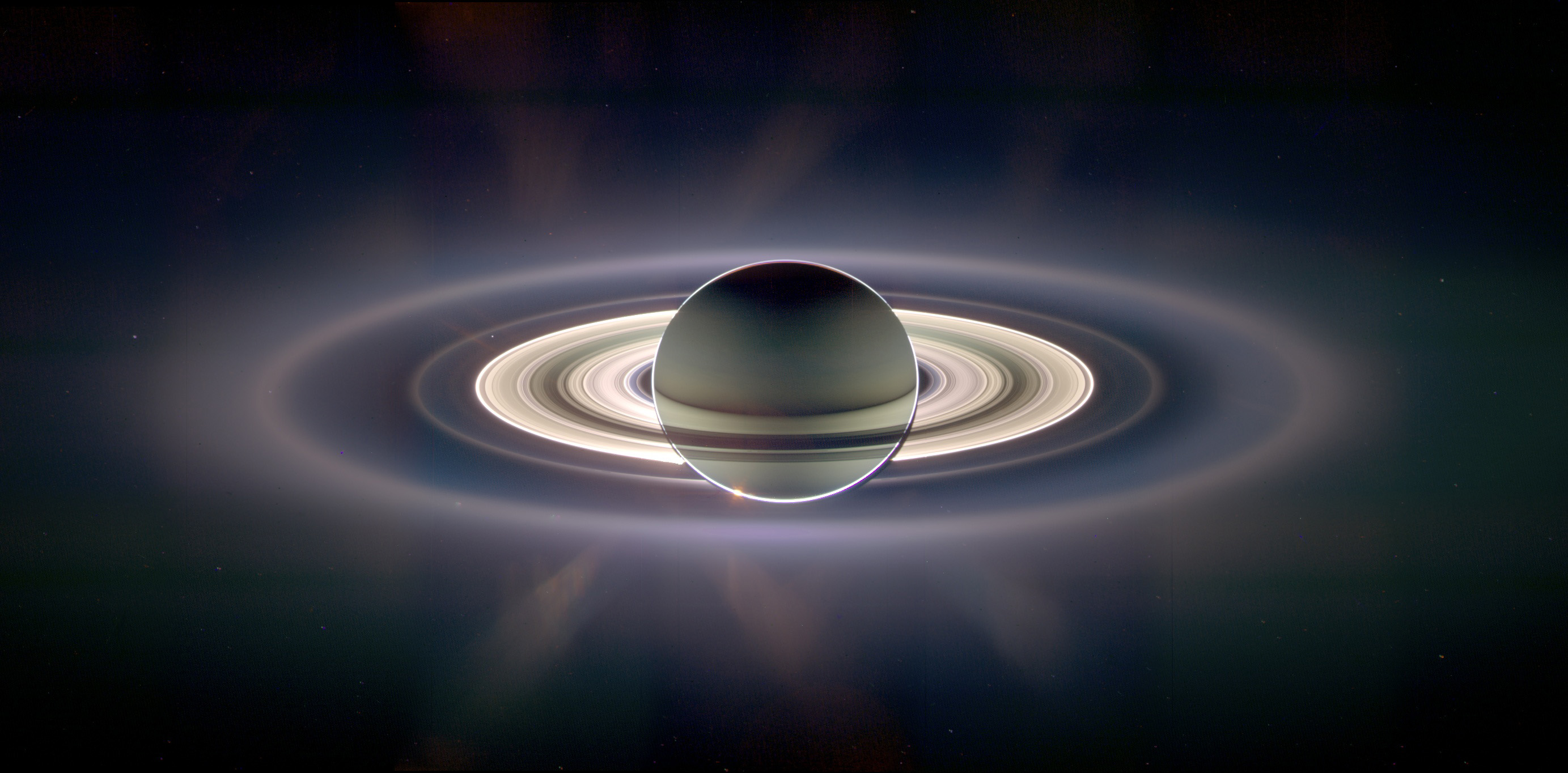
The Cassini spacecraft caught this remarkable photo of Saturn eclipsing the Sun in 2006.
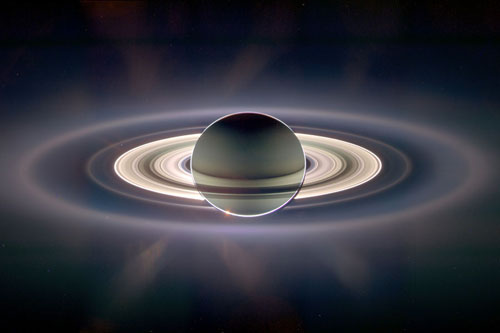
Click through for the big image and the massive image. If you look close can see the Earth in the image, for reals!
Indian lunar orbiter Chandrayaan-1 has discovered a large cave on the Moon. Aside from the hey, cool, there’s a cave on the Moon factor, the other big feature of the cave is its constant and temperate temperature.
Temperatures on the moon swing wildly, from a maximum of 262 degrees Fahrenheit to a minimum of -292. The cave holds steady at a (relatively) comfortable -4, since the moon’s weather can’t penetrate its 40-foot-thick wall. It could also protect astronauts from “hazardous radiations, micro-meteoritic impacts,” and dust storms, according to paper published by the journal Current Science.
(via @juliandibbell)
Over at Boing Boing, Lee Billings has an interview with Greg Laughlin, an astrophysicist who recently came up with an equation for estimating the value of planets, a sort of Drake equation for cosmic economics.
This equation’s initial purpose, he wrote, was to put meaningful prices on the terrestrial exoplanets that Kepler was bound to discover. But he soon found it could be used equally well to place any planet-even our own-in a context that was simultaneously cosmic and commercial. In essence, you feed Laughlin’s equation some key parameters — a planet’s mass, its estimated temperature, and the age, type, and apparent brightness of its star — and out pops a number that should, Laughlin says, equate to cold, hard cash.
At the time, the exoplanet Gliese 581 c was thought to be the most Earth-like world known beyond our solar system. The equation said it was worth a measly $160. Mars fared better, priced at $14,000. And Earth? Our planet’s value emerged as nearly 5 quadrillion dollars. That’s about 100 times Earth’s yearly GDP, and perhaps, Laughlin thought, not a bad ballpark estimate for the total economic value of our world and the technological civilization it supports.
This video shows what various planets (Jupiter, Mars, etc.) would look like in the night sky if they orbited the Earth at the same distance as the Moon.
See also Imagining Earth with Saturn’s rings and Helvetica! In! Space!
Early this week, I started seeing a little traffic to a post I wrote way back in March of 1999 called The new Zodiac.
An interesting calendrical tidbit: the Zodiac that everyone is familiar with today is actually based upon the movement of the sun through the constellations of 2500 years ago. Today, due to shifts in the earth’s rotation and orbit, the sun moves through 13 constellations, not just 12.
The thirteen constellation is called Ophiuchus. As I’m writing, Ophiuchus is the #1 trending topic on Twitter right now and there are dozens of news articles on the topic in outlets like Time, Huffington Post, and The Washington Post. Patient Zero of this most recent round of new Zodiac reporting is this January 9 Minneapolis Star-Tribune article in which the updated Zodiac is listed as:
Capricorn: Jan 20 - Feb 16
Aquarius: Feb 16 - Mar 11
Pisces: Mar 11 - Apr 18
Aries: Apr 18 - May 13
Taurus: May 13 - Jun 21
Gemini: Jun 21 - Jul 20
Cancer: Jul 20 - Aug 10
Leo: Aug 10 - Sept 16
Virgo: Sept 16 - Oct 30
Libra: Oct 30 - Nov 23
Scorpio: Nov 23 - Nov 29
Ophiuchus: Nov 29 - Dec 17
Sagittarius: Dec 17 - Jan 20
Wikipedia has a slightly different calendar for 2011:
Aries: Apr 19 - May 14
Taurus: May 14 - Jun 21
Gemini: Jun 21 - Jul 21
Cancer: Jul 21 - Aug 11
Leo: Aug 11 - Sept 17
Virgo: Sept 17 - Oct 31
Libra: Oct 31 - Nov 21
Scorpio: Nov 21 - Nov 30
Ophiuchus: Nov 30 - Dec 18
Sagittarius: Dec 18 - Jan 21
Capricorn: Jan 21 - Feb 17
Aquarius: Feb 17 - Mar 12
Pisces: Mar 12 - Apr 19
Which calendar to believe? Who knows, but one thing is for sure: astrology remains a steaming pile of horseshit.
Bad Astronomy lists its top fourteen astronomy photos of the year, including this nearly unbelievable spiral pattern caused by a binary star.
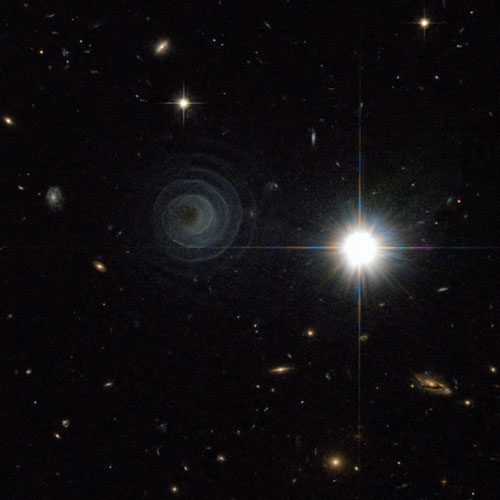
The object, called AFGL 3068, is a binary star, two stars in an 800-year orbit around one another. One of them is a red giant, a star near the end of its life. It’s blowing off massive amounts of dark dust, which is enveloping the pair and hiding them from view. But the system’s spin is spraying the material out like a water sprinkler head, causing this giant and delicate spiral pattern on the sky. And by giant, I mean giant: the entire structure is about 3 trillion kilometers (about 2 trillion miles) across.
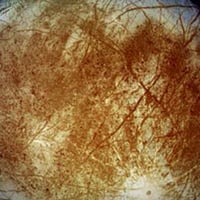
What is this, do you think? Electron microscope photo of pollen? Infrared tennis ball? Mars? The inside of a baseball?
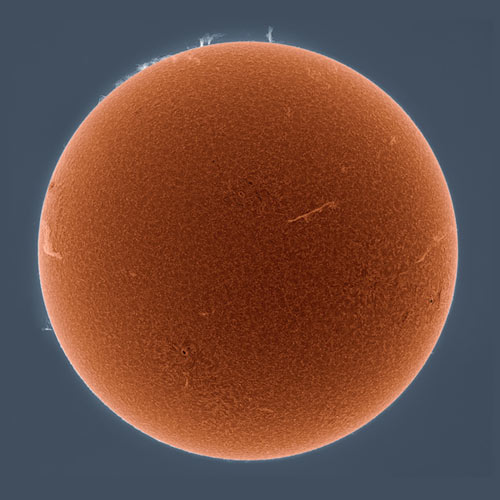
It’s actually a photo of the Sun taken at the H-alpha wavelength by an amateur astronomer.
That habitable exoplanet discovery? Maybe not.
Astronomer Francesco Pepe of the Geneva Observatory in Switzerland, who spoke Oct. 11 at an International Astronomical Union symposium on planetary systems, reported a new analysis using only HARPS data, but adding an extra 60 data points to the observations published in 2008. He and his colleagues could find no trace of the planet.
A team of scientists has discovered a potentially habitable planet located about 20 light years from Earth.
The paper reports the discovery of two new planets around the nearby red dwarf star Gliese 581. This brings the total number of known planets around this star to six, the most yet discovered in a planetary system other than our own solar system. Like our solar system, the planets around Gliese 581 have nearly circular orbits.
The most interesting of the two new planets is Gliese 581g, with a mass three to four times that of the Earth and an orbital period of just under 37 days. Its mass indicates that it is probably a rocky planet with a definite surface and that it has enough gravity to hold on to an atmosphere, according to Vogt.
Gliese 581, located 20 light years away from Earth in the constellation Libra, has a somewhat checkered history of habitable-planet claims. Two previously detected planets in the system lie at the edges of the habitable zone, one on the hot side (planet c) and one on the cold side (planet d). While some astronomers still think planet d may be habitable if it has a thick atmosphere with a strong greenhouse effect to warm it up, others are skeptical. The newly discovered planet g, however, lies right in the middle of the habitable zone.
Sam Arbesman’s prediction of May 2011 might have been too conservative. And 20 light years…that means we could send a signal there, and if someone of sufficient technological capability is there and listening, we could hear something back within our lifetime. Contact! (thx, jimray)
Back in July, Ben Terrett wrote a post about how many instances of the word “helvetica” set in unkerned 100 pt Helvetica it would take to go from the Earth to the Moon:
The distance to the moon is 385,000,000,000 mm. The size of an unkerned piece of normal cut Helvetica at 100pt is 136.23 mm. Therefore it would take 2,826,206,643.42 helveticas to get to the moon.
But let’s say you wanted to stretch one “helvetica” over the same distance…at what point size would you need to set it? The answer is 282.6 billion points. At that size, the “h” would be 44,600 miles tall, roughly 5.6 times as tall as the Earth. Here’s what that would look like:

The Earth is on the left and that little speck on the right side is the Moon. Here’s a close-up of the Earth and the “h”:
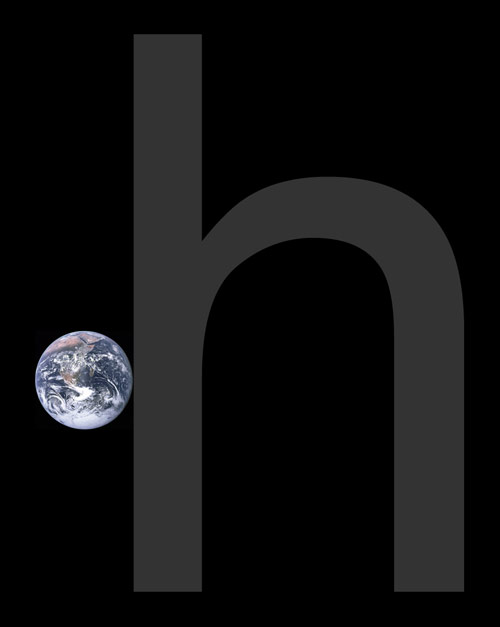
And if you wanted to put it yet another way, the Earth is set in 50.2 billion point type — Helvetically speaking — while the Moon is set in 13.7 billion point type. (thx, @brainpicker)
It’s not so much a video of a total solar eclipse (the recent one, as seen from Argentina on July 11) as a video of people watching a total solar eclipse.
The sound is key…the reaction is very much The Rapture/End Times/high on ecstasy. If I had a bucket list, seeing a total solar eclipse would be on it. (via bobulate)
A new Hubble discovery was announced today and it’s not for the faint of heart. At least, that is, if you care deeply about mysterious exoplanets 600 light years away.
WASP-12b is orbiting a sun-like yellow dwarf star 600 light-years away and it has such a tight orbit (of only 1.1 days) that it is being roasted to nearly 2,800 degrees Fahrenheit. This superheated state has caused the doomed exoplanet to puff up to nearly twice the size of Jupiter.
WASP-12b is in trouble and there’s no Willis/Affleck/Bay mission planned to save it. That said, it’s going to take about another 10 million years for WASP-12b to be totally eaten, so it has time to cross a few things off its bucket list.
Today’s wild space story is brought to us by Bad Astronomy:
We have a stellar cluster with thousands of times the Sun’s mass embedded in a nebula furiously cranking out newborn stars. A lot of them are near the physical upper limit of how big a star can get. The whole thing is only a couple of million years old, a fraction of the galaxy’s lifespan. One beefy star with 90 times the Sun’s mass got too close to some other stars, which summarily flung it out of the cluster at high speed, fast enough to cross the distance from the Earth to the Moon in an hour (it took Apollo three days). The star is barreling through the flotsam in that galaxy, its violent stellar wind carving out a bubble of gas that points right back to the scene of the crime, nearly 4 quadrillion kilometers and a million years behind it.
Click through to see the pictures and read a more thorough write up.
PS: 70% of the reason I linked to this is because of the title, “Rampaging cannonball star is rampaging.”
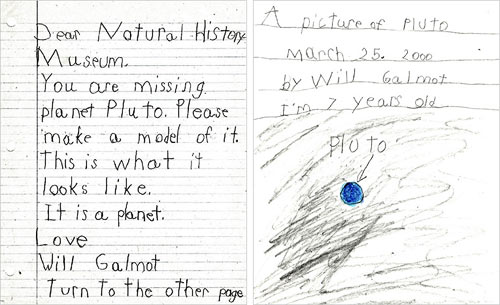
The Natural History Museum got a lot of hate mail from children when they demoted Pluto from planet to a resident of the Kuiper Belt, including this one from a fellow named Will:
One of the better lists out there: the top astronomy photos of the year. From the list, this is a more detailed view of the Martian landscape than we’re used to seeing:

My personal favorite, the photos taken by the LRO of Apollo 11’s landing site, made the list as well.
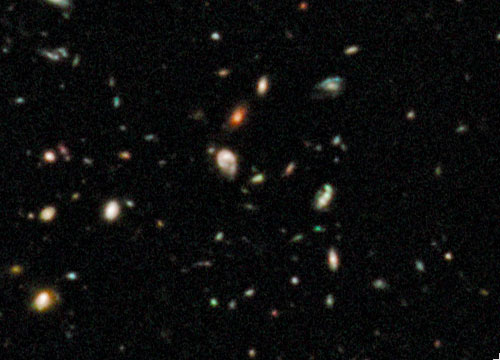
In 2004, the Hubble Space Telescope took an image called the Hubble Ultra Deep Field; basically astronomers pointed the Hubble toward an “empty” part of space and took a long-exposure shot in the visible spectrum. What they found were thousands of far away galaxies from early in the development of the universe. Now the Hubble has peered even deeper into the universe in near-infrared and captured this image:
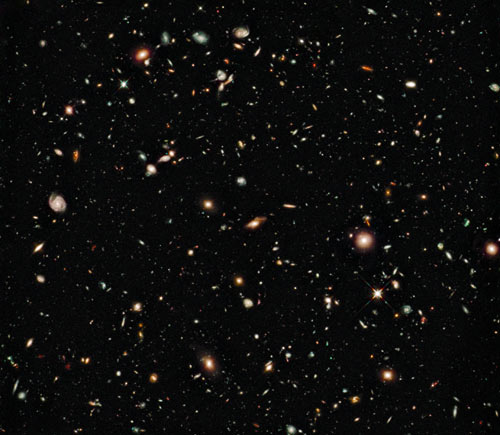
Each one of those little specks is an entire galaxy, some only 600 million years old. Here’s a zoomed-in section:
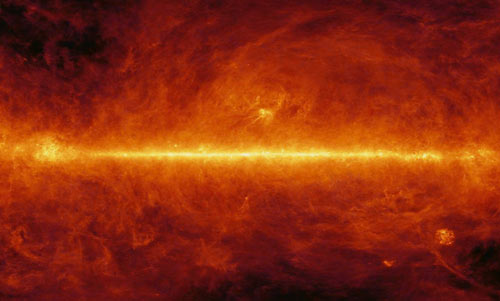
Chromoscope provides views of the Milky Way galaxy in x-ray, visible, microwave, and several other EM wavelengths. This is the view in far infrared:
NASA announced that it has found pretty hard evidence of significant amounts of water on the Moon.
“We are ecstatic,” said Anthony Colaprete, LCROSS project scientist and principal investigator at NASA’s Ames Research Center in Moffett Field, Calif. “Multiple lines of evidence show water was present in both the high angle vapor plume and the ejecta curtain created by the LCROSS Centaur impact. The concentration and distribution of water and other substances requires further analysis, but it is safe to say Cabeus holds water.”
I don’t have to tell you about the implications here. Just think of how much you could sell authentic Moon bottled water for.
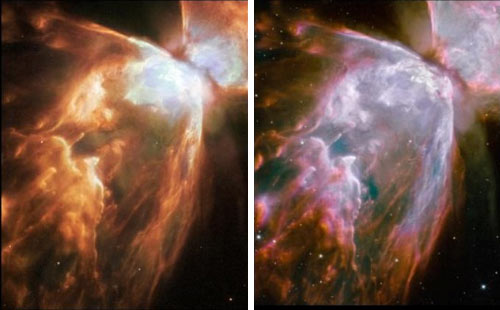
Before and after photos from the Hubble telescope, which recently underwent spaceLASIK to extend the life and capabilities of the prolific telescope.
The Royal Observatory has announced the winners of its Astronomy Photographer of the Year contest.
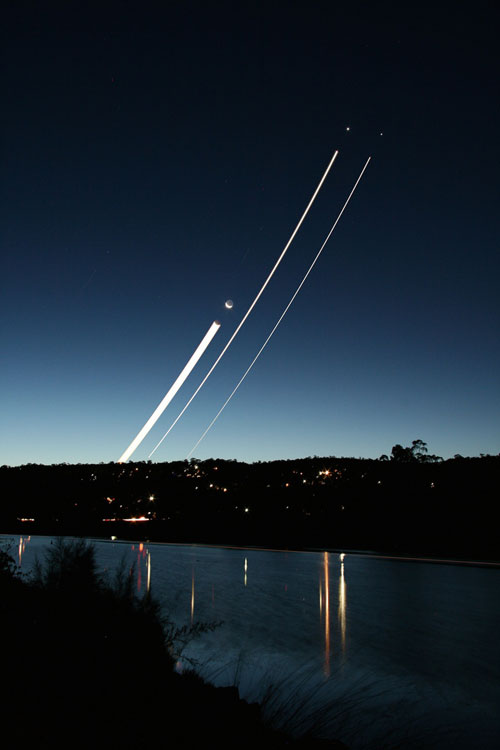
I had no idea that images this sharp and detailed could be taken with non-pro ground telescopes…particularly these shots of the Horsehead Nebula and the surface of the Moon. More winners listed here.
Update: Jonathan Crowe notes that the gear used to take these photos isn’t cheap.
The winner’s photo of the Horsehead Nebula (mpastro2001 also had a second photo in the top five) used a 12 1/2” Ritchey-Chretien telescope ($21,500) and an SBIG STL11000 camera ($7,195 and up) with an AO-L adaptive optics accessory ($1,795) on a Paramount ME mount ($14,500). Total cost for just the equipment mentioned here: $44,990.
A massive solar flare on September 1, 1859 “caused the most potent disruption of Earth’s ionosphere in recorded history”.
Within hours, telegraph wires in both the United States and Europe spontaneously shorted out, causing numerous fires, while the Northern Lights, solar-induced phenomena more closely associated with regions near Earth’s North Pole, were documented as far south as Rome, Havana and Hawaii, with similar effects at the South Pole.
(via the browser)
Using redshift data, a 3-D animated view of the Hubble Ultra Deep Field was created.
In early July, a photographer took a picture of what appears to be three Suns rising over Gdansk Bay in Poland.
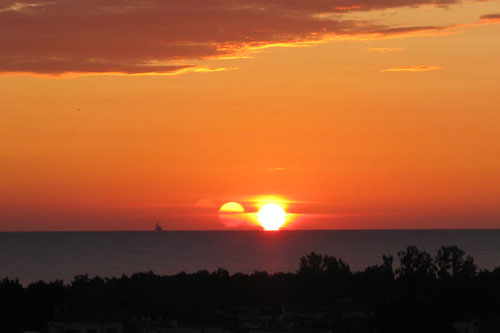
The photographer insists that the effect was not created by the camera and was visible to the naked eye. The early consensus in the forums is that the photo was taken through a double-paned window.
We Choose the Moon is a site that tracks the activities of the Apollo 11 mission as it happened 40 years ago. Nice work. The transmissions from the spacecraft, CAPCOM, and the lunar lander are cleverly published to and pulled in from Twitter.
With all this 40th anniversary stuff, I’m having trouble getting my mind around that the first Moon landing is as far removed from the present as the low point of The Great Depression was from my birth (i.e. the Moon landing, culturally speaking, is Ollie’s Great Depression). See also timeline twins. (via jimray)
From the folks who brought you The Periodic Table of Videos, Sixty Symbols is a series of videos on the symbols used in physics and astronomy. (via snarkmarket)
The scamps at Nature are updating the ApolloPlus40 Twitter account as the Apollo 11 mission happened 40 years ago. (thx, matt)
Oliver Morton fills us in on the current happenings in the search for planets outside of our solar system. A friend of his clued him in on a technique that could be used to not only discover planets but to determine if those planets show signs of supporting Earth-like life.
When they are passing in front of their stars, their atmospheres are backlit in a way that can make spectroscopic analysis of the different chemicals in their atmospheres comparatively easy: the wavelengths of light absorbed by the various chemicals will show up, in a tiny way, in the spectrum of the starlight. And this is what makes it possible to imagine looking at them for signs of life.
What scientists would look for are planets with unstable atmospheres, which James Lovelock said was an indication of life.
After the extragalactic planet post this morning, Sam Arbesman sent me a link to systemic, a blog dedicated to the search for extrasolar planets written by Greg Laughlin, one of the scientists involved in the effort. Here are two relevant posts. In Forward, Laughlin says we’re very close to finding a nearby Earth-like planet:
Detailed Monte-Carlo simulations indicate that there’s a 98% probability that TESS will locate a potentially habitable transiting terrestrial planet orbiting a red dwarf lying closer than 50 parsecs. When this planet is found, JWST (which will launch near the end of TESS’s two year mission) can take its spectrum and obtain resolved measurements of molecular absorption in the atmosphere.
In Too cheap to meter, Laughlin presents a formula for the land value of such a discovery that depends on how far away the planet is, the age of the star it orbits, and the star’s visual magnitude.
Applying the formula to an exact Earth-analog orbiting Alpha Cen B, the value is boosted to 6.4 billion dollars, which seems to be the right order of magnitude. And applying the formula to Earth (using the Sun’s apparent visual magnitude) one arrives at a figure close to 5 quadrillion dollars, which is roughly the economic value of Earth (~100x the Earth’s current yearly GDP)…
Scientists may have found the first planet located in another galaxy. The evidence is a little sparse but the search technique they’re using is solid.
The idea is to use gravitational microlensing, in which a distant source star is briefly magnified by the gravity of an object passing in front of it. This technique has already found several planets in our galaxy, out to distances of thousands of light years. Extending the method from thousands to millions of light years won’t be easy, says Philippe Jetzer of the University of Zurich in Switzerland, but it should be possible.
Socials & More