

The Moon in HD
HD video of the Moon from 13 miles above the surface taken by Japan’s KAGUYA probe. The probe’s orbit has been decaying since it began circling the Moon and will crash on the surface at 18:30 GMT on June 10.

This site is made possible by member support. 💞
Big thanks to Arcustech for hosting the site and offering amazing tech support.
When you buy through links on kottke.org, I may earn an affiliate commission. Thanks for supporting the site!
kottke.org. home of fine hypertext products since 1998.
Beloved by 86.47% of the web.
HD video of the Moon from 13 miles above the surface taken by Japan’s KAGUYA probe. The probe’s orbit has been decaying since it began circling the Moon and will crash on the surface at 18:30 GMT on June 10.
Using a Chilean telescope, astronomer Debra Fischer is leading a team searching for Earth-like planets around Alpha Centuri, our sun’s nearest stellar neighbor.
RV shifts are how the vast majority of extrasolar worlds have been discovered, but only because these planets, called “hot Jupiters,” are extremely massive and in hellishly close orbits around their stars. Their stellar wobbles are measurable in meters per second; seeing the much smaller centimeters-per-second wobble of an Earth twin is orders of magnitude more difficult. For the Alpha Centauri system, the feat is akin to detecting a bacterium orbiting a meter from a sand grain-from a distance of 10 kilometers. But by devoting hundreds of nights of telescope time to collecting hundreds of thousands of individual observations of just these two stars, Fischer believes she can eventually distill the faint RV signal of any Earth-like planets. It’s simply a matter of statistics and brute force. The planets wouldn’t reveal themselves as images in a telescope, but as steadily strengthening probabilistic peaks.
An excerpt from one of Galileo Galilei’s letters to Don Virginio Cesarini:
Long experience has taught me this about the status of mankind with regard to matters requiring thought: the less people know and understand about them, the more positively they attempt to argue concerning them, while on the other hand to know and understand a multitude of things renders men cautious in passing judgment upon anything new.
Want more Galileo? The Istituto e Museo di Storia della Scienza in Florence is loaning out their exhibit, Galileo, the Medici and the Age of Astronomy to The Franklin in Philadelphia. It features one of the last two telescopes belonging to the astronomer, as well as his notes, paintings, and other instruments, including the cylindrical sundial and Michelangelo’s compass.
The Hubble Space Telescope captured four of Saturn’s moons crossing its face at the same time. (via cyn-c)
This HD video taken by the Hubble telescope of Ganymede going behind Jupiter looks completely computer generated and surreal.
Bad Astronomy has its list of the top 10 astronomy pictures of 2008 up. It includes this video of the moon orbiting the earth, comprised of a series of photos taken by a reassigned space probe.
There has never been a generation of humans in all of history who could see such an event. If you ever get a little depressed, or lonely, or think like there’s nothing going on that’s interesting any more, think on that for a moment or two. A thousand generations of people could only imagine such a thing, but we can actually do it.
(thx, amos)
The universe is trying to kill us, let us count the (ten) ways.
Start worrying in a few million years about a cosmic dust collision, when the sun hits the closest spiral arm of our galaxy. Take your chances with an exploding star. Or manage to escape these threats, and you just get an extra 10^35 years before all matter decays anyway.
Meg bought Ollie this ball a couple of weeks ago. It’s got all the planets of the solar system on it, plus the Sun. But no Pluto. That’s right, it’s barely been two years since Pluto was demoted to dwarf planet status and the toy manufacturers have already made the adjustment.
It saddens me that Ollie has to grow up in a world where Pluto isn’t considered a planet, although I take comfort that his textbooks probably won’t be updated by the time he’s in school. In the meantime, I’ve Sharpied Pluto onto his ball.
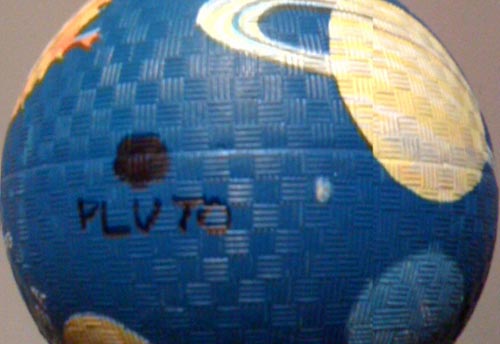
One ball at a time people, that’s how we win.
Observe sunspots by going to Grand Central Terminal?
The southern wall of the Grand Concourse, facing 42nd Street, has semicircular grills high up, with small curlicued spaces like those in a leafy tree. Many of those spaces act like the aperture of a pinhole camera, reflecting an image of the sun that, when it reaches the floor, will be 8 to 12 inches wide. The smaller grill spaces will produce dimmer but sharper solar images on your paper.
(via 92y blog)
From Harvard Magazine, an appreciation of the work that the Hubble telescope has done since its 1990 launch into orbit.
The “Pillars of Creation” may be the most iconic Hubble photograph ever taken. “Located in the Eagle Nebula, the pillars are clouds of molecular hydrogen, light years in length, where new stars are being born,” says Aguilar. “However, recent discoveries indicate these pillars were destroyed by a massive nearby super nova some 6,000 years ago. This is a ghost image of a past cosmic disaster that we won’t see here on Earth for another thousand years or so-and a perfect example of the fact that everything we see in the universe is history.”
The Hubble Space Telescope was launched into space 18 years ago and to celebrate, NASA has put up a photo gallery of merging galaxies, galaxies as in love with each other as NASA is with the Hubble. Aww.
A photograph of the newest possible moon, one that’s only about 15 hours old.
Finding the Moon when its slim crescent is still less than about 24 hours past the New Moon phase requires careful timing and planning, a challenging project even for experienced observers. In this sighting, only about 0.8 percent of the Moon’s disk appears illuminated.
(via airbag)
The Hubble telescope recently captured an image of a double Einstein Ring.
An Einstein Ring happens when two galaxies are perfectly aligned. The closer galaxy acts as a lens, magnifying and distorting the view of a more distant galaxy. But today astronomers announced that they’ve discovered a double Einstein Ring: three galaxies are perfectly aligned, creating a double ring around the lensing galaxy.
A list of the top 10 astronomy images of 2007, including entwined galaxies and a dying star.
On the origin of the Earth’s moon and how our planet would be different if we didn’t have a moon.
The Moon has been a stabilizing factor for the axis of rotation of the Earth. If you look at Mars, for instance, that planet has wobbled quite dramatically on its axis over time due to the gravitational influence of all the other planets in the solar system. Because of this obliquity change, the ice that is now at the poles on Mars would sometimes drift to the equator. But the Earth’s moon has helped stabilize our planet so that its axis of rotation stays in the same direction. For this reason, we had much less climatic change than if the Earth had been alone. And this has changed the way life evolved on Earth, allowing for the emergence of more complex multi-cellular organisms compared to a planet where drastic climatic change would allow only small, robust organisms to survive.
Comet Holmes brightened a millionfold late this week and has become visible to the naked eye, even in bright cities. The second chart on this page shows how quickly the comet shot up in brightness.
Using adaptive optics, which corrects for atmospheric distortion, some astronomers have modified a ground telescope to yield sharper images than the Hubble.
Hubble’s optics provide greater detail over a wider angle, while the Lucky camera as used at Palomar gives ultra-high resolution only for a tiny slice of the sky at one time.
This New Yorker article on light pollution makes mention of the Bortle Dark-Sky Scale, which is a measure of how bright the stars are in a particular part of the sky.
In Galileo’s time, nighttime skies all over the world would have merited the darkest Bortle ranking, Class 1. Today, the sky above New York City is Class 9, at the other extreme of the scale, and American suburban skies are typically Class 5, 6, or 7. The very darkest places in the continental United States today are almost never darker than Class 2, and are increasingly threatened. For someone standing on the North Rim of the Grand Canyon on a moonless night, the brightest feature of the sky is not the Milky Way but the glow of Las Vegas, a hundred and seventy-five miles away. To see skies truly comparable to those which Galileo knew, you would have to travel to such places as the Australian outback and the mountains of Peru.
Arecibo Observatory, the world’s largest radio telescope, is in danger of being shut down due to budget cuts. Arecibo could run for almost two years for the cost of a single F-16 fighter jet…to say nothing of the small fraction of the cost of the War in Iraq required.
Is the search for aliens such a good idea? If/when we find evidence of extraterrestrial intelligent life, will they welcome us as neighbors, treat us as vermin in their universe or something inbetween? “Jared Diamond, professor of evolutionary biology and Pulitzer Prize winner, says: ‘Those astronomers now preparing again to beam radio signals out to hoped-for extraterrestrials are naive, even dangerous.’”
Poor Pluto. First they demoted it from planet status and now it’s not even the biggest dwarf planet in the solar system.
Are there many small galaxies, like the one just discovered just outside our own, orbiting the larger visible galaxies?
Three trillion years from now, the universe will be observably static, the Milky Way alone, and scientists of the day likely won’t be able to “infer that the beginning involved a Big Bang”.
Closeup videos of the sun. The bottom one is especially mesmerizing.
How to survive a black hole. If you’re in a rocket ship about to fall into a black hole, you might live a bit longer if you turn on your engines. “But in general a person falling past the horizon won’t have zero velocity to begin with. Then the situation is different — in fact it’s worse. So firing the rocket for a short time can push the astronaut back on to the best-case scenario: the trajectory followed by free fall from rest.”
Scientists have found an Earth-like planet orbiting one of the closest stars to our solar system. “On the treasure map of the universe, one would be tempted to mark this planet with an X.”
For next time around, how to photograph a lunar eclipse. Here’s a list of upcoming eclipses. (via inmyallstars)
Nice composite photo of the lunar eclipse last night. We missed it because it was a bit cloudy and tall buildingy in NYC last night. (thx, ajit)
Update: Here’s another, another, and one more.

Socials & More