



Kubrick: more like music than like fiction
How many videos can we watch about the films of Stanley Kubrick? If you’re anything like me, the answer is never enough. This montage hinting at connections between his films is particularly well done.

This site is made possible by member support. 💞
Big thanks to Arcustech for hosting the site and offering amazing tech support.
When you buy through links on kottke.org, I may earn an affiliate commission. Thanks for supporting the site!
kottke.org. home of fine hypertext products since 1998.
Beloved by 86.47% of the web.
How many videos can we watch about the films of Stanley Kubrick? If you’re anything like me, the answer is never enough. This montage hinting at connections between his films is particularly well done.
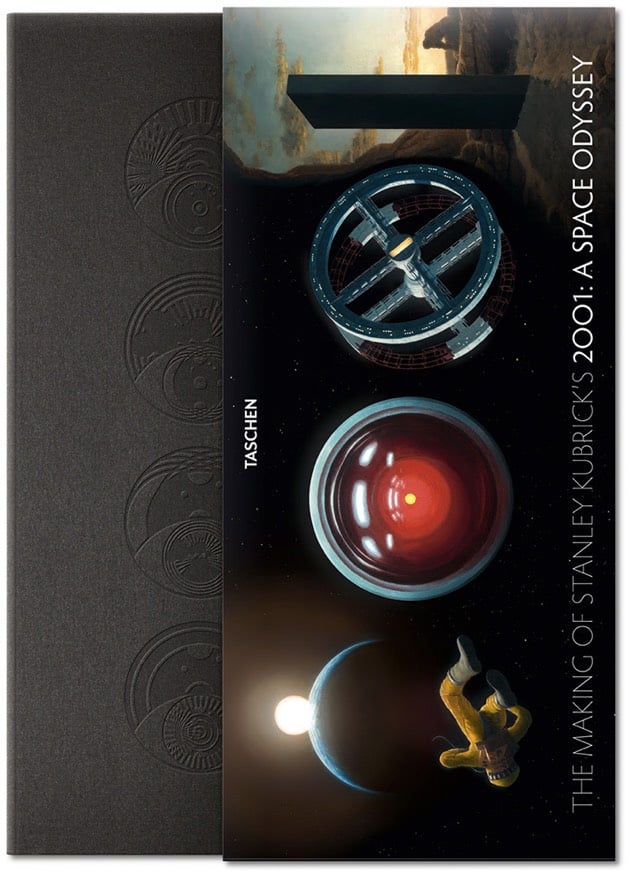
Last year, Taschen came out with a limited edition book on The Making of Stanley Kubrick’s ‘2001: A Space Odyssey’. Only a couple thousand were made and one of them is selling on Amazon for $1750. This year, they’re releasing a regular edition for a much more reasonable $47. (via @michaelbierut)
Inside the Making of Dr. Strangelove is a 45-minute behind-the-scenes documentary about Stanley Kubrick’s kooky masterpiece (and one of my two favorite movies).1
And speaking of Kubrick, director Marc Forster is making a trilogy of films based on Kubrick’s script for The Downslope, a movie about the Civil War. *tents fingers* Interesting…
The other is Rushmore.↩
If you take Wes Anderson’s The Grand Budapest Hotel and mix in elements of Stanley Kubrick’s The Shining, the result is pretty good.
(via devour)
From Cameron Beyl, a three-hour video essay on the films of Stanley Kubrick. The essay splits Kubrick’s career into five parts: the early independent features (Fear & Desire, Killer’s Kiss, The Killing), the Kirk Douglas years (Paths of Glory, Spartacus), the Peter Sellers comedies (Lolita, Dr. Strangelove), the Master Works (2001, A Clockwork Orange, Barry Lyndon, The Shining), and the final features (Full Metal Jacket, Eyes Wide Shut).
Beyl has just begun his second extended essay, on David Fincher. (via openculture)
The Art of the Title covers the opening title sequence to Kubrick’s Dr. Strangelove.
Notably, none of the aerial footage in the opening came from — or was even made for — Kubrick’s film. The footage is all stock. Because it came from more than one stock reel, the sequence features multiple aircraft, including an angle from a KC-135 Stratotanker’s refueling deck, which dates back to October 20, 1956 and came directly from the Boeing company. The sequence shows the KC-135 transferring its precious fluids to a B-52 Stratofortress, the colossal bomber featured later in the film. The phallic piece of machinery in the first shot, however, is not the refueling probe of a B-52 or of a KC-135, as one would assume, but possibly that of a Gloster Meteor jet fighter. Regardless, it is the first in a long line of sight gags and sex jokes sprinkled throughout the film.
Also included is a short interview with the title designer, Pablo Ferro.
So. Steven Soderbergh has cut his own version of Stanley Kubrick’s 2001: A Space Odyssey. Like, !!!1
I haven’t had a chance to watch this yet, so I don’t know what’s different about it aside from the shorter runtime of 1h50m. If someone watches it and wants to report in about the differences, let me know. Soderbergh also guessed that Kubrick would have liked shooting on digital:
let me also say i believe SK would have embraced the current crop of digital cameras, because from a visual standpoint, he was obsessed with two things: absolute fidelity to reality-based light sources, and image stabilization. regarding the former, the increased sensitivity without resolution loss allows us to really capture the world as it is, and regarding the latter, post-2001 SK generally shot matte perf film (normally reserved for effects shots, because of its added steadiness) all day, every day, something which digital capture makes moot. pile on things like never being distracted by weaving, splices, dirt, scratches, bad lab matches during changeovers, changeovers themselves, bad framing and focus exacerbated by projector vibration, and you can see why i think he might dig digital.
See also Soderbergh’s B&W edit of Raiders of the Lost Ark. (via @fengypants)
Update: Reader and 2001 fan Dan Norquist watched Soderbergh’s edit and reported back via email:
I love everything Soderbergh does and I love the fact that he cut this film. It’s fun to see it in a more concise form. Really, there’s no choppy edits or anything that doesn’t make sense (except the whole movie of course!). I did miss some of my favorite parts. I love when the father is talking to his daughter on the video phone. Also, if you weren’t around in 1968 it’s really hard to describe how scary the Cold War was. There was always this thing hanging over our heads, that the Russians really had the means to destroy us with nuclear weapons. So you really need the full scene where the American meets the Russians (Soviets). The forced, unnatural politeness is so brilliant and helped to give the film context in its time.
All the important stuff is there — the apes, the monolith, HAL turning evil, astronaut spinning away, the speeding light show (shortened?), old man pointing at space child — and it’s all recut by a master.
Finally, there is something about the full length of the original film that is part of its strength as a piece of art. There is no hurry, no cut to the chase. It’s almost as if you have to go through the entire journey before you can earn the bubble baby at the end.
No surprise that he tightened it up into something less Kubrickian and more Soderberghish. Dan closed his email by saying he would recommend it to fans of the original. (thx, dan)
Update: I’ve seen some comments on Twitter and elsewhere about the legality of Soderbergh posting the 2001 and Raiders edits. The videos are hosted on Vimeo, but are private and can’t be embedded on any site other than Soderbergh’s. But any enterprising person can easily figure out how to download either video. The Raiders video has been up since September, which means either that Paramount doesn’t care (most likely in my mind) or their lawyers somehow haven’t caught wind of it, even though it was all over the internet a few months ago (less likely). We’ll see if whoever owns the rights to 2001 (Time Warner?) feels similarly.
An interesting wrinkle here is that Soderbergh has been outspoken about copyright piracy and the Internet. From a 2009 NY Times article about a proposed French anti-piracy law:
In the United States, a Congressional committee this week began studying the issue. In a hearing Monday before the Foreign Affairs Committee of the House of Representatives, Steven Soderbergh, the film director, cited the French initiative in asking lawmakers to deputize the American film industry to pursue copyright pirates.
Deputizing the film industry to police piracy sounds a little too much like putting the fox in charge of the henhouse. I wonder if Soderbergh feels like these edits are legal to post publicly, if they are fair use for example. Or rather if he feels it’s not but he can get away with it because he is who he is. (thx, @bc_butler)
Update: Soderbergh has removed his cut of 2001 from his site “AT THE REQUEST OF WARNER BROS. AND THE STANLEY KUBRICK ESTATE”. So, that answers that question. (via @fengypants)
I also found out that apparently I had jury duty last week on the same day in the same room as Soderbergh. Total embarrassing fanboy meltdown narrowly avoided. ↩
During the production of 2001: A Space Odyssey, Stanley Kubrick commissioned well-known film score composer Alex North to do the score for the film. North had previously done scores for A Streetcar Named Desire, Spartacus, Cleopatra, and Who’s Afraid of Virginia Woolf? and later received an honorary Oscar for his lifetime of work. As production progressed, Kubrick began to feel that the temporary music he used to edit the film was more appropriate. From an interview with Kubrick by Michel Ciment:
However good our best film composers may be, they are not a Beethoven, a Mozart or a Brahms. Why use music which is less good when there is such a multitude of great orchestral music available from the past and from our own time? When you’re editing a film, it’s very helpful to be able to try out different pieces of music to see how they work with the scene. This is not at all an uncommon practice. Well, with a little more care and thought, these temporary music tracks can become the final score. When I had completed the editing of 2001: A Space Odyssey, I had laid in temporary music tracks for almost all of the music which was eventually used in the film. Then, in the normal way, I engaged the services of a distinguished film composer to write the score. Although he and I went over the picture very carefully, and he listened to these temporary tracks (Strauss, Ligeti, Khatchaturian) and agreed that they worked fine and would serve as a guide to the musical objectives of each sequence he, nevertheless, wrote and recorded a score which could not have been more alien to the music we had listened to, and much more serious than that, a score which, in my opinion, was completely inadequate for the film.
And so the temporary music became the iconic score we know today. For comparison, the embedded video shows how North’s original score would have sounded over the opening credits and initial scene.
Selections from North’s original score were later released publicly. Here’s a 38-minute album on Spotify:
Kubrick was absolutely right to ditch North’s score…it’s perfectly fine music but totally wrong for the movie, not to mention it sounds totally dated today. The classical score gives the film a timeless quality, adding to the film’s appeal and reputation more than 45 years later. (via @UnlikelyWorlds)
Update: Two additional facets to this story. North first learned that Kubrick ditched his score at the NYC premiere of the film; he was reportedly (and understandably) “devastated”. And even when Kubrick was artistically satisfied with the music he chose, negotiations to procure the rights weren’t necessarily smooth.
2) Kubrick’s associates did obtain licenses from Ligeti’s publishers and from record and radio companies, although they were not forthcoming about the pivotal role assigned to the music in the film; 3) Ligeti learned about the use of his music not from his publishers but from members of the Bavarian Radio Chorus; 4) he attended a showing of the film with stopwatch in hand, furiously scribbling down timings — thirty-two minutes in all;
Kubrick was undoubtably of the “shoot first, ask questions later” school of negotiation. (via @timrosenberg)
Worth a listen: a 30-minute BBC Radio show on 2001: A Space Odyssey.
Francine journeys through time and space to uncover the mysteries of this 1968 classic. Searching for the mind of H.A.L. and lost alien worlds among the delights of the Stanley Kubrick Archive at London’s University of the Arts. Joining Francine on her voyage of discovery are 2001 chronicler Piers Bizony, former urbane spaceman Keir Dullea and the woman who built the moon! Other voices include production designer Harry Lange, make-up genius Stuart Freeborn, editor Ray Lovejoy, all now so much stardust, as well as those of lead ape ‘Moonwatcher’ (Dan Richter) & Stargate deviser Douglas Trumbull.
Narrated by Malcolm McDowell and featuring interviews from many collaborators and colleagues, Lost Kubrick is a short documentary on the films that Stanley Kubrick never finished.
Through interviews and abundant archival materials, this documentary examines these “lost” films in depth to discover what drew Kubrick to these projects, the work he did to prepare them for production, and why they ultimately were abandoned. Some of the unfinished project discussed here are “Napoleon”, “The Aryan Papers” and also “A.I” (which we know finally made by Steven Spielberg).
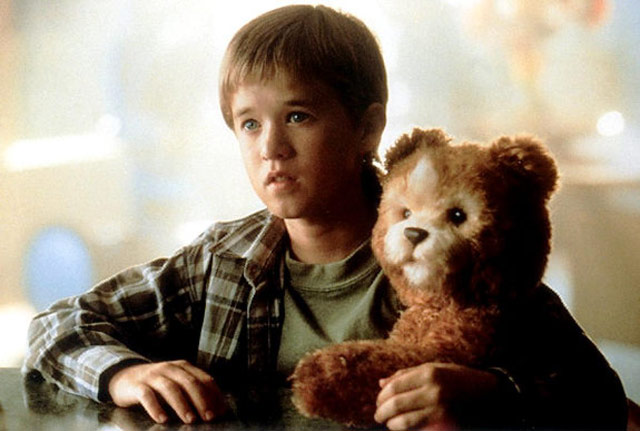
Today I learned that Hasbro released a toy based on the talking teddy bear in Kubrick/Spielberg’s A.I. W? T? F? And of course it’s super creepy:
Noel Murray has the whole story, along with an appreciation of the movie and Spielberg’s direction of it.
A.I. in particular still strikes me as a masterpiece. I thought it might be back in 2001; now I’m certain of it. But it isn’t any easier to watch in 2014 than it was before my first child was born. Like a lot of Spielberg’s films — even the earlier crowd-pleasers — A.I. is a pointed critique of human selfishness, and our tendency to assert our will and make bold, world-changing moves, with only passing regard for the long-term consequences. Spielberg carries this theme of misguided self-absorption to child-rearing, implying that parents program their kids to be cute love machines, unable to cope with the harshness of the real world. He also questions whether humankind is nothing but flesh-based technology, which emerged from the primordial ooze (represented in the opening shot of A.I. by a roiling ocean), and has been trained over millennia to respond to stimuli in socially appropriate ways. A.I. blurs the lines between human and mecha frequently, from an early shot of Monica that makes her look exactly like one of Professor Hobby’s creations, to the way Martin walks, thanks to mechanical legs.
From a large collection of photos shot on the set of 2001: A Space Odyssey, two of my favorites:
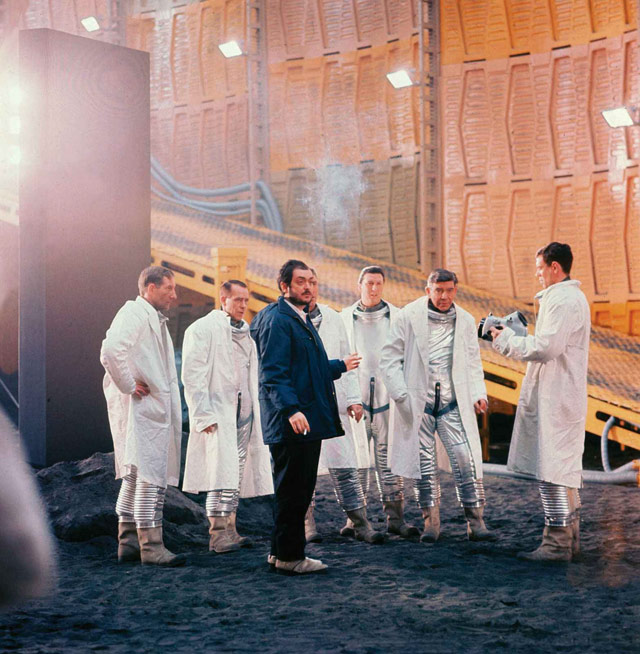
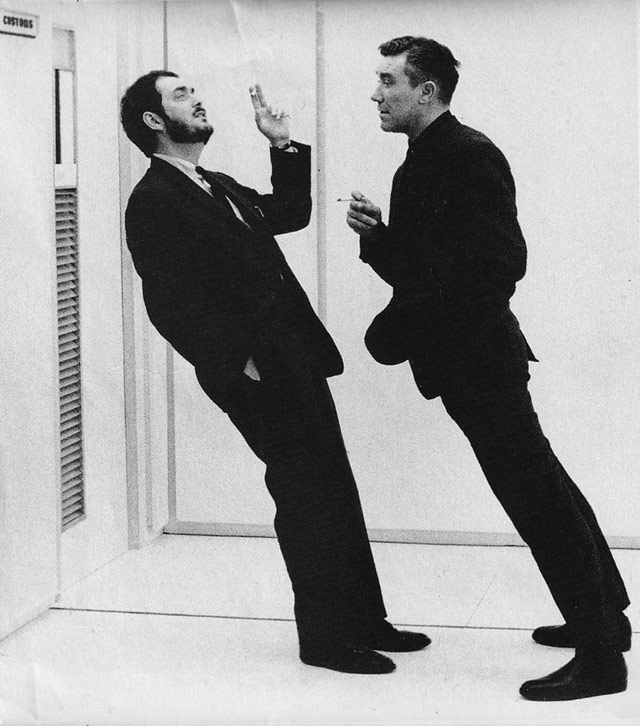
Those are a pair of smooth criminals right there.
From a new blog, Typeset in the Future, an examination of the typography in Kubrick’s 2001: A Space Odyssey.
It’s Futura again, with an M borrowed from Gill Sans, and a W that I don’t recognize from anywhere.
Well lookie here, a restored full-length version of Stanley Kubrick’s very first film, 1953’s Fear and Desire, has popped up on YouTube:
Kubrick famously disliked his first film. From a 1994 episode of All Things Considered:
D’Arcy: But Stanley Kubrick hates the film and to keep it off the screen he threatened Film Forum with copyright violations, even though Fear and Desire is in the public domain. Through a Warner Brothers’ publicist, Kubrick called his first feature ‘a bumbling amateur film exercise’.
Goldstein: Kubrick had Warner Brothers send a letter out to all the press in town saying that the picture was boring and pretentious and of course, that only drew more attention to it. So it now, now it really is a must see, because now it’s the picture Kubrick wants to suppress. So that makes it even sexier as a box office attraction. So I think he’s increased our attendance four-fold.
(via @SebastianNebel)
Vsevolod Pudovkin was a Soviet film director who developed influential theories of film editing. In this 12-minute video, Evan Richards uses clips from films like 2001, Lawrence of Arabia, and The Godfather to illustrate Pudovkin’s editing techniques.
Pudovkin’s book, Film Technique and Film Acting, which is available to read for free online. Stanley Kubrick was a fan:
The most instructive book on film aesthetics I came across was Pudovkin’s Film Technique, which simply explained that editing was the aspect of film art form which was completely unique, and which separated it from all other art forms. The ability to show a simple action like a man cutting wheat from a number of angles in a brief moment, to be able to see it in a special way not possible except through film — that this is what it was all about. This is obvious, of course, but it’s so important it cannot be too strongly stressed. Pudovkin gives many clear examples of how good film editing enhances a scene, and I would recommend his book to anyone seriously interested in film technique.
Socials & More