kottke.org posts about Stanley Kubrick
Because I like and respect Jason Kottke, I’m taking this opportunity to express a contrary viewpoint on a documentary he reviewed not two days ago, Rodney Ascher’s “Room 237”.
Before I forget, happy birthday, Jason.
Now, what I suspect has happened here is that both he and our friend John Gruber, whose tweet spurred Jason’s post, sort of missed the point. Which is that the film’s ambition was not to cast light on the conspiracy theories around their beloved Kubrick film (“The Shining”, in case you’re coming to this late), it was not to document further context around the film or to disclose any of its master filmmaker’s process or intentions, but rather to paint an artful picture—a media collage if you will-of obsession, and mania.
But “Room 237” isn’t about “The Shining” or about Kubrick, it’s about a small assortment of unrelated film scholars(?) who have selected “The Shining” as their thing. It’s about the degree of their obsessions, the intricacies of their fixations.
Or rather, it’s not about the people, it’s about the infatuation. Watching the film, you’ll notice fairly quickly that the filmmakers have made the unique and brilliant choice to never show the theorists’ faces on-camera. All we know of them is their voices and their theories. This was at once a respectful and calculated choice. Respectful in that it protects the interviewees from some of the involuntary judgments we the audience will tend to make when given the benefit of someone’s physical appearance. And calculated in that presenting the subjects in audio only frees the viewer from the distraction of a fully fleshed-out human connection. Sure, we can extrapolate character and make judgments based on vocal tone and demographic (not to mention the content of the speech). But the main focus is on the visualizations themselves, which are nightmarishly brilliant.
What we have in the supporting media is a mashup of Kubrickian archive, bizarro warpy analog synth music, some digital wizardy, and old dollar-bin stock footage, all coming together to form a spooky dream fort — a haunted factory built of unfamiliar nostalgia.
You know that psychological effect that has no name, when you used to find an old VHS tape in the back of the cabinet, one that your family would use to record TV shows a decade before, and you’d play it, only to find that the commercials were still intact? Remember that creepy, kind of gross but comfortable remembrance? That’s what “Room 237” has in spades.
I have a unique (or at least memorable) story of my first viewing of “The Shining”. Short version: impacted largely by the medium through which I viewed it, the movie scared the living piss out of me. But I’m willing to put a stake in the ground and say that as scary as “The Shining” is to me, “Room 237” is even scarier. Not because I believe any of the conspiracy theories to be true, but because our minds are capable of manufacturing them.
The documentary Room 237 doesn’t sound like it’s about any of the things I like about Stanley Kubrick’s films, especially The Shining. But Stephen King reminds us that he doesn’t like The Shining either, and for better reasons than novelists usually give when talking about movies based on their books:
Shelley Duvall as Wendy is really one of the most misogynistic characters ever put on film, she’s basically just there to scream and be stupid and that’s not the woman that I wrote about.
Wendy’s best moments in the film are when she’s not that thing, but yeah, she’s mostly that thing.
But at the same time King is bothered by one of the things that is actually super-distinctive and weirdly compelling about Kubrick, fucked up as that dude clearly was:
I’m not a cold guy. I think one of the things people relate to in my books is this warmth, there’s a reaching out and saying to the reader, “I want you to be a part of this.” With Kubrick’s The Shining I felt that it was very cold, very “We’re looking at these people, but they’re like ants in an anthill, aren’t they doing interesting things, these little insects.”
So wait, why is Stephen King talking about The Shining? Because he has a sequel to the book, just out today, called Doctor Sleep. It’s about Daniel Torrance, the little boy from the novel. It follows him through his childhood, and now he’s all grown up.
Haunted by the inhabitants of the Overlook Hotel where he spent one horrific childhood year, Dan has been drifting for decades, desperate to shed his father’s legacy of despair, alcoholism, and violence. Finally, he settles in a New Hampshire town, an AA community that sustains him, and a job at a nursing home where his remnant “shining” power provides the crucial final comfort to the dying. Aided by a prescient cat, he becomes “Doctor Sleep.”
“Aided by a prescient cat”! Oh, whoever at Studio Ghibli becomes the anointed heir of Hayao Miyazaki, please give us a warm, weird, spooky film version of this. This book trailer isn’t doing it for me.
King’s BBC interview is better. Besides Kubrick’s movie, he talks about how The Shining was in retrospect a way for him to autobiographically work through his own drinking problems and resentment for literary fiction.
John Gruber’s tweet last night reminded me I’d never written up a review for Room 237, the documentary about Stanley Kubrick’s The Shining. Gruber writes:
Broke down and watched “Room 237”. It was bad. Really bad. Boring bad. Crazy people.
Just watch “The Shining” again instead.
I agree. I watched it earlier this year and disliked the film so much, I didn’t even finish it, which is rare for me. As I hinted at on Twitter, I’m exposed to enough anti-vaccine, anti-evolution, anti-anthropogenic climate change, anti-science, and religious fundamentalist “theories” in my day-to-day reading that are genuinely harmful to humanity that an examination of how the minds of conspiracy theory crackpots take the smallest little details and weave them into fantastical stories that make no sense is not how I want to spend my time.
As if to underscore my dislike of the film, the following arrived in my inbox shortly after I watched it.
To: Jason Kottke <[email protected]>
Prospective Story: Re: Stanley Kubrick’s “The Shining”
i’m not good at salesmanship so i’ll get right to the point. i’ve solved the mystery of room 237 in stanley kubrick’s ‘the shining’ i’m shopping this information to various media sources. here’s the deal:
*** the price is $13,000.00
*** i’m aware of the documentaries, the scholarly analyses and the terrabytes of web space dedicated to the topic
*** nobody has gottten it right
*** i guarantee satisfaction
*** there’s no risk. either you think the solution to the greatest cinematic mystery of all time is worth 13k or you don’t. all i require beforehand is a conditional agreement protecting me from ip theft
*** i remain anonymous. once the transaction is complete the information is yours. i don’t care who receives credit or what you do with it
it’s been over 30 years. this information should be public. YOU can be the first.
i look forward to your response
Putting on my tin foil hat for a minute, DONT YOU SHEEPLE UNDERSTAND WHAT THIS MEANS? That someone is watching what I’m watching! How did this person know I had just watched Room 237?! I bet it’s the NSA! Or something! They are watching for people with large audiences to plant lies about Kubrick to deflect attention away from the faked Moon landing! For some reason! THIS IS THE PROOF WEVE BEEN WAITING FOR!??
Yep: “Really bad. Boring bad. Crazy people.”
From Stanley Kubrick, instructions to the new guy concerning the preparation of his French toast.
You must understand that without the French toast I am no good to the cast and crew. And I will not eat the French toast if it is not prepared the right way. If I do not eat the French toast, my blood sugar will drop to precariously low levels, and I will be groggy and unable to make the necessary split-second decisions a director has to make in order for a film to be successful. Therefore, it is essential that you understand something about the French toast: it is not only my breakfast, it is the film.
From August 1999, a long remembrance of Stanley Kubrick from his friend and colleague, Michael Herr, who co-wrote the screenplay for Full Metal Jacket.
Stanley Kubrick was a friend of mine, insofar as people like Stanley have friends, and as if there are any people like Stanley now. Famously reclusive, as I’m sure you’ve heard, he was in fact a complete failure as a recluse, unless you believe that a recluse is simply someone who seldom leaves his house. Stanley saw a lot of people. Sometimes he even went out to see people, but not often, very rarely, hardly ever. Still, he was one of the most gregarious men I ever knew, and it didn’t change anything that most of this conviviality went on over the phone. He viewed the telephone the way Mao viewed warfare, as the instrument of a protracted offensive where control of the ground was critical and timing crucial, while time itself was meaningless, except as something to be kept on your side. An hour was nothing, mere overture, or opening move, or gambit, a small taste of his virtuosity. The writer Gustav Hasford claimed that he and Stanley were once on the phone for seven hours, and I went over three with him many times. I’ve been hearing about all the people who say they talked to Stanley on the last day of his life, and however many of them there were, I believe them all.
Somebody who knew him 45 years ago, when he was starting out, said, “Stanley always acted like he knew something you didn’t know,” but honestly, he didn’t have to act. Not only that, by the time he was through having what he called, in quite another context, “strenuous intercourse” with you, he knew most of what you knew as well. Hasford called him an earwig; he’d go in one ear and not come out the other until he’d eaten clean through your head.
He had the endearing and certainly seductive habit when he talked to you of slipping your name in every few sentences, particularly in the punch line, and there was always a punch line. He had an especially fraternal temperament anyway, but I know quite a few women who found him extremely charming. A few of them were even actresses.
Some Americans move to London and in three weeks they’re talking like Denholm Elliott. Stanley picked up the odd English locution, but it didn’t take Henry Higgins to place him as pure, almost stainless Bronx. Stanley’s speech was very fluent, melodious even. In spite of the Bronx nasal-caustic, perhaps the shadow of some adenoidal trauma long ago, it was as close to the condition of music as speech can get and still be speech, like a very well-read jazz musician talking, with a pleasing and graceful Groucho-like rushing and ebbing of inflection for emphasis and suggested quotation marks to convey amused disdain, over-enunciating phrases that struck him as fabulously banal, with lots of innuendo, and lots of latent sarcasm, and some not so latent, lively tempi, brilliant timing, eloquent silences, and, always, masterful, seamless segues — “Lemme change the subject for just a minute,” or “What were we into before we got into this?” I never heard him try to do other voices, or dialects, even when he was telling Jewish jokes. Stanley quoted other people all the time, people in the industry whom he’d spoken to that morning (Steven and Mike, Warren and Jack, Tom and Nicole), or people who died a thousand years ago, but it was always Stanley speaking.
Kubrick died a few months before the piece was published and his final film, Eyes Wide Shut, came out right around the publication date. And if you don’t want to read all 12,000 words in your browser, there’s an expanded version of the essay available as a book.
Compiled from a bunch of different sources, here’s an attempt at an exhaustive list of movies that Stanley Kubrick liked. Among them:
Citizen Kane
The Godfather
Metropolis
One Flew Over the Cuckoo’s Nest
Harold and Maude
Close Encounters of the Third Kind
By far the weirdest entry on the list is White Men Can’t Jump. Then again, Terrence Malick loves Zoolander and David Foster Wallace once listed a Tom Clancy novel as a favorite. (via @DavidGrann)
Ah, the good old days, when people used to talk to each other in public rather than looking at their phones or listening to headphones all the time. Except that’s not been the case for awhile as XKCD demonstrates with a series of quotes from various publications dating back to 1871. This is from William Smith’s Morley: Ancient and Modern published in 1886.
With the advent of cheap newspapers and superior means of locomotion… the dreamy quiet old days are over… for men now live think and work at express speed. They have their Mercury or Post laid on their breakfast table in the early morning, and if they are too hurried to snatch from it the news during that meal, they carry it off, to be sulkily read as they travel… leaving them no time to talk with the friend who may share the compartment with them… the hurry and bustle of modern life… lacks the quiet and repose of the period when our forefathers, the day’s work done, took their ease…
In 1946, a young Stanley Kubrick worked as a photographer for Look magazine and took this shot of NYC subway commuters reading newspapers:
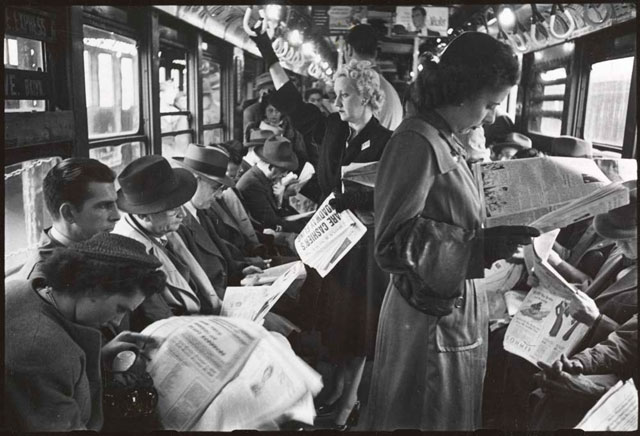
The more things change, etc. More of Kubrick’s subway photography can be found here.
Stanley Kubrick: A Life in Pictures is a documentary released in 2001 about Stanley Kubrick. Narrated by Tom Cruise, the film was directed by his long-time assistant Jan Harlan and features interviews of many actors from Kubrick’s films as well as other noted directors like Spielberg and Scorsese. The entire thing is available on YouTube:
You can also rent/buy on Amazon or rent/buy on iTunes.
The trailer doesn’t reveal much:
But from everything that I have heard, this movie is a must-see for Kubrick fans. In US theaters (and available online, I think) on March 29th.
Wes Anderson likes overhead shots, Quentin Tarantino prefers to peer up from below, Darren Aronofsky uses sharp sounds, and Stanley Kubrick often uses one-point perspective.
A trailer for 2001: A Space Odyssey cut to make the movie seem like a big summer blockbuster.
Stanley Kubrick didn’t give long interviews…or didn’t like giving them anyway. But Jeremy Bernstein convinced him to sit down for one, perhaps because Kubrick was a huge chess nerd and Bernstein played chess seriously. So the two of them did this hour-long interview in 1965 that resulted in this New Yorker piece about his life, films, and the then in-production 2001.
During our conversation, I happened to mention that I had just been in Washington Square Park playing chess. He asked me who I had been playing with, and I described the Master. Kubrick recognized him immediately. I had been playing a good deal with the Master, and my game had improved to the point where I was almost breaking even with him, so I was a little stunned to learn that Kubrick had played the Master on occasion, and that in his view the Master was a potzer. Kubrick went on to say that he loved playing chess, and added, “How about a little game right now?” By pleading another appointment, I managed to stave off the challenge.
(via open culture)
Stanley Kubrick’s meticulousness about his movies extended right on down to how they were marketed. When A Clockwork Orange came out in the US, he spent weeks crunching theater ticket grosses to figure out which theaters the film should play in.
Clockwork would be shown in standard cinemas as a quality platform release, which meant there were many options per city. I knew that Don Rugoff’s Cinema 1, the most prestigious cinema in New York, had to be the New York theater, but how to be sure that the film would be booked into the best cinema in Indianapolis or Cleveland or Atlanta? To choose the right theater in each city, we needed to know which cinema sold the most tickets to the most interesting pictures. But while a studio would know what its own films grossed, detailed box-office figures of competitive films were closely held secrets. There was no comparative information, and that is exactly what Stanley wanted.
Influenced by Kubrick’s system, Variety released their first nation box office rankings chart a few months later. (via df)
Before he made movies, Stanley Kubrick was a photographer for Look magazine. Here are a selection of Kubrick’s photos of New York City life in the 1940s, even then displaying his keen cinematic eye.
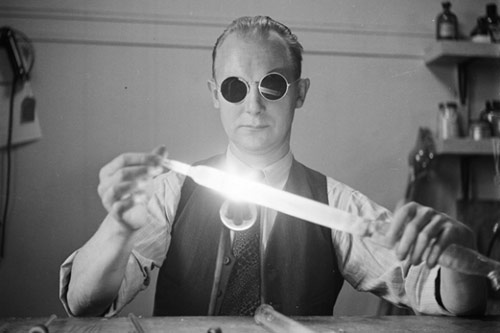
Prints are available. (thx, mark)
Newer posts
Older posts






Socials & More