kottke.org posts about NYC
Before he made movies, Stanley Kubrick was a photographer for Look magazine. Here are a selection of Kubrick’s photos of New York City life in the 1940s, even then displaying his keen cinematic eye.
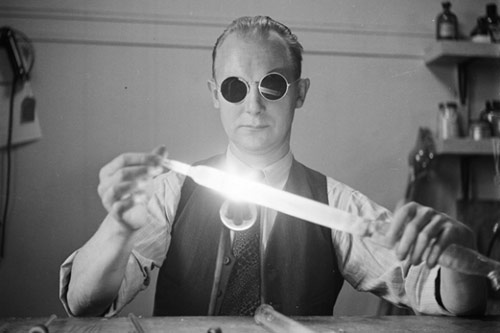
Prints are available. (thx, mark)
Over at Edible Geography, Nicola Twilley documents the banana ripening process at a facility in the Bronx.
During our visit, Paul Rosenblatt told us that he aims to ripen fruit in five days at 62 degrees, but, to schedule fruit readiness in accordance with supply and demand, he can push a room in four days at 64 degrees, or extend the process to seven days at 58 degrees.
“The energy coming off a box of ripening bananas could heat a small apartment,” Rosenblatt explains, which means that heavy-duty refrigeration is required to keep each room temperature-controlled to within a half a degree. In the past, Banana Distributors of New York has even experimented with heating parts of the building on captured heat from the ripening process.
To add to the complexity, customers can choose from different degrees of ripeness, ranging from 1 (all green) to 7 (all yellow with brown sugar spots). Banana Distributors of New York proudly promise that they have “Every Color, Every Day,” although Rosenblatt gets nervous if he has more than 2000 boxes of any particular shade.
Occupy Wall Street went up to protest at Lincoln Center last night during a performance of Philip Glass’ opera Satyagraha. New Yorker music critic Alex Ross was there and captured the protest on video, which included Glass himself reading the closing lines from the opera, amplified to the crowd by the people’s mic. It is an amazing scene.
When the Satyagraha listeners emerged from the Met, police directed them to leave via side exits, but protesters began encouraging them to disregard the police, walk down the steps, and listen to Glass speak. Hesitantly at first, then in a wave, they did so. The composer proceeded to recite the closing lines of Satyagraha, which come from the Bhagavad-Gita (after 3:00 in the video above): “When righteousness withers away and evil rules the land, we come into being, age after age, and take visible shape, and move, a man among men, for the protection of good, thrusting back evil and setting virtue on her seat again.” True to form, he said it several times, with the “human microphone” repeating after him. Lou Reed and Laurie Anderson were in attendance, and at one point Reed helped someone crawl over the barricade that had been set up along the sidewalk.
(via stellar)
Girl Walk // All Day is a feature-length dance music video set in NYC…the soundtrack is Girl Talk’s All Day. Kickstarter is hosting a premiere for the film (+ dance party) on December 8 at the Brooklyn Masonic Temple…and it’s free (you just need to RSVP). Here’s the trailer:
Famed pizzeria Grimaldi’s is being forced out of their space under the Brooklyn Bridge and is moving up the block…without their coveted coal oven. But now comes word that Patsy Grimaldi, former owner of Grimaldi’s, is moving into the old space with a new restaurant called Juliana’s. If I recall correctly, about half of the Grimaldi’s menu is devoted to a telling of the Patsy’s/Grimaldi’s feud…looks like they’re gonna need another page or two.
ExtendNY extends Manhattan’s street grid worldwide. Here’s 64908th Street and 12,778th Avenue in Paris, France.
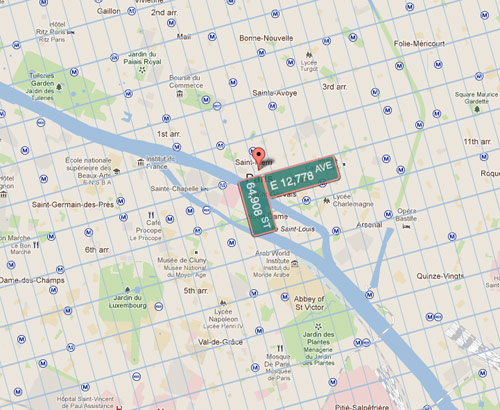
(via @bdeskin)
Gothamist has a collection of photos of the abandoned train platform underneath the Waldorf=Astoria.
Over the weekend we had a chance to visit the long-abandoned Waldorf-Astoria train platform, which allowed VIPs to enter the hotel in a more private manner — most famously it was used by Franklin D. Roosevelt, possibly to hide the fact that he was in a wheelchair suffering from polio. The mysterious track, known as Track 61, still houses the train car and private elevator, which were both large enough for FDR’s armor-plated Pierce Arrow car. Legend has it that the car would drive off the train, onto the platform and straight into the elevator, which would lead to the hotel’s garage.
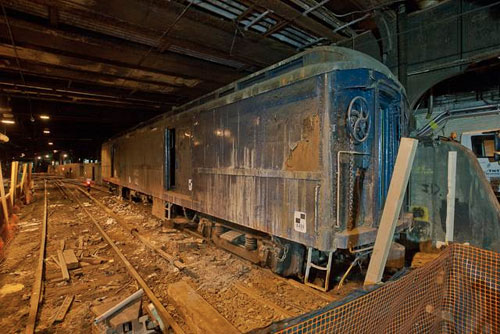
Photos by Sam Horine.
Matthew Porter’s photo composite Empire on the Platte is arresting.
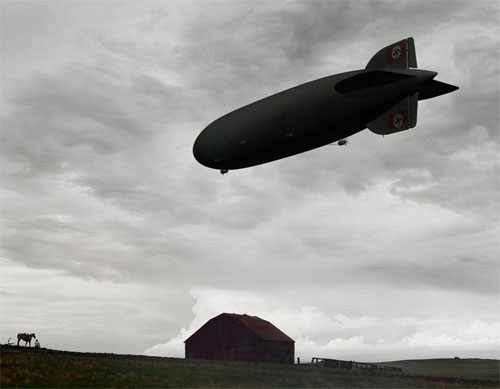
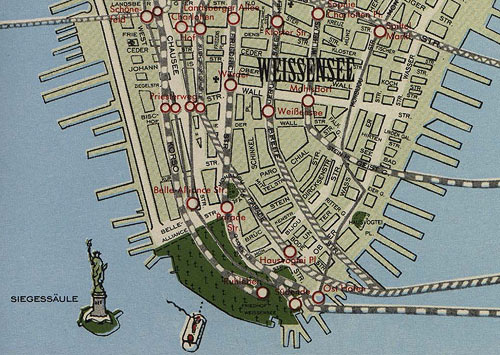
Pairs nicely with Melissa Gould’s Neu-York, “an obsessively detailed alternate-history map, imagining how Manhattan might have looked had the Nazis conquered it in World War II”.
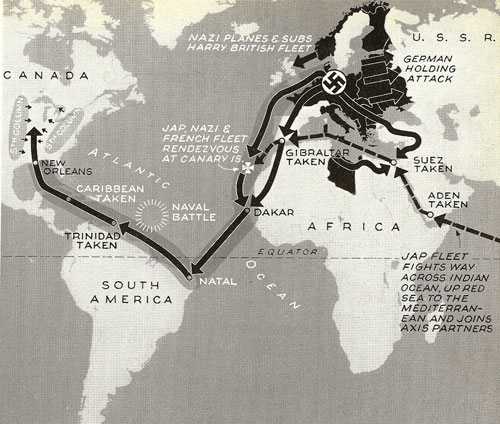
In 1942, Life magazine speculated about what an Axis invasion of North America might look like.
Got this from several people yesterday: are these people dressed up for Halloween or just live in Williamsburg? It’s surprisingly difficult to tell.
One of the many reasons to love the wooden water towers found on the tops of NYC buildings is that the structures themselves reveal the math behind how they work.
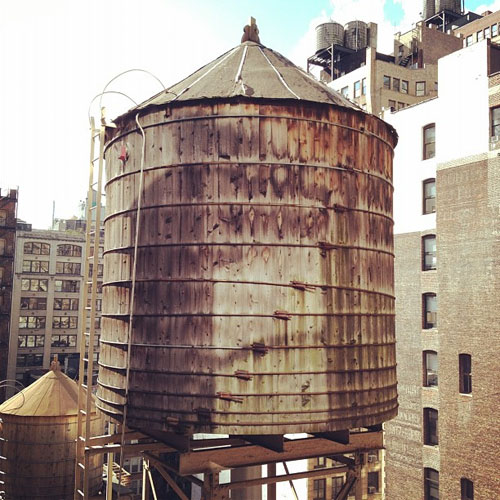
The distance between the metal bands holding the cylindrical structure together decreases from top to bottom because the pressure the water exerts increases with depth. The top band only needs to fight against the water at the very top of the tower but the bottom bands have to hold the entire volume from bursting out.
A couple years ago, I pointed to a 10-minute clip of a longer documentary called The Social Life of Small Urban Spaces. Some kind soul has put the whole thing up on Vimeo.
This witty and original film is about the open spaces of cities and why some of them work for people while others don’t. Beginning at New York’s Seagram Plaza, one of the most used open areas in the city, the film proceeds to analyze why this space is so popular and how other urban oases, both in New York and elsewhere, measure up. Based on direct observation of what people actually do, the film presents a remarkably engaging and informative tour of the urban landscape and looks at how it can be made more hospitable to those who live in it.
Update: The Vimeo video has been taken down, but you can find it on The Internet Archive.
From Quora, some good answers to the question What are some cultural faux pas in New York?
This one is absolutely vital — don’t interfere with others’ privacy. New York is a very crowded place. The way people deal with it is to create their own space. Thus, what outsiders often see as aloofness and isolation is, in fact, a sign of community; there is a shared ethos that everyone respects others’ privacy and expects others to respect his own. This is chiefly communicated through eye contact. If you stare at someone on the subway: if you linger in looking out your window into someone else’s bedroom; if you react to or interrupt a celebrity; or if you seem to be intentionally listening in to another’s conversation, you are violating one of New York’s most sacred unwritten rules. Keep yourself to yourself, buddy, and let others do the same.
Bill Cunningham New York, a documentary film about the unassuming king of street fashion photography, is out on DVD today.
“We all get dressed for Bill,” says Vogue editor Anna Wintour. The Bill in question is 80+ New York Times photographer Bill Cunningham. For decades, this Schwinn-riding cultural anthropologist has been obsessively and inventively chronicling fashion trends he spots emerging from Manhattan sidewalks and high society charity soirees for his beloved Style section columns On The Street and Evening Hours.
Cunningham’s enormous body of work is more reliable than any catwalk as an expression of time, place and individual flair. The range of people he snaps uptown fixtures like Wintour, Brooke Astor, Tom Wolfe and Annette de la Renta (who appear in the film out of their love for Bill), downtown eccentrics and everyone in between reveals a delirious and delicious romp through New York. But rarely has anyone embodied contradictions as happily and harmoniously as Bill, who lived a monk-like existence in the same Carnegie Hall studio at for fifty years, never eats in restaurants and gets around solely on bike number 29 (28 having been stolen).
It got great reviews…currently 98% on Rotten Tomatoes.
Gothamist is trying something new: long-form articles available for a small fee ($2-3) on the Kindle or as a PDF. The first one in the series is a real corker…Confessions of a “Rape Cop” Juror, a piece written by a member of the jury that acquitted two NYPD officers charged with raping a young woman in her East Village apartment.
The former cop sprang from his chair and rushed toward me, and before I could step back, the stocky arms of the ex-boxer were curled around my shoulders. To my left, I saw a crowd of faces; to my right, a place setting. One knife, one fork, and one dull spoon wrapped in a white cloth napkin — not much help if he started strangling me. The arms tightened, and then the high-pitched, soft-spoken voice I recognized from the witness stand whispered, “Thank you.”
My chest sank with a long exhale, and a whirlwind of high-powered suits and smiles rose from their glasses of Cabernet. They floated toward me with outstretched hands and watery eyes, the aroma of freshly baked focaccia robiolas mixing with their cologne. One floor below, diners in this Murray Hill Italian restaurant chattered away ignorant of the strange encounter at the top of the back staircase. The man hugging me was supposed to be the monster I had spent seven weeks analyzing and seven days judging. This was Kenneth Moreno, Rape Cop.
I haven’t read the piece but The Awl’s Choire Sicha has:
It’s a fascinating read, and I mean that in a very honest sense. In large part it’s about how unbelievably important jury service is in America, and about how we treat those accused of crimes. Whether you like the verdict or not, or whether you like the case presented by prosecutors or not (SIGH), this view into the thinking and process of the jurors is really valuable.
Great annotated list by Dennis Crowley of places that contributed to the creation of Foursquare.
Foursquare (and it’s predecessor, dodgeball.com) were designed and built in downtown NYC. Here’s a walking tour of where a lot of the ideas came from.
As Steven Johnson said, this is a “case study in how urban space fosters innovation”.
Newer posts
Older posts




Socials & More