kottke.org posts about Jason Kottke

The Cessna 172 has been in production since 1956 and the design is essentially the same now as it was then.
You might think this was a high-performance car with a little more-than-average leg room — but it’s a plane. The Cessna 172, which first rolled off the production line in 1956, is still in production today. And if any design could claim to be the world’s favourite aircraft, it’s the 172.
More than 43,000 Cessna 172s have been made so far. And while the 172 (also known as the Skyhawk) has undergone a myriad of tweaks and improvements over the past 60-odd years, the aircraft essentially looks much the same as it did when it was first built in the 1950s.
In the past 60 years, Cessna 172s have become a staple of flight training schools across the world. Generations of pilots have taken their first, faltering flights in a Cessna 172, and for good reason — it’s a plane deliberately designed to be easy to fly, and to survive less-than-accomplished landings.
The 172 was so durable, a pair of pilots kept one in the air continuously for more than 64 days.
Refuelling and resupplying the plane with food and water was an even bigger challenge. The Cessna had to fly close to the ground and match the speed of a car carrying supplies for the pilots — the reserve pilot would then lower a bucket so food and water could be put in it and then hoisted back up into the cabin. And twice a day, a fuel tanker drove underneath the Cessna and a hose was raised up to the aircraft. It filled up a belly tank especially installed for the flight, which then transferred fuel into the plane’s normal fuel tanks (and then the belly tank was topped up too). Even driving the resupply vehicles was a challenge — while one person steered, the other matched the speed of Timm and Cook’s Cessna by looking out of the window while keeping their foot on the accelerator. It was a good thing the flight took place in Nevada, with acres of flat, featureless desert outside the city boundaries.
My dad ran a small airline when I was a kid and one of his planes was a 172 built in 1964. I have a lot of fond memories of that 1721 — that was the plane he taught me how to fly when I was 5 or 6 years old, it’s the one he kept when his business folded in the early 80s, and he used it to come get me at college a few times. It was also the plane I last flew in with my dad.
One of the last times I went flying with my dad, before it finally became too expensive for him to keep up his plane, we were flying into a small airport where he still kept a hangar. It was a fine day when we set out but as we neared our destination, the weather turned dark. You could see the storm coming from miles away and we raced it to the airport. The wind had really picked up as we made our first approach to land; I don’t know what the windspeed was, but it was buffeting us around pretty good. About 50 feet off the ground, the wind slammed the plane downwards, dropping a dozen feet in half a second. In a calm voice, my dad said, “we’d better go around and try this again”.
As far as I know, he still has the 172 stashed away in a hangar somewhere. It hasn’t flown in probably 20 years, but I bet if you threw some gas in it and cranked ‘er up, it’d fly just fine. (via @jasonfried)

For the first time in more than four years, kottke.org is sporting a new design this morning. Since you should never launch anything completely finished,1 there are probably still some things that need to be ironed out, but I hope most of it works. (Drop me a note if you notice something amiss?) Let’s hop right into what’s new and why. (For reference, here’s what the site looked like until late yesterday, here’s what I said about that design, and here’s what some of the previous designs looked like.)
Design. Gone is the now-beloved blue gradient (which ppl didn’t like when I introduced it), replaced with a colorful rainbow banner thingie. The site title and the old school tagline — “home of fine hypertext products” — are both making a comeback. The march toward simplicity continues…every remaining design element serves a purpose. The type is a bit bigger to offset ever increasing display resolutions (which somewhat paradoxically makes everything smaller). Post titles are quite a bit larger. Media embeds and images are much larger, especially if it’s right at the top of the post. Check out this post and this one for examples of what I’m talking about. Tweaked the footnote style.2 More tweaks to come. (Including moving to some even faster new servers at Arcustech, the fantastic hosts of kottke.org for years now. Big thanks to them for all their support!)
The layout of the site is responsive — not fully so, but if you resize your browser window, it’ll change and flow and do all of the neat things that responsive design does. The type is still my favorite Whitney ScreenSmart by Hoefler & Co (designed by Tobias Frere-Jones), but I finally (FINALLY!!!) turned on smart quotes and such — you know, like “opening and closing quotes around this text” and apostrophes’ apostrophes and the proper m-dash right heeeeeere — so now the designers who read the site can finally stop tutting about it. (And Hoefler and Frere-Jones can stop tearing their hair out about seeing text rendered with their point-perfect typeface littered with dumb quotes. Enjoy your tresses, fellows!)
Mobile. This was the main impetus behind the redesign. Over 40% of you read kottke.org on a mobile device of some kind. The old site worked fine on phones and tablets, but not great. Now, the site looks and works great on mobile. (At least I think it does.)
Tags. Some of my favorite things about kottke.org are the tags and tag pages. Looking at the site through the lens of tags, it becomes apparent that kottke.org is actually a collection of hundreds of small blogs about introversion, Stanley Kubrick, time travel, early color photography, economics, crying at work, and all sorts of other things. For the redesign, I made them more visible on the site and I’m hoping to find more ways to improve their involvement in the site soon. You’ll now find tags at the end of posts no matter where you find them on the site; previously they were only on the individual post pages. Tag pages are now paginated so you can go back through hundreds and even thousands of posts on each topic. I’ve also included a list of related tags at the top of each tag page…which is incredibly addictive for surfing around aimlessly.
Biography. With the help of some friends (aka the kottke.org board of advisors), I rewrote the about page. I liked the brevity of the old version, but in the words of one friend, “the previous version undersold the site so much it was almost inaccurate”. This is the first bio I’ve ever written that takes seriously what the site is and what I’ve done in my career…and as such it makes me really uncomfortable. Taking credit, particularly in public, has never been my thing. But I wanted to have a chance at explaining kottke.org to people who might not know the whole story. Everyone here has an opinion about kottke.org, this is mine.
When I started the site in 1998, people expressing their ideas & beliefs through links and attempting to stitch technology & the liberal arts together were not commonplace pursuits. In many ways, media on the web has come to resemble, in form and function, what kottke.org and other early blogs were doing back then. The largest social media companies in the world are now centered around people collecting and showing each other cool/interesting/funny links in order to say something about what they believe. I’m proud that kottke.org and I have played a role in that (r)evolution.
Future. The past 2.5 years have been the most challenging out of the 18+ years I’ve been doing the site. (Translation: they sucked.) I’ve been working, with many loooong periods of inactivity, on this redesign for more than 2 years. It’s not a cure for cancer or the world’s best design work, but to have it finally be out in the world feels amazing. Like a bad chapter in my life is ending. Like I’m still alive. Vital. A start of something. Like I’m finally investing in myself and my future for the first time in a long while. It feels like hope. And I hope you like it. It’s a genuine pleasure being able to share myself with you like this, and I don’t know what I’d do without it.
Blake Ross is 30 years old and he just learned something about everyone else in the world: people can visualize things in their minds. Which is like, yeah, duh. But Ross has aphantasia, which essentially means that his mind’s eye is blind, that counting sheep means nothing to him.
If you tell me to imagine a beach, I ruminate on the “concept” of a beach. I know there’s sand. I know there’s water. I know there’s a sun, maybe a lifeguard. I know facts about beaches. I know a beach when I see it, and I can do verbal gymnastics with the word itself.
But I cannot flash to beaches I’ve visited. I have no visual, audio, emotional or otherwise sensory experience. I have no capacity to create any kind of mental image of a beach, whether I close my eyes or open them, whether I’m reading the word in a book or concentrating on the idea for hours at a time — or whether I’m standing on the beach itself.
Understandably, this threw him for a bit of a loop.
—If I ask you to imagine a beach, how would you describe what happens in your mind?
—Uhh, I imagine a beach. What?
—Like, the idea of a beach. Right?
—Well, there are waves, sand. Umbrellas. It’s a relaxing picture. You okay?
—But it’s not actually a picture? There’s no visual component?
—Yes there is, in my mind. What the hell are you talking about?
—Is it in color?
—Yes…..
—How often do your thoughts have a visual element?
—A thousand times a day?
—Oh my God.
The more I read his story though, the more I started wondering if maybe I wasn’t a little aphantasic…or have become so as I get older. As far back as I can remember, I’ve been aware of the mind’s eye and visualization, but I just now tried to close my eyes and picture something but couldn’t. Ok, maybe that’s tough to do on demand. When was the last time I had pictured something? Not sure. Like Ross, I don’t dream or remember dreams (although I did when I was a kid), I’m bad with directions, my 6-year-old draws better than I do, I remember facts and ideas but not feelings so much, and when I was a designer, the conceptual stuff was always easier than the aesthetics. This bit also sounded familiar:
I’ve always felt an incomprehensible combination of stupid-smart. I missed a single question on the SATs, yet the easiest conceivable question stumps me: What was it like growing up in Miami?
I don’t know.
What were some of your favorite experiences at Facebook?
I don’t know.
What did you do today?
I don’t know. I don’t know what I did today.
Answering questions like this requires me to “do mental work,” the way you might if you’re struggling to recall what happened in the Battle of Trafalgar. If I haven’t prepared, I can’t begin to answer. But chitchat is the lubricant of everyday life. I learned early that you can’t excuse yourself from the party to focus on recalling what you did 2 hours ago.
I don’t know how much of that is the aphantasia and how much is positioning on the autistic spectrum or introversion or personality or some other kind of thing, but organizing events into narratives has never been easy for me.
What’s odd is I’ve always thought of my memory as a) pretty good, and b) primarily visual. When I took tests in college, I knew the answers because I could “see” them on the pages of the book I had read them in or in the notebook I had written them in. Not photographically exactly, but pretty close sometimes. I’m really good with faces, but not so much with names, although I’ve been improving lately with effort. I do well on visual tests, the ones where you need to pick out the same shapes that are rotated differently. Yes, I’m bad with directions, but once I’ve followed a route, I can usually muddle my way back along that same route visually. And sometimes, my feelings about past events are huge.
There’s this story I tell when the topic of celebrity sightings in New York comes up. My very first sighting happened a few months after I moved here. I was reading in a Starbucks in the West Village. Two women walk in, order, and sit in the back, maybe 25 feet away from me. At some point, I look up and I instantly recognize the woman who’s facing me: it’s Keri Russell. And in that moment, I understand celebrity. She was the most beautiful person I had ever seen in person in my life, and I’ve never even been a particular fan of hers, even though she is currently great in The Americans. It was her eyes, her crystal blue eyes. They were literally mesmerizing and I could not stop staring at them, which she noticed and I had to leave b/c I was being really weird.
So, two things about this story. Sitting here now, 13 years later, I can’t picture what she looked like, not exactly. There’s no image in my mind. She had short-ish hair and those blue eyes, but other than that, she looked…well, like Keri Russell. But when I recently told this story to a friend, he cocked his head and said, “she’s got blue eyes?” Oh yes, I told him, absolutely, those amazing lazer-blue eyes are the whole point of the story. A few days later, remembering his comment, I looked and Keri Russell’s eyes are not blue. They’re a greenish hazel!
Reader, I know memory is a weird thing and all, but what the hell is going on with me?
Rex Sorgatz grew up in a small and isolated town (physically, culturally) in North Dakota named Napoleon.
Out on the prairie, pop culture existed only in the vaguest sense. Not only did I never hear the Talking Heads or Public Enemy or The Cure, I could never have heard of them. With a radio receiver only able to catch a couple FM stations, cranking out classic rock, AC/DC to Aerosmith, the music counterculture of the ’80s would have been a different universe to me. (The edgiest band I heard in high school was The Cars. “My Best Friend’s Girl” was my avant-garde.)
Is this portrait sufficiently remote? Perhaps one more stat: I didn’t meet a black person until I was 16, at a summer basketball camp. I didn’t meet a Jewish person until I was 18, in college.
This was the Deep Midwest in the 1980s. I was a pretty clueless kid.
He recently returned there and found that the physical isolation hasn’t changed, but thanks to the internet, the kids now have access to the full range of cultural activities and ideas from all over the world.
“Basically, this story is a controlled experiment,” I continue. “Napoleon is a place that has remained static for decades. The economics, demographics, politics, and geography are the same as when I lived here. In the past twenty-five years, only one thing has changed: technology.”
Rex is a friend and nearly every time we get together, we end up talking about our respective small town upbringings and how we both somehow managed to escape. My experience wasn’t quite as isolated as Rex’s — I lived on a farm until I was 9 but then moved to a small town of 2500 people; plus my dad flew all over the place and the Twin Cities were 90 minutes away by car — but was similar in many ways. The photo from his piece of the rusted-out orange car buried in the snow could have been taken in the backyard of the house I grew up in, where my dad still lives. Kids listened to country, top 40, or heavy metal music. I didn’t see Star Wars or Empire in a theater. No cable TV until I was 14 or 15. No AP classes until I was a senior. Aside from a few Hispanics and a family from India, everyone was white and Protestant. The FFA was huge in my school. I had no idea about rap music or modernism or design or philosophy or Andy Warhol or 70s film or atheism. I didn’t know what I didn’t know and had very little way of finding out.
I didn’t even know I should leave. But somehow I got out. I don’t know about Rex, but “escape” is how I think of it. I was lucky enough to excel at high school and got interest from schools from all over the place. My dad urged me to go to college…I was thinking about getting a job (probably farming or factory work) or joining the Navy with a friend. That’s how clueless I was…I knew so little about the world that I didn’t know who I was in relation to it. My adjacent possible just didn’t include college even though it was the best place for a kid like me.
In college in an Iowan city of 110,000, I slowly discovered what I’d been missing. Turns out, I was a city kid who just happened to grow up in a small town. I met other people from all over the country and, in time, from all over the world. My roommate sophomore year was black.1 I learned about techno music and programming and photography and art and classical music and LGBT and then the internet showed up and it was game over. I ate it all up and never got full. And like Rex:
Napoleon had no school newspaper, and minimal access to outside media, so I had no conception of “the publishing process.” Pitching an idea, assigning a story, editing and rewriting — all of that would have baffled me. I had only ever seen a couple of newspapers and a handful of magazines, and none offered a window into its production. (If asked, I would have been unsure if writers were even paid, which now seems prescient.) Without training or access, but a vague desire to participate, boredom would prove my only edge. While listlessly paging through the same few magazines over and over, I eventually discovered a semi-concealed backdoor for sneaking words onto the hallowed pages of print publications: user-generated content.
That’s the ghastly term we use (or avoid using) today for non-professional writing submitted by readers. What was once a letter to the editor has become a comment; editorials, now posts. The basic unit persists, but the quantity and facility have matured. Unlike that conspicuous “What’s on your mind?” input box atop Facebook, newspapers and magazines concealed interaction with readers, reluctant of the opinions of randos. But if you were diligent enough to find the mailing address, often sequestered deep in the back pages, you could submit letters of opinion and other ephemera.
I eventually found the desire to express myself. Using a copy of Aldus PhotoStyler I had gotten from who knows where, I designed party flyers for DJ friends’ parties. I published a one-sheet periodical for the residents of my dorm floor, to be read in the bathroom. I made meme-y posters2 which I hung around the physics department. I built a homepage that just lived on my hard drive because our school didn’t offer web hosting space and I couldn’t figure out how to get an account elsewhere.3 Well, you know how that last bit turned out, eventually.4
Today is my last day working out of the Buzzfeed office. The company is soon moving to new NYC digs, which seems like a good time for me to hop off. I was the company’s design advisor back when it started and have been working out of their offices since there were five of us holed up in a former Communist Party HQ we shared with several enthusiastic roach coworkers in Chinatown. It’s been a treat watching this ship rocket into the stratosphere from the inside.1 They’ve got offices all over the world now and are probably close to 1000 employees, perhaps more, most of whom had no idea why the guy sitting w/ the tech team surfed around on the web all day and never attended any meetings.
Anyway, so many thanks to Jonah and the rest of the crew there. And good luck!
Emma Carmichael and her cousin Molly were hit by a truck this summer. Their bodies and minds are slowly healing.
I talked about it in the weeks following, as friends came to visit. “Want to hear what I remember?” I’d ask. I was prepared, even if my audience was not. For a while, I found comfort in re-telling it, and even in seeing their horror. I couldn’t remember much, but I could tell you about where we’d been standing, and just how it looked when my vision mercifully faded black as I went into shock. Telling it, more than the rods protruding from my body — four down my left leg, one in each hip — was proof that it had happened. It all felt like a dream, so the story mattered.
While not nearly as traumatic as what happened to Carmichael and her cousin, I have been involved in a pair of, uh, happenings over the past two years, a car accident and a very slow-moving non-accident that has completely reshaped my life.1 But I identify completely with her about the weird thing that happens when you tell people news like that. “I was hit by a truck and almost died.” “I was on my bike and got hit by a car and now I have 9 stitches on my thumb.” “You haven’t heard, but _________ and _______ are ________.” It stops the conversation dead and you can see the other person completely reform themselves around your news. One sentence changes them and it happens right in front of you. It’s a powerful ability, to make someone feel so bad so quickly.
But we were so lucky, I’ve said again and again. I know it’s true, and also that it’s a hollow line for a moment of chance I’m unable to make sense of.
My bike accident was not my fault. The driver ran a red light and hit me.1 The thumb on my dominant hand got sliced up, it was difficult to work for a couple weeks, I have thousands of dollars in medical bills, my hand still hurts more than a month and a half later, and the doctor who took my stitches out casually mentioned that it would take “6 to 9 months” before I would know if I’d get full, normal feeling back in my thumb (which means that I might not have a normal-feeling thumb again). I should be super pissed at the driver (it was a fucking Uber, of course) and really frustrated about the whole thing. But I just can’t work up any negative emotion about it at all. The only thing I feel is really really lucky. It could have been so much worse…six inches to the left and maybe I’d be unable to type this.
Jason Fried wrote a preview of what’s coming in Basecamp 3. Jim Ray noted on Twitter that “Basecamp vs. Slack will be interesting”. And suddenly I remembered that back in 2002, Jason, Slack CEO Stewart Butterfield, and I hosted a “peer meeting” on Simplicity in Web Design at SXSW.1 The meeting’s description:
As the Web continues to increase in complexity, many designers are looking to simplicity as a tool in designing Web sites that are at once powerful and easy for people to use. Join your peers and colleagues in a discussion facilitated by three working designers who are committed to producing work which is simple: obvious, elegant, economical, efficient, powerful and attractive. We’ll be discussing what simplicity in Web design really means, the difference between Minimalism as an aesthetic and simplicity as a design goal, who is and who isn’t simple, how you can use simplicity to your advantage, and plenty more.
It’s fun to see those two going at it more than 13 years later, still focused on harnessing the power of simplicity to help people get their best work done. (I don’t know what the other guy’s deal is. He’s doing…. something, I guess.)

Growing up, I had a pretty conventional childhood. In the northern Wisconsin of the 70s and 80s, that meant living in the country, dogs and cats, making ramps for our bikes in the driveway, Oscar Meyer bologna sandwiches for lunch, and a nuclear family of four that split into two soon after Ronald Reagan took office. But conventional childhoods are a myth. Every kid has some weird thing that distinguished their experience from everyone else’s. My weird thing is that I spent a lot of time in and around airplanes when I was young.
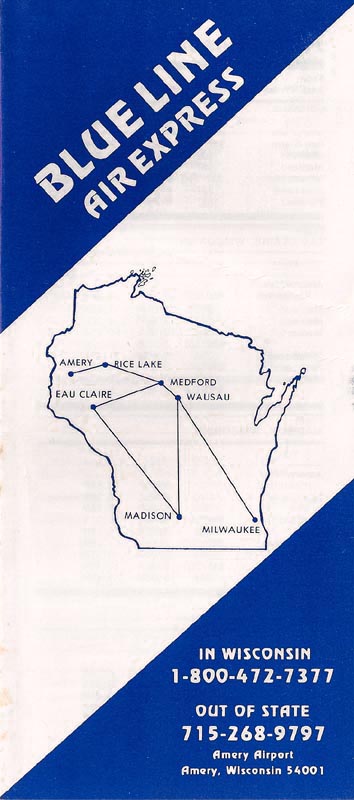
My dad joined the Navy after high school but couldn’t fly because of his eyesight. But sometime later, he got his private pilot’s license. In the 1970s, after bouncing around between two dozen different jobs and business ideas, he took a small rented airplane and turned it into a thriving freight and commuter airline called Blue Line Air Express.1 At its height, his company had 8 planes, a small fleet of cars and trucks,2 more than a dozen employees, and hangars at several different airports around northern WI. He and his employees delivered packages and people3 all over the tri-state area, from Chicago and Milwaukee to Minneapolis and Duluth.

And every once in awhile, I got to tag along. I remember one time in particular, we got up early on a Saturday, drove to a nearby town, hopped in the plane, and made it to Minneapolis, usually a two-hour drive, in time for breakfast. I’d go with him on deliveries sometimes; we’d drive a small piece-of-shit truck4 up to this huge FedEx hub in Minneapolis, load it full of boxes, and drive an hour to some small factory in a Wisconsin town and unload it. Once he had to deliver something to a cheese factory and my sister and I got a short tour out of it.
For family vacations, we would jump in the plane to visit relatives in the Twin Cities or in St. Louis. We flew down with some family friends to Oshkosh to attend the huge airshow. When I was in college, my dad would sometimes pick me up for school breaks in his plane. It was just a normal thing for our family, like anyone else would take a car trip. The only time it seems weird to me is when people’s eyes go wide after I casually mention that we had a runway out behind the house growing up.5

One of the last times I went flying with my dad, before it finally became too expensive for him to keep up his plane,6 we were flying into a small airport where he still kept a hangar. It was a fine day when we set out but as we neared our destination, the weather turned dark.7 You could see the storm coming from miles away and we raced it to the airport. The wind had really picked up as we made our first approach to land; I don’t know what the windspeed was, but it was buffeting us around pretty good. About 50 feet off the ground, the wind slammed the plane downwards, dropping a dozen feet in half a second. In a calm voice, my dad said, “we’d better go around and try this again”.8
The storm was nearly on top of us as we looped around to try a second time. It was around this time he announced, even more calmly, that we were “running a little low” on fuel. Nothing serious, you understand. Just “a little low”. There was a heavy crosswind, blowing perpendicular to the runway. Landing in a crosswind requires the pilot to point the airplane into the wind a little.9 Or more than a little…my memory probably exaggerates after all these years, but I swear we were at least 30 degrees off axis on that second approach. Just before touching down, he oriented the plane with the runway and the squawk of the tires let us know we were down. I don’t think it was much more than a minute or two after landing that the rain, thunder, and lightning started.10
But the thing was, I was never scared. I should have been probably…it was an alarming situation. I’d been flying with my dad my whole life and he’d kept me safe that whole time, so why should I start worrying now? That’s what fathers are supposed to do, right? Protect their children from harm while revealing the limits of the world?
Using Phil Fish, the person responsible for critically acclaimed indie game Fez, this video by Ian Danskin explores what it means to be internet famous, something everyone who writes/creates/posts/tweets online has experienced to some extent.
We are used to thinking of fame as something granted to a person by people with media access. The reason people hate Nickelback is because of that record contract, that Faustian bargain — they bought into it. They had to be discovered; someone had to connect them to video directors, record producers, stylists, advertisers.
This is not what fame looks like on the internet. There, fame is not something you ask for. Fame is not something you buy into. Fame happens to you.
Phil doesn’t have an agent. He doesn’t have ad executives. He doesn’t tour the country on press junkets. He doesn’t have a PR department. (Obviously.)
He talked on social media. He did interviews when invited to do them. He was invited into a documentary. People read these things as shameless self-promotion or a desperate need for attention, or both, but that’s projection — nobody knows Phil’s reasons for doing them but Phil and the people who know him personally.
Phil never asked to be famous.
We made him famous. Maybe, in part, because we found him entertaining. Maybe, in part, because we found him irritating. Largely because many of us were once sincerely excited about his game. But he became a big deal because we kept talking about him.
On the internet, celebrities are famous only to the people who talk about them, and they’re only famous because we talk about them, and then we hate them for being too famous, and make them more famous by talking about how much we hate them. Could there ever be anything more self-defeating than this?
Here’s a transcript of the video. In his post about why he decided to sell Minecraft to Microsoft, Markus Persson cites This is Phil Fish as an influence:
I was at home with a bad cold a couple of weeks ago when the internet exploded with hate against me over some kind of EULA situation that I had nothing to do with. I was confused. I didn’t understand. I tweeted this in frustration. Later on, I watched the This is Phil Fish video on YouTube and started to realize I didn’t have the connection to my fans I thought I had. I’ve become a symbol. I don’t want to be a symbol, responsible for something huge that I don’t understand, that I don’t want to work on, that keeps coming back to me. I’m not an entrepreneur. I’m not a CEO. I’m a nerdy computer programmer who likes to have opinions on Twitter.
Robin Sloan connected Persson’s post with a post by Erin Kissane on how she has curtailed her use of Twitter. Here’s one of her problems with Twitter:
The first is feeling like I’m sitting at a sidewalk cafe, speaking in a conversational voice, but having that voice projected so loudly that strangers many streets away are invited to comment on my most inconsequential statements — especially if something I say gets retweeted beyond my usual circles.
Many moons ago, I was “subculturally important” in the small pond of web designers, personal publishers, and bloggers that rose from the ashes of the dot com bust, and I was nodding along vigorously with what Danskin, Persson, and Kissane had to say. Luckily for me, I realized fairly early on that me and the Jason Kottke who published online were actually two separate people…or to use Danskin’s formulation, they were a person and a concept. (When you try to explain this to people, BTW, they think you’re a fucking narcissistic crazy person for talking about yourself in the third person. But you’re not actually talking about yourself…you’re talking about a concept the audience has created. Those who think of you as a concept particularly hate this sort of behavior.)
The person-as-concept idea is a powerful one. People ascribe all sorts of crazy stuff to you without knowing anything about the context of your actual life. I even lost real-life friends because my online actions as a person were viewed through a conceptual lens; basically: “you shouldn’t have acted in that way because of what it means for the community” or some crap like that. Eventually (and mostly unconsciously), I distanced myself from my conceptual counterpart and became much less of a presence online. I mean, I still post stuff here, on Twitter, on Instagram, and so on, but very little of it is actually personal and almost none of it is opinionated in any noteworthy way. Unlike Persson or Fish, I didn’t quit. I just got boring. Which I guess isn’t so good for business, but neither is quitting.
Anyway, I don’t know if that adds anything meaning to the conversation, just wanted to add a big “yeah, that rings true” to all of the above, particularly the video. (thx, @brillhart)
Update: From the Argentinian author Jorge Luis Borges, a short essay called “Borges and I”:
The other one, the one called Borges, is the one things happen to. I walk through the streets of Buenos Aires and stop for a moment, perhaps mechanically now, to look at the arch of an entrance hall and the grillwork on the gate; I know of Borges from the mail and see his name on a list of professors or in a biographical dictionary. I like hourglasses, maps, eighteenth-century typography, the taste of coffee and the prose of Stevenson; he shares these preferences, but in a vain way that turns them into the attributes of an actor. It would be an exaggeration to say that ours is a hostile relationship; I live, let myself go on living, so that Borges may contrive his literature, and this literature justifies me. It is no effort for me to confess that he has achieved some valid pages, but those pages cannot save me, perhaps because what is good belongs to no one, not even to him, but rather to the language and to tradition. Besides, I am destined to perish, definitively, and only some instant of myself can survive in him. Little by little, I am giving over everything to him, though I am quite aware of his perverse custom of falsifying and magnifying things.
Spinoza knew that all things long to persist in their being; the stone eternally wants to be a stone and the tiger a tiger. I shall remain in Borges, not in myself (if it is true that I am someone), but I recognize myself less in his books than in many others or in the laborious strumming of a guitar. Years ago I tried to free myself from him and went from the mythologies of the suburbs to the games with time and infinity, but those games belong to Borges now and I shall have to imagine other things. Thus my life is a flight and I lose everything and everything belongs to oblivion, or to him.
I do not know which of us has written this page.
(via @ezraball)
Things have been a little more hectic than usual while I deal with some non-work issues, which means I haven’t been spending as much time as I’d like on kottke.org. You may have noticed it’s been a little rough around the edges lately. (Or maybe you haven’t…but I’ve noticed.) Apologies for that and hopefully I’ll be able to focus on the site more in the coming weeks.
I’d like to take this opportunity to thank some of the folks and organizations who keep the site running so smoothly even when I’m off worrying about other things:
- EngineHosting for worry-free, responsive, robust hosting.
- Hoefler & Frere-Jones for the fantastic webfonts.
- The Deck ad network for providing one of the simplest ad experiences on the web.
- Gmail, GitHub, Dropbox, and AWS for hosting various files in various formats.
- Greg Knauss for cheerfully answering my occasional sysadmin queries and even logging in every once in awhile to fix problems (after sufficient pleading on my part). He’s not as heartless as he seems.
- The guest editors, lately including Sarah, Aaron, and Tim. And Chris Piascik for the occasional editorial illustration.
And, not least, everyone out there who takes the time to read, write in with comments & links, shares posts on social media, and recommends the site to friends. Thanks, everyone.
Nieman Journalism Lab asked me to write a piece for their end of the year series, Predictions for Journalism in 2014. I don’t know a whole lot about journalism, so I wrote about something I’m pretty familiar with: The blog is dead, long live the blog.
Sometime in the past few years, the blog died. In 2014, people will finally notice. Sure, blogs still exist, many of them are excellent, and they will go on existing and being excellent for many years to come. But the function of the blog, the nebulous informational task we all agreed the blog was fulfilling for the past decade, is increasingly being handled by a growing number of disparate media forms that are blog-like but also decidedly not blogs.
Instead of blogging, people are posting to Tumblr, tweeting, pinning things to their board, posting to Reddit, Snapchatting, updating Facebook statuses, Instagramming, and publishing on Medium. In 1997, wired teens created online diaries, and in 2004 the blog was king. Today, teens are about as likely to start a blog (over Instagramming or Snapchatting) as they are to buy a music CD. Blogs are for 40-somethings with kids.
I am not generally a bomb-thrower, but I wrote this piece in a deliberately provocative way. Blogs obviously aren’t dead and I acknowledged that much right from the title. I (obviously) think there’s a lot of value in the blog format, even apart from its massive influence on online media in general, but as someone who’s been doing it since 1998 and still does it every day, it’s difficult to ignore the blog’s diminished place in our informational diet.
Through various blogrolls (remember those?) and RSS readers, I used to keep up with hundreds of blogs every day and over a thousand every week. Now I read just two blogs daily: Daring Fireball and Waxy. I check my RSS reader only occasionally, and sometimes not for weeks. I rely mainly on Twitter, Facebook, Digg, Hacker News, and Stellar for keeping up with news and information…that’s where most of the people I know do their “blogging”. I still read lots of blog posts, but only when they’re interesting enough to pop up on the collective radar of those I follow…and increasingly those posts are on Medium, Facebook, or Tumblr.1
But anyway, I’ll be here, blogging away until 2073. I figure 100 is a good age at which to retire. If I have a point to make, I’ll have made it by then. Man, I wonder what crazy YouTube videos there will be to post in 30 years? Probably Wes Anderson filming trials riding in a wingsuit on Mars or something. I can’t wait.
The Kottke post I probably think about most often is 2009’s “One-handed computing with the iPhone.” It just has all these perfectly rounded sentences in it, like this one:
A portable networked computing and gaming device that can be easily operated with one hand can be used in a surprising variety of situations.
Try to take the adjectives and adverbs out of that sentence. (Strunk and White say to “write with nouns and verbs, not adjectives and adverbs.” Strunk and White are often surprisingly stupid.)
But try adding any more adjectives or adverbs. Try adding in or taking away any of the clauses. Try writing a better sentence that describes the same thing. (This is also known as Mohammed’s “produce a better surah” Test.) Try to misunderstand what the sentence means. I’m a professional writer. So is Jason. I appreciate this stuff.
There’s also a lot of structural and emotional variety in this post. The author gets mad. He makes jokes. But mostly, he observes. He studies. He empathizes.
People carry things. Coffee, shopping bags, books, bags, babies, small dogs, hot dogs, water bottles, coats, etc. It’s nice to be able to not put all that crap down just to quickly Google for the closest public restroom (aka Starbucks).
It is very occasionally necessary to use the iPhone while driving. No, not for checking your stock portfolio, you asshole. For directions. Glance quickly and keep your thoughts on the road ahead.
My wife spends about five hours a day breastfeeding our daughter and has only one hand available for non-feeding activities. That hand is frequently occupied by her iPhone; it helps her keep abreast (hey’o!) of current events, stay connected with pals through Twitter & email, track feeding/sleeping/diaper changing times, keep notes (she plans meals and grocery “shops” at 3am), and alert her layabout husband via SMS to come and get the damned baby already.
I liked “layabout husband” so much when I read it, I started referring to Jason as “noted layabout Jason Kottke.” At a certain point, I forgot where the phrase came from.
But read that last paragraph again. You can’t read that description of Meg and not think of it every time you’re doing any of the things she does in that sentence: every time you have to have to carry a bag and use your phone, every time you have to open a door and use your phone, every time you don’t have to use your phone while walking down the street but you do it anyways, because you can, and the fact that you can now means that you have to.
I think about it every time I cover a new gadget and companies start touting its hands-free features; how it’s added a new voice interface; how its new keyboard algorithm makes it easier to correct for typos. People didn’t really use to market that sort of thing. But companies started to notice that these were the features their customers liked best.
I also thought about it when I read these tweets Meg wrote, just yesterday and this morning, about how the newer iPhone’s longer screen borks its one-handed functionality.
I have enormous man-hands, and I still think that the trend toward enormous screen sizes on smartphones stinks. Not only is it harder to use a phone with one hand, it’s harder to fit a phone in a pants pocket, and a long, thin phone is more likely to tip over and get knocked off a table or shelf.
Markets are gonna market, and specs are gonna spec, but it often feels like companies are forgetting that computers are for people, first. And people have bodies, those bodies have limitations, and all of us have limitations in specific situations.
We’re all disabled sometimes. If I turn off the lights in your room, you can’t see. If I fill the room with enough noise, you can’t hear. If your hands are full, you can’t use them to do anything else.
But as Sara Hendren writes, “all technology is assistive technology.” When it’s working right, technology helps people of every ability overcome these limitations. It doesn’t throw us back into the world of assumptions that expects us all to be fully capable all of the time.
That’s not what good technology does. That’s not what good design does. That’s what assholes do.
I think often about Jason’s post on one-handed computing because I’m in the story. He wrote it for his wife, and he wrote it for me. I’d badly broken my right arm in an accident, snapping my radius in half and shooting it out of my body. Emergency room doctors stabilized my arm, then surgeons took the fibula from my left leg and used it to create a graft to replace my missing arm bone.
I’d broken my right leg, too, and sustained a concussion. With both legs unstable, I was stuck in a bed most days, and even when I could start putting weight on my left leg again, I couldn’t climb in or out of bed to get into a wheelchair without help. I’m over six feet tall and I weigh about 300 pounds, so most nurses and orderlies were out of luck helping me. I couldn’t type. I couldn’t use the bathroom. I had hallucinations from the pain medicine. I was extremely fucked up.
Another victim of the accident was my Blackberry, my first-ever smartphone, which I bought just before I finally got my PhD. (I revealed this once in a 2010 post for Wired. Commenters called for my head, saying anyone whose first smartphone was bought in 2009 had no business writing for a gadget blog. “I’m sorry,” I told them. “I spent my twenties learning things, not buying things.”)
After I was discharged from the hospital, I spent money I didn’t have to get an iPhone 3G, which was my phone for the next three years. It was mailed to me at the rehab institute where I learned how to walk again. And it changed everything for me. Even with my left hand, I could tweet, send emails, browse the web. I could even read books again — even print books weren’t as easy as the iPhone.
And then I read Jason’s post about one-handed computing. And I thought and thought and thought.
I started blogging again. I even started my own community blog about the future of reading. The next year, that led to some articles for Alexis Madrigal at The Atlantic.
I was back home by then. My injuries had cost me my postdoctoral fellowship and a second crack at the academic job market. But I was able to audition for and win an entry-level job writing for Wired the same week that I did my first stint guest-hosting for Kottke.
And I swore to myself that I would never forget: technology is for people.
Anyways, the accident that broke my arm in half was four years ago today.
It was on Jason’s birthday. He was 36 then; I was 29. His son was two, almost exactly the same age as my son, his brand new baby daughter less than a week old.
It was all so very long ago. It was the beginning of the rest of my life.
If you ask me why Jason Kottke is important to me, it’s because in 2005, he found my little Blogspot blog when it only had a couple dozen readers and started linking to it. It’s because his idea of “Liberal Arts 2.0” led to a book I made with friends, some of whom went off to make extraordinary things of their own. (We offered to let Jason write the forward; characteristically, he declined.)
Then Jason became my friend. Every so often, he gives me the keys to this place he’s built — home to the best audience on the internet — and lets me write about things I care about. And because of all of that, I got a second chance — me, with all of my flaws and frailties, my misdeeds and mistakes.
But really Jason is important to me because Jason is always writing about how technology is for human beings. He doesn’t bang gavels and rattle sabres and shout “TECHNOLOGY IS FOR HUMAN BEINGS!” That’s partly because Jason is not a gavel-banging, sabre-rattling sort of person. But it’s mostly because it wouldn’t occur to him to talk about it in any other way. It’s so obvious.
The thing that tech companies forget — that journalists forget, that Wall Street never knew, that commenters who root for tech companies like sports fans for their teams could never formulate — that technology is for people — is obvious to Jason. Technology is for us. All of us. People who carry things.
People. Us. These stupid, stubborn, spectacular machines made of meat and electricity, friends and laughter, genes and dreams.
Happy birthday, Jason. Here’s to the next forty years of Kottke.org.
Building on yesterday’s “The dirty BLEEP,” here are a few more great moments in the artful use of censorship (or its illusion):
- Neven Mrgan and James Moore have an iOS game called “Blackbar” that involves playful use of blacked-out text. (If my last name were missing an expected vowel, I’d be interested in intentional omissions too.) It’s described as “serious,” “artsy,” and “texty,” all adjectives I hope I will one day earn.
- Jimmy Kimmel has gotten a lot of mileage out of “Unnecessary Censorship,” a recurring sketch that uses bleeps and blurs for comedic effect. A proprietor of a popular internet site named J—n K——e confided in me this week that “Kimmel’s… skit always makes me laugh until I pee my pants,” a pretty stirring endorsement if I’ve ever heard one.
Also, besides using the appearance of censorship to remix existing text, audio, and video like “Unnecessary Censorship” does or fully scripting the bleep ahead of time like Arrested Development or South Park do, there’s been a real rise in a mode that’s in between, something that’s deliberate but has the feel of being off-the-cuff. This is probably best exemplified by The Daily Show and The Colbert Report. Check out Ashton Kutcher’s “surprise” experience on Colbert:
Here the tension isn’t just between what you’ve heard and what you know was said, but also between the live experience and that of broadcast. It used to be that if you heard a bleep of an event that was recorded live, someone had gone off the rails, like Madonna on the David Letterman show.
Now, TV mostly just lets anything and everything rip for the people in the room, knowing it will amp up the energy in the crowd, but can be bleeped for broadcast later. Then sometimes (like with The Daily Show or Chappelle’s Show on DVD or Netflix), you can catch the uncensored cut at home.
So we get the live, the censored, and the edited-but-encensored experiences, and we’re always mentally bouncing between all three. We know it’s not really spontaneous, but knowing is part of what lets us in on the joke, even though we can’t be in the room.
Wired published its first issue 20 years ago and the most recent issue is a collection of stories “for, by, and about the people who have shaped the planet’s past 20 years”. I am pleased and proud to have been included in this issue; I wrote a piece about kottke.org.
One of the first pages I ever visited in the fall of 1994 was the National Center for Supercomputing Applications’ “What’s New” page. Every time someone added a new homepage to the web, the NCSA would publish it on this page. In hindsight, that was the first blog — published reverse-chronologically, colloquial, and full of links. It was the family encyclopedia with velocity.
“Pleased and proud” is a slight understatement. I first ran across Wired at college. A friend had an early issue and I had never seen anything like it. (He also had a copy of 2600…the pairing of the two was irresistible to a culturally isolated midwestern kid raised on Time and Newsweek.) When I got on the web in 1994, HotWired was the coolest site out there. HotWired begat Suck and became the nexus of a bunch of the coolest online writing, culture, and design. The way people discuss the cultural and technical influence of Facebook and Twitter today, that position was occupied by Wired and HotWired back in the mid-1990s.
After I dropped out of grad school to teach myself web design, I applied for an internship at HotWired but never heard back. I wanted to work there so bad, to be at the center of all the excitement of the web, but I’m sure it was an easy decision for them to pass over an unemployed grad school drop-out living with his dad on a farm in rural Wisconsin in favor of any one of the thousands of other applicants who had likely taken more than zero design, programming, or even art classes. So yeah, to have written an article for the 20th anniversary issue of Wired about a project I created…well, 1995 Jason’s head would have exploded.
I write like I talk. Or at least I thought I did. But after listening to the first 10 minutes of this episode of Unprofessional I did with Lex Friedman and Dave Wiskus, that is untrue. Because I, you know, actually talk, like, like this, basically. You know. Yeah. Gonna have to, um, work on that if, basically, you know, I’m gonna keep doing, like, podcasts. Basically. But Lex and Dave sound so silky smooth so you should give it a listen in spite of, you know, me.
The Internet’s Jason Kottke joins Lex and Dave to talk digital friendships, the future of keeping in touch, and what life would be like without connectivity.
Newer posts
Older posts







Socials & More