kottke.org posts about Facebook
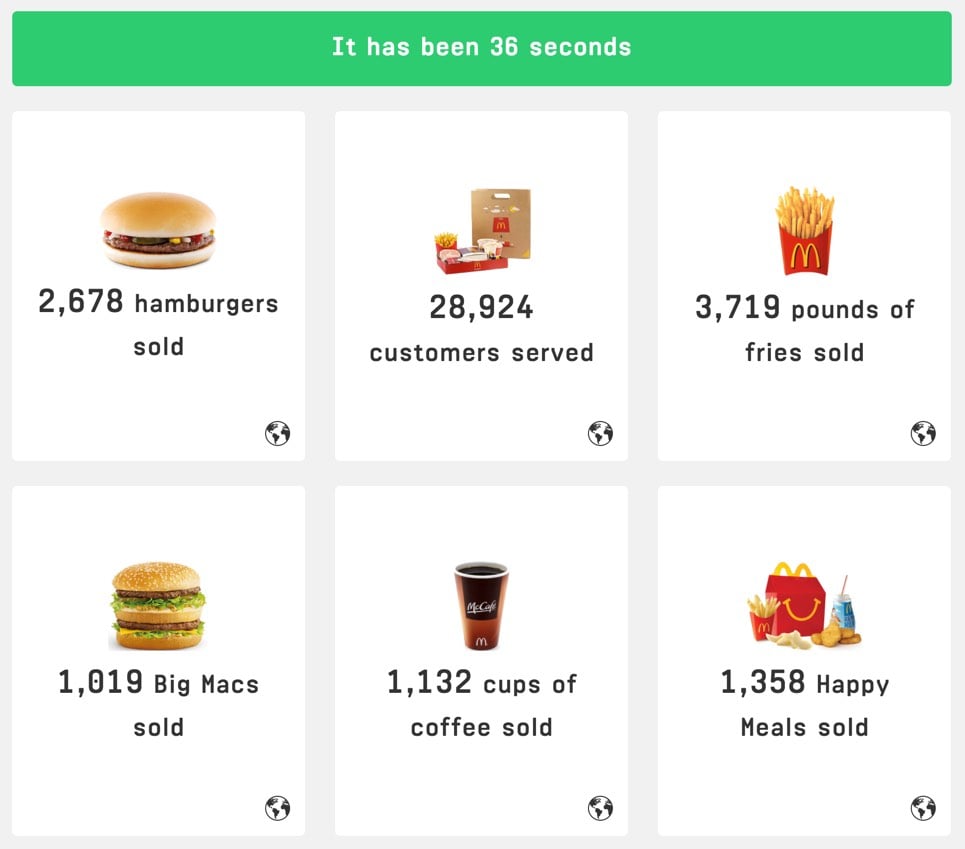
Every Second is a site that keeps track of various things that happen around the world by the second. For instance:
McDonald’s sells ~75 burgers, serves 810 customers, and makes about $800 every second of the day.
On Facebook, each second brings 52,000 new likes, 8500 new comments, and $261 in profit.
Apple sells 6.5 iPhones and handles 460,000 iMessages every second.
In 2016, Taylor Swift earned about $5 every second of the year. (via @daveg)
The scuttlebutt around the tech/media internet water cooler over the past few months is that Facebook CEO Mark Zuckerberg is going to run for President in 2020. This feeling has been fueled by Zuck’s goal for this year of visiting the remaining 30 or so US states that he has yet to visit and the way in which he’s been documenting his trips. Nathan Hubbard argues that Zuck actually has other things on his mind as he tours America:
Zuck isn’t running for President. He’s trying to understand the role the product he created played in getting this one elected.
Facebook has undergone two major evolutionary events in its history, both of which were driven by what Zuck saw as existential threats.
The incredible revenue growth in mobile (probably the greatest biz execution of our generation) helped Facebook survive a platform shift.
And the fearless acquisitive streak of Instagram, WhatsApp and others helped Facebook survive a shift in how we communicate and organize.
Zuck woke up on Nov 9th acutely aware that FB had facilitated a new shift he didn’t foresee or understand; that’s terrifying to a founder.
He’s the head of product. So he’s ventured out into the world beyond his bubble to do field research and inform how FB will evolve again.
I am also sympathetic to the argument that Zuckerberg doesn’t need to run for President because he’s already the leader of the largest group of people ever assembled in the history of humanity (aside from possibly the British Empire). Facebook doesn’t possess many necessary qualities of a sovereign country, but it also has many advantages that countries don’t. Zuckerberg is already among the world’s most important people and with Facebook still growing, he could one day soon be the most powerful person in the world.
You may recognize some of these types of videos in Materialisimo’s funny review of Every Facebook Video EVER. (via @JossFong)
Last week (approx. May 7-14), I stopped using social media for an entire week. I logged out of all the sites and deleted the apps from my phone. I didn’t so much as peek at Instagram, which is, with Twitter and old-school Flickr, probably my favorite online service of all time. I used Twitter as minimally as I could, for work only.1 I didn’t check in anywhere on Swarm. No Facebook. As much as I could, I didn’t use my phone. I left it at home when I went to the grocery store. I didn’t play any games on it. I left it across the room when I went to bed and when I worked.
Many people have given up social media and written about it — the digital equivalent of the “Why I’m Leaving New York” essay — but since I didn’t write about leaving New York, I’m going to do this instead.
I used to be very good about using my phone and social media appropriately. More than a decade of working on kottke.org taught me how to not be online when I wasn’t working (for the most part). I tried super hard not to use my phone at all around my kids and if I was out with friends, my phone stayed in my pocket.2
Almost a year ago, after 13+ years in the city, I moved from lower Manhattan3 to rural Vermont. It’s beautiful here. I live in a house in the country surrounded by horse pasture and there’s great skiing in the winter. The nearest town is only five minutes away by car; it has a two-screen movie theater, a handful of restaurants (none of which are typically open after 10pm), two grocery stores, but nowhere to get a proper donut, sushi, or bowl of ramen. (The nearest ramen is an hour’s drive away.) While I was writing this post yesterday afternoon, the power in my house went out and didn’t come back on for three hours, forcing a delay in publication. It’s been difficult to meet people. Folks here are nice, but they mostly remind me of the people in the small town I grew up in (aka why I moved to the city in the first place). I work from home at a desk in my bedroom and some days, the only beings I’ll talk to are Siri, my landlord’s horses, and some days, my kids and their mom.
Social media, mostly through my phone, has been an important way for me to stay connected with friends and goings on in the wider world. But lately I’d noticed an obsessiveness, an addiction really, that I didn’t like once I became fully aware of it. When I wasn’t working, I was on my phone, refreshing Instagram, Twitter, and Facebook repeatedly in an endless series, like a little old lady at Caesar’s Palace working several slot machines at the same time. And I couldn’t stop it — my phone was in my hand even when I was trying to concentrate on my kids, watching a movie, or reading a book. So, I quit for a week to see what would happen. It’s not a super-long time period, but here’s what I noticed:
- Once I’d set my mind to it, it was pretty easy to go cold turkey. Perhaps my Twitter usage and keeping up with the news for kottke.org acted as a nicotine patch, but I don’t think so. Instagram was the toughest to stay away from, but I didn’t crack once.
- As the week went on, it was more and more evident that it wasn’t so much social media as the phone that was the problem. Even now, a few days after the conclusion of my experiment, I’m leaving my phone at home when I go out or across the room when I’m doing something. I’m going to try hard to keep this up.
- Buuuut, when you have kids, there is no such thing as giving up your phone. There’s always the potential call from their school or their mom or their doctor or another parent regarding a playdate or or or. I spend enough time online at my computer for work that I could mostly do without my phone, but with kids, that’s not really an option.
- Not a single person noticed that I had stopped using social media. (Not enough to tell me anyway.) Perhaps if it had been two weeks? For me, this reinforced that social media is actually not a good way to “stay connected with friends”. Social media aggregates interactions between loved ones so that you get industrialized communication rather than personal connection. No one really notices if a particular person goes missing because they’re just one interchangeable node in a network.
- My no-social week, for a variety of reasons, was probably the shittiest week I’d had in more than a year. Total emotional mess. Being off social media didn’t make it any better, but I doubt it made it worse. Overall, it was probably a good thing I wasn’t subjecting my friends and followers to self-subtweets and emo Instagram Stories…I was already scoring enough own goals without social media’s help.
- So, what did I do instead? I wish I could say that I had loads of extra free time that I used to learn Spanish, clean my house, catch up with old friends, cook delicious meals, and finish a couple work projects. Perhaps if shittiest week ever hadn’t been happening, I would have done some of that. Still, I did end up going to bed early every night, read a couple books, and had more time for work and dealing with kid drama.
After the week was up, I greedily checked in on Instagram and Facebook to see what I had missed. Nothing much, of course. Since then, I’ve been checking them a bit less. When I am on, I’ve been faving and commenting more in an attempt to be a little more active in connecting. I unfollowed some accounts I realized I didn’t care that much about and followed others I’ve been curious to check out. Swarm I check a lot less, about once a day — there was a lot of FOMO going on when I saw friends checked in at cool places in NYC or on vacations in Europe. And I’m only checking in when I go someplace novel, just to keep a log of where I’ve been…that’s always fun to look back on.
Mostly, I’ve resolved to use my phone less. Being on my phone was my fidget spinner…this thing that I would do when there was nothing else to do or that I would use to delay going to bed or delay getting out of bed in the morning. Going forward, I’m going to be more mindful about its use. If nothing else, my hands and thumbs might start feeling better.
Alexis Madrigal is back at The Atlantic, where he’ll be writing about technology, science, and business. His first piece is a reflection on how the Internet has changed in the 10 years he’s been writing about it. In 2007, the Web was triumphant. But then came apps and Facebook and other semi-walled gardens:
O’Reilly’s lengthy description of the principles of Web 2.0 has become more fascinating through time. It seems to be describing a slightly parallel universe. “Hyperlinking is the foundation of the web,” O’Reilly wrote. “As users add new content, and new sites, it is bound into the structure of the web by other users discovering the content and linking to it. Much as synapses form in the brain, with associations becoming stronger through repetition or intensity, the web of connections grows organically as an output of the collective activity of all web users.”
Nowadays, (hyper)linking is an afterthought because most of the action occurs within platforms like Facebook, Twitter, Instagram, Snapchat, and messaging apps, which all have carved space out of the open web.
That strategy has made the top tech companies insanely valuable:
In mid-May of 2007, these five companies were worth $577 billion. Now, they represent $2.9 trillion worth of market value! Not so far off from the combined market cap ($2.85T) of the top 10 largest companies in the second quarter of 2007: Exxon Mobil, GE, Microsoft, Royal Dutch Shell, AT&T, Citigroup, Gazprom, BP, Toyota, and Bank of America.
In 2007, I wrote a piece (and a follow-up) about how Facebook was the new AOL and how their walled garden strategy was doomed to fail in the face of the open Web. The final paragraph of that initial post is a good example of the Web triumphalism described by Madrigal but hasn’t aged well:
As it happens, we already have a platform on which anyone can communicate and collaborate with anyone else, individuals and companies can develop applications which can interoperate with one another through open and freely available tools, protocols, and interfaces. It’s called the internet and it’s more compelling than AOL was in 1994 and Facebook in 2007. Eventually, someone will come along and turn Facebook inside-out, so that instead of custom applications running on a platform in a walled garden, applications run on the internet, out in the open, and people can tie their social network into it if they want, with privacy controls, access levels, and alter-egos galore.
The thing is, Facebook did open up…they turned themselves inside-out and crushed the small pieces loosely joined contingent. They let the Web flood in but caught the Web’s users and content creators before they could wash back out again. The final paragraph of the follow-up piece fared much better in hindsight:
At some point in the future, Facebook may well open up, rendering much of this criticism irrelevant. Their privacy controls are legendarily flexible and precise…it should be easy for them to let people expose parts of the information to anyone if they wanted to. And as Matt Webb pointed out to me in an email, there’s the possibility that Facebook turn itself inside out and be the social network bit for everyone else’s web apps. In the meantime, maybe we shouldn’t be so excited about the web’s future moving onto an intranet.
What no one saw back then, about a week after the release of the original iPhone, was how apps on smartphones would change everything. In a non-mobile world, these companies and services would still be formidable but if we were all still using laptops and desktops to access information instead of phones and tablets, I bet the open Web would have stood a better chance.

Two years ago, Facebook COO and Lean In author Sheryl Sandberg lost her husband to an unexpected death. The loss left her bereft and adrift. Grieving hard, she struggled to figure out how to move forward with her life. The result of her journey is a book co-authored by Adam Grant called Option B: Facing Adversity, Building Resilience and Finding Joy.
After the sudden death of her husband, Sheryl Sandberg felt certain that she and her children would never feel pure joy again. “I was in ‘the void,’” she writes, “a vast emptiness that fills your heart and lungs and restricts your ability to think or even breathe.” Her friend Adam Grant, a psychologist at Wharton, told her there are concrete steps people can take to recover and rebound from life-shattering experiences. We are not born with a fixed amount of resilience. It is a muscle that everyone can build.
Option B combines Sheryl’s personal insights with Adam’s eye-opening research on finding strength in the face of adversity.
Jessi Hempel’s piece on Sandberg is a good overview on the book and that period in her life, particularly in relation to Sandberg’s return to work and how that changed leadership & communication at Facebook.
Every year in late May, Facebook gathers its policy and communications team for a day-long retreat. Employees fly in from satellite offices in Germany, say, or Japan. It’s a chance to address problems, and set strategy for the year to come.
Sandberg always speaks, but that year Caryn Marooney, who was then in charge of technology communications, remembers everyone told her she could skip it. She insisted on coming anyway. As 200 people looked on, she began telling the group what she was going through, and how it was. “There were a lot of tears. It was incredibly raw, and then she said, “I’m going to open it up to Q and A,” Marooney remembers. People spoke up.
Talking about her situation allowed Sandberg — and the entire team — to move past it and transition into a productive conversation. Having acknowledged the proverbial elephant in the room, they could all focus on the work at hand. “I think people think that vulnerable is soft, but it’s not,” said Marooney, as she described Sandberg’s tough approach to business questions that followed. “It was a blueprint of what we saw from Sheryl going forward.”
Sandberg has also started a non-profit “dedicated to helping you build resilience in the face of adversity — and giving you the tools to help your family, friends, and community build resilience too.”
See also Sandberg’s Facebook post about her husband’s death and her NY Times opinion piece How to Build Resilient Kids, Even After a Loss.
One afternoon, I sat down with my kids to write out “family rules” to remind us of the coping mechanisms we would need. We wrote together that it’s O.K. to be sad and to take a break from any activity to cry. It’s O.K. to be happy and laugh. It’s O.K. to be angry and jealous of friends and cousins who still have fathers. It’s O.K. to say to anyone that we do not want to talk about it now. And it’s always O.K. to ask for help. The poster we made that day — with the rules written by my kids in colored markers — still hangs in our hall so we can look at it every day. It reminds us that our feelings matter and that we are not alone.
Sad but not unexpected news: Facebook is shutting down its Paper app.
When it was introduced in January 2014, Paper signaled the beginning of a design renaissance at Facebook. The look and feel of the app were orchestrated by Mike Matas, whose design firm Push Pop Press was acquired by Facebook in 2011. Paper was notable for the novel animations it used to guide you through the app - tap on a link and it would unfold like a letter; pull down on the story and it would fold back up, returning you to the feed.
They say the app is shutting down on July 29th, but my news feed has already stopped updating.
I love Paper. The look and feel of the app is amazing; it’s still one of the best apps ever for reading things online. Paper was the only way I read Facebook…I guess I’ll either d/l the Facebook app or stop reading?
It’s a throwaway line in a longer talk and we probably shouldn’t make too much of it, but I will anyway.
In five years time Facebook “will be definitely mobile, it will be probably all video,” said Nicola Mendelsohn, who heads up Facebook’s operations in Europe, the Middle East and Africa, at a conference in London this morning. Mark Zuckerberg, Facebook’s CEO, has already noted that video will be more and more important for the platform. But Mendelsohn went further, suggesting that stats showed the written word becoming all but obsolete, replaced by moving images and speech.
“The best way to tell stories in this world, where so much information is coming at us, actually is video,” Mendelsohn said. “It conveys so much more information in a much quicker period. So actually the trend helps us to digest much more information.”
Maybe this is coming from deep within the literacy bubble, but:
Text is surprisingly resilient. It’s cheap, it’s flexible, it’s discreet. Human brains process it absurdly well considering there’s nothing really built-in for it. Plenty of people can deal with text better than they can spoken language, whether as a matter of preference or necessity. And it’s endlessly computable — you can search it, code it. You can use text to make it do other things.
In short, all of the same technological advances that enable more and more video, audio, and immersive VR entertainment also enable more and more text. We will see more of all of them as the technological bottlenecks open up.
And text itself will get weirder, its properties less distinct, as it reflects new assumptions and possibilities borrowed from other tech and media. It already has! Text can be real-time, text can be ephemeral — text has taken on almost all of the attributes we always used to distinguish speech, but it’s still remained text. It’s still visual characters registered by the eye standing in for (and shaping its own) language.
Because nothing has proved as invincible as writing and literacy. Because text is just so malleable. Because it fits into any container we put it in. Because our world is supersaturated in it, indoors and out. Because we have so much invested in it. Because nothing we have ever made has ever rewarded our universal investment in it more. Unless our civilization fundamentally collapses, we will never give up writing and reading.
We’re still not even talking to our computers as often as we’re typing on our phones. What logs the most attention-hours — i.e., how media companies make their money — is not and has never been the universe of communications.
(And my god — the very best feature Facebook Video has, what’s helping that platform eat the world — is muted autoplay video with automatic text captions. Forget literature — even the stupid viral videos people watch waiting for the train are better when they’re made with text!)
Nothing is inevitable in history, media, or culture — but literacy is the only thing that’s even close. Bet for better video, bet for better speech, bet for better things we can’t imagine — but if you bet against text, you will lose.
Kurzgesagt’s newest video is about all the stolen video content on Facebook and the social network’s continued indifference to and profit from content creators, particularly small and independent creators.
Facebook just announced 8 billion video views per day. This number is made out of lies, cheating and worst of all: theft. All of this is wildly known but the media giant Facebook is pretending everything is fine, while damaging independent creators in the process. How does this work?
Hank Green wrote an essay in August called Theft, Lies, and Facebook Video.
According to a recent report from Ogilvy and Tubular Labs, of the 1000 most popular Facebook videos of Q1 2015, 725 were stolen re-uploads. Just these 725 “freebooted” videos were responsible for around 17 BILLION views last quarter. This is not insignificant, it’s the vast majority of Facebook’s high volume traffic. And no wonder, when embedding a YouTube video on your company’s Facebook page is a sure way to see it die a sudden death, we shouldn’t be surprised when they rip it off YouTube and upload it natively. Facebook’s algorithms encourage this theft.
What is Facebook doing about it?
They’ll take the video down a couple days after you let them know. Y’know, once it’s received 99.9% of the views it will ever receive.
In the New Yorker, Matthew J.X. Malady writes about finding his deceased mother standing outside her house on Google Street View and, more generally, when technology clumsily reminds us of loved ones who are no longer with us.
When I reached my mother’s house, that all changed. First, I noticed that a gigantic American flag had been affixed to the mailbox post at the corner of the driveway. That was new. Then I spotted the fire pit in the front yard that my mom and her husband, my stepfather, used for block parties, and the grill on the patio, and my mom’s car. And then there she was, out front, walking on the path that leads from the driveway to the home’s front door. My mom.
At first I was convinced that it couldn’t be her, that I was just seeing things. When’s the last time you’ve spotted someone you know on Google Maps? I never had. And my mother, besides, is no longer alive. It couldn’t be her.
Facebook in particular has been dinged for inadvertent algorithmic cruelty, but they have recently been making strides in a better direction. (via @tcarmody)
From 1957, this is a drawing of the synergistic strategy of Walt Disney Productions, or what Todd Zenger of Harvard Business Review calls “a corporate theory of sustained growth”.
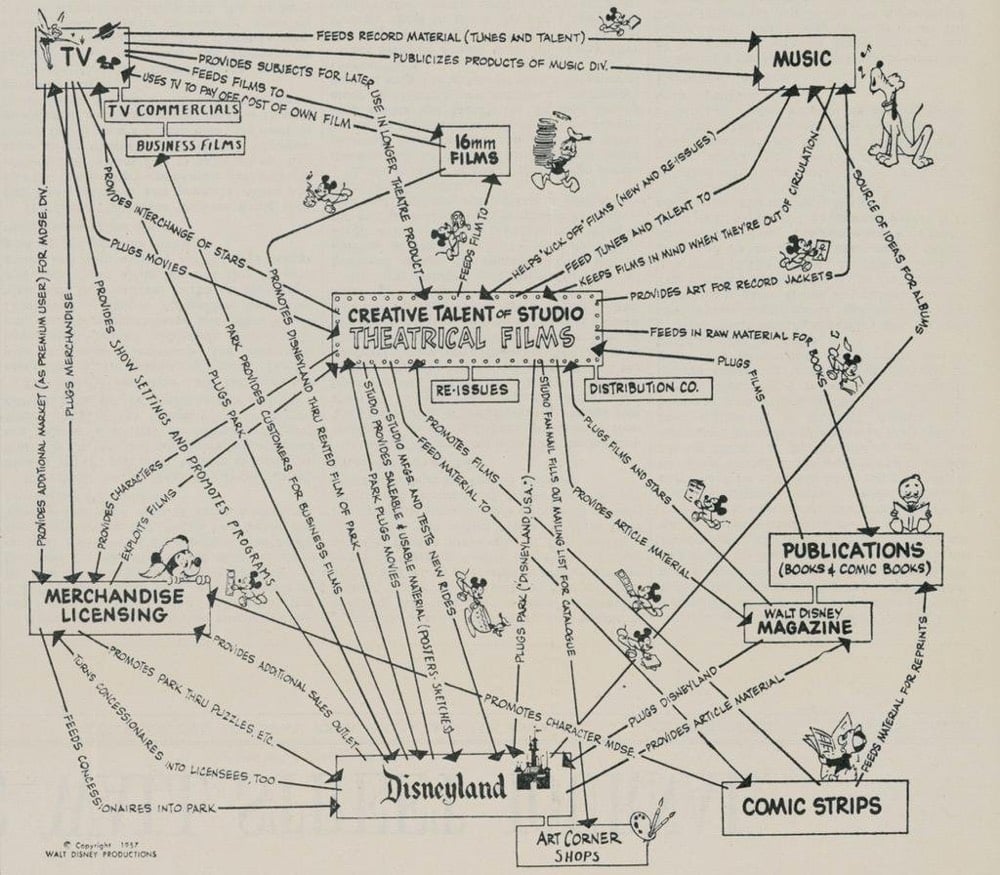
The boxes on the chart have changed, but since the appointment of Bob Iger as CEO, Disney has seemingly doubled down on Walt’s old strategy with their increased focus on franchises.
Disney’s dominance can be boiled down very simply to one word: franchises. Or rather, an “incessant focus on franchises” in the words of former Disney CFO Jay Rasulo.
“Everything we do is about brands and franchises,” Rasulo told a group of financial analysts last September. “Ten years ago we were more like other media companies, more broad-based, big movie slate, 20 something pictures, some franchise, some not franchise. If you look at our slate strategy now, our television strategy, almost every aspect of the company, we are oriented around brands and franchises.”
Franchises are well suited to extend across multiple parts of a big business like Disney, particularly because it’s a repeating virtuous cycle: movies drive merchandise sales and theme park visits, which in turn drives interest for sequels and spin-offs, rinse, repeat, reboot.
I wonder if more tech companies could be using this strategy more effectively. Apple does pretty well; their various hardware (iPhone, iPad, Mac), software (iOS, OS X), and services (iCloud, App Store, iTunes Store) work together effectively. Microsoft rode Office & Windows for quite awhile. Google seems a bit more all over the place — for instance, it’s unclear how their self-driving car helps their search business and Google+ largely failed to connect various offerings. Facebook seems to be headed in the right direction. Twitter? Not so much, but we’ll see how they do with new leadership. Or old leadership…I discovered Walt’s chart via interim Twitter CEO Jack Dorsey.
Hi, everybody! Tim Carmody here, guest-hosting for Jason this week.
On Monday, I tried to list some reasons why OKCupid’s self-acknowledged experiments on its users didn’t seem to be stirring up the same outrage that Facebook’s had. Here at the end of the week, I think I was largely right: fewer people are upset, the anger is more tempered, and that has a lot to do with the reasons I gave. But one reaction I didn’t expect is that some people took it as saying that I wasn’t upset by what OKCupid did, or that people shouldn’t be as upset by it.
What OKCupid did has actually made me madder and madder as the week’s gone on, but for reasons that are different from other people’s. I think this is pretty important, so I’m going to try to explain why.
Let’s start with the Facebook “social contagion” study. Most Facebook critics focused on the people who were the subjects of the study, for good reasons. Did these users give consent? Can terms of service count as consent for an academic study? Should they have been informed of the study afterwards? Is Facebook responsible for any harm these users might have suffered? Is an increase or decrease in engagement really a sign that users’ emotions were affected? How else has Facebook attempted to influence its users, or might try in the future? These are all good questions.
But what if you flip it around? What if you weren’t one of the subjects whose moods Facebook was trying to study, but one of their friends or family? What if you were one of the people whose posts were filtered because your keywords were too happy, too angry, or too sad?
I think there’s no way to know whether the Facebook study may have harmed people who weren’t being studied. And even though the TOS basically says that users give Facebook permission to do whatever they want not only with the users’ data, but all of their friends’ too, you can’t call that consent with a straight face. (This is just another reason that software terms of service are a rotten legal and ethical basis for research. They just weren’t built for that reason, or to solve any of those problems.)
So Facebook didn’t just mess around with some of its users’ feeds, hoping to see if it might mess around with their feelings. It used some of its users’ posts in order to do it. Arguably, it made them complicit.
To be clear, filtering posts, giving preference to some and not others, is how Facebook’s newsfeed algorithm always works. Facebook users have been complaining about this for a long time, especially brands and news organizations and other companies who’ve built up their subscriber counts and complain that hardly anybody ever sees their posts unless they pay off Facebook’s ad department. And Facebook makes no guarantees, anywhere, that they’re going to deliver every message to every user who’s subscribed to it. Readers miss posts all the time, usually just because they’re just not looking at the screen or reading everything they could see. Facebook isn’t certified mail. It’s not even email. All this is known.
However.
We all buy in to Facebook (and Twitter, and OKCupid, and every other social media network), giving them a huge amount of personal data, free content, and discretion on how they show it to us, with the understanding that all of this will largely be driven by choices that we make. We build our own profiles, we select our favorite pictures, we make our own friends, we friend whatever brands we like, we pick the users we want to block or mute or select for special attention, and we write our own stories.
Even the filtering algorithms, we’re both told and led to assume, are the product of our choices. Either we make these choices explicitly (mute this user, don’t show me this again, more results like these) or implicitly (we liked the last five baby pictures, so Facebook shows us more baby pictures; we looked at sites X, Y, and Z, so we see Amazon ads for people who looked at X, Y, and Z.) It’s not arbitrary; it’s personalized. And it’s personalized for our benefit, to reflect the choices that we and the people we trust have made.
This is what makes the user-created social web great. It’s the value it adds over traditional news media, traditional classified ads, traditional shopping, everything.
We keep copyright on everything we write and every image we post, giving these services a broad license to use it. And whenever the terms of service seem to be saying that these companies have the right to do things we would never want them to do, we’re told that these are just the legal terms that the companies need in order to offer the ordinary, everyday service that we’ve asked them to do for us.
This is why it really stings whenever somebody turns around and says, “well actually, the terms you’ve signed give us permission to do whatever we want. Not just the thing you were afraid of, but a huge range of things you never thought of.” You can’t on one hand tell us to pay no attention when you change these things on us, and with the other insist that this is what we’ve really wanted to do all along. I mean, fuck me over, but don’t tell me that I really wanted you to fuck me over all along.
Because ultimately, the reason you needed me to agree in the first place isn’t just because I’m using your software, but because you’re using my stuff. And the reason I’m letting you use my stuff, and spending all this time working on it, is so that you can show it to people.
I’m not just a user of your service, somebody who reads the things that you show it to me: I’m one of the reasons you have anything that you can show to anyone at all.
Now let’s go back to the OKCupid experiment. Facebook didn’t show some of its users posts that their friends wrote. But at least it was a binary thing: either your post was shown, just as you wrote it, or it wasn’t. OKCupid actually changed the information it displayed to users.
You can pick nits and say OKC didn’t change it, but rather, just selectively repressed parts of it, deleting photos on some profiles and text on others. But if you’ve ever created a profile on any web site, you know that it’s presented as being a whole ensemble, the equivalent of a home page. The photos, the background, the description, the questions you answer: taken altogether, that’s your representation of yourself to everyone else who may be interested. It’s the entire reason why you are there.
Now imagine you’re an OKCupid user, and you strike up a conversation with someone or someone strikes up a conversation with you. You assume that the other person has all of your information available to them if they’re willing to look at it. That’s the basis of every conversation you have on that site. Except they don’t. The profile that OKCupid has implicitly promised they’ll show to everyone who looks at it has been changed. The other person either doesn’t know what you look like (and assumes you can’t be bothered to post a photo) or doesn’t know anything else about you (and assumes you can’t be bothered to write anything about yourself.) Both of you have been deceived, so the site can see what happens.
This is why I question the conclusion that OKC users who were only shown profiles with pictures are shallow, because their conversations were almost as long as the ones who were shown full profiles. This is how I imagine those conversations going:
Rosencrantz: So what do you do?
Guildenstern: Um I work in marketing?
Rosencrantz: That’s great! Where did you go to school?
Guildenstern: I went to UVA
Guildenstern: Wait a minute are you some kind of bot?
Rosencrantz: What makes you say that?
Guildenstern: You keep asking me questions that are in my profile, did you even read it
Rosencrantz: I’m looking at it right now, why didn’t you answer any of the questions
Guildenstern: lol I guess you can’t read nice pic though goodbye
That’s a high-value interaction by the OKC researchers’ standards, by the way.
This is also why I don’t have much patience with the idea that “The worst thing could have happened [with the OkCupid testing] is people send a few more messages, and maybe you went on a date you didn’t like.” (Rey Junco told this to ReadWrite to explain why he thought Facebook’s study was worse than OKCupid’s, but you see versions of this all over.)
First, going on “a date you didn’t like” isn’t a frivolous thing. It definitely incurs more material costs than not seeing a Facebook status. And bad (or good) messages or a bad or good date can definitely have a bigger emotional impact as well.
More importantly, though, don’t make this just a question about dates or feelings, about what somebody did or didn’t read and what its effect on them was. I don’t care if you think someone making a dating profile is a frivolous thing. Somebody made that. They thought the company hosting it could be trusted to present it honestly. They were wrong.
So this is the problem I see not just with Facebook and OKCupid’s experiments, but with most of the arguments about them. They’re all too quick to accept that users of these sites are readers who’ve agreed to let these sites show them things. They don’t recognize or respect that the users are also the ones who’ve made almost everything that those sites show. They only treat you as a customer, never a client.
And in this respect, OKCupid’s Christian Rudder and the brigade of “and this surprises you?” cynics are right: this is what everybody does. This is the way the internet works now. (Too much of it, anyway.) It doesn’t matter whether your site is performing interventions on you or not, let alone publishing them. Too many of them have accepted this framework.
Still, for as long as the web does work this way, we are never only these companies’ “products,” but their producers, too. And to the extent that these companies show they aren’t willing to live up to the basic agreement that we make these things and give them to you so you will show them to other people — the engine that makes this whole world wide web business go — I’m not going to have anything to do with them any more. What’s more, I’ll get mad enough to find a place that will show the things I write to other people and tell them they shouldn’t accept it either. Because, ultimately, you ought to be ashamed to treat people and the things they make this way.
It’s not A/B testing. It’s just being an asshole.
Update: OKCupid’s Christian Rudder (author of the “We Experiment On Human Beings” post) gave an interview to Alex Goldman and PJ Vogt for On the Media’s TLDR podcast.
Rudder says some of the negative response “is my own fault, because, y’know, the blog post is sensationally written, for sure.” But he doesn’t back off of that tone one bit. In fact, he doubles down.
Alex Goldman: Have you thought about bringing in, say, like an ethicist to, to vet your experiments?
Christian Rudder, founder of OkCupid: To wring his hands all day for a hundred thousand dollars a year?… This is the only way to find this stuff out. If you guys have an alternative to the scientific method, I’m all ears.
I think he maybe should have just written the blog post and left it alone.
Update: University of Maryland Professor of Law James Grimmelmann say that not only were OKCupid’s and Facebook’s studies unethical, but they were illegal.
Most of the resulting discussion has treated this as a story about ethics. Which it is — and the lapses of ethical judgment shown by Facebook and OkCupid are scandalous. But the ethics are only half of the story. What Facebook and OkCupid did wasn’t just unethical. It was illegal. A common assumption is that even if research laws ought to apply to private companies, they don’t. But that assumption is false. Facebook and OkCupid are bound by research laws, and those research laws quite clearly prohibit what they did.
Hi, everybody! Tim Carmody here, guest-hosting for Jason this week.
OK Cupid’s Christian Rudder has responded to the outcry over Facebook’s experiments with user emotions by… publishing a list of experiments that the dating site has run on its users, along with their results.
And it’s not little stuff either! To test its matching algorithms, OKC has selectively hidden users’ profile images, their profile text, and even told pairs of users they were a good match when the algo said they weren’t, and vice versa.
In short, Facebook may have hid stuff from you, but OK Cupid might have actually lied to you.
But… nobody’s really upset about this. Or if they are, they’re mostly just upset (or dryly observing, it’s hard to tell) that other people aren’t upset.
Why? I have some theories:
- It’s early yet. It took the Facebook story some time to steep before it really picked up steam.
- OKC users are less likely to be troubled by this sort of thing than Facebook users are. And people get more upset when they feel like they personally might have been messed with. Hilary Parker pointed out that non-online daters are less likely to get upset on online daters’ behalf: even if you don’t actively look down on OKC users (and many do), you might be more likely to think they got what they deserved. OK Cupid has a history of disclosing these kinds of numbers, and there’s a laissez-faire attitude towards users gaming accounts for their own purposes.
- We trust Facebook in a way we don’t trust OKC. Facebook is the safe baby internet, with our real friends and family sending us real messages. OKC is more internet than the internet, with creeps and jerks and catfishers with phony avatars. So Facebook messing with us feels like a bigger betrayal.
- OKC’s matching algorithm may be at least as opaque as Facebook’s news feed, but it’s clearer to users that site matches and views are generated using an algorithm. Reportedly, 62 percent of Facebook users weren’t aware that Facebook’s news feed was filtered by an algorithm at all. (That study has a small sample size, but still, we can infer that lots of Facebook users have no idea.)
- The results of OKC’s experiments are less troubling. Facebook’s study showed that our posting behavior (and maybe our feelings) were pretty susceptible to manipulation without a whole lot of effort. OKC’s results seemed more complimentary. Sure, lots of people on dating sites are shallow, and sometimes you may have ended up in longer conversations than you might like with incompatible people, but good matches seem to find a way to connect no matter what OKC tells us! So… the algorithm works and I guess we can trust what they tell us? My head hurts. (Jess Zimmerman adds that part of the Facebook intervention was deliberately designed to cause harm, by making people unhappy, at least as mediated through their posts. The difference here depends on whether you think trying to match you up with someone incompatible might be causing them harm.)
- The tone of the OKC post is just so darned charming. Rudder is casual, self-deprecating. It’s a blog post! Meanwhile, Facebook’s “emotional contagion” scholarly paper was chillingly matter-of-fact. In short, the scientism of the thing just creeped us the fuck out.
- This is related to the tone issue, but OKC seems to be fairly straightforward about why it performed the experiment: they didn’t understand whether or how their matching algorithm was working, and they were trying to figure that out to make it better. Facebook seemed to be testing user’s emotional expressions partly to solve a scholarly dispute and partly just to see if they could. And most of the practical justifications folks came up with for the Facebook study were pretty sinister: tricky folks into posting more often, into clicking on ads, into buying stuff. (Really, both experiments are probably a mix of product testing and shooting frogs for kicks, but the perception seems to be different.)
- The Facebook study had an added wrinkle in that academics were involved in designing the study and writing it up. This raised all sorts of factual and ethical issues about university institutional review boards and the responsibility of the journal’s editors and publishers that don’t seem to be relevant here. I mean, maybe SOMEbody should be veryifying that experiments done on human subjects are ethical, whether it’s in a university, medical, or government context or not, but it’s not like someone may have been asleep at the switch. Here, there is no switch.
- Maybe we’re all just worn out. Between Facebook, this, Uber ratings, and god knows what, even if you’re bothered by this kind of experimentation, it’s more difficult to stay angry at any one company. So some people are jaded, some people would rather call attention to broader issues and themes of power, and some people are just tired. There’s only so many times you can say “see? THIS! THIS is what I’ve been telling you about!” or “I can’t believe you’re surprised by this” before you’re just like, ¯\_(?)_/¯.
I don’t agree with all of these explanations, and all of them feel a little thin. But maybe for most of us, those little scraps of difference are enough.
Update: Here’s a tenth reason that I thought of and then forgot until people brought up variations of it on Twitter: Facebook feels “mandatory” in a way that OKCupid doesn’t. It’s a bigger company with a bigger reach that plays a bigger part in more people’s lives. As Sam Biddle wrote on Twitter, “Facebook is almost a utility at this point. It’s like ConEd fucking with us.”
Raffi Khatchadourian’s long piece on the construction of the International Thermonuclear Experimental Reactor (ITER) is at once fascinating (for science reasons) and depressing (for political/bureaucratic reasons). Fusion reactors hold incredible promise:
But if it is truly possible to bottle up a star, and to do so economically, the technology could solve the world’s energy problems for the next thirty million years, and help save the planet from environmental catastrophe. Hydrogen, a primordial element, is the most abundant atom in the universe, a potential fuel that poses little risk of scarcity. Eventually, physicists hope, commercial reactors modelled on iter will be built, too-generating terawatts of power with no carbon, virtually no pollution, and scant radioactive waste. The reactor would run on no more than seawater and lithium. It would never melt down. It would realize a yearning, as old as the story of Prometheus, to bring the light of the heavens to Earth, and bend it to humanity’s will. iter, in Latin, means “the way.”
But ITER is a collaborative effort between 35 different countries, which means the project is political, slow, and expensive.
For the machine’s creators, this process-sparking and controlling a self-sustaining synthetic star-will be the culmination of decades of preparation, billions of dollars’ worth of investment, and immeasurable ingenuity, misdirection, recalibration, infighting, heartache, and ridicule. Few engineering feats can compare, in scale, in technical complexity, in ambition or hubris. Even the iter organization, a makeshift scientific United Nations, assembled eight years ago to construct the machine, is unprecedented. Thirty-five countries, representing more than half the world’s population, are invested in the project, which is so complex to finance that it requires its own currency: the iter Unit of Account.
No one knows iter’s true cost, which may be incalculable, but estimates have been rising steadily, and a conservative figure rests at twenty billion dollars — a sum that makes iter the most expensive scientific instrument on Earth.
I wonder what the project would look like if, say, Google or Apple were to take the reins instead. In that context, it’s only $20 billion to build a tiny Sun on the Earth. Facebook just paid $19 billion for WhatsApp, Apple has a whopping $158.8 billion in cash, and Google & Microsoft both have more than $50 billion in cash. Google in particular, which is making a self-driving car and has been buying up robots by the company-full recently, might want their own tiny star.
But back to reality, the circumstances of ITER’s international construction consortium reminded me of the building of The Machine in Carl Sagan’s Contact. In the book, the countries of the world work together to make a machine of unknown function from plans beamed to them from an alien intelligence, which results in the development of several new lucrative life-enhancing technologies and generally unites humanity. In Sagan’s view, that’s the power of science. Hopefully the ITER can work through its difficulties to achieve something similar.
I don’t know if Facebook buying WhatsApp for $16 billion is a good idea for Facebook or not, but I’m pretty sure it’s a potentially good idea. I’d heard of WhatsApp before, but I first took real notice of it last July when researching this post about Instagram businesses in Kuwait.
Several of the businesses I found used WhatsApp for messaging…browse via Instagram, arrange to buy via WhatsApp. Very low cost, more flexible than SMS, cross-platform, no giant social network appendage to deal with (e.g. Facebook/Twitter), and it’s not email. And, the thing that struck me, WhatsApp (and Instagram) being used for financial/business transactions. Services teens use for social grooming are certainly interesting and important (after all, teens’ social grooming is how, eventually, we end up with more teens), but when you’ve got something being used in all sorts of places all over the world as a social tool *and* a marketplace, you’ve got yourself a platform and that is potentially very valuable.
Newer posts
Older posts






Socials & More