kottke.org posts about Donald Trump
Maria Guadalupe, an economics and political science professor, and Joe Salvatore, a professor of educational theater, recently put on a pair of performances that restaged the three Presidential debates between Donald Trump and Hillary Clinton. But this time, they had a woman play the Trump role (as “Brenda King”) and a man play the Clinton role (as “Jonathan Gordon”), with each attempting to portray the precise mannerisms, styles, and speech of the respective candidates. How would audiences react to the gender-switched candidates?
Salvatore says he and Guadalupe began the project assuming that the gender inversion would confirm what they’d each suspected watching the real-life debates: that Trump’s aggression — his tendency to interrupt and attack — would never be tolerated in a woman, and that Clinton’s competence and preparedness would seem even more convincing coming from a man.
But the lessons about gender that emerged in rehearsal turned out to be much less tidy. What was Jonathan Gordon smiling about all the time? And didn’t he seem a little stiff, tethered to rehearsed statements at the podium, while Brenda King, plainspoken and confident, freely roamed the stage? Which one would audiences find more likeable?
The audience’s reaction to the performances was surprising.
We heard a lot of “now I understand how this happened” — meaning how Trump won the election. People got upset. There was a guy two rows in front of me who was literally holding his head in his hands, and the person with him was rubbing his back. The simplicity of Trump’s message became easier for people to hear when it was coming from a woman — that was a theme. One person said, “I’m just so struck by how precise Trump’s technique is.” Another — a musical theater composer, actually — said that Trump created “hummable lyrics,” while Clinton talked a lot, and everything she was was true and factual, but there was no “hook” to it. Another theme was about not liking either candidate — you know, “I wouldn’t vote for either one.”
Here’s a clip from one of the rehearsals:
I think it’s important not to take away too much from this experiment (and perhaps the same should be said of televised political debates in general) but after watching that short clip and hearing about the audience’s reaction, I couldn’t help but think of Al Gore. In the lead-up to the election, I’d never thought of Clinton that way — meaning very smart, compassionate, and supremely qualified but ultimately a bit dull and uninspiring a la Gore — but maybe she did lack a critical charisma compared to Trump.
Since the Kennedy/Nixon debates, we’ve known that how candidates handle themselves on television — in debates, interviews, televised speeches, etc. — is critical to the voters’ perceptions of them. Gore, Jimmy Carter, Michael Dukakis, Mitt Romney, Bob Dole, Walter Mondale, John Kerry…they all were bested by more charismatic candidates (Reagan, Obama, Bill Clinton) that were in some cases not as qualified on paper. Even the Bushes (especially Dubya) had an aw shucks-y folksiness that could charm people sympathetic to their message. Perhaps Hillary Clinton belongs on that list as well. (via mr)
Jason Ditzian writes about how the Nazis used new technological advances — high-fidelity microphones, public address systems, magnetic tape recording — to rise to power.
And since this amplification invention was new, the novelty added to the mesmerizing effects of a little man shouting atop the biggest soapbox that had ever existed. The quality of sound had a mystical effect upon listeners. It imbued Hitler with godlike powers, making him a deity who could project himself everywhere at once, whether one was standing amid a vast audience or sitting in one’s living room listening to the radio. Sometimes the voice was live; sometimes the voice was recorded in life-like clarity by another cutting-edge German innovation — a reel of magnetic tape.
He compares it to Donald Trump’s use of Twitter, which allows him to instantly soapbox to his millions of followers at all hours of the day and night — “a deity who could project himself everywhere at once” indeed.
With Twitter, every moment is a Trump rally. Everyone in the connected world knows what this unhinged narcissistic compulsive liar is thinking at any given moment. More time, energy, thought and commentary have been given to his minute-by-minute inane bullshit than any other issue of the last two years. And a lot of important things happened in the last two years.
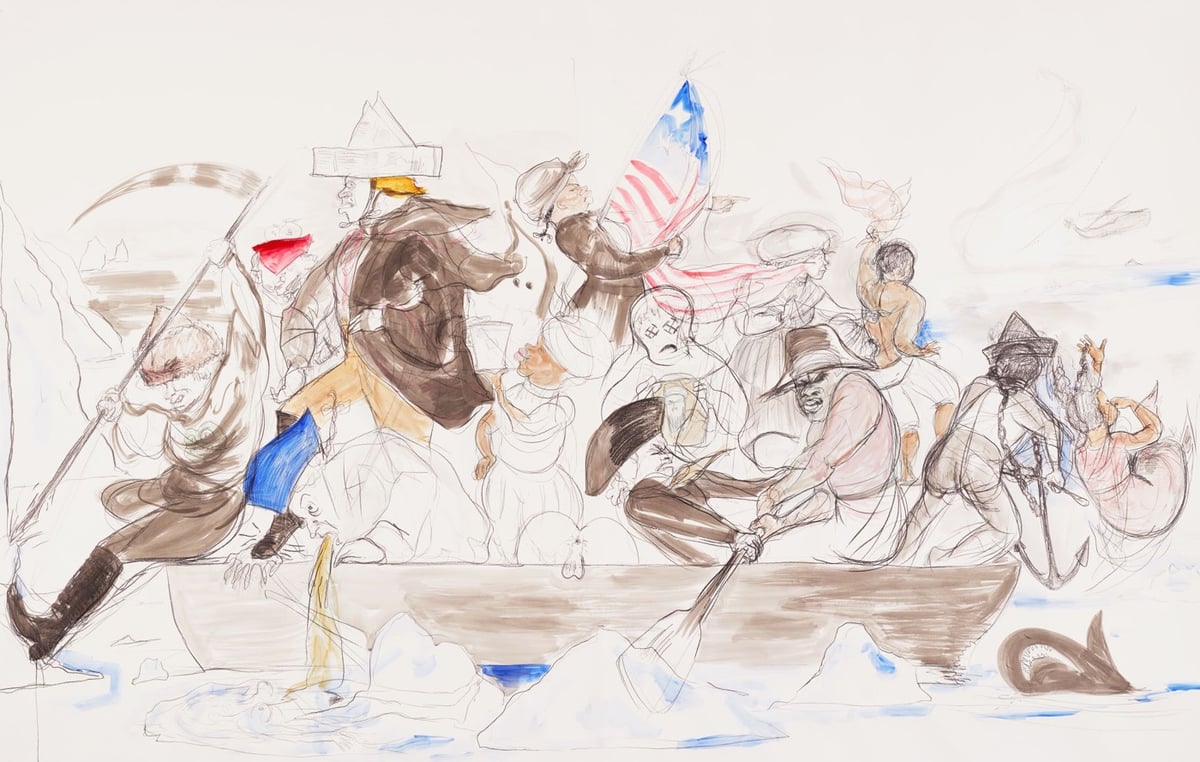
Not wanting to listen to the news on inauguration day, artist Kara Walker painted. The result is a Trumpian take on Emanuel Leutze’s famous work “Washington Crossing the Delaware”, a copy of which is on display at the Met Museum. I hope I get to see Walker’s version in a museum or gallery someday soon.
Voracious reader Tyler Cowen has been reading about fascism recently and shares his thoughts on some specific books. It seems as though A History of Fascism, 1914-1945 and The Anatomy of Fascism are the two to start with.
Stanley G. Payne, A History of Fascism 1914-1945. One of the classics, readable and comprehensive and one of the best places to start. One thing I learned from this pile of books is how hard some of those leaders worked to have the mid-level bureaucracy on their side. The centralization often occurred at higher levels, for instance Mussolini had 72 cabinet meetings in 1933, but only 4 in 1936. The Italian Fascist party, by the way, was disproportionately Jewish, at least pre-1938.
Cowen’s conclusion after his reading? The US is not headed toward fascism:
Overall I did not conclude that we Americans are careening toward fascist outcomes. I do not think that notion is well-suited to the great complexity of contemporary bureaucracy, nor to our more feminized and also older societies. Furthermore, in America democracy has taken much deeper roots and the system of checks and balances, whatever its flaws, has stood for a few hundred years, contra either Italy or Germany in their fascist phases.
Looking over Umberto Eco’s 14 Features of Eternal Fascism, I might disagree with that. So far, the Trump administration has been working quickly to consolidate its power and the Republican-majority Congress has shown little interest in stopping them — e.g. the so-called confirmation hearings are little more than formalities when Republicans are voting as a bloc in most cases. The judicial branch has been more attentive thus far in making sure the Republicans are operating within the law (e.g. the rulings against Trump’s travel ban and the NC governor’s limitation of powers), providing the essential “checks and balances” Cowen speaks of. But the law…well, let’s just say that plenty of bad and immoral things are legal, particularly when powerful people and the governmental bodies responsible for making laws are concerned, and much depends on the intelligence and resourcefulness of the lawyers and political viewpoints of the judges involved. All it would take is a little more thoughtfulness1 on the part of Trump’s team in writing his executive orders and they can probably get much of what they want legally.
Anyway, on a broader authoritarian note, Brendan Nyham of Dartmouth College has compiled a reading list for understanding the authoritarian turn in US politics.
Josh Marshall from Talking Points Memo urges us that when it comes to figuring out what Donald Trump’s up to, we should keep it simple. The media has covered Trump for more than 30 years, he appeared weekly on television for several years, and the coverage of his campaign over the past two years was unprecedented. That, says Marshall, means that we know Trump and his motivations quite well at this point and offers a list of five things we should keep in mind:
1. Trump is a Damaged Personality
2. Trump is a Great Communicator
3. Trump’s Hold on His Base Is Grievance
4. Trump is Possible Because of Partisan Polarization
5. Trump is Surrounded By Extremists and Desperados
Trump is an impulsive narcissist who is easily bored and driven mainly by the desire to chalk up ‘wins’ which drive the affirmation and praise which are his chief need and drive. He needs to dominate everyone around him and is profoundly susceptible to ego injuries tied to not ‘winning’, not being the best, not being sufficiently praised and acclaimed, etc. All of this drives a confrontational style and high levels of organizational chaos and drama. This need for praise and affirmation and a lack of patience for understanding the basic details of governing are a volatile and dangerous mix. They catalyze and intensify each other. Perhaps most importantly, the drive to be the best and right drives promises, claims and policy pronouncements which may contradict his already existing positions or be impossible to fulfill.
Marshall also calls out something I’ve been thinking about recently, the Make America Great Again branding:
‘Make America Great Again’ may be awful and retrograde in all its various meanings. But it captured in myriad ways almost every demand, fear and grievance that motivated the Americans who eventually became the Trump base. It is almost certainly the case that MAGA is entirely Trump’s invention, not the work of any consultant or media specialist but from Trump himself. The Trump Trucker baseball cap, a physical manifestation of Trumpite branding, is similarly ingenious.
As much as I came to admire Pentagram’s work on Hillary Clinton’s campaign branding and loved the Obama campaign’s branding (complete with beautiful typefaces from Hoefler and Frere-Jones), I think the MAGA design easily beats them both. Marshall nailed it…it was exactly right for who it was designed to appeal to. It’s perhaps unlikely to happen, but the Make America Great Again hat should be added to the permanent collections of design museums as an exemplary example of branding, right alongside Got Milk?, Think Different, and Just Do It. (Also, you know who else came up with an extraordinarily effective design for his fascist authoritarian movement?)

In response to the Trump administration’s monumentally cruel immigrant travel ban, the Museum of Modern Art in NYC has retooled its galleries to hang art by artists from countries affected by the ban, noting that if those artists are currently out of the country, they wouldn’t even be able to come to see their works in one of the world’s best art museums.
In one of the strongest protests yet by a major cultural institution, the museum has reconfigured its fifth-floor permanent-collection galleries — interrupting its narrative of Western Modernism, from Cezanne through World War II — to showcase contemporary art from Iran, Iraq and Sudan, whose citizens are subject to the ban. A Picasso came down. Matisse, down. Ensor, Boccioni, Picabia, Burri: They made way for artists who, if they are alive and abroad, cannot see their work in the museum’s most august galleries. (A work from a Syrian artist has been added to the film program. The other affected countries are Somalia, Yemen and Libya.)
The works will be up for several months, and alongside each painting, sculpture, or photograph is a text that makes no bones about why it has suddenly surfaced: “This work is by an artist from a nation whose citizens are being denied entry into the United States, according to a presidential executive order issued on January 27, 2017. This is one of several such artworks from the Museum’s collection installed throughout the fifth-floor galleries to affirm the ideals of welcome and freedom as vital to this Museum, as they are to the United States.”
The travel ban is currently not being enforced due to a temporary restraining order…hopefully that will hold up indefinitely.
Corey Robin is a political scientist whose expertise is the history of conservative movements and the politics of fear. Sounds like the perfect person to predict whether reactionary strongmen are about to swoop in and destroy the democratic institutions we’ve all enjoyed, right?
It’s a little more complicated. We are more complicated.
The worst, most terrible things that the United States has done have almost never happened through an assault on American institutions; they’ve always happened through American institutions and practices. These are the elements of the American polity that have offered especially potent tools and instruments of intimidation and coercion: federalism, the separation of powers, social pluralism, and the rule of law. All the elements of the American experience that liberals and conservatives have so cherished as bulwarks of American freedom have also been sources and instruments of political fear. In all the cases I looked at, coercion, intimidation, repression, and violence were leveraged through these mechanisms, not in spite of them.
Genocide, slavery, Jim Crow, imperialism, internment camps, crushing unions, mass surveillance, torture, lynching, indefinite detention, extrajudicial murder, and on, and on — Americans have inflicted all of this on other Americans and on the rest of the world, not in the distant past, not as an original sin, but right up to the present day.
Which is not so unusual, for great powers of the world, or even most of the smaller ones. What is exceptional about America, if anything, is we have done all of this without once needing a strongman to do it. As Robin says, it’s been done “through lawyers, genteel men of the Senate with their august traditions and practices, and the Supreme Court.”
This is why people like SCOTUS nominee Neil Gorsuch seem almost comforting next to Trump and his inner circle. They seem so familiar.
This is what the “resilience of American institutions” means.
When it comes to the most terrible kinds of repression and violence, Fear, American Style has worked because it has given so many players a piece of the pie.
The storm is called progress.
The truth of the matter is that Trump and Bannon could get most if not all of what they want—in terms of the revanchism of race, gender, and class, the white Christian nation that they seem to wish for—without strongman politics. American institutions offer more than enough resources for revanchism. That they seem not to know this—that they are willing to make opponents of the military and the security establishment, that they are willing to arouse into opposition and conjure enemies out of potential friends—may be their biggest weakness of all. Or, if they do know this, but seek strongman politics anyway, perhaps because it is a surplus, then they’re willing to put strongman politics above and beyond the project of social revanchism that their base seeks. Which may be their other biggest weakness of all.
In my experience with abusers — and the best working explanation I have found for most of Trump’s behavior is not any exotic psychological disorder or espionage-related intrigue, but that he is a self-confessed, well-documented serial abuser — getting what they want is secondary. The abuse itself, the bullying exercise of power, the maintenance of dominance, is the point. Which is the other way in which all of this feels way too familiar.
More than a year ago, before the Iowa caucuses, the story of folk singer/songwriter/activist Woody Guthrie’s hatred for his landlord, Fred Trump (father of Donald) started to circulate. (I believe the first piece was this nicely done essay at The Conversation, by Will Kaufman.)
The story goes like this: Between 1950 and 1952, Guthrie lived in a Federal Housing Administration-funded low-income apartment building in Brooklyn’s Coney Island built by Fred Trump. But Trump (who already had a history of bigotry, including an arrest at a Klan parade that turned into a riot in 1927), quickly worked to segregate even his federal developments, prohibiting black tenants from renting in majority-white complexes or neighborhoods.
Guthrie moved out of the Trump building when his two-year-lease was up, but wrote a song about it called “Old Man Trump”:
I suppose that Old Man Trump knows just how much racial hate
He stirred up in that bloodpot of human hearts
When he drawed that color line
Here at his Beach Haven family project
Beach Haven ain’t my home!
No, I just can’t pay this rent!
My money’s down the drain,
And my soul is badly bent!
Beach Haven is Trump’s Tower
Where no black folks come to roam,
No, no, Old Man Trump!
Old Beach Haven ain’t my home!
And in fact, Donald and his father Fred would eventually be sued for housing discrimination under the Fair Housing Act of 1968; this was 1973, and was the first time Donald Trump ever appeared in the New York Times (“Major Landlord Accused of Antiblack Bias in City”). They settled the lawsuit in 1975.
But that’s not the end of the story. The present-day Trump slogan “America First” is a direct callback to the America First Committee, an isolationist antiwar group that formed after the outbreak of World War 2 in Europe. It included pacifists and farmers and students and socialists and businessmen and a lot of wealthy, anti-Semitic, pro-German, pro-fascist Americans, notably its main spokesman Charles Lindbergh.
As it happens, one of Woody Guthrie’s best protest songs, “Lindbergh” (or “Mister Charlie Lindbergh”) is about America First. It criticizes Lindbergh and the group, but also the devil’s bargain socialist and other workers’ groups across the midwest had made in partnering up with pro-Nazi capitalists:
Hitler said to Lindy: “Stall ‘em all you can,
Gonna bomb Pearl Harbor with the help of old Japan.”
In Washington, Washington.
Then on a December mornin’, the bombs come from Japan,
Wake Island and Pearl Harbor, kill fifteen hundred men.
In Washington, Washington
Now Lindy tried to join the army, but they wouldn’t let him in,
Afraid he’d sell to Hitler a few more million men.
In Washington, Washington
So I’m a-gonna tell you people, if Hitler’s gonna be beat,
The common workin’ people has got to take the seat
In Washington, Washington.
And I’m gonna tell you workers, ‘fore you cash in your checks:
They say “America First,” but they mean “America Next!”
In Washington, Washington.
Easy enough to remember.
Over at Bloomberg, Tyler Cowen provides an explanation as to why Donald Trump and his staff are lying.
By requiring subordinates to speak untruths, a leader can undercut their independent standing, including their standing with the public, with the media and with other members of the administration. That makes those individuals grow more dependent on the leader and less likely to mount independent rebellions against the structure of command. Promoting such chains of lies is a classic tactic when a leader distrusts his subordinates and expects to continue to distrust them in the future.
Another reason for promoting lying is what economists sometimes call loyalty filters. If you want to ascertain if someone is truly loyal to you, ask them to do something outrageous or stupid. If they balk, then you know right away they aren’t fully with you. That too is a sign of incipient mistrust within the ruling clique, and it is part of the same worldview that leads Trump to rely so heavily on family members.
This is interesting throughout, particularly the bit about “higher-status mistruths and lower-status mistruths”.
Note that these tactics do not require a strategic masterplan.1 We know Trump acts mostly on instinct, so all the lying is just how he’s found success doing business in the past. I’ve been listening to The Power Broker on audiobook for the past few months and the similarities between how Robert Moses operated (particularly in NYC at the height of his powers) and Trump’s tactics are downright eerie, right down to the outright lies, ignoring outside counsel, and favoring short-term results over deeper long-term consequences.2 Both men had so much power and (especially in Moses’ case) capability that they could have really helped people and made a difference in the lives of millions but instead used it mainly to get their own way.
Robert Hickey is the deputy director of The Protocol School of Washington, which provides etiquette and protocol training. In his book Honor & Respect, he covers the “correct written and oral forms of address for everyone from local officials to foreign heads of state”. For The President of the United States, the proper forms of address are:
Letter salutation: Dear Mr. President:
Complimentary close: Most respectfully,
Announced: The President of the United States
Introduction: Mr. President, may I present …
Conversation: Mr. President
And contrary to how many media outlets refer to former US Presidents, they should not be referred to as “President” (e.g. “President Bush”):
“While it is common practice in the media and elsewhere to address and identify former presidents as ‘President (Name),’ this is a mistake,” said Hickey. “Serving as President of the United States does not grant one the personal rank of ‘President’ for life. The office of President is a one-person-at-a-time role that a specific individual holds and then hands off to the next person.”
“Courtesies, honors, and special forms of address are symbols of the power of the office. They belong to the office and to the citizens, not former office holders.”
Hickey recommends “The Honorable” as an official title (e.g. “The Honorable Jimmy Carter”) and “Mr./Ms.” for conversation or salutation (e.g. “Mr. Clinton”).
While Donald Trump was officially sworn in as the President on Friday, this site will continue to refer to Trump as “Trump” or “Donald Trump”1 and not as “President Trump”. Again and again, almost to a pathological degree, Trump has demonstrated, in word and deed, that he has not earned and does not deserve our respect and the title of his office. It’s a small protest by a small “media outlet”, perhaps petty, but as long as the First Amendment still applies, I will publish what I like on my own damn website.
And since I am all for the “one-person-at-a-time” rule, this site will also continue to refer to Barack Obama as “President Obama”. He’s earned it many times over.
I posted earlier about Atul Gawande’s piece in the New Yorker on the importance of incremental care in medicine. One of the things that the Affordable Care Act1 did was to make it illegal for insurance companies to deny coverage to people with “preexisting conditions”, which makes it difficult for those people to receive the type of incremental care Gawande touts. And who has these preexisting conditions? An estimated 27% of US adults under 65, including Gawande’s own son:
In the next few months, the worry is whether Walker and others like him will be able to have health-care coverage of any kind. His heart condition makes him, essentially, uninsurable. Until he’s twenty-six, he can stay on our family policy. But after that? In the work he’s done in his field, he’s had the status of a freelancer. Without the Affordable Care Act’s protections requiring all insurers to provide coverage to people regardless of their health history and at the same price as others their age, he’d be unable to find health insurance. Republican replacement plans threaten to weaken or drop these requirements, and leave no meaningful solution for people like him. And data indicate that twenty-seven per cent of adults under sixty-five are like him, with past health conditions that make them uninsurable without the protections.
That’s 52 million people, potentially ineligible for health insurance. And that’s not counting children. Spurred on by Gawande, people have been sharing their preexisting conditions stories on Twitter with the hashtag #the27Percent.
The 27% figure comes from a recent analysis by the Kaiser Family Foundation:
A new Kaiser Family Foundation analysis finds that 52 million adults under 65 — or 27 percent of that population — have pre-existing health conditions that would likely make them uninsurable if they applied for health coverage under medical underwriting practices that existed in most states before insurance regulation changes made by the Affordable Care Act.
In eleven states, at least three in ten non-elderly adults would have a declinable condition, according to the analysis: West Virginia (36%), Mississippi (34%), Kentucky (33%), Alabama (33%), Arkansas (32%), Tennessee (32%), Oklahoma (31%), Louisiana (30%), Missouri (30%), Indiana (30%) and Kansas (30%).
36% uninsurable in West Virginia! You’ll note that all 11 of those states voted for Trump in the recent election and in West Virginia, Trump carried the day with 68.7% of the vote, the highest percentage of any state. The states whose people need the ACA’s protection the most voted most heavily against their own interest.
Update: An earlier version of this post unfairly pinned the entire blame for the lack of coverage of those with preexisting conditions on the insurance companies.2 I removed the last paragraph because it was more or less completely wrong. Except for the part where I said we should be pissed at the Republican dickheads in Congress who want to repeal the ACA without replacing it with something better.3 And the part where we should be outraged. And the part where we regulated cars and cigarettes and food to make them safer, forced companies to build products in ways they didn’t want, and saved millions of lives. We can’t make everyone healthier and raise taxes to do it? Pathetic for what is supposedly the world’s most powerful and wealthy nation. (thx @JPVMan + many others)
Last night, as she accepted a lifetime achievement award at the Golden Globes, Meryl Streep made some comments about the current political situation and about Donald Trump in particular (although she never mentioned him by name). The clip above (which may not last long on YouTube) is worth watching.
But there was one performance this year that stunned me. It sank its hooks in my heart. Not because it was good; there was nothing good about it. But it was effective and it did its job. It made its intended audience laugh, and show their teeth. It was that moment when the person asking to sit in the most respected seat in our country imitated a disabled reporter. Someone he outranked in privilege, power and the capacity to fight back. It kind of broke my heart when I saw it, and I still can’t get it out of my head, because it wasn’t in a movie. It was real life. And this instinct to humiliate, when it’s modeled by someone in the public platform, by someone powerful, it filters down into everybody’s life, because it kinda gives permission for other people to do the same thing. Disrespect invites disrespect, violence incites violence. And when the powerful use their position to bully others we all lose. OK, go on with it.
And the NY Times — in an effort to “get both sides” of the story, I guess? — ran a story that I’m not going to link to called “Donald Trump Says He’s Not Surprised by Meryl Streep’s Golden Globes Speech”. Is it newsworthy, what he thought of Streep’s remarks? Unless he agrees with her and plans to honestly reevaluate how he treats others when he speaks, I would argue it’s not at all worth printing what’s essentially a Trump press release full of bullshit. And news outlets that actually care about the truth and not just printing spin should stop doing it.
Political scientists Yascha Mounk and Roberto Stefan Foa have been doing research on the stability of contemporary liberal democracies, looking in particular at the assumption a country becomes a democracy, it will stay that way. Their conclusion? We may be in trouble: “liberal democracies around the world may be at serious risk of decline”.
But since 2005, Freedom House’s index has shown a decline in global freedom each year. Is that a statistical anomaly, a result of a few random events in a relatively short period of time? Or does it indicate a meaningful pattern?
Mr. Mounk and Mr. Foa developed a three-factor formula to answer that question. Mr. Mounk thinks of it as an early-warning system, and it works something like a medical test: a way to detect that a democracy is ill before it develops full-blown symptoms.
The first factor was public support: How important do citizens think it is for their country to remain democratic? The second was public openness to nondemocratic forms of government, such as military rule. And the third factor was whether “antisystem parties and movements” — political parties and other major players whose core message is that the current system is illegitimate — were gaining support.
Regarding that first factor, public support for democracy, their research indicates a worrying trend: younger people around the world think it’s less “essential” to live in a democracy.

Younger people would also be more in favor of military rule:
Support for autocratic alternatives is rising, too. Drawing on data from the European and World Values Surveys, the researchers found that the share of Americans who say that army rule would be a “good” or “very good” thing had risen to 1 in 6 in 2014, compared with 1 in 16 in 1995.
That trend is particularly strong among young people. For instance, in a previously published paper, the researchers calculated that 43 percent of older Americans believed it was illegitimate for the military to take over if the government were incompetent or failing to do its job, but only 19 percent of millennials agreed. The same generational divide showed up in Europe, where 53 percent of older people thought a military takeover would be illegitimate, while only 36 percent of millennials agreed.
What’s interesting is that Trump, who Mounk believes is a threat to liberal democracy in the US, drew his support from older Americans, which would seem to be a contradiction. It is also unclear if young people have always felt this way (i.e. do people appreciate democracy more as they get older?) or if this is a newly growing sentiment (i.e. people are now less appreciative of democracy, young people particularly so).
Something I think about often is cultural memory and how it shifts, seen most notably on kottke.org in my mild obsession with The Great Span. Back in July, writer John Scalzi tweeted:
Sometimes feels like a strong correlation between WWII passing from living memory, and autocracy seemingly getting more popular.
Scalzi is on to something here, I think. Those who fought in or lived through World War II are either dead or dying. Their children, the Baby Boomers, had a very different experience in hunky dory Leave It to Beaver postwar America.1 Anyone under 50 probably doesn’t remember anything significant about the Vietnam War and anyone under 35 didn’t really experience the Cold War.2 Couple that with an increasingly poor educational experience in many areas of the country and it seems as though Americans have forgotten how bad it was (Stalin, Hitler, the Holocaust, Vietnam, the Cold War) and take for granted the rights and protections that liberal democracy, despite its faults, offers its citizens. Shame on us if we throw all of that hard-fought progress away in exchange for — how did Franklin put it? — “a little temporary safety”.
Update: The graph above showing public support for democracy is misleading and overly dramatic. Looking at the average scores is more instructive for people’s feelings on democracy:
So where does this graph go wrong? It plots the percentage of people who answer 10, and it treats everyone else the same. The graph treats the people who place themselves at 1 as having the same commitment to democracy as those who answer 9. In reality, almost no one (less than 1 percent) said that democracy is “not at all important.”
Here’s a less misleading graph:

The kicker?
Vast majorities of younger people in the West still attach great importance to living in a democracy.
Dave Pell from Nextdraft on the connection between OJ Simpson and Donald Trump and how celebrity warps American minds.
By the time OJ Simpson was arrested after the infamous ride in the White Ford Bronco, it was totally impossible to imagine he’d be found not guilty.
By the time Trump reached election day, he had broken every rule of politics. He committed more campaign-ending gaffes in a week than most losing presidential campaigns during an entire run.
Both men had a fame that completely cut across all American demographics.
I thought I’d mentioned this somewhere at the time — Twitter? kottke.org? Can’t find it… — but when I watched the excellent OJ: Made in America documentary this summer, the parallels between the OJ story and Trump made me feel very uneasy. Two men, both broadly famous, both wealthy, both charming, both outcasts from their respective social groups, both misogynist abusers, both committed crimes, both gamed the American political and legal systems to get away with something that they shouldn’t have. OJ eventually got his but will Trump? Are Americans doomed to keep repeating these mistakes when it comes to celebrity?
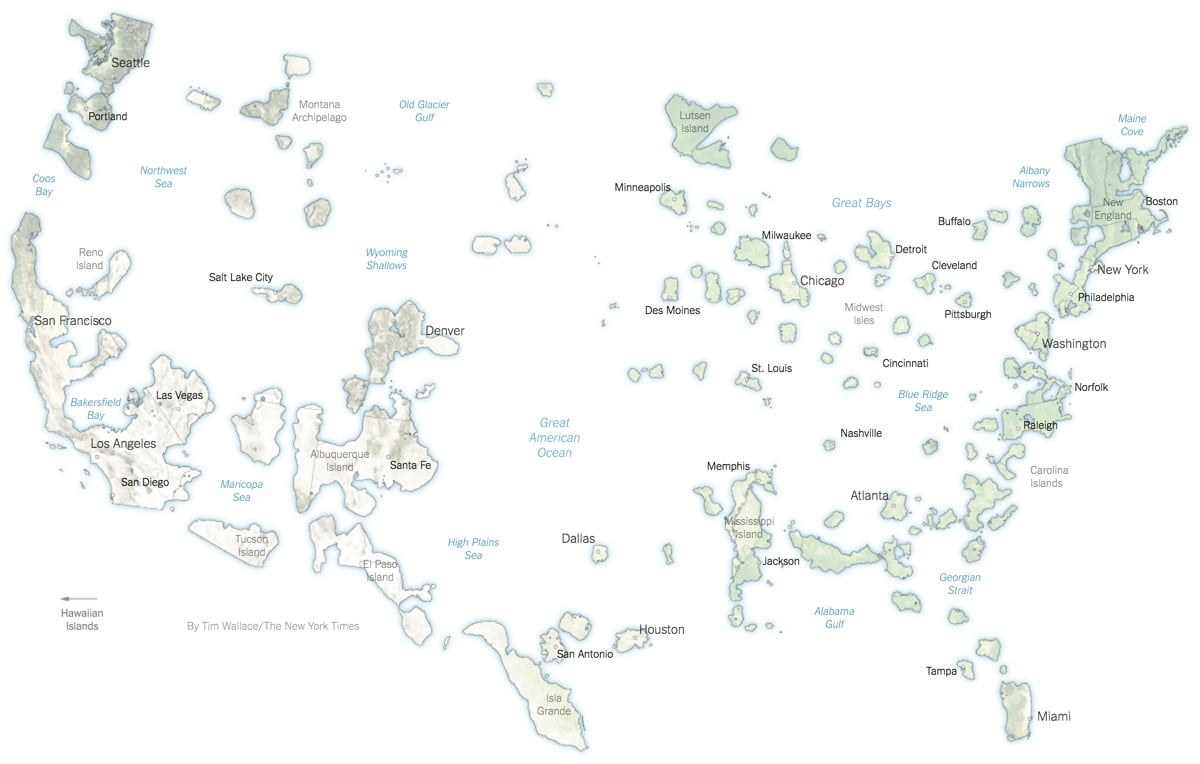
The New York Times took a map of the US and split it in two based on areas that voted for Clinton and Trump in the 2016 election. (Clinton’s map is pictured above.)
Mrs. Clinton’s island nation has large atolls and small island chains with liberal cores, like college towns, Native American reservations and areas with black and Hispanic majorities. While the land area is small, the residents here voted for Mrs. Clinton in large enough numbers to make her the winner of the overall popular vote.
That’s fun, but it’s another reminder of how strictly geographical maps distort election results.
P.S. They missed a real opportunity to call the chain of islands in the southern states The Cretaceous Atoll.
Newer posts
Older posts




Socials & More