kottke.org posts about Barack Obama
In partnership with sciencedebate.org, Scientific American asked both major party candidates to answer questions about the important scientific questions of the day. Here are the results.
I am not a scientist myself, but my best assessment of the data is that the world is getting warmer, that human activity contributes to that warming, and that policymakers should therefore consider the risk of negative consequences. However, there remains a lack of scientific consensus on the issue — on the extent of the warming, the extent of the human contribution, and the severity of the risk — and I believe we must support continued debate and investigation within the scientific community.
I’m surprised and mostly pleased that the Supreme Court has upheld President Obama’s Patient Protection and Affordable Care Act.
The Court’s ruling means, that unless Congress acts, in 2014 all Americans will be required to purchase health insurance in the most sweeping overhaul of the nation’s health care system since the Great Society. The Court, according to early analysis, redefined the mandate as a tax, skirting some Constitutional questions but offering a dramatic affirmation to Obama’s key initiative.
Update: Josh Marshall speaks for me here.
This is an imperfect law. But what’s most important is that it provides a structure under which the country can make a start not only on universal coverage — as an ethical imperative — but on doing away with the waste and inefficiencies created by the chronic market failure of the US health insurance system. Again, that matters. And I suspect that there’s no going back.
This might be the coolest thing a sitting President has ever done. Aside from, maybe, freeing the slaves or The New Deal or winning WWII.
Update: And an amazingly depressing excerpt from a speech Obama gave earlier in the day:
But we only finished paying off our student loans — check this out, all right, I’m the President of the United States — we only finished paying off our student loans about eight years ago.
Last week after an event at Prince Georges Community College in Maryland, a deaf audience member named Stephon used American Sign Language to tell President Obama, ‘I am proud of you,’ and as you can see in the video, President Obama signed back, ‘Thank you’. Hearing the crowd’s response to this was pretty neat, and imagine what it must have felt like to be the audience member. To be clear, this type of engagement/recognition would be cool from any president.
The moment I will never forget was when he looked at me. He gave me a chance to talk to him. It was like he was waiting for me to say something. I took the moment and signed “I am proud of you,” and his response was “Thank u” in sign language back! Oh my gosh! I was like wow! He understood me after I said I was proud of him. It was so amazing…I was just speechless.
Turn the volume down. Signing is at about :30 seconds.
(Hat tip anildash)
That is the question that Grantland is attempting to answer with a NCAA-style tournament bracket.

Did we mention that our esteemed editor-in-chief hung out with President Obama last week? Because that totally happened. Just two regular guys, discussing Linsanity, Blake Griffin’s jump shot, what it’s like to pitch a baseball while wearing a bulletproof vest, and — as the conversation wound down — The Wire. Asked to name the greatest Wire character of all time (let it never be said that Grantland does not ask the tough questions!), the Commander in Chief didn’t hesitate: “It’s gotta be Omar, right? I mean, that guy is unbelievable, right?”
With respect to the President, Omar is the most overrated character on The Wire. I mean, I love Omar. I do. He is everyone’s favorite character and easy to love because he’s one of the show’s most manufactured characters. Gay, doesn’t swear, strong sense of morals, robs drug dealers, respected/feared by all…come on, all that doesn’t just get rolled up into one person like that. The Wire aspires to be more than just mere television, but when Omar is on the screen, it’s difficult for me to take the show as seriously as it wants me to.
Writing on his Tumblr blog (!!), former Secretary of Labor Robert Reich makes the case for a Clinton/Biden swap that would lead to an unstoppable Obama/Clinton presidental ticket in 2012.
My political prediction for 2012 (based on absolutely no inside information): Hillary Clinton and Joe Biden swap places. Biden becomes Secretary of State - a position he’s apparently coveted for years. And Hillary Clinton, Vice President.
So the Democratic ticket for 2012 is Obama-Clinton.
Why do I say this? Because Obama needs to stir the passions and enthusiasms of a Democratic base that’s been disillusioned with his cave-ins to regressive Republicans. Hillary Clinton on the ticket can do that.
(via ★djacobs)
This article on why Americans don’t want to compromise was pretty dumb, but this is an interesting tidbit:
89 percent of the Whole Foods stores in the United States were in counties carried by Barack Obama in 2008, while 62 percent of Cracker Barrel restaurants were in counties carried by John McCain.
For what it’s worth, I was seriously disappointed by the biscuits at Cracker Barrel when I had them the first time.
Long interview with Barack Obama in Rolling Stone. Most of it is politics, but they also discussed music.
My iPod now has about 2,000 songs, and it is a source of great pleasure to me. I am probably still more heavily weighted toward the music of my childhood than I am the new stuff. There’s still a lot of Stevie Wonder, a lot of Bob Dylan, a lot of Rolling Stones, a lot of R&B, a lot of Miles Davis and John Coltrane. Those are the old standards.
A lot of classical music. I’m not a big opera buff in terms of going to opera, but there are days where Maria Callas is exactly what I need.
Thanks to Reggie [Love, the president’s personal aide], my rap palate has greatly improved. Jay-Z used to be sort of what predominated, but now I’ve got a little Nas and a little Lil Wayne and some other stuff, but I would not claim to be an expert. Malia and Sasha are now getting old enough to where they start hipping me to things. Music is still a great source of joy and occasional solace in the midst of what can be some difficult days.
Vanity Fair has a really interesting but depressing look at how The President of the United States spends a typical day navigating the upfuckedness of national American politics and its capital, Washington DC — which Rahm Emanuel calls Fucknutsville.
We think of the presidency as somehow eternal and unchanging, a straight-line progression from 1 to 44, from the first to the latest. And in some respects it is. Except for George Washington, all of the presidents have lived in the White House. They’ve all taken the same oath to uphold the same constitution. But the modern presidency — Barack Obama’s presidency — has become a job of such gargantuan size, speed, and complexity as to be all but unrecognizable to most of the previous chief executives. The sheer growth of the federal government, the paralysis of Congress, the systemic corruption brought on by lobbying, the trivialization of the “news” by the media, the willful disregard for facts and truth — these forces have made today’s Washington a depressing and dysfunctional place. They have shaped and at times hobbled the presidency itself.
For much of the past half-century, the problems that have brought Washington to its current state have been concealed or made tolerable by other circumstances. The discipline of the Cold War kept certain kinds of debate within bounds. America’s artificial “last one standing” postwar economy allowed the country to ignore obvious signs of political and social decay. Wars and other military interventions provided ample distraction from matters of substance at home. Like many changes that are revolutionary, none of Washington’s problems happened overnight. But slow and steady change over many decades — at a rate barely noticeable while it’s happening — produces change that is transformative. In this instance, it’s the kind of evolution that happens inevitably to rich and powerful states, from imperial Rome to Victorian England. The neural network of money, politics, bureaucracy, and values becomes so tautly interconnected that no individual part can be touched or fixed without affecting the whole organism, which reacts defensively. And thus a new president, who was elected with 53 percent of the popular vote, and who began office with 80 percent public-approval ratings and large majorities in both houses of Congress, found himself for much of his first year in office in stalemate, pronounced an incipient failure, until the narrowest possible passage of a health-care bill made him a sudden success in the fickle view of the commentariat, whose opinion curdled again when Obama was unable, with a snap of the fingers or an outburst of anger, to stanch the BP oil spill overnight. And whose opinion spun around once more when he strong-armed BP into putting $20 billion aside to settle claims, and asserted presidential authority by replacing General Stanley McChrystal with General David Petraeus. The commentariat’s opinion will keep spinning with the wind.
(via waxy)
Designing Obama, a book chronicling how the visual branding of the Obama campaign came about, is available in several formats, most notably in a completely free online version. Written by the campaign’s design director, the making of the book was funded through the first big Kickstarter campaign.
Tom Junod says that the key to understanding how Obama governs is to look at how you’d imagine he might raise Sasha and Malia. Specifically, Junod compares the President’s community organization roots with the parenting technique of positive discipline.
You don’t have to win, we were told at the positive-discipline workshop. Your child is not damaged, morally, if your child wins, if the battle is withdrawn, or, better yet, never joined. Our culture has viewed parenthood in terms of decisive moments, but it’s better to view it in terms of development, as a continual process, and to be in it for the long haul. Nothing lies like the moment of truth, and if there’s no powerlessness, then there are fewer power struggles. If your child has a problem with authority, it’s likely that you have a problem with authority, or your lack of it. The answer is to return it to your child in the form of choices, while you set an example. Your example is your authority. Positive discipline does not mean no discipline; it means that discipline is a matter of teaching mutual respect, rather than making your child suffer. “Children do better when they feel better, not worse,” is what it says on my kitchen cabinet, and so when faced with intransigence, parents have to respond by stating their expectations, repeating the rules, and then giving their children the love and support they need to follow them. Always try to include, rather than isolate; avoid labels; don’t negotiate, but don’t escalate, either. If your children are not doing well, either take them out of the situation or remove yourself. You — and they — can always try again.
It is a philosophy that could have been minted by Cass Sunstein, the White House advisor who is developing ways to “nudge” citizens to make the right choices without them being aware of the manipulation. It could serve as a precis for how Obama has dealt with Joe Wilson, not to mention Skip Gates and Sergeant Jim Crowley, not to mention Mahmoud Ahmadinejad, who was never threatened but rather told to “think carefully” while answering the protests of the Iranian presidential election with the truncheon and the gallows. One could almost hear Obama saying, “Use your words, Mahmoud. Use your words.”
The piece is interesting throughout, but I particularly liked this observation:
Barack Obama, then, is not the agent of change; he’s the fulfillment of a change that is already occurring culture-wide, in every place but politics. That’s why the Republicans fear him so much; why, while waiting for him to fail, they just come off as the political party for people who want to hit their kids.
When Obama poses for photos, he smiles in exactly the same way each time.
And I thought Paris was consistent.
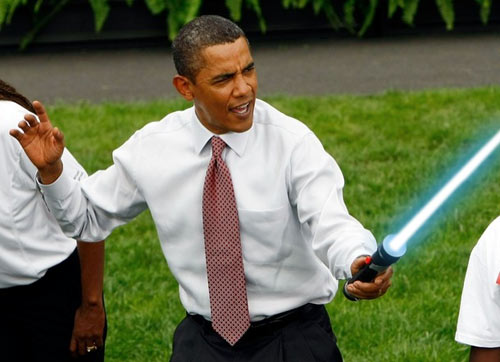
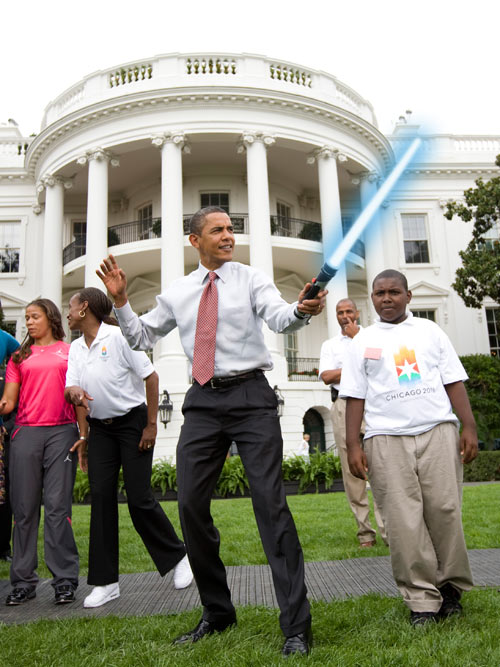
The President recently hosted a rally at The White House in support of Chicago’s bid to hold the 2016 Summer Olympics. Some members of the Olympic fencing team were there. Obama was given a plastic sword. Photos were taken. Photoshop (with an assist from me) did the rest.
Here’s our President attacking an unseen Sith Lord or perhaps someone condemned by a death panel:
And having finished them off to the delight of the assembled, a victory pose.
Update: See also the Japanese Obama action figures. (thx, myles)
CereProc’s computer generated voices are impressive…scroll down the page for a passable Obama and a downright convincing Schwarzenegger. (via ebert)
Newer posts
Older posts





Socials & More