A new HIV vaccine has shown promise in Phase I trials. “The vaccine successfully stimulated the production of the rare immune cells needed to generate antibodies against HIV in 97 percent of participants.”

Advertise here with Carbon Ads
This site is made possible by member support. 💞
Big thanks to Arcustech for hosting the site and offering amazing tech support.
When you buy through links on kottke.org, I may earn an affiliate commission. Thanks for supporting the site!
kottke.org. home of fine hypertext products since 1998.
Beloved by 86.47% of the web.
Entries for April 2021
Wobbling Muons May Hint at Unknown Forces
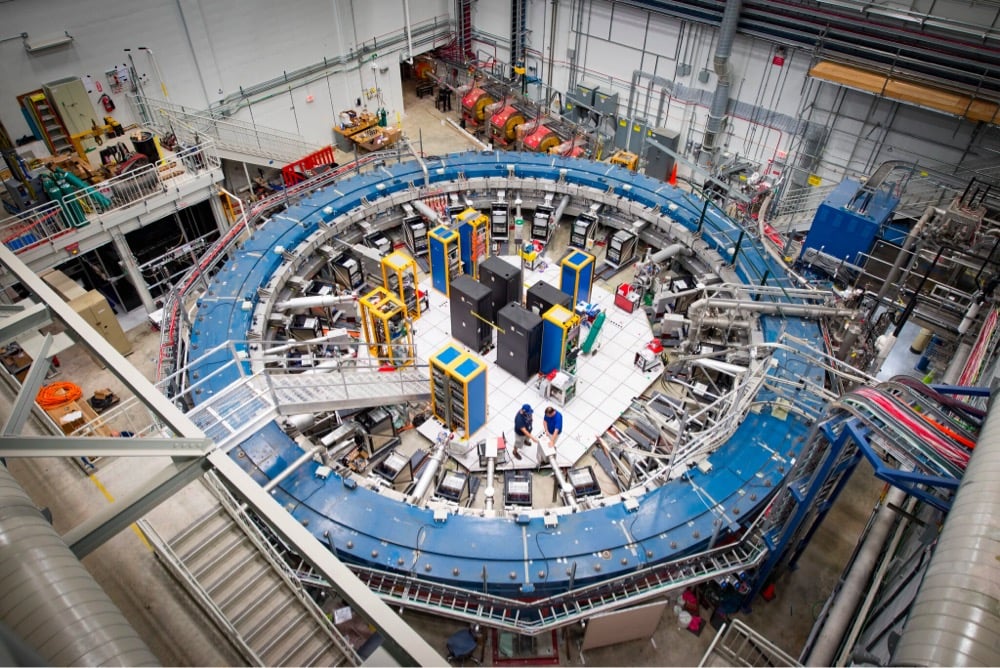
The preliminary results of a study of elementary particles at Fermilab and elsewhere show that the behavior of particles called muons deviates from standard physical theories, indicating that previously unknown forces are at work.
Evidence is mounting that a tiny subatomic particle seems to be disobeying the known laws of physics, scientists announced on Wednesday, a finding that would open a vast and tantalizing hole in our understanding of the universe.
The result, physicists say, suggests that there are forms of matter and energy vital to the nature and evolution of the cosmos that are not yet known to science.
“This is our Mars rover landing moment,” said Chris Polly, a physicist at the Fermi National Accelerator Laboratory, or Fermilab, in Batavia, Ill., who has been working toward this finding for most of his career.
The particle célèbre is the muon, which is akin to an electron but far heavier, and is an integral element of the cosmos. Dr. Polly and his colleagues — an international team of 200 physicists from seven countries — found that muons did not behave as predicted when shot through an intense magnetic field at Fermilab.
The aberrant behavior poses a firm challenge to the Standard Model, the suite of equations that enumerates the fundamental particles in the universe (17, at last count) and how they interact.
“This is strong evidence that the muon is sensitive to something that is not in our best theory,” said Renee Fatemi, a physicist at the University of Kentucky.
Update: At Quanta Magazine, Natalie Wolchover dives deeper into the preliminary results and what they might mean.
CDC (finally!): The risk of Covid-19 infection from contact with contaminated surfaces (fomites) is low. Let’s end this “deep cleaning” hygiene theater and focus instead on hand washing, masking, and ventilation.
Anywhere Can Happen
Sure, there’s the big budget superhero & action films, but the falling cost and increasing availability of really good motion graphics tools also enables a sort of everyday surrealism that’s on display in this short video by Fernando Livschitz. (via colossal)
The Galactic Federation interviews Earth for membership. “Is there enough food to go around? It’s looks like some people are starving.”
The Secret of Synchronization
What do swaying bridges, flashing fireflies, clapping audiences, the far side of the Moon, and beating hearts have in common? Their behavior all has something to do with synchronization. In this video, Veritasium explains why and how spontaneous synchronization appears all the time in the physical world.
I was really into the instability of the Millennium Bridge back when it was first opened (and then rapidly closed), so it was great to hear Steven Strogatz’s explanation of the bridge’s failure.
Oh, and do go play with Nicky Case’s firefly visualization to see how synchronization can arise from really simple rules.
The conservative movement is rejecting America. “A recent essay in a prominent right-wing outlet gives an unusually clear window into the modern right’s anti-democratic worldview.”
Journey to the Microcosmos
Thanks to a recommendation from Wander Lines, I just found the Journey to the Microcosmos channel on YouTube. The imagery is fantastic and the narration informative — my absolute favorite combo. The video above, called Microbes Don’t Actually Look Like Anything, is about how light and microscopy work together to produce images of these tiny things that humans can see and make use of. It reminds me of how many of the brilliantly colorful astronomy images we see of far-flung galaxies and nebulae don’t look anything like that in actuality.
Some of the other popular videos on the channel are Tardigrades: Chubby, Misunderstood, & Not Immortal, Diatoms: Tiny Factories You Can See From Space, and How Microscopic Hunters Get Their Lunch.
How QAnon Is Tearing Families Apart. “Long before Mark walked in the door of their Chicago home one day last year carrying a machete, Elena knew that their 20-year marriage was coming to an end…”
Ted Chiang: Fears of Technology Are Fears of Capitalism
Writer Ted Chiang (author of the fantastic Exhalation) was recently a guest on the Ezra Klein Show. The conversation ranged widely — I enjoyed his thoughts on superheroes — but his comments on capitalism and technology seem particularly relevant right now. From the transcript:
I tend to think that most fears about A.I. are best understood as fears about capitalism. And I think that this is actually true of most fears of technology, too. Most of our fears or anxieties about technology are best understood as fears or anxiety about how capitalism will use technology against us. And technology and capitalism have been so closely intertwined that it’s hard to distinguish the two.
Let’s think about it this way. How much would we fear any technology, whether A.I. or some other technology, how much would you fear it if we lived in a world that was a lot like Denmark or if the entire world was run sort of on the principles of one of the Scandinavian countries? There’s universal health care. Everyone has child care, free college maybe. And maybe there’s some version of universal basic income there.
Now if the entire world operates according to — is run on those principles, how much do you worry about a new technology then? I think much, much less than we do now. Most of the things that we worry about under the mode of capitalism that the U.S practices, that is going to put people out of work, that is going to make people’s lives harder, because corporations will see it as a way to increase their profits and reduce their costs. It’s not intrinsic to that technology. It’s not that technology fundamentally is about putting people out of work.
It’s capitalism that wants to reduce costs and reduce costs by laying people off. It’s not that like all technology suddenly becomes benign in this world. But it’s like, in a world where we have really strong social safety nets, then you could maybe actually evaluate sort of the pros and cons of technology as a technology, as opposed to seeing it through how capitalism is going to use it against us. How are giant corporations going to use this to increase their profits at our expense?
And so, I feel like that is kind of the unexamined assumption in a lot of discussions about the inevitability of technological change and technologically-induced unemployment. Those are fundamentally about capitalism and the fact that we are sort of unable to question capitalism. We take it as an assumption that it will always exist and that we will never escape it. And that’s sort of the background radiation that we are all having to live with. But yeah, I’d like us to be able to separate an evaluation of the merits and drawbacks of technology from the framework of capitalism.
Echoing some of his other thoughts during the podcast, Chiang also wrote a piece for the New Yorker the other day about how the singularity will probably never come.
Bhutan is racing to get initial Covid-19 vaccine shots to their entire eligible population within a week. After much planning and a massive push, they should be done in the next day or two.
Friendship
From poet David Whyte’s book Consolations (ebook), a short essay on friendship.
Friendship is a mirror to presence and a testament to forgiveness. Friendship not only helps us see ourselves through another’s eyes, but can be sustained over the years only with someone who has repeatedly forgiven us for our trespasses as we must find it in ourselves to forgive them in turn. A friend knows our difficulties and shadows and remains in sight, a companion to our vulnerabilities more than our triumphs, when we are under the strange illusion we do not need them. An undercurrent of real friendship is a blessing exactly because its elemental form is rediscovered again and again through understanding and mercy. All friendships of any length are based on a continued, mutual forgiveness. Without tolerance and mercy all friendships die.
I heard Whyte read this essay on the Making Sense podcast a few weeks ago and I’ve been thinking about it ever since — it’s a wonderful read but it’s even better to hear a practiced poet recite it aloud. If you’re interested in hearing more, Consolations, which is composed of similarly short essays on topics like anger, beauty, shyness, and gratitude, is available as an audiobook read by Whyte. (thx, megan)
How Sounds Are Faked For Nature Documentaries
Foley artist Richard Hinton talks about how he creates sounds for nature documentaries like Planet Earth. I love watching Foley artists do their thing, but I have mixed feelings about these made-up sounds!
Despite the veneer of neutrality of nature documentaries, I know there’s no such thing as objective truth when you’re dealing with cameras and film editing. And silent video is boring. But on the other hand, just making up sounds that spiders don’t actually make — I don’t know. I’ve posted about this before, regarding a video series about how Planet Earth II was made:
I hope the third program is on sound, which has been bugging me while watching Planet Earth II. I could be wrong, but they seem to be using extensive foley effects for the sounds the animals make — not their cries necessarily, but the sounds they make as they move. Once you notice, it feels deceptive.
See also How Fake Are Nature Documentaries?
Is it manipulation? Or good storytelling? And what’s the difference between the two anyway? A silent security feed of a Walmart parking lot is not a documentary but The Thin Blue Line, with its many dramatizations and Philip Glass score, is a great documentary.
(via open culture)
Dr. Matt Lodder discovered he had an imposter. “I found a video clip of him at a conference, reading out a chapter I’d written. He was dressed like me. He had even copied my tattoos.”
Stop Motion Lego Chocolate Cake
Watch as YouTuber tomosteen makes a Lego chocolate cake out of Lego ingredients, from cracking the eggs to the frosting on top. The little details here are *chef’s kiss*: the transitions from food to Lego brick, the way the chocolate bar breaks imperfectly, the little peaky dollop left after piping the chocolate frosting out of the pastry bag.
Don’t care for chocolate cake? How about a Japanese breakfast (featuring tamagoyaki) or churros instead?
See also Lego In Real Life or search for Lego in real life on YouTube. (via colossal)
Podcast: @debbiemillman interviews @robynkanner, senior creative advisor for the Biden/Harris campaign. “Kanner’s sponsor asked what her goals were. She said she was going to elect the next president of the United States.”
Re-Wilding Yourself by Swimming in Nature
In this short film called Hydrotherapy, Laura Owen Sanderson talks about how she found relief from a life-changing illness through wild swimming.
I wasn’t afraid to die. I was more afraid, or angry if you’d like, that I hadn’t lived, that I hadn’t made the most of every opportunity. So I was waiting for a day that might never come — when you retire or when you’re thin enough or when the kids have grown up — and there was a sudden realization that that day might never come.
If you’d like to reconnect with nature through wild swimming or cold water swimming, check out these two videos for some handy tips on how to get started and do it safely. (via huit denim newsletter)
How the pandemic changed our friendships. “Over the past year, she said, we stopped exploring, often limiting our rare encounters to tiny groups of trusted intimates. We didn’t get new ones.”
Socials & More