Entries for March 2015
From filmmaker Adam Curtis, a four-part documentary series on “how those in power have used Freud’s theories to try and control the dangerous crowd in an age of mass democracy”. Here’s part one:
And continue with the rest in this playlist. Here is a good review:
This is a powerful and arresting documentary series — I ended up watching all four episodes back to back in a marathon effort. It was that gripping. I had felt similarly about his more recent documentary about the rise of neo conservatism and arab fundamentalism and the similarity in their techniques for recruiting followers (and their mutual need of each other in that project) — but ‘The Century of the Self’ (TCS from now on), is much grander in its scope. It seeks to analyse the different conceptions of the self in the twentieth century, and how these conceptions were ultimately used by corporations to manipulate consumers into purchasing their products. Curtis takes large swipes at corporate capitalism in this documentary, but his target is even wider than this — he seeks to tell a story about the relationship between the differing conceptions of individualism and the capitalist, democratic institutions (corporations and governments) which organise themselves around these conceptions.
(thx, kyle)
This metaphorical explanation of the post-2008 Irish banking crisis works equally well as an explanation for contemporary global financial markets in general.
Mary is the proprietor of a bar in Dublin. She realises that virtually all of her customers are unemployed alcoholics and, as such, can no longer afford to patronise her bar — she will go broke.
To solve this problem, she comes up with a new marketing plan that allows her customers to drink now, but pay later.
She keeps track of the drinks consumed on a ledger (thereby granting the customers loans).
Word gets around about Mary’s ‘drink now, pay later’ marketing strategy and, as a result, increasing numbers of customers flood into Mary’s bar.
Soon she has the largest sales volume for any bar in Dublin — all is starting to look rosy.
By providing her customers freedom from immediate payment demands Mary gets no resistance when, at regular intervals, she substantially increases her prices for wine and beer, the most consumed beverages.
Consequently, Mary’s gross sales volume increases massively.
A young and dynamic vice-president at the local bank recognises that these customer debts constitute valuable future assets and increases Mary’s borrowing limit.
He sees no reason for any undue concern, since he has the debts of the unemployed alcoholics as collateral.
At the bank’s corporate headquarters, expert traders figure a way to make huge commissions, and transform these customer loans into Drinkbonds and Alkibonds. These securities are then bundled and traded on international security markets.
The new investors don’t really understand that the securities being sold to them as ‘AAA’ secured bonds are really the debts of unemployed alcoholics. They have had a ‘rating house’ certify they are of good quality.
Koa Smith rides in the barrel of a wave for almost 30 seconds…it just goes on and on and on.
This video is a bit misleading. The ride is shown twice but the first time through it’s slowed down so it lasts more than a minute. The full-speed replay starts at 2:01 and is still impressive. (via digg)
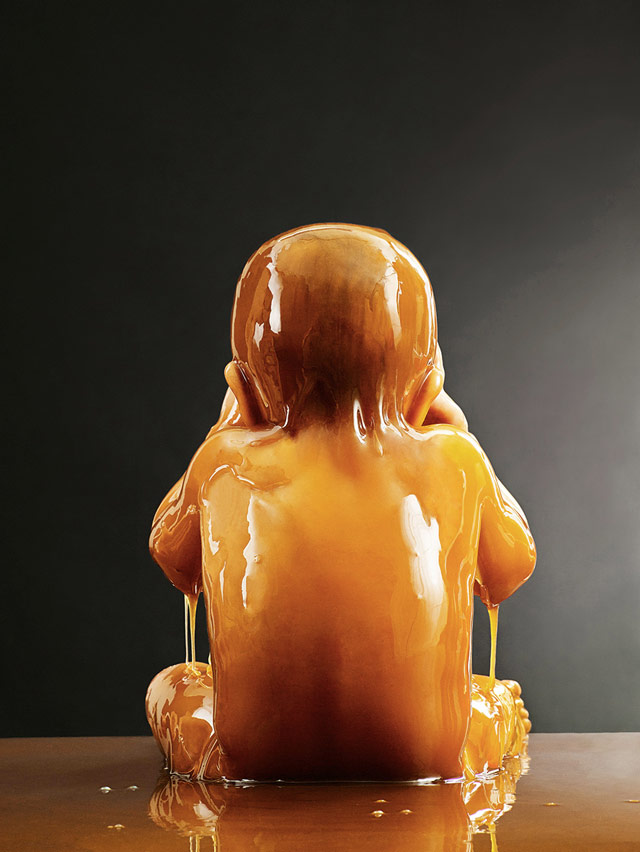
For his book Preservation, Blake Little drenched his subjects in honey and took their photos, mid-drizzle. A bit NSFW.

(via slate)
Astronomers have been able to view the same supernova in a distant part of the Universe several times due to the gravitational lensing effect of a cluster of galaxies in-between here and there. From Dennis Overbye in the NY Times:
Supernovas are among the most violent and rare events in the universe, occurring perhaps once per century in a typical galaxy. They outshine entire galaxies, spewing elemental particles like oxygen and gold out into space to form the foundations of new worlds, and leaving behind crushed remnants called neutron stars or black holes.
Because of the galaxy cluster standing between this star and the Hubble, “basically, we got to see the supernova four times,” Dr. Kelly said. And the explosion is expected to appear again in another part of the sky in the next 10 years. Timing the delays between its appearances, he explained, will allow astronomers to refine measurements of how fast the universe is expanding and to map the mysterious dark matter that supplies the bulk of the mass and gravitational oomph of the universe.
Scientists expect the supernova to reappear in the next few years. Gravitational lensing was predicted by Einstein’s general theory of relativity and as Overbye writes, “the heavens continue to light candles for Albert Einstein.”
A video of the output of an ASCII fluid dynamics simulator.
Sloshy! (via waxy)
In Mr. Holmes, Ian McKellen plays a post-retirement Sherlock Holmes who has moved to the country to take up beekeeping. Here’s the trailer:
Update: Not that the first trailer was bad or anything, but this new one provides much more of a sense of what the film is about.
I’m going to watch the shit out of this movie.
Beautiful video of the Himalayas shot from a helicopter flying at up to 24,000 feet high.
(via ★interesting)
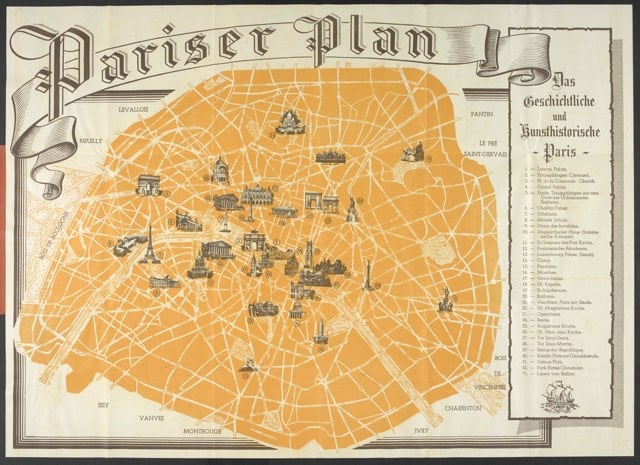
In 1940, Germany published a tourist map of occupied Paris intended for use by German soldiers on leave.
For the New Yorker, Alex Ross writes about movie soundtracks, with an emphasis on the scores for the 2014 crop of films.
This year’s Oscar nominations for Best Original Score did the field few favors, overlooking some significant work. Jonny Greenwood, increasingly known as much for his film music as for his contributions to Radiohead, has yet to be acknowledged by the Academy, despite his idiosyncratic, imaginative collaborations with the director Paul Thomas Anderson, most recently in “Inherent Vice.” Jason Moran deserved a nod for his “Selma” score, which oscillates between subdued moods of hope and dread, avoiding the telltale gestures of the great-man bio-pic. (The Aaron Copland trumpet of lonely American power is in abeyance.) Most baffling was the omission of Mica Levi’s score for “Under the Skin,” which, like Greenwood’s work for Anderson, moves from seething dissonance to eerie simplicity and back again.
I listen to movie soundtracks quite a bit; they’re good to play while working. Here are a few I’ve enjoyed from 2014:
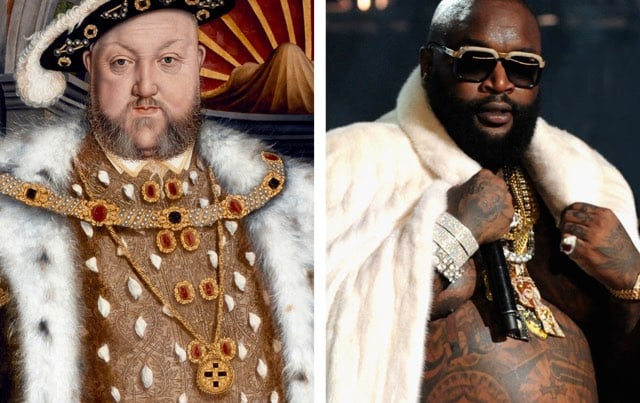
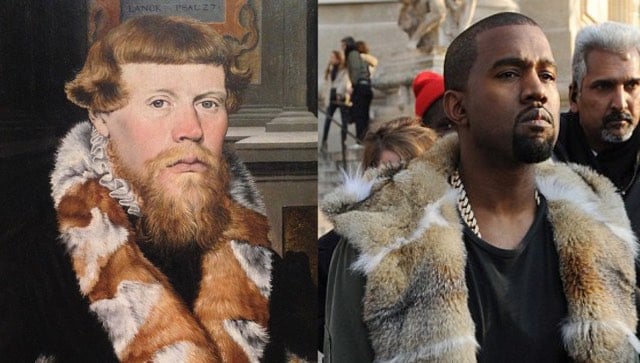
There are only a dozen images so far, but this Tumblr comparing art from before the 16th century and contemporary images of hip hop is fantastic. My favorites:
Camponotus fellah (which you almost certainly know is a species of carpenter ant) have a lot of incentive to stick together. The worker ants that live and work alone enjoy only a tenth of the lifespan of their more social co-workers. While that stat is extreme, it’s not necessarily unique.
Isolation can also enfeeble rats, mice, pigs, rabbits, squirrel monkeys, starlings, and parrots.
And of course humans. What is it about being together that makes us — and the ants — more healthy? From The New Yorker’s Emily Anthes: Marching One by One.
My answer to that question, having read nothing about it beyond this article, is “it sounds like a bit of a stretch, but what an interesting thing to think about”. This theory about how humans and wolves (and later, dogs) teamed up to outcompete Neanderthals for food is being forwarded by anthropologist Pat Shipman, author of the new book, The Invaders: How Humans and Their Dogs Drove Neanderthals to Extinction.
Modern humans formed an alliance with wolves soon after we entered Europe, argues Shipman. We tamed some and the dogs we bred from them were then used to chase prey and to drive off rival carnivores, including lions and leopards, that tried to steal the meat.
“Early wolf-dogs would have tracked and harassed animals like elk and bison and would have hounded them until they tired,” said Shipman. “Then humans would have killed them with spears or bows and arrows.
“This meant the dogs did not need to approach these large cornered animals to finish them off — often the most dangerous part of a hunt — while humans didn’t have to expend energy in tracking and wearing down prey. Dogs would have done that. Then we shared the meat. It was a win-win situation.”
At that time, the European landscape was dominated by mammoths, rhinos, bison and several other large herbivores. Both Neanderthals and modern humans hunted them with spears and possibly bows and arrows. It would have been a tricky business made worse by competition from lions, leopards, hyenas, and other carnivores, including wolves.
“Even if you brought down a bison, within minutes other carnivores would have been lining up to attack you and steal your prey,” said Shipman. The answer, she argues, was the creation of the human-wolf alliance. Previously they separately hunted the same creatures, with mixed results. Once they joined forces, they dominated the food chain in prehistoric Europe — though this success came at a price for other species. First Neanderthals disappeared to be followed by lions, mammoths, hyenas and bison over the succeeding millennia. Humans and hunting dogs were, and still are, a deadly combination, says Shipman.
(via @robinsloan)
For their new ad campaign, Apple gathered some photos that people had taken with their iPhones and are featuring them on their website and on billboards. Here are a few I found particularly engaging.

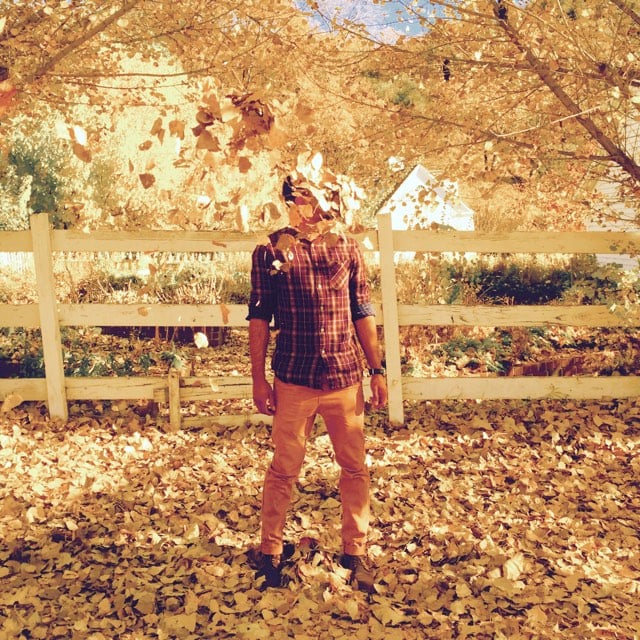


I’ve said it before and it’s just getting more obvious: the iPhone is the best camera in the world.
Update: Apple has added a section for films shot on iPhone 6.
As part of Errol Morris Week on Grantland1, Alex Pappademas did a great interview with Morris about his work. Morris has interviewed serial killers, Holocaust deniers, rapists, and the architect of the Vietnam War but said that the person that most challenged his capacity for empathy was Donald Rumsfeld.
He’s confident right now! He doesn’t have to wait 100 or 500 years. He doesn’t care. I really care whether I’m right or wrong. I really do care. And probably for lots of reasons. I don’t want to be seen as a dumbass, I don’t want to be seen as someone who believes in something that’s absolutely false, untrue, something that can’t be substantiated, checked. I believe that there’s some deep virtue in pursuing truth. Maybe it’s the highest virtue. I believe that. Whether you can attain it or not, you can pursue it. It can be a goal. It can be a destination. I don’t believe that’s Donald Rumsfeld’s goal. I believe that Robert S. McNamara really wanted to understand what he had done and why he had done it. You know, we remain a mystery to ourselves, among the many, many, many other mysteries there are. And McNamara’s struggle with his own past — I was deeply moved by it. I think he’s a war criminal, I think he sees himself as a war criminal, but I like him.
Update: Another recent interview, by Brin-Jonathan Butler, is being offered as a 99¢ Kindle Single.
This collection of political cartoons depict the FCC’s recent ruling on net neutrality as Big Government throttling the free internet, except that every caption has been replaced with “the cartoonist has no idea how net neutrality works”. Here’s one example followed by the unadulterated cartoon:
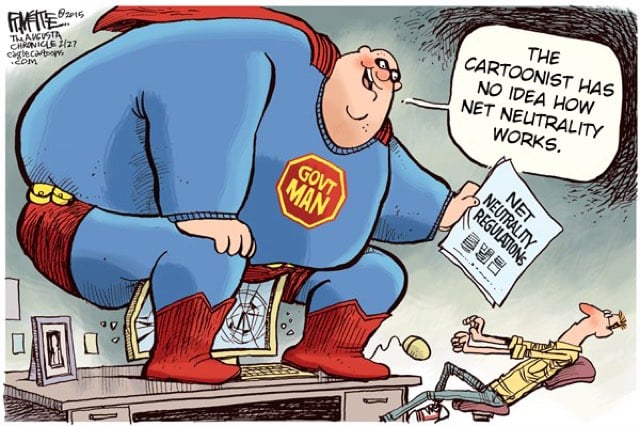
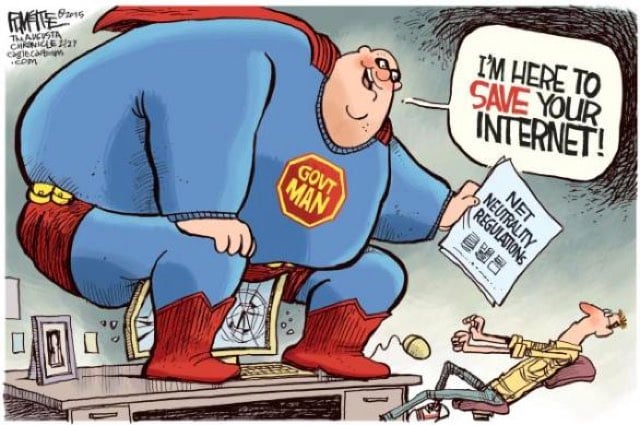
The zingers get zinged. (via @john_overholt)
A new biography of Steve Jobs is coming out in March, written by Brent Schlender and Rick Tetzeli, a pair of technology journalists who have covered Jobs and the personal computer revolution for decades. John Gruber has read it and calls it “remarkable”.
It is, in short, the book about Steve Jobs that the world deserves. You might wonder how such a book could be written without Jobs’s participation, but effectively, he did participate. Schlender, in his work as a reporter for The Wall Street Journal and Fortune, interviewed Jobs extensively numerous times spanning 25 years. Remember the 1991 joint interview with Jobs and Bill Gates? That was Schlender. As the book makes clear, Jobs and Schlender had a very personal relationship.
The book is smart, accurate, informative, insightful, and at times, utterly heartbreaking. Schlender and Tetzeli paint a vivid picture of Jobs the man, and also clearly understand the industry in which he worked. They also got an astonishing amount of cooperation from the people who knew Jobs best: colleagues past and present from Apple and Pixar — particularly Tim Cook — and his widow, Laurene Powell Jobs.
Instant pre-order.
Update: A glitch in Amazon’s Look Inside the Book feature gave Luke Dormehl a sneak peek at some of the book’s details, including that Tim Cook offered Jobs a part of his liver and Jobs talked about buying Yahoo.
Another interesting tidbit: Steve Jobs and Disney boss Bob Iger talked about buying Yahoo! together at one point, a move that would have given Apple an “in” in the search business.
While the question of Apple buying Yahoo! has been raised plenty of times over the years, this is the first time there’s been a serious suggestion that Jobs considered such an acquisition.
Buying Yahoo! would have given Apple access to a host of patents, web services and other tools in a fiercely competitive sector. Yahoo! would have been an interesting fit for Apple (which is probably why it didn’t happen), but it’s fascinating to consider what might have been.
Update: Excerpts of the book are starting appear. Fast Company has a Tim Cook-related excerpt as well as an interview with Cook conducted by Schlender and Tetzeli.
One afternoon, Cook left [Jobs’] house feeling so upset that he had his own blood tested. He found out that he, like Steve, had a rare blood type, and guessed that it might be the same. He started doing research, and learned that it is possible to transfer a portion of a living person’s liver to someone in need of a transplant. About 6,000 living-donor transplants are performed every year in the United States, and the rate of success for both donor and recipient is high. The liver is a regenerative organ. The portion transplanted into the recipient will grow to a functional size, and the portion of the liver that the donor gives up will also grow back.
I love watching people who are particularly adept at food prep and this guy preparing teh tarik certainly fits the bill. His pour seems to violate at least two of Newton’s three laws of motion.
This guy has some serious skills as well.
These gentlemen making parathas is still my all-time favorite food prep video, but these are good as well. (via cyn-c)
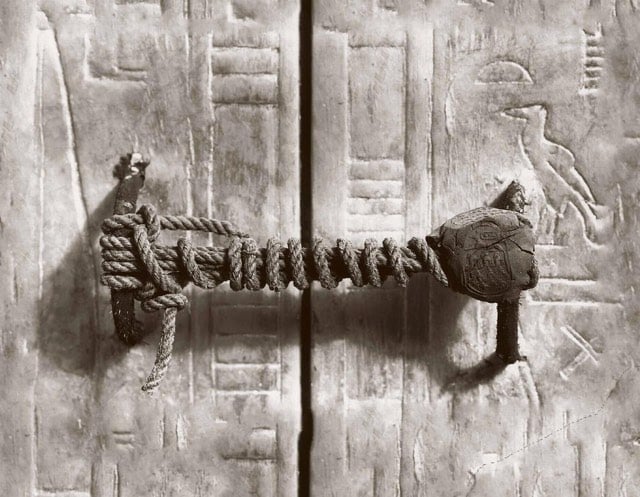
This is the rope seal securing the doors of Tutankhamun’s tomb, unbroken for more than 3200 years until shortly after Harry Burton took this photo in 1923. A description from National Geographic:
Still intact in 1923 after 32 centuries, rope secures the doors to the second of four nested shrines in Tutankhamun’s burial chamber. The necropolis seal — depicting captives on their knees and Anubis, the jackal god of the dead — remains unbroken, a sign that Tut’s mummy lies undisturbed inside.
How did the rope last for so long? Rare Historical Photos explains:
Rope is one of the fundamental human technologies. Archaeologists have found two-ply ropes going back 28,000 years. Egyptians were the first documented civilization to use specialized tools to make rope. One key why the rope lasted so long wasn’t the rope itself, it was the aridity of the air in the desert. It dries out and preserves things. Another key is oxygen deprivation. Tombs are sealed to the outside. Bacteria can break things down as long as they have oxygen, but then they effectively suffocate. It’s not uncommon to find rope, wooden carvings, cloth, organic dyes, etc. in Egyptian pyramids and tombs that wouldn’t have survived elsewhere in the world.
The plans for Google’s new offices in Mountain View blew me away. Not so much the reconfigurable office spaces1 but the greenhouse canopies. If those canopies actually work, they could result in a workspace that combines the best parts of being outdoors (the openness, the natural light & heat, greenery) with the benefits of working indoors (lack of wind & rain, moderate temperatures).
For years, one of the holy grails of computer generated visual effects was realistic looking water. Millions of dollars and rendering hours spent. Now, using just 185 lines of WebGL JavaScript code, you can get super-realistic ocean waves rendered right in any modern web browser at 60 frames/sec.
Wow. Wow wow. (via ★interesting-links)
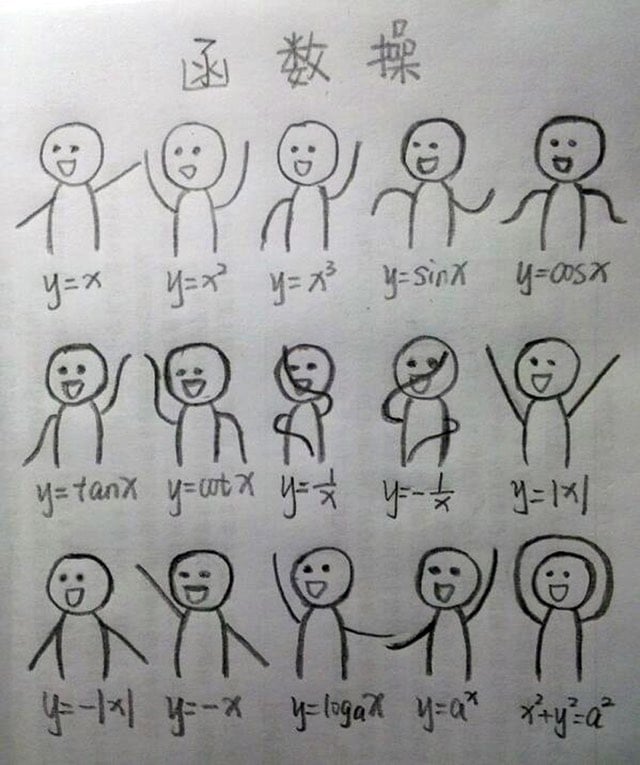
Mathematical functions depicted as stick figure dance moves. (via @mulegirl)
Newer posts


Socials & More